
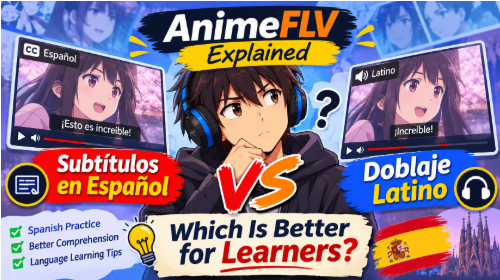

Anime fans who want to learn Spanish quickly run into the same question: should you watch with Spanish subtitles or switch to the Latino dub? Fans who follow AnimeFLV see both options side by side for many series, and each one trains a different language skill.
In this guide, we compare the two methods honestly, explain how Latin American Spanish differs from Spanish in Spain, and show you how to combine both for the fastest progress.
What Do “Sub Español” and “Latino” Mean?
Before comparing, it helps to understand the labels you will see on anime pages.
- Sub Español (subtitulado): The original Japanese audio with Spanish text on screen. You read Spanish while hearing Japanese.
- Latino (doblaje latino or audio latino): The whole show is re-voiced in Spanish by Latin American voice actors. You hear Spanish, and you may or may not have text on screen.
A third label sometimes appears: Castellano, a dub made in Spain with Spain’s accent and vocabulary. Most online anime sites focus on subtitles and Latino audio.
Option 1: Spanish Subtitles
How it helps
Subtitles train your reading and vocabulary. You see every word spelled correctly, which helps you connect sounds to spelling and notice grammar patterns such as verb endings, gender (el/la) and plurals.
Because you can pause and re-read a line, subtitles also give you time to think. If you meet a new word like “venganza” (revenge) or “promesa” (promise), you can pause, look it up, and see it again in the next episode.
Limitations
- You are not hearing Spanish. The audio is Japanese, so your listening skills for Spanish do not improve.
- Subtitles are often shortened to fit the screen, so you do not always see the full sentence.
- Fast scenes force you to read quickly, which can be tiring for beginners.
- It is easy to slip into just following the story and forget to study.
Option 2: Latino Dub
How it helps
The Latino dub trains your listening and pronunciation. You hear natural rhythm, intonation and everyday expressions spoken by native speakers. Many Latino dubs use español neutro (neutral Spanish), a clear, widely understood accent designed for audiences across Latin America, which makes it a good model for learners.
Dubs also use conversational language: contractions of speech, exclamations and informal phrases that sound natural when spoken aloud, such as “¡Qué onda!” (What’s up!), “¡No manches!” (No way!, used in Mexico) or “¡Vamos!” (Let’s go!).
Limitations
- Beginners may find fast speech hard to follow without any text.
- Dub scripts are adapted, so some lines are rephrased to match the lip movement, and not every word is a literal translation.
- Voices can sound dramatic or exaggerated, especially in action series, which differs from calm daily conversation.
- Dubs are not available for every series, especially newer ones.
Side-by-Side Comparison
| Skill | Spanish Subtitles | Latino Dub |
|---|---|---|
| Reading | Excellent | Weak, unless text is on |
| Listening | Weak (audio is Japanese) | Excellent |
| Vocabulary spelling | Excellent | Moderate |
| Pronunciation | Weak | Excellent |
| Natural spoken phrases | Moderate | Excellent |
| Best for | Beginners building vocabulary | Intermediate learners building listening |
| Difficulty | Easier | Harder without text |
So, Which Is Better for Learners?
The honest answer is that it depends on your level and goal.
- Complete beginner: Start with Spanish subtitles. You need to see words in writing before your ear can recognise them.
- Upper beginner to intermediate: Move to the Latino dub, ideally with Spanish text on screen if the player offers it.
- Focused on speaking and listening: Choose the Latino dub and shadow the characters, repeating lines right after they speak.
- Focused on reading and writing: Stay with subtitles and keep a vocabulary notebook.
Most learners get the best results by using both, as described below.
The Two-Pass Method: Use Both
This simple routine takes advantage of each version:
- Watch the first episode with Spanish subtitles. Learn the story and note 5 to 10 new words.
- Rewatch a short scene in the Latino dub. You already know the plot, so your brain can focus on the sounds.
- Pause and repeat. Say each line out loud right after the character.
- Write three sentences using the new words.
- Review the words the next day, then again after a week.
This approach gives you reading, listening and speaking practice from just one episode.
Latin American Spanish vs. Spain Spanish
Because dubs are often Latin American, it is worth knowing the main differences, so you are not confused if you later hear Spanish from Spain.
| English | Latin America | Spain |
|---|---|---|
| You all | ustedes | vosotros |
| Computer | computadora | ordenador |
| Car | carro / auto | coche |
| Cell phone | celular | móvil |
| Okay | okey / está bien | vale |
Pronunciation differs too. In most of Latin America, the letters c (before e/i) and z sound like an English “s.” In much of Spain, they sound like the “th” in “think.” Neither is wrong, so choose the version of Spanish you plan to use and stay consistent.
Where to Practise
To follow this method, you need a place where you can easily switch between versions of the same series. If you want to ver anime online with the choice of Spanish subtitles or Latin American dubbing, a dedicated anime site saves you from searching for each episode separately. Look for clear subtitles, regular updates and good video quality, since blurry text makes learning harder.
Common Mistakes to Avoid
- Watching passively. Pause often and write down words.
- Starting with a hard genre. Everyday school and comedy series are easier than fantasy or war stories packed with special terms.
- Copying slang everywhere. Words like “no manches” are informal. Avoid them in essays and formal emails.
- Skipping review. New words fade quickly without repetition.
Frequently Asked Questions
Can I really learn Spanish from anime?
Yes, as a supplement. Anime builds vocabulary, listening and a feel for natural speech, but you should combine it with grammar practice and real conversation.
Are Spanish subtitles or the Latino dub better for beginners?
Subtitles are usually easier for true beginners because you can see and read every word. After a few weeks, add the Latino dub for listening practice.
Is the Latino dub accurate?
It is a faithful adaptation, but some lines are reworded to match mouth movements and local humor, so it is not always word for word.
Which Spanish will I learn from Latino dubs?
Mostly neutral Latin American Spanish, which is understood across Latin America and is a solid foundation for any Spanish speaker you meet.
Final Thoughts
Spanish subtitles and the Latino dub are not rivals. Subtitles build your reading and vocabulary, while dubs train your ear and your accent. Start with the one that fits your level, then combine both using the two-pass method. Pick a series you enjoy, keep a notebook nearby, and you will be surprised how quickly the words stick. You can find both subtitled and dubbed series at animeflv.camp to start practising today.