
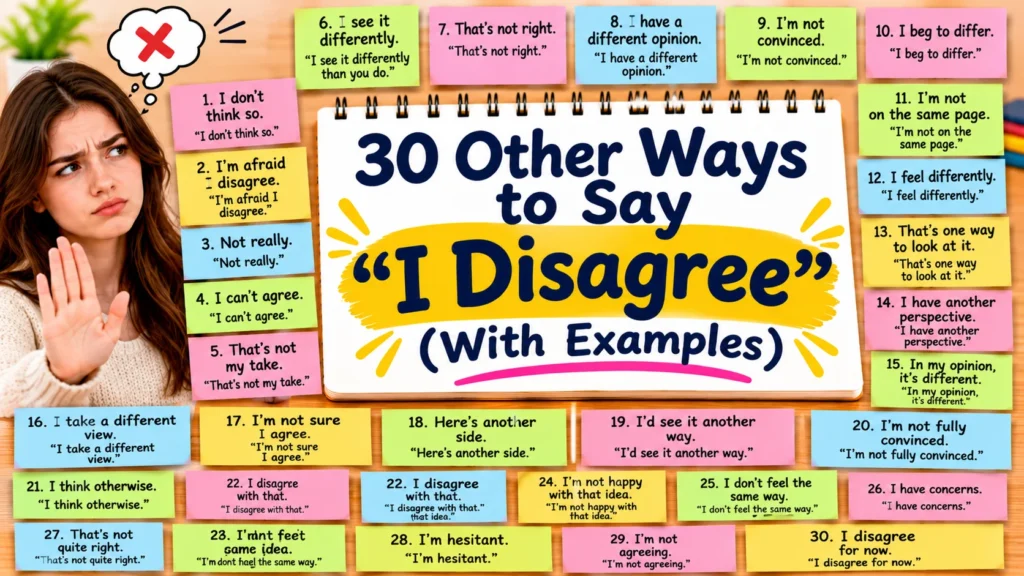

Disagreeing with someone doesn’t mean you have to sound rude, dismissive, or disrespectful. Sometimes, you simply have a different opinion, see a situation from another perspective, or interpret something differently. Instead of repeatedly saying “I disagree,” you can use more thoughtful expressions to communicate your point while keeping the conversation friendly and respectful. Choosing the right words can make even a difficult discussion feel more productive.
The best alternative depends on the situation and how strongly you feel about the topic. For example, “I see it differently” offers a polite way to express another perspective, while “I beg to differ” communicates disagreement more firmly. Phrases like “I’m not sure I agree,” “That’s not how I see it,” “I have a different opinion,” and “I respectfully disagree” can help you express your thoughts without creating unnecessary tension. Some expressions work well in casual conversations, while others are more appropriate for professional discussions and formal debates.
In this guide, you’ll discover 30 other ways to say “I disagree”, along with their meanings and practical examples. Whether you’re sharing your opinion with a friend, responding to a colleague, or participating in a serious discussion, these alternatives will help you communicate clearly and confidently. You’ll also learn how to disagree respectfully, explain your point of view, and keep conversations open to different ideas.
What Does “I Disagree” Mean?
The phrase “I disagree” means that you have a different opinion, belief, or understanding from someone else. It is used when you don’t share another person’s perspective or accept their argument. Disagreement is a normal part of communication because people have different experiences, ideas, and ways of thinking. For example, if someone says that working from home reduces productivity, you might respond, “I disagree because many people work more efficiently from home.” The expression allows you to communicate your position honestly without necessarily creating an argument.
Is It Professional or Polite to Say “I Disagree”?
Yes, saying “I disagree” is generally professional and polite when you use a respectful tone. It is a straightforward way to express a different opinion during meetings, discussions, or everyday conversations. However, depending on how you say it, the phrase can sometimes sound blunt or confrontational. In professional settings, alternatives such as “I see it differently,” “I have a different perspective,” or “I respectfully disagree” can make your response sound more diplomatic. The important thing is to explain your reasoning, acknowledge the other person’s perspective, and keep the conversation constructive.
Advantages and Disadvantages of Saying “I Disagree”
Advantages
- Encourages Honest Communication: Saying “I disagree” allows you to share your genuine thoughts instead of agreeing with something you don’t believe.
- Promotes Different Perspectives: Expressing disagreement introduces new ideas and encourages people to consider alternative viewpoints.
- Builds Mutual Understanding: Respectful disagreement can help people understand each other’s reasoning, beliefs, and expectations.
Disadvantages
- May Sound Confrontational: If delivered harshly, the phrase can make someone feel criticized or dismissed.
- Can Create Tension: Disagreement may lead to misunderstandings or uncomfortable situations, especially when discussing sensitive topics.
- Doesn’t Explain Your Reasoning: Simply saying “I disagree” doesn’t communicate why you have a different opinion or what you believe instead.
30 Alternatives to Say “I Disagree” (With Examples)
Here is a complete list of 30 alternatives to “I disagree” that can help you express your opinions with confidence, respect, and clarity.
- I See It Differently
- I Have a Different Perspective
- I Respectfully Disagree
- I’m Not Sure I Agree
- I Beg to Differ
- I Don’t Quite See It That Way
- I Have a Different Opinion
- I See Your Point, but…
- I Would Look at It Another Way
- That’s Not How I See It
- I Have to Disagree on That
- I Understand Your Point, However…
- I Don’t Share That View
- I Think Differently About This
- I Wouldn’t Necessarily Agree
- My Viewpoint Is a Little Different
- I See Things Another Way
- I’m Afraid I Have to Disagree
- I Have Some Reservations About That
- I Don’t Fully Agree With That
- I Would Challenge That Idea
- I See Some Things Differently
- That’s Not Entirely My Perspective
- I Have a Slightly Different Take
- I Don’t Think That’s Quite Right
- I Would Offer a Different Opinion
- I See Where You’re Coming From, but…
- I Think There May Be Another Way to Look at It
- I Can’t Quite Agree With That
- I Have to Look at It From a Different Angle
1. I See It Differently
Meaning: This expression means you have a different opinion or understanding of a particular situation.
Definition: A polite statement used to introduce an alternative viewpoint or interpretation.
Detailed Explanation: “I see it differently” is one of the most natural alternatives to saying “I disagree.” It allows you to express your thoughts without directly rejecting someone else’s opinion. Rather than making the conversation feel like an argument, it encourages both people to explain their perspectives. It’s especially useful when you want to maintain a friendly relationship while standing by your beliefs.
Scenario Examples:
- “I see it differently. I think giving employees more flexibility improves productivity.”
- “I understand your concerns, but I see it differently when it comes to this decision.”
Best Use: Use it during workplace discussions, friendly conversations, and situations where you want to introduce another perspective.
Tone: Respectful, calm, and diplomatic.
2. I Have a Different Perspective
Meaning: This phrase means you look at a situation from another point of view.
Definition: A professional expression used to communicate an alternative understanding or interpretation.
Detailed Explanation: Sometimes two people can examine the same situation and reach different conclusions. Saying “I have a different perspective” communicates that your opinion comes from another way of looking at the issue. It sounds thoughtful and professional because it focuses on individual viewpoints rather than suggesting that someone is wrong.
Scenario Examples:
- “I have a different perspective on how we should approach this project.”
- “I have a different perspective because I’ve experienced this situation before.”
Best Use: Use it in professional meetings, academic discussions, and conversations involving different ideas.
Tone: Professional, thoughtful, and respectful.
3. I Respectfully Disagree
Meaning: This expression means you don’t share someone’s opinion but want to communicate your disagreement politely.
Definition: A courteous statement that expresses opposition while acknowledging another person’s right to their viewpoint.
Detailed Explanation: “I respectfully disagree” is a useful expression when discussing serious topics or challenging someone’s argument. The word respectfully makes your intention clear: you’re questioning the opinion, not attacking the person. It helps maintain professionalism while allowing you to communicate your position confidently.
Scenario Examples:
- “I respectfully disagree because I believe the evidence supports a different conclusion.”
- “I respectfully disagree with that recommendation, but I appreciate your input.”
Best Use: Use it during formal discussions, workplace meetings, debates, and sensitive conversations.
Tone: Polite, confident, and professional.
4. I’m Not Sure I Agree
Meaning: This phrase means you’re uncertain about accepting someone’s opinion or argument.
Definition: A gentle expression used to communicate hesitation or partial disagreement.
Detailed Explanation: If you don’t want to sound too direct, “I’m not sure I agree” can help you introduce a different opinion. It softens your response and gives the other person an opportunity to explain their reasoning. It’s particularly useful when you’re discussing something complicated or when you don’t want the conversation to become uncomfortable.
Scenario Examples:
- “I’m not sure I agree that this is the best solution for everyone.”
- “I’m not sure I agree with that conclusion. Could we look at the other options?”
Best Use: Use it when you want to express mild disagreement or invite further discussion.
Tone: Gentle, cautious, and conversational.
5. I Beg to Differ
Meaning: This expression means you strongly believe that someone else’s opinion or statement is incorrect.
Definition: A traditional expression used to politely introduce a contrasting opinion.
Detailed Explanation: “I beg to differ” is a recognizable way to disagree without using harsh language. It can sound sophisticated, confident, and slightly formal. Depending on your delivery, it may also feel playful or sarcastic. It’s best used when you want to challenge someone’s statement while keeping your response relatively brief.
Scenario Examples:
- “I beg to differ. I think the second proposal offers much better results.”
- “You believe the movie was disappointing? I beg to differ; I thought it was excellent.”
Best Use: Use it in friendly debates, discussions, and situations where a confident response is appropriate.
Tone: Assertive, polished, and sometimes playful.
6. I Don’t Quite See It That Way
Meaning: This phrase means your interpretation of a situation is different from someone else’s.
Definition: A soft and conversational expression used to introduce a contrasting viewpoint.
Detailed Explanation: This alternative is helpful when you want to disagree without making someone feel that their opinion has been dismissed. The word quite softens the statement and makes it sound less confrontational. It also creates an opportunity to explain your understanding of the issue.
Scenario Examples:
- “I don’t quite see it that way. I think the problem started much earlier.”
- “I understand your reasoning, but I don’t quite see it that way.”
Best Use: Use it in personal conversations, workplace discussions, and situations requiring a diplomatic response.
Tone: Gentle, thoughtful, and diplomatic.
7. I Have a Different Opinion
Meaning: This expression means you believe something different from what another person has suggested.
Definition: A straightforward statement communicating an alternative personal belief or judgment.
Detailed Explanation: Sometimes the simplest way to express disagreement is to explain that your opinion is different. This phrase is clear without being unnecessarily aggressive. It works well when discussing preferences, decisions, plans, or general topics. You can also follow it with an explanation to make your position easier to understand.
Scenario Examples:
- “I have a different opinion about how this campaign should be managed.”
- “I have a different opinion. I think traveling by train would be more enjoyable.”
Best Use: Use it in everyday conversations, group discussions, and professional exchanges.
Tone: Neutral, direct, and respectful.
8. I See Your Point, but…
Meaning: This phrase means you understand someone’s argument but don’t completely agree with their conclusion.
Definition: A conversational expression that acknowledges another person’s reasoning before introducing a different opinion.
Detailed Explanation: This is a particularly thoughtful way to disagree because it recognizes that the other person may have a valid reason for their position. Starting with “I see your point” helps create a respectful atmosphere. You can then introduce your own reasoning using the word “but.”
Scenario Examples:
- “I see your point, but I think we should consider the long-term costs.”
- “I see your point, but there might be a better way to solve this problem.”
Best Use: Use it when you want to acknowledge someone’s argument before offering a different perspective.
Tone: Understanding, diplomatic, and constructive.
9. I Would Look at It Another Way
Meaning: This expression means you would approach or understand a situation differently.
Definition: A polite statement introducing an alternative interpretation or method of thinking.
Detailed Explanation: Rather than directly challenging someone’s opinion, this phrase encourages people to consider another possibility. It works particularly well when discussing business strategies, personal decisions, and problem-solving. It also communicates that disagreement doesn’t necessarily mean rejecting every part of the other person’s argument.
Scenario Examples:
- “I would look at it another way. Instead of reducing costs, we could improve efficiency.”
- “I would look at it another way because there are several factors we haven’t considered.”
Best Use: Use it during brainstorming sessions, professional discussions, and conversations involving solutions.
Tone: Analytical, respectful, and constructive.
10. That’s Not How I See It
Meaning: This phrase means your understanding or opinion differs from someone else’s.
Definition: A direct but relatively polite statement used to express a contrasting viewpoint.
Detailed Explanation: “That’s not how I see it” is a natural alternative when you want to explain that your interpretation is different. It can be used in casual and professional conversations, depending on your delivery. Adding a short explanation afterward can make your disagreement sound more reasonable and less dismissive.
Scenario Examples:
- “That’s not how I see it. I believe the team needs more time to prepare.”
- “I understand your argument, but that’s not how I see it.”
Best Use: Use it when discussing opinions, decisions, or different interpretations of a situation.
Tone: Direct, confident, and conversational.
11. I Have to Disagree on That
Meaning: This expression means you feel strongly enough about an issue that you cannot support the other person’s opinion.
Definition: A direct statement communicating a clear difference of opinion.
Detailed Explanation: This alternative is slightly stronger than saying “I’m not sure I agree.” It communicates that you have considered the other person’s position but still hold a different view. It’s useful when you need to make your position clear, especially during discussions about decisions, responsibilities, or important issues.
Scenario Examples:
- “I have to disagree on that. The available information suggests otherwise.”
- “I have to disagree on that point because customer feedback tells a different story.”
Best Use: Use it when you want to communicate firm disagreement without being unnecessarily rude.
Tone: Assertive, serious, and professional.
12. I Understand Your Point, However…
Meaning: This phrase means you recognize someone’s argument but want to introduce a contrasting opinion.
Definition: A diplomatic expression used to acknowledge another perspective before presenting a disagreement.
Detailed Explanation: This alternative is especially helpful when you want to keep a conversation respectful. The opening acknowledges the other person’s reasoning, while however introduces your alternative position. It helps you communicate disagreement without making the other person feel ignored.
Scenario Examples:
- “I understand your point, however, I think we should explore other options.”
- “I understand your point, however, the results don’t fully support that conclusion.”
Best Use: Use it in professional emails, business meetings, academic discussions, and formal conversations.
Tone: Formal, diplomatic, and considerate.
13. I Don’t Share That View
Meaning: This expression means you don’t hold the same belief or opinion as someone else.
Definition: A direct statement communicating that your personal viewpoint differs from another person’s.
Detailed Explanation: “I don’t share that view” is useful when discussing beliefs, opinions, and interpretations. It communicates disagreement without suggesting that the other person has no right to their opinion. It is also a good choice when you want to express your position clearly in a professional setting.
Scenario Examples:
- “I don’t share that view because I believe education should be accessible to everyone.”
- “I respect your decision, but I don’t share that view.”
Best Use: Use it when discussing personal beliefs, professional opinions, or important decisions.
Tone: Firm, respectful, and composed.
14. I Think Differently About This
Meaning: This phrase means you have another way of understanding or evaluating a particular issue.
Definition: A conversational expression used to communicate an alternative opinion.
Detailed Explanation: This alternative makes disagreement feel less confrontational because it focuses on your own thinking. Instead of telling someone they’re wrong, you explain that your reasoning leads you to another conclusion. It is useful when you want to encourage an open exchange of ideas.
Scenario Examples:
- “I think differently about this. We should focus on quality rather than speed.”
- “I think differently about this situation because there are other factors involved.”
Best Use: Use it in discussions where different experiences or opinions need to be considered.
Tone: Thoughtful, open-minded, and conversational.
15. I Wouldn’t Necessarily Agree
Meaning: This phrase means you don’t completely accept someone’s statement or conclusion.
Definition: A cautious expression used to communicate partial or qualified disagreement.
Detailed Explanation: If you want to disagree without sounding too forceful, this phrase can be a good option. It leaves room for discussion and suggests that the issue may be more complicated than the other person realizes. It is particularly useful when you agree with some parts of an argument but not the entire conclusion.
Scenario Examples:
- “I wouldn’t necessarily agree that experience is more important than education.”
- “I wouldn’t necessarily agree with that approach, although I understand why you suggested it.”
Best Use: Use it when your disagreement is moderate or when you want to avoid making an absolute statement.
Tone: Diplomatic, cautious, and measured.
16. My Viewpoint Is a Little Different
Meaning: This expression means your personal understanding or opinion doesn’t completely match someone else’s.
Definition: A gentle statement introducing an alternative personal perspective.
Detailed Explanation: This phrase is useful when you want to share your thoughts without challenging another person too directly. It creates a friendly opening for further discussion. The words “a little different” soften the disagreement and make your response sound considerate.
Scenario Examples:
- “My viewpoint is a little different. I think we should give the idea more time.”
- “My viewpoint is a little different when it comes to managing a team.”
Best Use: Use it during friendly conversations, workplace discussions, and collaborative decision-making.
Tone: Gentle, respectful, and diplomatic.
17. I See Things Another Way
Meaning: This phrase means you interpret a situation differently from the person you’re speaking with.
Definition: A simple expression used to communicate an alternative way of understanding an issue.
Detailed Explanation: Sometimes people disagree because they have different experiences or priorities. Saying “I see things another way” helps communicate that difference without turning the conversation into a competition. It encourages people to understand how another person reached their conclusion.
Scenario Examples:
- “I see things another way. I think the project needs better planning.”
- “You might prefer the traditional approach, but I see things another way.”
Best Use: Use it when discussing personal experiences, opinions, or alternative solutions.
Tone: Friendly, calm, and open-minded.
18. I’m Afraid I Have to Disagree
Meaning: This expression means you disagree with someone but want to communicate your position politely.
Definition: A courteous statement introducing a firm difference of opinion.
Detailed Explanation: The phrase “I’m afraid” softens the opening, while “I have to disagree” makes your position clear. It is useful in formal conversations where you want to challenge an idea without sounding disrespectful. However, it can sometimes sound overly formal in relaxed conversations.
Scenario Examples:
- “I’m afraid I have to disagree with that assessment.”
- “I’m afraid I have to disagree. The figures suggest a different result.”
Best Use: Use it in formal meetings, professional discussions, and situations requiring a courteous but firm response.
Tone: Formal, polite, and assertive.
19. I Have Some Reservations About That
Meaning: This phrase means you have doubts or concerns about a particular suggestion, decision, or opinion.
Definition: A diplomatic expression communicating hesitation or uncertainty about an idea.
Detailed Explanation: Not every disagreement means you completely reject someone’s suggestion. Sometimes you simply have concerns that need to be discussed. This expression communicates those concerns in a professional and constructive way. It also invites the other person to explain their reasoning or address your questions.
Scenario Examples:
- “I have some reservations about that plan because the budget is quite limited.”
- “I have some reservations about introducing the changes so quickly.”
Best Use: Use it during business meetings, planning discussions, and important decision-making conversations.
Tone: Professional, cautious, and thoughtful.
20. I Don’t Fully Agree With That
Meaning: This expression means you accept some parts of an opinion but disagree with others.
Definition: A statement expressing partial disagreement with a particular argument or viewpoint.
Detailed Explanation: This phrase is helpful when someone’s opinion contains both reasonable and questionable points. Instead of rejecting the entire argument, you can explain that you don’t agree with everything being suggested. It makes your response more balanced and encourages a detailed discussion.
Scenario Examples:
- “I don’t fully agree with that because there are other factors to consider.”
- “I don’t fully agree with the proposal, although I like some of its ideas.”
Best Use: Use it when you have a mixed opinion or want to express partial disagreement.
Tone: Balanced, respectful, and thoughtful.
21. I Would Challenge That Idea
Meaning: This phrase means you want to question or examine someone’s suggestion or argument.
Definition: An assertive expression used to introduce criticism or an alternative interpretation of an idea.
Detailed Explanation: “I would challenge that idea” is useful when you believe a suggestion needs further examination. Rather than automatically accepting an argument, you’re inviting others to consider its limitations. It works particularly well in debates, academic discussions, and professional brainstorming sessions.
Scenario Examples:
- “I would challenge that idea because it doesn’t address the customers’ main concerns.”
- “I would challenge that assumption before making a final decision.”
Best Use: Use it when questioning an argument, testing an assumption, or encouraging critical thinking.
Tone: Analytical, confident, and assertive.
22. I See Some Things Differently
Meaning: This expression means you agree with certain parts of someone’s perspective but interpret other parts differently.
Definition: A gentle statement communicating differences in understanding or opinion.
Detailed Explanation: This phrase is useful when you want to acknowledge that a conversation isn’t entirely about agreeing or disagreeing. You might share some beliefs with another person while having a different opinion about specific details. It keeps the conversation balanced and allows you to explain those differences.
Scenario Examples:
- “I see some things differently, especially when it comes to the project’s priorities.”
- “I understand most of your argument, but I see some things differently.”
Best Use: Use it when you agree with certain points but have reservations about others.
Tone: Diplomatic, thoughtful, and understanding.
23. That’s Not Entirely My Perspective
Meaning: This phrase means the other person’s statement doesn’t completely reflect your own understanding or opinion.
Definition: A polite expression used to communicate that your viewpoint differs in some respects.
Detailed Explanation: This alternative is useful when you want to avoid directly rejecting someone’s argument. It suggests that your interpretation includes different considerations or experiences. Although it sounds slightly formal, it can help you communicate disagreement in a measured and professional way.
Scenario Examples:
- “That’s not entirely my perspective. I think the situation is more complicated.”
- “That’s not entirely my perspective, but I understand why you feel that way.”
Best Use: Use it during thoughtful discussions, professional conversations, and situations where you want to explain a nuanced opinion.
Tone: Formal, measured, and respectful.
24. I Have a Slightly Different Take
Meaning: This expression means you have another interpretation or opinion about a particular topic.
Definition: An informal statement introducing a different personal viewpoint.
Detailed Explanation: The word take refers to someone’s opinion or interpretation of something. Saying “I have a slightly different take” makes disagreement sound natural and approachable. It’s particularly useful in conversations with friends, colleagues, and people who enjoy exchanging ideas.
Scenario Examples:
- “I have a slightly different take on how we should advertise this product.”
- “I have a slightly different take. Maybe the problem isn’t the design but the message.”
Best Use: Use it in casual conversations, creative discussions, and collaborative work environments.
Tone: Conversational, friendly, and confident.
25. I Don’t Think That’s Quite Right
Meaning: This phrase means you believe something may be inaccurate, incomplete, or incorrect.
Definition: A polite expression used to question the accuracy of a statement or conclusion.
Detailed Explanation: This alternative is particularly useful when you disagree with factual information or someone’s interpretation of an event. The word quite softens the response and makes it less confrontational. You can follow it with evidence or an explanation to help the other person understand your reasoning.
Scenario Examples:
- “I don’t think that’s quite right. The report shows a different figure.”
- “I don’t think that’s quite right because the meeting was scheduled for Thursday.”
Best Use: Use it when correcting information or questioning an argument respectfully.
Tone: Direct, careful, and constructive.
26. I Would Offer a Different Opinion
Meaning: This phrase means you want to share an alternative belief or recommendation.
Definition: A courteous expression used to introduce a contrasting opinion.
Detailed Explanation: This alternative focuses on contributing another idea rather than rejecting someone’s position. It works particularly well in professional discussions, group conversations, and decision-making situations. It also gives you an opportunity to explain your reasoning in a calm and organized way.
Scenario Examples:
- “I would offer a different opinion. I think we should focus on customer satisfaction first.”
- “I would offer a different opinion based on the results we’ve received.”
Best Use: Use it when participating in meetings, discussions, or conversations where multiple opinions are welcome.
Tone: Professional, constructive, and diplomatic.
27. I See Where You’re Coming From, but…
Meaning: This expression means you understand the reasoning behind someone’s opinion but have a different conclusion.
Definition: A conversational phrase that acknowledges another person’s perspective before expressing disagreement.
Detailed Explanation: This is one of the warmer alternatives because it shows that you’re listening rather than immediately rejecting someone’s thoughts. It communicates understanding while leaving room for a different interpretation. It’s especially helpful during sensitive conversations where maintaining a positive relationship matters.
Scenario Examples:
- “I see where you’re coming from, but I think we need to consider the long-term effects.”
- “I see where you’re coming from, but that solution might create another problem.”
Best Use: Use it when disagreeing with friends, colleagues, family members, or anyone whose feelings you want to consider.
Tone: Empathetic, understanding, and diplomatic.
28. I Think There May Be Another Way to Look at It
Meaning: This phrase means you believe a situation can be understood or approached from another perspective.
Definition: A thoughtful expression used to introduce an alternative interpretation or solution.
Detailed Explanation: Instead of telling someone their opinion is wrong, this phrase invites them to consider another possibility. It is particularly useful when discussing complicated issues that may have several reasonable interpretations. It also encourages cooperation rather than competition.
Scenario Examples:
- “I think there may be another way to look at it. We could focus on the benefits instead.”
- “I think there may be another way to look at this problem before making a decision.”
Best Use: Use it during brainstorming, problem-solving, and conversations where you want to encourage open-mindedness.
Tone: Thoughtful, collaborative, and respectful.
29. I Can’t Quite Agree With That
Meaning: This expression means you find it difficult to accept someone’s opinion or conclusion.
Definition: A polite statement communicating disagreement or hesitation toward a particular viewpoint.
Detailed Explanation: This alternative is useful when you want to express a clear difference of opinion without sounding overly aggressive. The word quite makes the statement softer, while the overall phrase communicates that you aren’t convinced by the other person’s argument. You can make your response more constructive by explaining which part concerns you.
Scenario Examples:
- “I can’t quite agree with that because the evidence suggests something different.”
- “I understand your reasoning, but I can’t quite agree with that decision.”
Best Use: Use it in professional discussions, personal conversations, and situations requiring gentle but clear disagreement.
Tone: Polite, cautious, and firm.
30. I Have to Look at It From a Different Angle
Meaning: This phrase means you approach a situation using another perspective or way of thinking.
Definition: An expression describing the need to consider an issue from an alternative viewpoint.
Detailed Explanation: Sometimes disagreement happens because people focus on different aspects of the same situation. This phrase communicates that you are considering additional factors before reaching a conclusion. It sounds constructive because it emphasizes understanding and critical thinking rather than simply rejecting another person’s opinion.
Scenario Examples:
- “I have to look at it from a different angle because the customers have different needs.”
- “I understand your suggestion, but I have to look at it from a different angle before agreeing.”
Best Use: Use it during strategic discussions, problem-solving, and situations where multiple perspectives matter.
Tone: Analytical, thoughtful, and open-minded.
Conclusion
Disagreeing with someone doesn’t have to create tension or damage a relationship. The way you express your opinion can make a significant difference in how your message is received. Instead of always saying “I disagree,” you can choose alternatives such as “I see it differently,” “I respectfully disagree,” or “I have a different perspective.” Each expression has its own meaning, definition, and tone, allowing you to communicate your thoughts according to the situation. For professional conversations, diplomatic phrases can help you maintain respect, while casual alternatives make everyday discussions feel more natural. Ultimately, the best way to disagree is to explain your viewpoint clearly, listen to others, and remain open to different ideas.