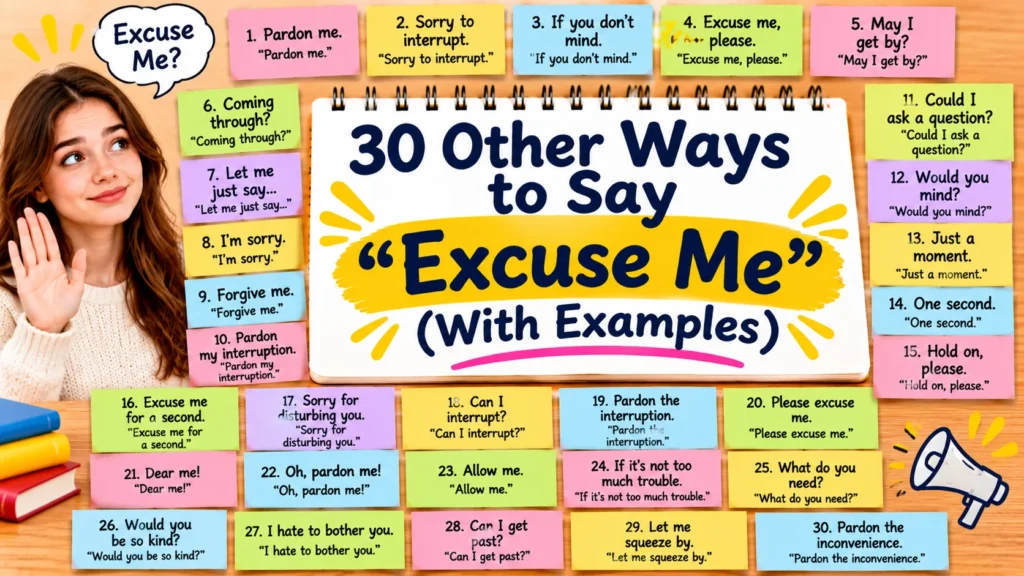

“Excuse me” is a useful phrase, but repeating it in every situation can sometimes make your conversations sound less natural. Whether you want to get someone’s attention, politely interrupt, move past someone, or apologize for a small mistake, choosing the right words can make your message clearer and more thoughtful.
The good news is that you have plenty of alternatives. Phrases like “Pardon me,” “May I have your attention?” “Sorry to bother you,” “Could you please move?” and “I apologize” can all replace “Excuse me,” depending on the situation. Some sound more formal and professional, while others feel friendly, casual, or especially polite.
In this guide, you’ll discover 30 other ways to say “Excuse me,” along with simple explanations and practical examples. These alternatives will help you communicate more confidently, show respect, and choose words that fit different situations, from everyday conversations to workplace discussions.
What Does “Excuse Me” Mean?
The phrase “Excuse me” is a polite expression used in different situations to get someone’s attention, apologize for a small mistake, interrupt a conversation, or ask someone to move out of your way. It can also be used when you need clarification because you didn’t hear or understand something. For example, you might say, “Excuse me, could you tell me where the nearest bus stop is?” when asking a stranger for directions. The meaning depends on the situation, your tone, and the intention behind your words. Overall, it helps people communicate courteously and show respect during everyday interactions.
Is It Professional or Polite to Say “Excuse Me”?
Yes, “Excuse me” is both professional and polite. It is widely accepted in workplaces, formal conversations, public places, and everyday interactions. You can use it to politely interrupt someone, ask a question, get a person’s attention, or apologize for a minor inconvenience. However, repeating the same expression in every situation can sometimes make your communication sound less natural. Alternatives such as “May I interrupt for a moment?”, “Pardon me,” and “Could I get your attention, please?” can make your message more suitable for particular circumstances. Choosing the right expression helps you sound considerate, confident, and respectful.
Advantages and Disadvantages of Saying “Excuse Me”
Advantages
- Shows Good Manners: Saying “Excuse me” demonstrates politeness and consideration for other people’s time, personal space, and attention.
- Makes Communication Easier: It provides a simple way to get someone’s attention, ask a question, or interrupt a conversation without being unnecessarily abrupt.
- Works in Different Situations: The expression is suitable for professional environments, casual conversations, public places, and formal interactions.
Disadvantages
- Can Sound Repetitive: Using “Excuse me” too frequently may make your conversations sound less varied or natural.
- May Be Misunderstood: Depending on your tone, the expression can sometimes sound impatient, sarcastic, or confrontational.
- Doesn’t Always Explain Your Intention: Someone might not understand whether you’re apologizing, asking them to move, requesting attention, or expressing surprise.
30 Alternatives to Say “Excuse Me” (With Examples)
Here is a complete list of 30 alternatives you can use instead of “Excuse me.” Each expression has a slightly different purpose, so you can choose one that fits your situation.
- Pardon Me
- Sorry to Bother You
- May I Have Your Attention, Please?
- Could You Please Move?
- Sorry for Interrupting
- May I Interrupt for a Moment?
- I Beg Your Pardon
- Please Forgive the Interruption
- Could I Get Past You?
- Sorry, Could You Repeat That?
- May I Ask You Something?
- If You Don’t Mind
- Just a Moment, Please
- I Didn’t Mean to Interrupt
- Could You Spare a Moment?
- My Apologies
- Sorry About That
- Would You Mind Moving Aside?
- May I Come Through?
- Could I Get Your Attention?
- Please Pardon the Interruption
- Sorry to Cut In
- Can I Get By?
- I Hope I’m Not Interrupting
- Would You Excuse Me for a Moment?
- Let Me Get Your Attention
- Could You Clarify That, Please?
- I Didn’t Catch That
- Please Allow Me to Pass
- One Moment, If You Please
1. Pardon Me
Meaning: “Pardon me” is a polite expression used to apologize for a minor inconvenience, get someone’s attention, or ask someone to repeat something.
Definition: A courteous phrase used to request forgiveness, clarification, or someone’s attention.
Detailed Explanation: This is one of the closest alternatives to “Excuse me.” It works in both formal and everyday conversations. You can use it when accidentally bumping into someone, interrupting a discussion, or failing to hear what another person said. It sounds slightly more formal than the original expression, making it useful when you want to communicate respectfully.
Scenario Examples:
- “Pardon me, could you tell me where the reception desk is?”
- “Pardon me, I didn’t hear your last question.”
Best Use: Use it in formal conversations, public places, and situations where you want to get someone’s attention politely.
Tone: Polite, courteous, and slightly formal.
2. Sorry to Bother You
Meaning: This phrase means you’re apologizing for interrupting someone or taking up their time.
Definition: A polite expression used before asking someone for help, attention, or information.
Detailed Explanation: “Sorry to bother you” is a thoughtful alternative when you need to approach someone who may be busy. It acknowledges that the other person has their own responsibilities and shows that you respect their time. It’s especially useful when asking colleagues, teachers, customers, or strangers for assistance.
Scenario Examples:
- “Sorry to bother you, but could you help me find this document?”
- “Sorry to bother you while you’re working. I have a quick question.”
Best Use: Use it when approaching someone who is busy or requesting a small favor.
Tone: Considerate, friendly, and respectful.
3. May I Have Your Attention, Please?
Meaning: This expression means you’re politely asking people to focus on what you’re about to say.
Definition: A formal request for someone’s attention before making an announcement or sharing information.
Detailed Explanation: This phrase is useful when speaking to a group rather than one individual. It allows you to begin a conversation or announcement without raising your voice or interrupting abruptly. It is commonly used in meetings, classrooms, presentations, and public announcements.
Scenario Examples:
- “May I have your attention, please? We are about to begin the presentation.”
- “May I have your attention, please? I have an important update to share.”
Best Use: Use it during meetings, presentations, public announcements, or group discussions.
Tone: Formal, professional, and courteous.
4. Could You Please Move?
Meaning: This phrase means you’re politely asking someone to change their position or make space for you.
Definition: A courteous request asking someone to move away from a particular spot.
Detailed Explanation: Sometimes you need to pass through a crowded area or access something that another person is blocking. Instead of sounding demanding, adding “please” makes the request more respectful. However, in especially sensitive situations, you may want to use a softer alternative such as “Would you mind moving aside?”
Scenario Examples:
- “Could you please move? I need to open the door.”
- “Could you please move a little so everyone can see the screen?”
Best Use: Use it when asking someone to make room or change their position.
Tone: Direct, polite, and practical.
5. Sorry for Interrupting
Meaning: This expression means you’re apologizing for speaking while someone else is talking or doing something.
Definition: A courteous statement acknowledging that you have interrupted another person’s conversation or activity.
Detailed Explanation: Interruptions sometimes happen because you have an urgent question, important information, or something relevant to add. Saying “Sorry for interrupting” shows that you recognize the other person’s time and attention. It is especially useful in workplaces, meetings, and discussions where everyone deserves an opportunity to speak.
Scenario Examples:
- “Sorry for interrupting, but I have an important detail to add.”
- “Sorry for interrupting your conversation. Could I ask you something?”
Best Use: Use it when entering an ongoing conversation or speaking before someone has finished.
Tone: Respectful, apologetic, and professional.
6. May I Interrupt for a Moment?
Meaning: This phrase means you’re politely asking permission to speak during an ongoing conversation or activity.
Definition: A courteous request to temporarily interrupt someone’s speech or attention.
Detailed Explanation: This expression is especially useful when you don’t want to interrupt someone without acknowledging their conversation. Asking permission first makes your intention clear and gives the other person a chance to respond. It works well in professional meetings, interviews, and formal discussions.
Scenario Examples:
- “May I interrupt for a moment? I have a question about the schedule.”
- “May I interrupt for a moment to clarify something?”
Best Use: Use it when you need to speak during a meeting, discussion, or formal conversation.
Tone: Professional, considerate, and diplomatic.
7. I Beg Your Pardon
Meaning: “I beg your pardon” is a formal expression used to apologize, request repetition, or express surprise at something someone has said.
Definition: A traditional polite phrase requesting forgiveness or clarification.
Detailed Explanation: This expression is more formal than everyday alternatives such as “Sorry?” or “Pardon me.” It can be used when you accidentally offend someone, fail to hear a statement, or want someone to repeat their words. In certain situations, especially with a sharp tone, it can also communicate surprise or displeasure.
Scenario Examples:
- “I beg your pardon. I didn’t mean to interrupt.”
- “I beg your pardon, could you repeat the last part?”
Best Use: Use it in formal situations or when you want to express an apology or request clarification politely.
Tone: Formal, courteous, and traditional.
8. Please Forgive the Interruption
Meaning: This phrase means you’re asking someone to excuse you for interrupting their activity or conversation.
Definition: A formal apology acknowledging an interruption and requesting understanding.
Detailed Explanation: This alternative is appropriate when you need to interrupt someone in a professional or formal environment. It recognizes that the person was already occupied and communicates that you don’t intend to be disrespectful. It is especially useful when addressing senior colleagues, clients, or people involved in important discussions.
Scenario Examples:
- “Please forgive the interruption, but we need your approval.”
- “Please forgive the interruption. I’d like to share a quick update.”
Best Use: Use it during formal meetings, professional conversations, and important discussions.
Tone: Formal, respectful, and apologetic.
9. Could I Get Past You?
Meaning: This expression means you’re politely asking someone to let you pass through a space.
Definition: A courteous request for permission to move beyond someone who is blocking your path.
Detailed Explanation: This phrase is useful in crowded places, narrow hallways, public transportation, and busy environments. It sounds natural because you’re asking for a little space rather than directly telling someone to move. It helps you avoid unnecessary awkwardness while respecting the other person’s personal space.
Scenario Examples:
- “Could I get past you? I need to reach the exit.”
- “Excuse me, could I get past you to take my seat?”
Best Use: Use it when you need to pass someone in a narrow or crowded area.
Tone: Friendly, polite, and practical.
10. Sorry, Could You Repeat That?
Meaning: This phrase means you didn’t hear or understand something and want the other person to say it again.
Definition: A polite request asking someone to repeat information or a statement.
Detailed Explanation: Conversations don’t always go perfectly. Background noise, distractions, or unfamiliar words can make it difficult to understand what someone has said. Instead of pretending you heard everything, this phrase allows you to ask for clarification naturally. It also shows that you’re interested in understanding the other person correctly.
Scenario Examples:
- “Sorry, could you repeat that? I didn’t hear the last part.”
- “Sorry, could you repeat the address a little more slowly?”
Best Use: Use it when you miss something during a conversation or need clarification.
Tone: Polite, friendly, and attentive.
11. May I Ask You Something?
Meaning: This expression means you’re politely asking permission to ask someone a question.
Definition: A courteous phrase used to introduce a question or begin a conversation.
Detailed Explanation: Sometimes you want to get someone’s attention because you need information or assistance. This phrase creates a natural opening without interrupting too abruptly. It works in professional and personal conversations, particularly when you don’t know the person very well.
Scenario Examples:
- “May I ask you something about the application process?”
- “May I ask you something? Do you know when the store closes?”
Best Use: Use it when starting a conversation or preparing to ask someone a question.
Tone: Respectful, friendly, and considerate.
12. If You Don’t Mind
Meaning: This phrase means you’re making a request while showing consideration for the other person’s preferences.
Definition: A polite expression used to soften a request or ask for someone’s cooperation.
Detailed Explanation: “If you don’t mind” is a flexible expression that can make your requests sound less demanding. It is particularly useful when asking someone to move, wait, help, or allow you to do something. It shows that you’re considering their comfort rather than assuming they must agree.
Scenario Examples:
- “If you don’t mind, could I sit next to you?”
- “I’d like to ask a quick question, if you don’t mind.”
Best Use: Use it when making polite requests in everyday and professional conversations.
Tone: Gentle, considerate, and friendly.
13. Just a Moment, Please
Meaning: This expression means you’re politely asking someone to wait briefly.
Definition: A courteous request for a short pause before continuing an activity or conversation.
Detailed Explanation: You can use this phrase when you’re busy, need to finish something, or want to organize your thoughts before responding. It helps manage conversations without ignoring the other person. In professional settings, it also communicates that you’re acknowledging their presence and will attend to them shortly.
Scenario Examples:
- “Just a moment, please. I’ll be with you shortly.”
- “Just a moment, please. I need to check that information.”
Best Use: Use it when asking someone to wait briefly.
Tone: Polite, calm, and professional.
14. I Didn’t Mean to Interrupt
Meaning: This phrase means you didn’t intend to disturb or interrupt someone’s conversation or activity.
Definition: An expression used to clarify that an interruption was unintentional.
Detailed Explanation: Sometimes you begin speaking without realizing that someone else hasn’t finished. This phrase helps acknowledge the situation and shows that you respect the other person’s opportunity to speak. It is particularly helpful when you want to correct an awkward moment without making it bigger than necessary.
Scenario Examples:
- “I didn’t mean to interrupt. Please continue.”
- “I didn’t mean to interrupt your meeting. I just wanted to share some information.”
Best Use: Use it when you accidentally interrupt someone and want to acknowledge your mistake.
Tone: Apologetic, thoughtful, and respectful.
15. Could You Spare a Moment?
Meaning: This expression means you’re asking someone to give you a little of their time.
Definition: A polite request for someone’s attention or availability for a short conversation.
Detailed Explanation: This alternative is useful when you need to discuss something but aren’t sure whether the other person is available. It recognizes that their time may be limited and gives them the opportunity to respond. It is especially appropriate in professional environments.
Scenario Examples:
- “Could you spare a moment? I’d like to discuss the new project.”
- “Could you spare a moment to help me understand this instruction?”
Best Use: Use it when approaching a colleague, manager, teacher, or someone whose time you respect.
Tone: Professional, courteous, and considerate.
16. My Apologies
Meaning: “My apologies” means you’re expressing regret for a mistake, inconvenience, or interruption.
Definition: A formal expression of regret or acknowledgment of an action that may have inconvenienced someone.
Detailed Explanation: This phrase is a useful alternative when you want to apologize without giving a lengthy explanation. It sounds professional and can be used in emails, meetings, and face-to-face conversations. It is particularly appropriate when you accidentally disturb someone or make a minor mistake.
Scenario Examples:
- “My apologies for interrupting your conversation.”
- “My apologies. I didn’t realize you were waiting.”
Best Use: Use it in professional settings and situations where you want to offer a brief, polite apology.
Tone: Formal, sincere, and respectful.
17. Sorry About That
Meaning: This phrase means you’re apologizing for something that happened or for a minor inconvenience you caused.
Definition: An informal expression used to acknowledge a small mistake or inconvenience.
Detailed Explanation: “Sorry about that” is a natural alternative in everyday conversations. You can use it after accidentally bumping into someone, interrupting a person, or causing a small inconvenience. It sounds less formal than “My apologies” and is suitable for friendly interactions.
Scenario Examples:
- “Sorry about that. I didn’t see you standing there.”
- “Sorry about that. I didn’t mean to interrupt your conversation.”
Best Use: Use it when apologizing for minor mistakes in casual situations.
Tone: Friendly, casual, and apologetic.
18. Would You Mind Moving Aside?
Meaning: This expression means you’re politely asking someone to move to another position so you can pass.
Definition: A courteous request for someone to make space or move out of the way.
Detailed Explanation: This phrase is useful when someone is standing in a doorway, blocking a pathway, or preventing others from passing. The words “would you mind” soften the request and make it sound more considerate. It is a good choice when you want to communicate directly without sounding demanding.
Scenario Examples:
- “Would you mind moving aside? I’d like to get through.”
- “Would you mind moving aside so the others can enter?”
Best Use: Use it in crowded places, hallways, entrances, and situations where someone needs to make room.
Tone: Polite, considerate, and direct.
19. May I Come Through?
Meaning: This phrase means you’re asking permission to pass through a space occupied by someone else.
Definition: A polite request for access through a crowded or restricted area.
Detailed Explanation: “May I come through?” is a natural alternative to “Excuse me” when you need to move through a group of people. It is particularly helpful at public events, crowded shops, stations, and busy workplaces. It makes your intention clear while allowing others to move comfortably.
Scenario Examples:
- “May I come through? I need to reach the other side.”
- “May I come through, please? My seat is near the window.”
Best Use: Use it when passing through a crowd or entering a space where people are standing.
Tone: Courteous, gentle, and friendly.
20. Could I Get Your Attention?
Meaning: This expression means you’re politely asking someone to focus on you or listen to what you have to say.
Definition: A request for another person’s attention before communicating important information.
Detailed Explanation: This alternative is useful when someone is distracted or focused on another activity. It communicates your need to speak without demanding immediate attention. Adding “please” can make the expression sound even more respectful, especially in professional settings.
Scenario Examples:
- “Could I get your attention for a moment? I have an announcement.”
- “Could I get your attention, please? We need to discuss the next step.”
Best Use: Use it during meetings, group discussions, presentations, and workplace conversations.
Tone: Professional, direct, and respectful.
21. Please Pardon the Interruption
Meaning: This phrase means you’re politely apologizing for interrupting someone or disturbing an ongoing activity.
Definition: A formal expression requesting understanding after temporarily interrupting a person or group.
Detailed Explanation: This alternative is similar to “Please forgive the interruption,” but it can sound slightly more traditional. It is useful when you need to enter a formal conversation or approach someone who is already occupied. It communicates that you understand the interruption may be inconvenient.
Scenario Examples:
- “Please pardon the interruption. We need your signature before proceeding.”
- “Please pardon the interruption, but the meeting room is ready.”
Best Use: Use it in formal meetings, professional environments, and situations involving important conversations.
Tone: Formal, courteous, and apologetic.
22. Sorry to Cut In
Meaning: This expression means you’re apologizing for joining a conversation before someone has finished speaking.
Definition: An informal phrase used to acknowledge an interruption while introducing something you want to say.
Detailed Explanation: “Sorry to cut in” is particularly useful during group conversations when you have a relevant point to add. It shows that you recognize someone else was speaking but would like to contribute. It can make your interruption feel more natural and less abrupt.
Scenario Examples:
- “Sorry to cut in, but I think we should consider another option.”
- “Sorry to cut in. I just wanted to clarify one important detail.”
Best Use: Use it during casual conversations, team discussions, and informal meetings.
Tone: Friendly, conversational, and considerate.
23. Can I Get By?
Meaning: This phrase means you’re asking someone to make enough space for you to pass.
Definition: An informal request for permission to move past another person.
Detailed Explanation: This expression is short, natural, and useful in everyday situations. You might say it when someone is standing in a narrow passage, blocking an aisle, or occupying the space you need to use. It communicates your intention clearly without requiring a lengthy explanation.
Scenario Examples:
- “Can I get by? I need to grab something from the shelf.”
- “Can I get by, please? I’m trying to reach the door.”
Best Use: Use it in casual settings, crowded areas, and everyday interactions.
Tone: Casual, friendly, and direct.
24. I Hope I’m Not Interrupting
Meaning: This phrase means you’re checking whether it’s appropriate to join someone or begin speaking.
Definition: A considerate expression used when approaching someone who may already be occupied.
Detailed Explanation: This alternative is useful when you’re unsure whether someone is available for a conversation. It shows that you recognize they may be busy and don’t want to disturb them unnecessarily. It is especially appropriate when approaching colleagues, managers, or people involved in important activities.
Scenario Examples:
- “I hope I’m not interrupting, but could I ask you a quick question?”
- “I hope I’m not interrupting your work. I wanted to discuss the schedule.”
Best Use: Use it when approaching someone who appears busy or engaged in another conversation.
Tone: Thoughtful, considerate, and professional.
25. Would You Excuse Me for a Moment?
Meaning: This expression means you’re politely asking permission to leave a conversation or situation temporarily.
Definition: A courteous request to be allowed to step away for a short period.
Detailed Explanation: Sometimes you need to leave a meeting, conversation, or social gathering briefly. Instead of walking away without saying anything, this phrase helps you communicate your intention politely. It is especially suitable for formal occasions and professional environments.
Scenario Examples:
- “Would you excuse me for a moment? I need to take an important call.”
- “Would you excuse me for a moment? I’ll be right back.”
Best Use: Use it when temporarily leaving a conversation, meeting, or social event.
Tone: Formal, polite, and considerate.
26. Let Me Get Your Attention
Meaning: This expression means you want someone to focus on what you’re about to say.
Definition: A direct statement used to shift someone’s attention toward a speaker or important message.
Detailed Explanation: This phrase is useful when you need to make an announcement or bring a group back to a discussion. However, it can sound more commanding than “May I have your attention, please?” Adding polite language can make it more suitable for professional communication.
Scenario Examples:
- “Let me get your attention for a moment before we begin.”
- “Let me get your attention so I can explain the next activity.”
Best Use: Use it when addressing a group or redirecting attention during a discussion.
Tone: Direct, confident, and slightly authoritative.
27. Could You Clarify That, Please?
Meaning: This phrase means you’re asking someone to explain something more clearly.
Definition: A polite request for additional information or a clearer explanation.
Detailed Explanation: Sometimes you need to say “Excuse me” because a statement isn’t clear or you don’t understand what someone means. This alternative communicates exactly what you need. It is particularly helpful in professional conversations, classrooms, interviews, and situations involving complicated information.
Scenario Examples:
- “Could you clarify that, please? I want to make sure I understand.”
- “Could you clarify the last instruction before we continue?”
Best Use: Use it when you need clarification about instructions, information, or someone’s statement.
Tone: Professional, polite, and inquisitive.
28. I Didn’t Catch That
Meaning: This expression means you didn’t hear or understand what someone said.
Definition: An informal statement used to explain that information was missed during a conversation.
Detailed Explanation: “I didn’t catch that” is a natural alternative when someone speaks too quickly, quietly, or unclearly. It allows you to ask for repetition without making the other person feel uncomfortable. You can make it more polite by adding “Sorry” or following it with a request to repeat the statement.
Scenario Examples:
- “Sorry, I didn’t catch that. Could you say it again?”
- “I didn’t catch that last part because there was too much background noise.”
Best Use: Use it in everyday conversations when you haven’t heard or understood something.
Tone: Casual, friendly, and natural.
29. Please Allow Me to Pass
Meaning: This phrase means you’re politely requesting permission to move through a space.
Definition: A formal expression asking someone to make room so you can pass.
Detailed Explanation: This alternative is particularly useful in formal environments or situations where you want to sound especially courteous. It communicates your intention without making a direct demand. Although it may sound a little traditional in everyday conversation, it is appropriate for formal events and respectful interactions.
Scenario Examples:
- “Please allow me to pass so I can reach my seat.”
- “Please allow me to pass through the doorway.”
Best Use: Use it during formal events, crowded gatherings, and situations requiring extra courtesy.
Tone: Formal, respectful, and courteous.
30. One Moment, If You Please
Meaning: This expression means you’re politely asking someone to wait briefly.
Definition: A formal request for a short pause before continuing a conversation or activity.
Detailed Explanation: “One moment, if you please” is a slightly traditional way of asking someone to wait. It can be useful when you need to finish a task, check information, or prepare a response. The expression sounds more formal than simply saying “Wait a second,” making it suitable for professional or service-related interactions.
Scenario Examples:
- “One moment, if you please. I’ll check the information for you.”
- “One moment, if you please, while I speak with the manager.”
Best Use: Use it when politely asking someone to wait in a formal or customer-service situation.
Tone: Formal, courteous, and composed.
Conclusion
Knowing different ways to say “Excuse me” can make your conversations sound more natural, thoughtful, and respectful. Although the original expression works in many situations, alternatives allow you to communicate your exact intention. For example, “Pardon me” is useful when getting someone’s attention, while “Sorry for interrupting” acknowledges that you’ve entered an ongoing conversation. Similarly, “Could I get past you?” works when you need to move through a crowded space, and “Would you excuse me for a moment?” is appropriate when leaving a conversation temporarily. Each expression has its own meaning, definition, and tone. Choosing the right one helps you communicate clearly while showing consideration for the people around you.