


If you’re updating a resume, 30 Other Ways to Say ‘Self-Starter’ can help you find precise wording that highlights your strengths without sounding repetitive.
In resume writing, you can articulate how you take initiative, work independently, and get things done without constant direction. A self-motivated, proactive, or driven candidate can present yourself as a high-quality candidate by showing real results, skills, abilities, and experience instead of relying on a common label.
This can make your qualifications stronger in a job application, particularly when your wording matches the job descriptions and shows that you can stay motivated and work without being asked.
The right wording should clearly match your audience and purpose, whether you are writing for interviews, performance reviews, or professional conversations. You might describe a person as enterprising, initiative-taking, or someone who takes action and develops new ideas. My advice is to choose a precise alternative that explains what someone actually does rather than using predictable language.
For example, a candidate who reaches specific goals may be described as driven, while someone who starts useful work before being told can be described as someone who takes initiative. These examples can help you update your resume and make your professional language more specific.
Quick Answer
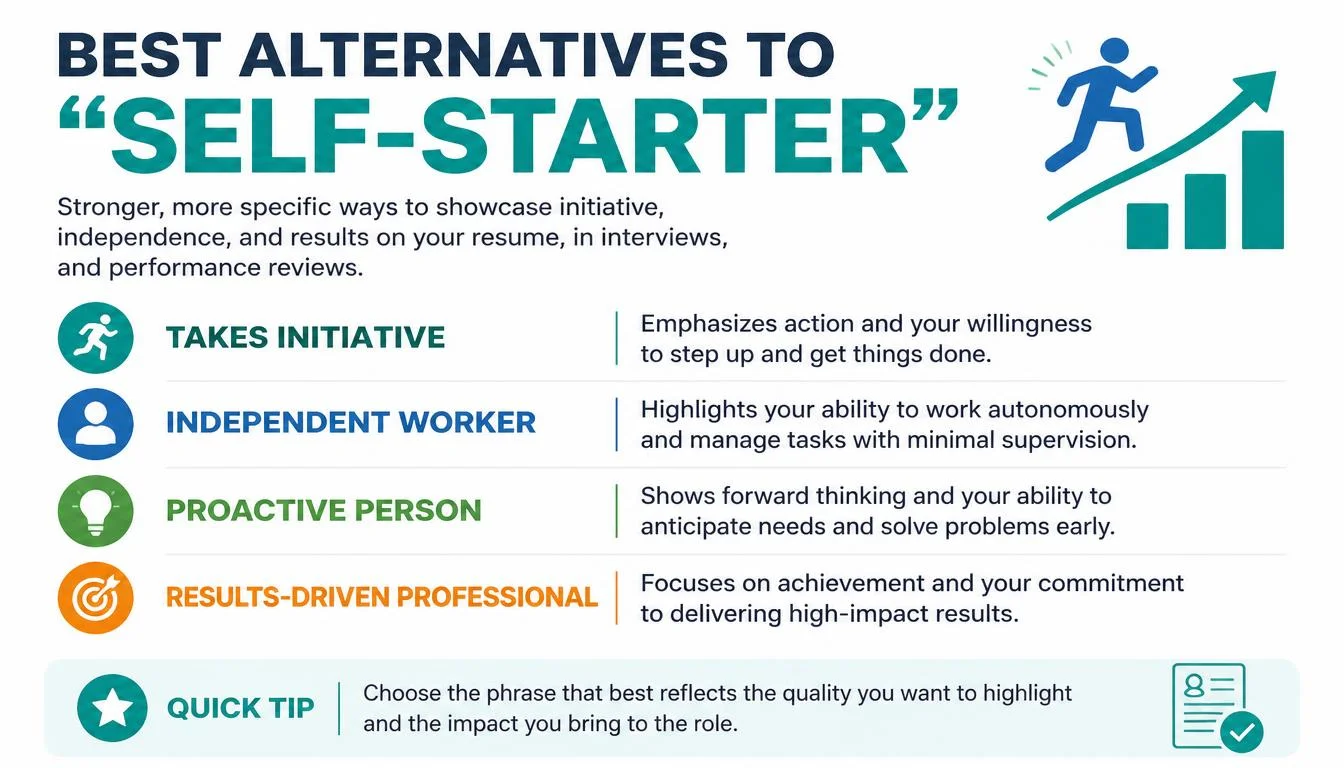
If you want a more natural way to say “self-starter,” choose a phrase that shows the specific quality you want to highlight. For example, “takes initiative” emphasizes action, “independent worker” highlights autonomy, “proactive person” shows forward thinking, and “results-driven professional” focuses on achievement. These alternatives can make your resume, recommendation, interview answer, or performance review sound more specific and genuine than relying on the familiar phrase “self-starter.”
What Does “Self-Starter” Mean?
A self-starter is someone who can begin work, solve problems, and take action without constantly waiting for instructions. The term describes a person who is motivated, proactive, independent, and willing to take initiative. A self-starter does not always need someone else to tell them what to do next. Instead, they recognize opportunities, set goals, manage responsibilities, and move forward on their own.
In the workplace, calling someone a self-starter is usually a compliment. It suggests that the person has internal motivation, takes responsibility, and can make progress without excessive supervision. For example, a manager might describe an employee as a self-starter because they notice a problem and begin working on a solution before being asked.
Is It Professional or Polite to Say “Self-Starter”?
Yes, “self-starter” is professional and positive, especially in resumes, interviews, job descriptions, performance reviews, and recommendations. It communicates that someone is motivated and dependable. However, the phrase can sometimes sound like a standard workplace cliché because employers see it frequently on resumes. Using a more specific alternative can make your description feel more natural, memorable, and genuine.
For example, instead of simply saying, “She is a self-starter,” you could say, “She takes initiative and independently identifies ways to improve our workflow.” The second version gives the reader a clearer picture of the person’s behavior.
Advantages and Disadvantages of Saying “Self-Starter
Advantages
- Shows initiative: It tells others that you can take action without waiting for constant direction.
- Highlights independence: The phrase suggests you can manage responsibilities and make progress on your own.
- Works well professionally: It fits naturally in resumes, interviews, recommendations, and performance reviews.
Disadvantages
- It can sound overused: “Self-starter” appears frequently in professional writing, especially on resumes.
- It can be vague: The phrase does not explain exactly how someone demonstrates initiative.
- It may feel impersonal: A more specific description can show the person’s actual strengths and achievements more effectively.
Synonyms for “Self-Starter”
- Proactive Person
- Initiative-Taker
- Highly Motivated Individual
- Go-Getter
- Independent Worker
- Self-Motivated Professional
- Driven Individual
- Takes Initiative
- Action-Oriented Person
- Independent Thinker
- Highly Resourceful Person
- Motivated Achiever
- Results-Driven Professional
- Entrepreneurial Thinker
- Problem Solver
- Self-Directed Worker
- Forward-Thinking Professional
- Motivated Leader
- Independent Contributor
- Resourceful Professional
- Ambitious Individual
- Goal-Oriented Person
- Take-Charge Person
- Dynamic Professional
- Energetic Contributor
- Opportunity-Seeker
- Independent Go-Getter
- Highly Driven Professional
- Initiative-Driven Individual
- Someone Who Gets Things Done
1. Proactive Person
Meaning: A proactive person takes action before being asked.
Definition: Someone who anticipates needs, recognizes opportunities, and acts independently.
Detailed Explanation: This is a strong alternative to self-starter when you want to emphasize initiative and forward thinking. It shows that someone does not simply react to problems. They look ahead and take useful action.
Scenario Example: “Maria is a proactive person who regularly finds ways to improve our team’s workflow.”
Best Use: Use it in performance reviews, resumes, recommendations, and workplace conversations.
Tone: Professional, positive, and confident.
2. Initiative-Taker
Meaning: Someone who willingly takes action without waiting for instructions.
Definition: A person who identifies what needs to be done and begins working on it independently.
Detailed Explanation: Initiative-taker directly communicates one of the most important qualities associated with a self-starter. It is especially useful when describing someone who sees a task and takes responsibility for getting it started.
Scenario Example: “He is a natural initiative-taker who quickly turns ideas into practical projects.”
Best Use: Use it when discussing leadership, teamwork, or workplace performance.
Tone: Professional and appreciative.
3. Highly Motivated Individual
Meaning: A person with strong internal motivation to accomplish goals.
Definition: Someone who consistently puts effort into reaching personal or professional objectives.
Detailed Explanation: This phrase focuses more on motivation and determination than independence. It works well when you want to praise someone’s willingness to work hard and keep progressing.
Scenario Example: “She is a highly motivated individual who consistently exceeds expectations.”
Best Use: Resumes, recommendation letters, interviews, and evaluations.
Tone: Formal, positive, and encouraging.
4. Go-Getter
Meaning: Someone who actively pursues goals and opportunities.
Definition: A confident and energetic person who works hard to achieve desired results.
Detailed Explanation: Go-getter has a more conversational feel than self-starter. It suggests enthusiasm, ambition, confidence, and a willingness to take action.
Scenario Example: “Daniel is a real go-getter who never waits around for opportunities to appear.”
Best Use: Informal professional conversations, recommendations, and networking.
Tone: Energetic, friendly, and confident.
5. Independent Worker
Meaning: Someone who can work effectively without constant supervision.
Definition: A person who manages tasks and responsibilities independently.
Detailed Explanation: This alternative emphasizes independence and reliability. It is useful when the important quality is someone’s ability to stay productive without frequent guidance.
Scenario Example: “She is an independent worker who can manage complex assignments with minimal supervision.”
Best Use: Resumes, job interviews, and performance reviews.
Tone: Professional and dependable.
6. Self-Motivated Professional
Meaning: A professional who creates their own motivation to succeed.
Definition: Someone who remains driven and productive without needing constant external encouragement.
Detailed Explanation: This phrase is a polished alternative to self-starter. It works particularly well when describing someone who maintains strong performance even when working independently.
Scenario Example: “We are looking for a self-motivated professional who can manage projects independently.”
Best Use: Job applications, resumes, and professional profiles.
Tone: Polished and professional.
7. Driven Individual
Meaning: Someone strongly determined to achieve their goals.
Definition: A person with ambition, persistence, and a strong desire to succeed.
Detailed Explanation: Driven individual focuses on determination rather than simply taking initiative. It is useful when you want to describe someone who consistently pushes toward meaningful results.
Scenario Example: “She is a driven individual who approaches every project with focus and determination.”
Best Use: Recommendations, interviews, and professional evaluations.
Tone: Confident and ambitious.
8. Takes Initiative
Meaning: To act without waiting to be told what to do.
Definition: A phrase describing someone who independently identifies and addresses tasks or opportunities.
Detailed Explanation: This is one of the most natural alternatives because it describes an actual behavior instead of applying a label. It can make professional writing more specific and convincing.
Scenario Example: “He consistently takes initiative when the team faces new challenges.”
Best Use: Performance reviews, resumes, interviews, and recommendations.
Tone: Professional and direct.
9. Action-Oriented Person
Meaning: Someone who focuses on turning plans into action.
Definition: A person who prefers practical steps and measurable progress over unnecessary delay.
Detailed Explanation: An action-oriented person does not simply discuss possibilities. They look for practical ways to move forward. This makes the phrase particularly useful when describing productivity.
Scenario Example: “She is an action-oriented person who quickly turns ideas into workable solutions.”
Best Use: Business, leadership, project management, and resumes.
Tone: Professional and energetic.
See More:30 Other Ways to Say ‘I Am Not Feeling Well’ to Your Boss
10. Independent Thinker
Meaning: Someone who forms ideas and judgments independently.
Definition: A person who can evaluate situations, develop opinions, and make decisions without relying heavily on others.
Detailed Explanation: Independent thinker emphasizes judgment and original thinking. It is a good choice when a self-starter’s strength comes from confidently developing their own approach.
Scenario Example: “He is an independent thinker who brings thoughtful solutions to difficult problems.”
Best Use: Academic, professional, leadership, and recommendation contexts.
Tone: Thoughtful and confident.
11. Highly Resourceful Person
Meaning: Someone who finds effective ways to solve problems.
Definition: A person who uses available resources creatively and efficiently.
Detailed Explanation: Resourcefulness is closely connected to being a self-starter because independent people often need to figure things out without having every answer handed to them.
Scenario Example: “She is a highly resourceful person who finds practical solutions even when resources are limited.”
Best Use: Work evaluations, interviews, and recommendations.
Tone: Positive and capable.
12. Motivated Achiever
Meaning: Someone who is strongly motivated to accomplish goals.
Definition: A person who combines determination with a consistent focus on achievement.
Detailed Explanation: This phrase highlights both motivation and accomplishment. It works well when the person’s initiative has already produced meaningful results.
Scenario Example: “He is a motivated achiever who consistently delivers excellent results.”
Best Use: Resumes, recommendations, and professional profiles.
Tone: Formal and achievement-focused.
13. Results-Driven Professional
Meaning: A professional who focuses strongly on achieving outcomes.
Definition: Someone who organizes their efforts around measurable goals and successful results.
Detailed Explanation: Results-driven professional is particularly useful when describing someone who not only takes initiative but also follows through and produces outcomes.
Scenario Example: “She is a results-driven professional who consistently completes projects ahead of schedule.”
Best Use: Resumes, LinkedIn profiles, interviews, and business writing.
Tone: Professional and polished.
14. Entrepreneurial Thinker
Meaning: Someone who approaches opportunities with an entrepreneurial mindset.
Definition: A person who identifies opportunities, accepts responsibility, and develops creative approaches to challenges.
Detailed Explanation: This alternative works well when self-starter refers to someone who thinks creatively and is comfortable creating opportunities rather than waiting for them.
Scenario Example: “He is an entrepreneurial thinker who constantly identifies new ways to grow the business.”
Best Use: Business, startups, leadership, and innovation.
Tone: Ambitious and forward-looking.
15. Problem Solver
Meaning: Someone who actively finds solutions to challenges.
Definition: A person who analyzes difficulties and develops practical ways to resolve them.
Detailed Explanation: Sometimes being a self-starter is less about beginning tasks and more about seeing a problem and doing something about it. In that situation, problem solver is a stronger and more specific choice.
Scenario Example: “She is an excellent problem solver who can handle unexpected challenges independently.”
Best Use: Resumes, interviews, evaluations, and recommendations.
Tone: Practical and professional.
16. Self-Directed Worker
Meaning: Someone who can organize and manage their own work.
Definition: A person who establishes priorities, manages responsibilities, and works independently.
Detailed Explanation: Self-directed worker closely matches the meaning of self-starter while sounding slightly more formal. It is especially useful for roles that require limited supervision.
Scenario Example: “We need a self-directed worker who can manage several projects independently.”
Best Use: Job descriptions, resumes, and performance reviews.
Tone: Formal and professional.
17. Forward-Thinking Professional
Meaning: Someone who considers future opportunities and possibilities.
Definition: A person who anticipates changes and develops ideas with future needs in mind.
Detailed Explanation: This phrase adds a sense of vision and planning to the idea of being a self-starter. It is ideal when someone does more than simply act independently.
Scenario Example: “She is a forward-thinking professional who regularly suggests improvements before problems arise.”
Best Use: Leadership, business, innovation, and professional profiles.
Tone: Strategic and positive.
18. Motivated Leader
Meaning: Someone who is driven while also encouraging others.
Definition: A person who takes responsibility, pursues goals, and helps guide others toward success.
Detailed Explanation: Use this phrase when the person’s initiative extends beyond their own work. It suggests motivation, responsibility, and positive influence.
Scenario Example: “He is a motivated leader who inspires the team to approach challenges with confidence.”
Best Use: Leadership recommendations, evaluations, and professional profiles.
Tone: Encouraging and authoritative.
19. Independent Contributor
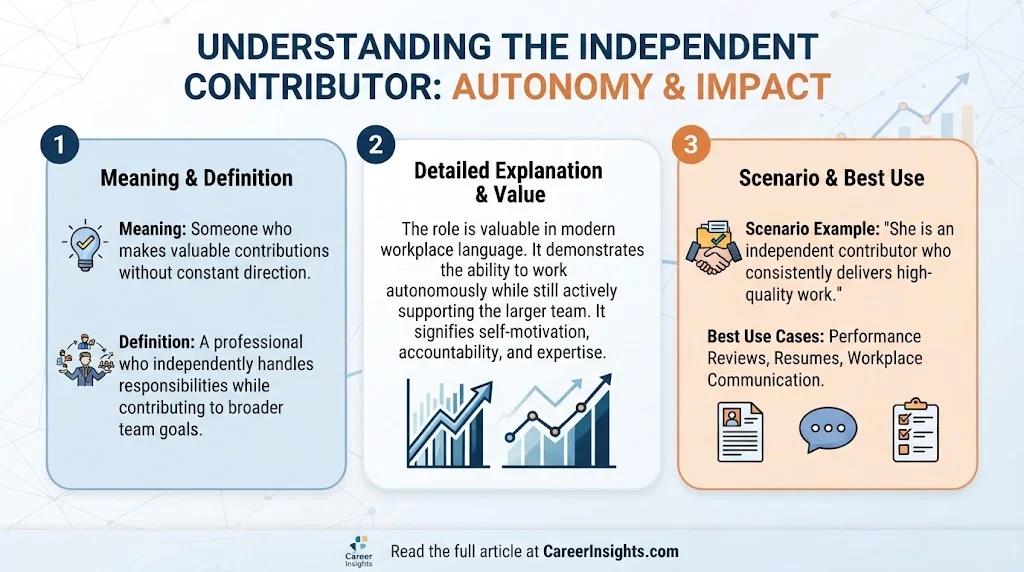
Meaning: Someone who makes valuable contributions without constant direction.
Definition: A professional who independently handles responsibilities while contributing to broader team goals.
Detailed Explanation: Independent contributor is useful in modern workplace language. It shows that someone can work autonomously while still supporting the larger team.
Scenario Example: “She is an independent contributor who consistently delivers high-quality work.”
Best Use: Performance reviews, resumes, and workplace communication.
Tone: Professional and balanced.
20. Resourceful Professional
Meaning: A professional who can find practical solutions.
Definition: Someone who uses creativity, knowledge, and available resources to overcome challenges.
Detailed Explanation: This phrase emphasizes adaptability and problem-solving. It is a strong alternative when the person regularly figures things out without needing extensive assistance.
Scenario Example: “He is a resourceful professional who handles unexpected situations with confidence.”
Best Use: Resumes, interviews, recommendations, and evaluations.
Tone: Capable and professional.
21. Ambitious Individual
Meaning: Someone who has strong goals and aspirations.
Definition: A person who actively seeks growth, achievement, and advancement.
Detailed Explanation: Ambitious individual highlights the desire to progress. It is slightly different from self-starter because it focuses more on aspiration and achievement than independent action.
Scenario Example: “She is an ambitious individual who is always looking for opportunities to develop her skills.”
Best Use: Professional profiles, recommendations, and interviews.
Tone: Positive and aspirational.
22. Goal-Oriented Person
Meaning: Someone who stays focused on achieving specific objectives.
Definition: A person who organizes their actions around clearly defined goals.
Detailed Explanation: A goal-oriented person may be a self-starter because they know where they want to go and take consistent steps to get there. The phrase works especially well when discussing measurable achievements.
Scenario Example: “He is a goal-oriented person who consistently meets challenging deadlines.”
Best Use: Resumes, interviews, evaluations, and recommendations.
Tone: Focused and professional.
23. Take-Charge Person
Meaning: Someone who willingly assumes responsibility.
Definition: A person who steps forward, makes decisions, and takes responsibility for moving things ahead.
Detailed Explanation: Take-charge person gives self-starter a more energetic and conversational feel. It suggests confidence and willingness to accept responsibility.
Scenario Example: “Sarah is a take-charge person who keeps projects moving when unexpected issues arise.”
Best Use: Informal professional descriptions and recommendations.
Tone: Confident and energetic.
24. Dynamic Professional
Meaning: A professional who brings energy, flexibility, and initiative to their work.
Definition: Someone who actively responds to challenges and creates progress.
Detailed Explanation: Dynamic professional is broader than self-starter. It can describe someone who combines energy, adaptability, confidence, and initiative.
Scenario Example: “She is a dynamic professional who brings fresh ideas and energy to every project.”
Best Use: Professional profiles, resumes, and recommendations.
Tone: Modern and confident.
25. Energetic Contributor
Meaning: Someone who actively and enthusiastically contributes.
Definition: A person who brings consistent energy and involvement to their responsibilities.
Detailed Explanation: This phrase focuses on enthusiasm and participation. It works well when you want your description of a self-starter to sound warm rather than overly corporate.
Scenario Example: “He is an energetic contributor who brings enthusiasm to team projects.”
Best Use: Team feedback, recommendations, and workplace communication.
Tone: Warm, positive, and encouraging.
26. Opportunity-Seeker
Meaning: Someone who actively looks for useful opportunities.
Definition: A person who identifies and pursues chances for growth, improvement, or success.
Detailed Explanation: An opportunity-seeker does not wait for possibilities to arrive. They actively look for ways to grow or contribute, making this a useful alternative when initiative is connected to ambition.
Scenario Example: “She is an opportunity-seeker who continually looks for ways to expand her skills.”
Best Use: Career discussions, interviews, recommendations, and professional profiles.
Tone: Positive and ambitious.
27. Independent Go-Getter
Meaning: Someone who combines independence with strong determination.
Definition: A person who takes responsibility for their progress and actively pursues results.
Detailed Explanation: Independent go-getter combines two valuable qualities: the ability to work alone and the motivation to pursue goals. It has a friendly, energetic sound.
Scenario Example: “He is an independent go-getter who can take a project from an idea to completion.”
Best Use: Recommendations, interviews, and informal professional conversations.
Tone: Energetic and confident.
28. Highly Driven Professional
Meaning: A professional with strong determination and ambition.
Definition: Someone who consistently works toward challenging goals with focus and persistence.
Detailed Explanation: This phrase is especially useful when the person demonstrates strong ambition, persistence, and commitment. It sounds polished without being overly complicated.
Scenario Example: “She is a highly driven professional who consistently looks for ways to improve her performance.”
Best Use: Resumes, LinkedIn profiles, interviews, and recommendations.
Tone: Professional and ambitious.
29. Initiative-Driven Individual
Meaning: Someone whose actions are guided by initiative.
Definition: A person who actively identifies responsibilities and opportunities and takes action independently.
Detailed Explanation: Initiative-driven individual is a formal way to describe someone who naturally moves from observation to action. It can be useful when a traditional phrase like self-starter feels too common.
Scenario Example: “He is an initiative-driven individual who regularly identifies ways to improve team efficiency.”
Best Use: Performance reviews, recommendations, and formal professional writing.
Tone: Formal and positive.
See More: 30 Other Ways to Say ‘I Hope Life Is Treating You Well’
30. Someone Who Gets Things Done
Meaning: A person who turns plans and ideas into completed actions.
Definition: Someone who consistently takes action, solves problems, and follows tasks through to completion.
Detailed Explanation: Someone who gets things done is a natural, conversational alternative to self-starter. It focuses less on labels and more on real results and follow-through.
Scenario Example: “She is someone who gets things done, even when a project requires independent problem-solving.”
Best Use: Recommendations, interviews, casual professional conversations, and team feedback.
Tone: Direct, warm, and confident.
Frequently Asked Questions
1. What does “self-starter” mean?
A self-starter is someone who takes initiative, stays motivated, and completes tasks without needing constant direction or supervision.
2. Is “self-starter” professional for a resume?
Yes, self-starter is professional and positive, but it can feel overused. A more specific alternative can make your resume sound more natural and memorable.
3. What is another word for self-starter?
Some useful alternatives include proactive, self-motivated, independent worker, driven, initiative-taker, and results-driven professional.
4. What is a better way to say self-starter on a resume?
Instead of simply saying you are a self-starter, describe what you actually do. For example, you can say that you take initiative, solve problems independently, or consistently achieve results.
5. Is “proactive” the same as “self-starter”?
They are closely related, but proactive focuses more on taking action before problems or needs arise. Self-starter emphasizes working independently without needing constant instructions.
6. How can I describe myself as a self-starter?
Use specific examples of your skills, achievements, and actions. Explain how you started projects, solved problems, improved processes, or reached goals without waiting to be told what to do.
7. Can I use “self-motivated” instead of “self-starter”?
Yes. Self-motivated is a strong alternative when you want to emphasize your ability to remain focused and productive without external encouragement.
8. What is a good synonym for self-starter in an interview?
Takes initiative is a natural choice in an interview because it describes a real behavior. You can strengthen it by giving a brief example of when you acted independently.
9. What is the most professional alternative to self-starter?
The best choice depends on the quality you want to emphasize. Proactive, self-motivated professional, self-directed worker, and results-driven professional can all work well in professional settings.
10. Why should I avoid overusing “self-starter”?
Using the same phrase repeatedly can make your writing sound predictable or generic. Specific alternatives show employers exactly how you contribute, take responsibility, and create results.
Conclusion
There are plenty of effective alternatives to self-starter, and the strongest choice depends on the quality you want to highlight. Use proactive for initiative, self-motivated for internal drive, independent worker for autonomy, and results-driven professional for achievement. Rather than relying on a familiar phrase, choose wording that gives readers a clear picture of what you can actually do. A specific example will usually make your resume, interview, or professional conversation much more convincing.