

If you spend any time online, you have probably seen words like otaku, senpai or kawaii in comments, memes and even everyday conversation. These words come from Japanese, but thanks to the worldwide popularity of anime and manga, they have found a comfortable home in the English language. Some of them are now listed in major English dictionaries.
Fans who stream shows on sites like AnimeKai hear these terms in almost every episode, and many of them have become part of internet English. In this guide, we explain the most common anime words, what they mean, how to pronounce them, and how to use them correctly in English sentences.
Why Japanese Anime Words Are Entering English
English has always borrowed words from other languages. Karaoke, emoji, tsunami and sushi all came from Japanese long before anime became a global hit. Words borrowed this way are called loanwords.
Anime has sped up this process. Millions of viewers watch subtitled episodes where certain Japanese words are left untranslated, because no English word captures their exact meaning. Over time, fans start using those words in English sentences, and they spread through social media, gaming and online communities.
Words About People and Fans
Otaku
Pronunciation: oh-TAH-koo
Meaning: A person who is extremely passionate about anime, manga or video games. In Japan the word can sound slightly negative, but in English it is usually used proudly.
Example: My brother is a total otaku; he has watched every episode of One Piece twice.
Weeb
Pronunciation: weeb
Meaning: Short for “weeaboo,” an informal and sometimes teasing English word for a non-Japanese person who is obsessed with Japanese culture. It is internet slang, not Japanese.
Example: She jokingly calls herself a weeb because she decorates her room with anime posters.
Senpai
Pronunciation: SEN-pie
Meaning: An older or more experienced person, such as a senior student or coworker. The phrase “notice me, senpai” became a popular meme about wanting attention from someone you admire.
Example: My senpai at work showed me how to use the new software.
Kohai
Pronunciation: KOH-hi
Meaning: The opposite of senpai: a junior or less experienced person.
Example: As the team leader, he always helps his kohai with difficult tasks.
Sensei
Pronunciation: SEN-say
Meaning: A teacher, master or expert. In English, it is often used for martial arts instructors.
Example: Our karate sensei is strict but very kind.
Nakama
Pronunciation: nah-KAH-mah
Meaning: Close friends or comrades who share a goal, almost like a chosen family. It is famous among fans of adventure anime.
Example: We have been through so much together; you are my nakama.
Words for Feelings and Reactions
Kawaii
Pronunciation: kah-WAH-ee
Meaning: Cute, adorable or lovable. It can describe people, animals, clothes or almost anything charming.
Example: That little cat in a hoodie is so kawaii!
Sugoi
Pronunciation: SOO-goy
Meaning: Amazing, awesome or incredible.
Example: He finished the puzzle in one minute? Sugoi!
Baka
Pronunciation: BAH-kah
Meaning: Fool or idiot. In anime it is often used playfully between friends, but it can be rude in real life.
Example: “You forgot your keys again, baka,” she laughed.
Moe
Pronunciation: MOH-eh
Meaning: A strong feeling of affection toward a cute, innocent character.
Example: Fans love the series because the main character is pure moe.
Character Personality Types
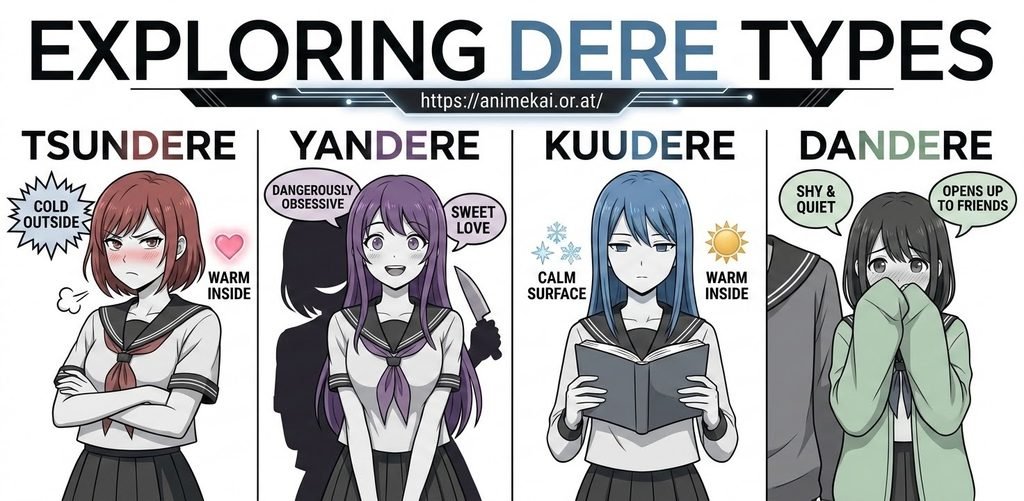
Anime fans use special words to describe common personality types. These “dere” words are now widely used in English online.
| Term | Meaning | Example in a sentence |
| Tsundere | Acts cold or harsh at first, but is secretly caring | She acts annoyed, but she’s a classic tsundere. |
| Yandere | Sweet on the outside, but dangerously obsessive in love | The villain turned out to be a yandere. |
| Kuudere | Calm and emotionless on the surface, warm inside | He rarely smiles; he’s a kuudere type. |
| Dandere | Shy and quiet, but opens up to close friends | The dandere girl finally spoke up in class. |
| Chibi | A small, cute, cartoon-style version of a character | I drew a chibi version of my favorite hero. |
| Waifu / Husbando | A fictional character someone considers their ideal partner | Fans argue online about who the best waifu is. |
Anime Genre Words
Knowing these terms helps you choose what to watch. Many fans who watch anime free online filter shows by these exact genre labels:
- Shonen: Action-focused anime aimed at young male viewers, full of battles and friendship. Example: Naruto is one of the most famous shonen series.
- Shojo: Anime aimed at young female viewers, often focused on romance and emotions.
- Seinen: Anime for adult men, usually with darker or more complex stories.
- Josei: Anime for adult women, with realistic relationships and everyday life.
- Isekai: Stories where a character is transported to another world. Example: I’m tired of isekai shows where the hero is overpowered from the start.
- Slice of life: Calm stories about ordinary daily life.
- Mecha: Anime featuring giant robots.
Other Useful Anime Terms
- Filler: Episodes that are not part of the original manga story. You can skip the filler episodes.
- OVA: Original Video Animation, a special episode released outside the main TV series.
- Arc: A section of the story with its own main event. The tournament arc was the best part of the season.
- Itadakimasu: A phrase said before eating, similar to “Let’s eat.”
- Arigatou: Thank you.
Grammar Tips for Using Anime Words in English
Borrowed words follow some special rules in English writing:
- Plurals usually stay the same. Japanese does not add “s” for plurals, so many writers say two otaku rather than two otakus. Both forms appear online, but the unchanged form is more traditional.
- Use italics in formal writing. When a foreign word is not yet common in English, style guides recommend italics: The students bowed to their sensei. Very common words like anime, manga and karaoke do not need italics.
- Don’t capitalize unless it’s a name. Write kawaii and senpai in lowercase, unless they start a sentence or are used as a title, such as Senpai Tanaka.
- Know your audience. Words like baka, weeb and waifu are informal slang. Use them in chats and social media, not in essays, business emails or exams.
- Watch the part of speech. Kawaii works as an adjective (a kawaii dress), while otaku is a noun (he is an otaku). Avoid mixing them, such as “he is very otaku,” in careful writing.
Frequently Asked Questions
Are anime words in the English dictionary?
Some are. Words like anime, manga, otaku and kawaii appear in major English dictionaries, while terms like tsundere and isekai are still mostly used in fan communities.
Is it okay to call someone senpai in English?
Yes, in a casual and friendly context. Among anime fans it is fun and respectful, but in formal or professional settings it is better to use normal English words like “mentor” or “senior colleague.”
What is the difference between otaku and weeb?
Otaku is a Japanese word for any passionate fan of anime, manga or games. Weeb is English internet slang for a non-Japanese person who is very obsessed with Japanese culture, and it is often used jokingly.
Is baka a bad word?
It means “idiot,” so it can be rude. In anime it is often playful, but be careful using it with people who might take it seriously.
Final Thoughts
Anime words like otaku, senpai and kawaii show how quickly language changes when cultures meet. Learning their meanings helps you understand online conversations, enjoy anime more deeply and use these terms correctly in your own writing. The best way to remember them is to hear them in context, so pick a series, turn on English subtitles and listen for these words. You can find a wide range of subbed and dubbed series at animekai.or.at to start practicing today.