

The FOH Meaning: Full Guide, Usage and Examples explains how this popular internet slang appears across social media, texting, and everyday conversations.
When scrolling through TikTok, Instagram, or X, you might see FOH in a comment, a funny meme, or a heated online argument. This abbreviation usually stands for “Fuck Outta Here” or “Fuck Out of Here.” People use it to express disbelief, annoyance, rejection, or disagreement.
As digital communication grows, new slang terms and internet abbreviations become part of everyday language. Some become viral slang or trending slang, while others remain common slang for years. Understanding its origin, context-dependent meaning, and tone helps you interpret online discussions and recognize different slang expressions.
The key to FOH usage is understanding the context and the relationship between speakers. During online arguments, someone might use FOH to reject a claim or show anger, while friends may use it as a playful reaction to memes or funny content. For example, a friend might text, “FOH, you did not finish that whole pizza!” as a joking response.
In my view, checking the surrounding words and conversation tone is a practical way to understand what someone means. This full guide covers the exact meaning, where it came from, how people use it, when to use it, and important mistakes to avoid.
Quick Answer
FOH usually stands for “F* Outta Here”** in texting and internet slang. People use it to express disbelief, dismiss an idea, reject a claim, or show annoyance. Depending on the relationship and tone, it can sound playful, sarcastic, or offensive.
In workplaces such as restaurants and theaters, FOH means “Front of House,” referring to the customer-facing areas and employees who interact with guests.
Examples:
- Friend: “I finished a 100-question exam in five minutes.”
- Reply: “FOH! No way you did that.”
In a restaurant, someone might say, “The FOH team needs help during dinner service.” Here, FOH refers to the front-of-house staff.
What Does FOH Mean in Texting?
In texting, FOH commonly means “F* Outta Here.”** It is a casual slang expression that communicates a strong reaction to something someone says.
People often use it when they find a statement unbelievable, ridiculous, annoying, or difficult to accept. Depending on the conversation, it can mean “Get out of here,” “I don’t believe you,” or “Stop talking nonsense.”
For example:
Person A: “I can beat every professional player without practicing.”
Person B: “FOH 😂 You lost your last three matches.”
In this conversation, Person B uses FOH to challenge an exaggerated claim. The laughing emoji suggests that the response might be playful rather than genuinely hostile.
However, FOH does not always indicate anger. Friends may use it jokingly, while strangers may interpret it as an insult. The relationship between the people, the surrounding messages, and the tone all influence its meaning.
What Does FOH Stand For?
FOH has two common meanings, and the correct interpretation depends on the context.
| Abbreviation | Full Form | Common Context |
| FOH | F*** Outta Here | Texting, slang, social media |
| FOH | Front of House | Restaurants, hotels, theaters, events |
The slang meaning is common in informal online conversations. The professional meaning appears in hospitality, entertainment, and event management.
When you see FOH in a message about an argument or an unbelievable claim, it probably refers to the slang expression. When it appears in a staff schedule or restaurant discussion, it generally means Front of House.
FOH Meaning in Different Contexts
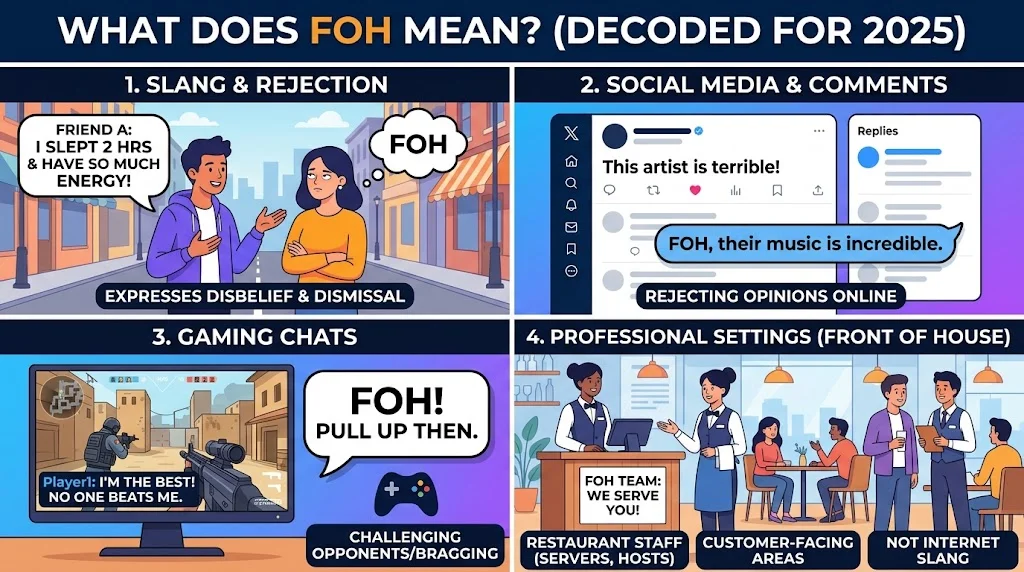
1. FOH in Slang
In casual conversations, FOH expresses strong rejection or disbelief. It can communicate that someone thinks another person’s statement is exaggerated, dishonest, or unreasonable.
Example:
Friend A: “I haven’t slept for two days, and I’m still full of energy.”
Friend B: “FOH, you were falling asleep during class.”
Explanation: Friend B doubts the claim and uses FOH to challenge it.
2. FOH on Social Media
On platforms such as Instagram, TikTok, and X, people use FOH in comments and replies to disagree with opinions, react to bold claims, or criticize something they consider ridiculous.
Example:
Post: “This is the worst song ever recorded.”
Comment: “FOH, the song is actually great.”
Explanation: The commenter strongly rejects the original opinion. Depending on the discussion, the reply might sound humorous or confrontational.
3. FOH in Gaming Chats
Gamers sometimes use FOH to challenge an opponent, respond to bragging, or joke with teammates. Gaming conversations often move quickly, so short expressions can communicate strong reactions.
Example:
Player A: “Nobody in this lobby can beat me.”
Player B: “FOH! Let’s see you prove it.”
Explanation: Player B challenges the other player’s confidence.
4. FOH in Professional Settings
In hospitality and entertainment, FOH usually means Front of House. It describes the customer-facing areas of a venue and often refers to the employees who serve or assist guests.
Examples of front-of-house roles include:
- Restaurant servers
- Hosts and hostesses
- Bartenders
- Hotel receptionists
- Theater ushers
- Event staff who assist guests
Example: “The FOH manager will organize the staff before the restaurant opens.”
Explanation: Here, FOH refers to the team responsible for guest-facing operations, not internet slang.
5. FOH in Everyday Conversations
People may also use FOH in casual speech when they want to dismiss a claim or express disbelief. The expression can be blunt, so it works best among people who understand each other’s humor.
Example:
Person A: “I’m never going to buy another pair of shoes.”
Person B: “FOH! You said that last week.”
Explanation: Person B playfully points out the contradiction.
Origin and History of FOH
FOH is associated with informal speech and the development of internet slang. Its wording resembles expressions such as “Get out of here,” which people have long used to express disbelief or dismissal.
The abbreviation became easier to use in short messages, online arguments, music-related conversations, and social media discussions. Its blunt wording makes it useful when someone wants to communicate a strong reaction with only a few letters.
However, it is difficult to establish one precise origin or a definitive timeline for the abbreviation. Claims about a specific starting year should be treated cautiously unless reliable historical evidence supports them.
Today, FOH can appear in text messages, memes, gaming chats, comment sections, and other informal digital conversations. Its professional meaning, Front of House, has a separate use in hospitality and event operations.
Personality Traits Behind FOH Usage
Using FOH does not automatically reveal someone’s personality. Still, the expression can communicate different attitudes depending on the situation.
1. Direct Communication
Some people prefer blunt language instead of lengthy explanations. They may use FOH to reject a claim immediately.
Example: “FOH, that explanation doesn’t make sense.”
2. Playfulness and Sarcasm
Close friends may use FOH to tease one another without intending to cause offense.
Example:
Friend A: “I’m the best cook in the world.”
Friend B: “FOH 😂 You burned the toast yesterday.”
The joke depends on the friendly relationship and shared sense of humor.
3. Frustration or Annoyance
FOH can also express irritation when someone makes an exaggerated claim or says something the speaker finds unacceptable.
Example: “FOH. I’m tired of hearing excuses.”
This response sounds much more confrontational than the playful example above.
4. Strong Disagreement
Someone may use FOH to reject an opinion rather than politely explain why they disagree.
Example: “FOH, that was not a fair decision.”
Although the expression communicates a strong position, it may make a discussion more hostile.
Related Post: 68+ GNG Meaning in Texting with Examples
Real-Life Examples of FOH
Here are several examples showing how people use FOH in different conversations.
Example 1: Expressing Disbelief
Person A: “I learned an entire semester of programming in one hour.”
Person B: “FOH! That’s not how learning works.”
Explanation: Person B doubts the claim and responds strongly.
Example 2: Joking With Friends
Friend A: “I never lose at video games.”
Friend B: “FOH, I beat you yesterday.”
Explanation: The reply challenges a boast and may be playful.
Example 3: Showing Annoyance
Person A: “You should agree with me because I’m always right.”
Person B: “FOH. Nobody is right all the time.”
Explanation: Person B rejects the statement with frustration or disbelief.
Example 4: Reacting to Social Media
Post: “This phone is perfect and has absolutely no disadvantages.”
Reply: “FOH, every phone has some drawbacks.”
Explanation: The commenter challenges an exaggerated claim.
Example 5: Discussing Restaurant Staff
Manager: “The FOH team should prepare the dining area before the guests arrive.”
Employee: “I’ll coordinate with the servers and hosts.”
Explanation: FOH means Front of House because the conversation concerns restaurant operations.
Example 6: Responding to an Unrealistic Promise
Friend A: “I’ll finish all my assignments tonight, even though I haven’t started.”
Friend B: “FOH 😂 You said the same thing yesterday.”
Explanation: The response combines disbelief with teasing.
Short Dialogues Using FOH
Dialogue 1: Gaming
A: “I’m going to win every match today.”
B: “FOH, you haven’t won one yet!”
Meaning: B challenges A’s confidence.
Dialogue 2: Food
A: “I didn’t touch your pizza.”
B: “FOH, I saw you eating the last slice.”
Meaning: B uses FOH to express disbelief.
Dialogue 3: Studying
A: “I passed the exam without opening the textbook.”
B: “FOH! How did you even do that?”
Meaning: B is surprised and skeptical. Depending on the tone, the response may be humorous.
Dialogue 4: Workplace
A: “Who will manage the restaurant entrance tonight?”
B: “The FOH supervisor will handle it.”
Meaning: FOH refers to Front of House.
Common Situations Where FOH Is Used
People use FOH in different informal settings, including:
- Text messages: Reacting to surprising or unbelievable statements.
- Social media comments: Challenging opinions or criticizing claims.
- Gaming chats: Responding to bragging or teasing opponents.
- Group chats: Joking with friends and sharing sarcastic reactions.
- Memes: Emphasizing disbelief or disagreement.
- Casual conversations: Dismissing an idea or expressing frustration.
In professional settings, FOH can appear in staff schedules, restaurant discussions, theater operations, and event-planning documents. In those cases, it generally means Front of House.
FOH Usage and Tone
The tone of FOH can change significantly depending on the situation.
| Context | Intended Meaning | Possible Tone |
| Close friends | Playful rejection | Funny or sarcastic |
| Heated argument | Strong disagreement | Rude or hostile |
| Social media | Disbelief or criticism | Mixed |
| Gaming chat | Challenge or teasing | Competitive |
| Restaurant workplace | Front of House | Professional |
| Formal email | Usually inappropriate as slang | Unprofessional |
Remember that text messages lack vocal tone and facial expressions. A friend might understand FOH as a joke, while someone unfamiliar with your humor may interpret it as disrespectful.
Modern and Relatable FOH Examples (2026)
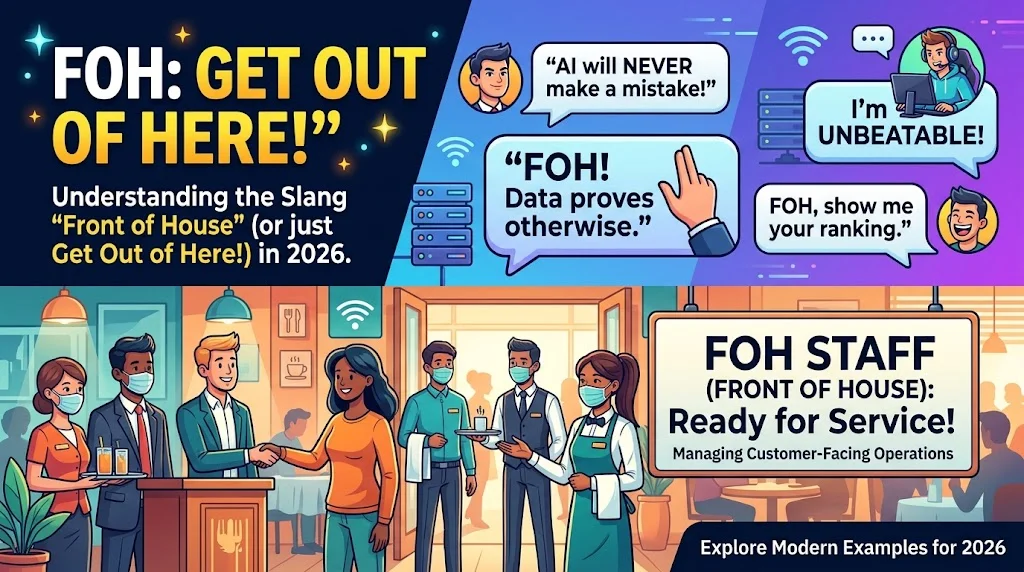
Example 1: AI Discussion
Post: “Artificial intelligence will never make a single mistake.”
Comment: “FOH, AI systems can make mistakes too.”
Explanation: The commenter rejects an unrealistic statement.
Example 2: Online Gaming
Player: “I’m unbeatable in this game.”
Reply: “FOH, let’s see your ranking.”
Explanation: The reply challenges the player’s claim.
Example 3: Shopping
Friend A: “This is definitely the cheapest laptop available anywhere.”
Friend B: “FOH, you haven’t even compared the prices.”
Explanation: Friend B doubts the statement because it lacks evidence.
Example 4: School or College
Student A: “I can pass the final without studying.”
Student B: “FOH, you struggled with the last quiz.”
Explanation: Student B uses FOH to challenge the claim. The wording is informal and may sound disrespectful outside a friendly conversation.
Example 5: Restaurant Management
Supervisor: “The FOH staff needs to be ready before dinner service.”
Employee: “I’ll make sure the hosts and servers are prepared.”
Explanation: FOH means Front of House and refers to customer-facing operations.
Common Mistakes and Misconceptions About FOH
1. Assuming FOH Is Always Playful
FOH can be humorous among close friends, but it may sound aggressive in a serious discussion. Consider your relationship with the other person before using it.
2. Using FOH in Formal Emails
The slang meaning contains profanity and can damage your professional image. Use a polite alternative when communicating with managers, clients, teachers, or unfamiliar people.
3. Confusing Slang With Front of House
The abbreviation has different meanings in different settings. A restaurant manager discussing FOH staff is probably not using internet slang.
4. Assuming Everyone Understands It
Not everyone knows internet abbreviations. If the context is unclear, spell out your meaning instead of relying on slang.
5. Treating FOH as a Neutral Expression
Even when the abbreviation is intended as a joke, its wording can offend people. Emojis and friendly relationships may soften the message, but they do not guarantee that the recipient will take it positively.
When Should You Avoid Using FOH?
Avoid using FOH as slang in situations that require respectful or professional communication.
Examples include:
- Formal emails and business correspondence
- Job interviews and workplace meetings
- Academic assignments and presentations
- Conversations with clients or customers
- Messages to teachers, supervisors, or unfamiliar people
- Serious disagreements where you want to resolve a problem
Instead of writing “FOH, that makes no sense,” you could say, “I see it differently because the facts don’t support that conclusion.”
The second response communicates disagreement without unnecessarily escalating the conversation.
Better Alternatives to FOH
If you want to express disbelief or disagreement without profanity, try one of these alternatives.
| Alternative | Meaning or Best Use | Tone |
| “No way!” | Reacting to something surprising | Casual |
| “I don’t believe that.” | Expressing doubt | Direct |
| “That doesn’t sound right.” | Questioning a claim | Polite |
| “Come on!” | Expressing disbelief or frustration | Casual |
| “You’ve got to be kidding me.” | Reacting to something unbelievable | Emotional |
| “I disagree.” | Rejecting an opinion | Professional |
| “That seems unlikely.” | Questioning a claim carefully | Formal |
| “Are you serious?” | Expressing surprise or doubt | Context-dependent |
| “That’s not true.” | Directly correcting a statement | Firm |
| “Let’s be realistic.” | Challenging an unrealistic idea | Direct |
Choose an alternative based on the relationship and the message you want to communicate. With friends, “No way!” may be enough. At work, “That seems unlikely” is usually a better choice.
Similar Slang Words and Abbreviations
FOH belongs to a larger group of informal expressions used in digital communication.
| Slang | Full Form | Common Meaning |
| GTFO | Get the F*** Out | A stronger dismissal or expression of disbelief |
| SMH | Shaking My Head | Disappointment or disapproval |
| LOL | Laughing Out Loud | Laughter or amusement |
| LMAO | Laughing My Ass Off | Strong amusement |
| NGL | Not Gonna Lie | Introducing an honest opinion |
| FR | For Real | Agreement, emphasis, or a serious reaction |
| IDC | I Don’t Care | Expressing indifference |
| WTF | What the F*** | Surprise, confusion, or frustration |
These expressions are not interchangeable. For example, SMH often communicates disappointment, while FOH more directly rejects or challenges a statement. GTFO can be even more aggressive depending on the context.
How FOH Reflects the Evolution of Language
Internet slang shows how people adapt language to fast-moving digital conversations. Abbreviations save typing time, express emotions, and help users establish a shared conversational style.
FOH is one example of this process. A short expression can communicate disbelief or frustration without a lengthy explanation. Its meaning also depends on social context, just as the same phrase can sound friendly among friends and rude in a workplace.
However, slang changes over time. Some expressions become less common, while others move from online communities into everyday speech. Learning the context behind an abbreviation is more useful than memorizing its definition alone.
Tips for Using FOH Correctly
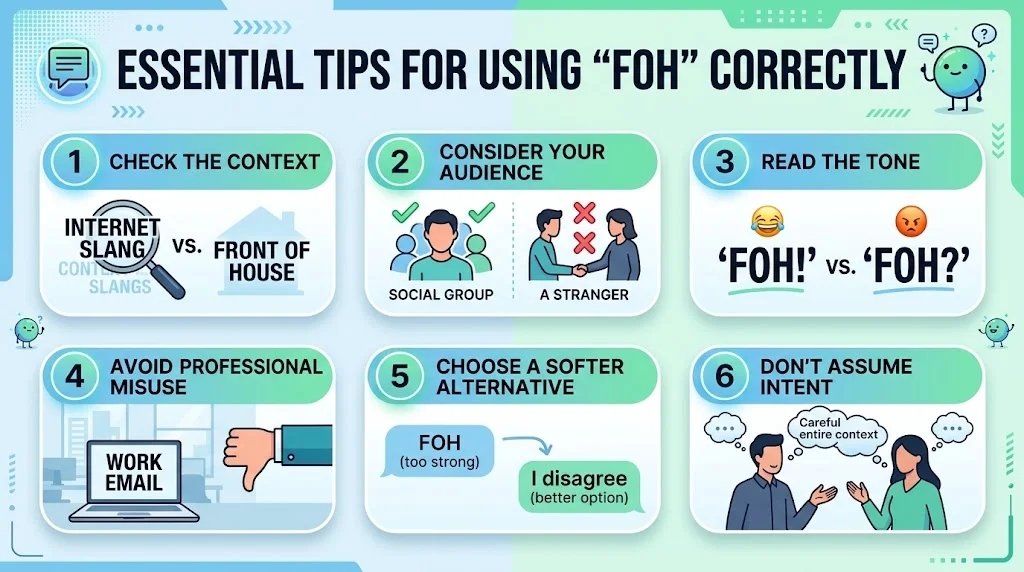
Follow these simple tips if you encounter FOH or plan to use it in a message.
- Check the context. Determine whether the conversation concerns internet slang or a professional term such as Front of House.
- Consider your audience. Close friends may understand the expression, but strangers might find it offensive.
- Read the tone. Emojis, punctuation, and the surrounding conversation can help you understand whether FOH is playful or angry.
- Avoid professional misuse. Use clear, respectful language in work emails and formal discussions.
- Choose a softer alternative when necessary. “I don’t think that’s correct” can communicate disagreement without profanity.
- Don’t assume intent. If someone sends FOH, consider the full conversation before deciding whether the message is hostile.
FOH vs. Other Expressions
The following comparison explains how FOH differs from common alternatives.
| Expression | Strength | Typical Use |
| FOH | Strong | Blunt rejection or disbelief |
| “No way!” | Mild to moderate | Surprise or disbelief |
| “I disagree.” | Moderate | Respectful disagreement |
| “That’s not true.” | Moderate | Correcting a claim |
| “Get out of here!” | Context-dependent | Literal instruction or disbelief |
| GTFO | Very strong | Aggressive dismissal or intense disbelief |
The strongest expression isn’t always the most effective. If your goal is to explain a problem or maintain a positive relationship, clear wording usually works better than a harsh reaction.
Frequently Asked Questions
1. What does FOH mean in text?
FOH usually means “Fuck Outta Here” or “Fuck Out of Here.” People use it in text messages to express disbelief, annoyance, rejection, or disagreement.
2. What does FOH mean on social media?
On social media platforms like TikTok, Instagram, and X, FOH is a slang expression used in comments, memes, and online arguments. Its meaning depends on the conversation and the speaker’s tone.
3. Is FOH a rude word?
Yes, FOH can be considered rude because it commonly includes profanity. However, friends sometimes use it playfully when joking with each other.
4. What does FOH mean in a funny conversation?
In a funny conversation, FOH can express playful disbelief or surprise. For example, someone might say, “FOH, you really ate that whole cake?” to tease a friend.
5. Can I use FOH in professional communication?
It’s best to avoid FOH in professional emails, workplace messages, and formal conversations. The expression can sound disrespectful or aggressive, even when you intend it as a joke.
6. How can I understand the meaning of FOH in different situations?
Check the surrounding words, the relationship between the speakers, and the overall conversation tone. These clues can help you determine whether FOH expresses humor, disbelief, frustration, or rejection.
Conclusion
Understanding FOH meaning helps you follow modern internet slang and communicate more confidently online. This abbreviation usually stands for “Fuck Outta Here” or “Fuck Out of Here,” but its tone can change depending on the situation. Friends may use it playfully, while others may use it to express anger or dismiss an opinion. Before using FOH in a conversation, consider your audience and the setting. It may fit casual chats with close friends, but polite alternatives are usually better for professional or unfamiliar interactions. By paying attention to context, you can understand this popular slang term and avoid unnecessary misunderstandings.