
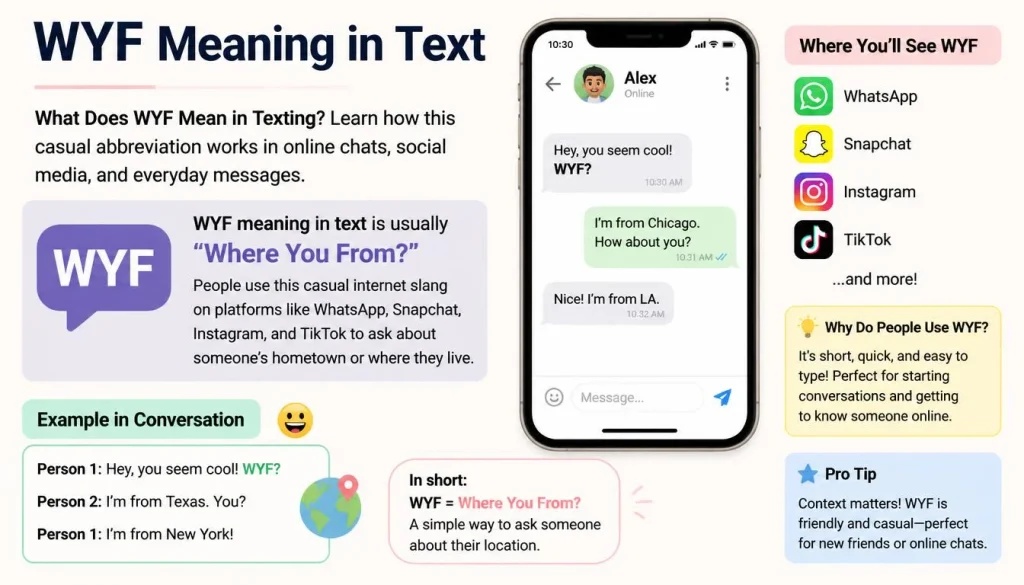

WYF Meaning in Text: What Does WYF Mean in Texting? Learn how this casual abbreviation works in online chats, social media, and everyday messages.
If you enjoy online chatting, texting friends, or scrolling through social media, you may have seen WYF in messages. WYF meaning in text is usually “Where You From?”
People use this casual internet slang on platforms like WhatsApp, Snapchat, Instagram, and TikTok to ask about someone’s hometown or where they live. For example, someone might text, “Hey, you seem cool! WYF?” to start a conversation or get to know you better.
However, WYF can have different meanings depending on the context. It may also stand for “What’s Your Favourite?” or “Who’s Your Favourite?”
For example, someone might ask “WYF?” when discussing movies, music, or other interests. Understanding the surrounding conversation helps you identify the correct meaning and reply naturally to WYF in a text message.
Quick Answer: What Does WYF Mean in Text?
WYF means “Where You From?” in casual texting and online conversations. People use it to ask about someone’s hometown, country of origin, or general background. It’s informal internet slang commonly used in text messages, Snapchat, Instagram, TikTok, and other social platforms.
Example:
- Person A: WYF?
- Person B: I’m from Chicago. Wbu?
- Person A: Nice! I’m from Dallas.
WYF is best suited to casual conversations with friends, new acquaintances, or online contacts. If you’re speaking in a professional setting, “Where are you from?” sounds more polished and respectful.
What Does WYF Stand for in Texting?
WYF stands for “Where You From?” The abbreviation comes from the first letters of the words Where, You, and From. People shorten the phrase to save time and keep digital conversations quick.
Instead of typing a complete question, someone can simply send “WYF?” The meaning is usually clear when both people are familiar with texting slang.
Here’s how the abbreviation works:
| Element | Meaning |
| W | Where |
| Y | You |
| F | From |
| WYF | Where you from? |
The phrase is an informal version of “Where are you from?” It leaves out the word are, which is common in casual speech and internet slang.
WYF vs. Asking Where Someone Currently Is
One important detail is that WYF usually asks about someone’s origin, not their current location.
For example:
- WYF? — “I’m from Lahore, Pakistan.”
- WYA? — “I’m at home right now.”
Someone asking WYF might want to know where you grew up, where you were born, or which city or country you consider home. If they want to know where you are at that moment, they’ll more likely use WYA, meaning “Where you at?”
The distinction matters because someone can be from one city while living in another country.
What Does WYF Mean on Social Media?
The WYF meaning in social media is generally the same as in regular texting: “Where you from?” People use it to start conversations, learn about other users, and discover shared backgrounds. However, the platform and the surrounding messages can influence how the question feels.
WYF Meaning on Snapchat
On Snapchat, WYF often appears in private chats, replies to snaps, and conversations with new contacts. Someone might ask after viewing your story or adding you as a friend.
Example:
- Person A: Hey, WYF?
- Person B: I’m from Islamabad.
- Person A: Cool! I’ve always wanted to visit.
A person who asks WYF on Snapchat may simply be curious. You shouldn’t automatically assume they’re flirting or asking for your exact address.
WYF Meaning on Instagram
On Instagram, users may send WYF in direct messages after following each other or interacting with a post. It can help them find out whether they share a hometown or live in the same region.
Example:
- Person A: Thanks for following me!
- Person B: No problem. WYF?
- Person A: I’m from Karachi.
The question is particularly natural when two people have similar interests but haven’t introduced themselves properly.
WYF Meaning on TikTok
On TikTok, WYF can appear in comments, direct messages, or conversations that begin after someone watches a video. Users might ask about a creator’s location or background when a video features a recognizable place, accent, or local tradition.
Example:
- Person A: Your food videos look amazing!
- Person B: Thank you!
- Person A: WYF? Your city looks beautiful.
The abbreviation can open the door to conversations about local food, travel, culture, and regional experiences.
WYF Meaning in WhatsApp and Group Chats
In WhatsApp conversations and group chats, WYF is a quick way to ask where other members come from. It works especially well in communities where people meet online for gaming, studying, hobbies, or friendship.
Example:
- Person A: Hey, everyone! WYF?
- Person B: I’m from Lahore.
- Person C: I’m from London.
- Person D: Nice! We have people from different countries here.
Because group chats often include people who have never met in person, WYF can help everyone get acquainted.
How Is WYF Used in Text Messages?
People use WYF for different reasons, but the central idea is usually the same: they want to learn where someone comes from.
Asking About Someone’s Hometown
WYF can help people discover whether they grew up in the same city or region.
Example:
- Alex: WYF originally?
- Sam: I’m from Boston, but I moved to Seattle.
- Alex: That’s interesting! I’ve lived in Seattle for years.
The word originally makes the question more clearly about someone’s background rather than their current residence.
Getting to Know Someone New
When two people meet online, asking where they’re from can be an easy way to start learning about each other.
Example:
- Mia: Hey, nice to meet you!
- Jordan: Nice to meet you too.
- Mia: WYF?
- Jordan: I’m from Denver. How about you?
This question can lead naturally to discussions about hobbies, school, work, or everyday life.
Starting a Conversation Online
Sometimes, a short message is all someone needs to begin a conversation. WYF can work as an opening question when the people involved have little information about each other.
Example:
- Person A: Hey!
- Person B: Hi, what’s up?
- Person A: Not much. WYF?
- Person B: I’m from Toronto.
Although the abbreviation is brief, adding a greeting can make the opening feel friendlier.
Asking About Someone’s Background
WYF may also invite someone to share their regional or cultural background. Still, the question doesn’t establish someone’s ethnicity, nationality, or personal identity.
Example:
- Person A: Your accent sounds familiar. WYF?
- Person B: I’m from Manchester, England.
- Person A: Oh, nice! I’ve visited there before.
If you’re asking about someone’s background, avoid making assumptions based on their name, appearance, accent, or profile.
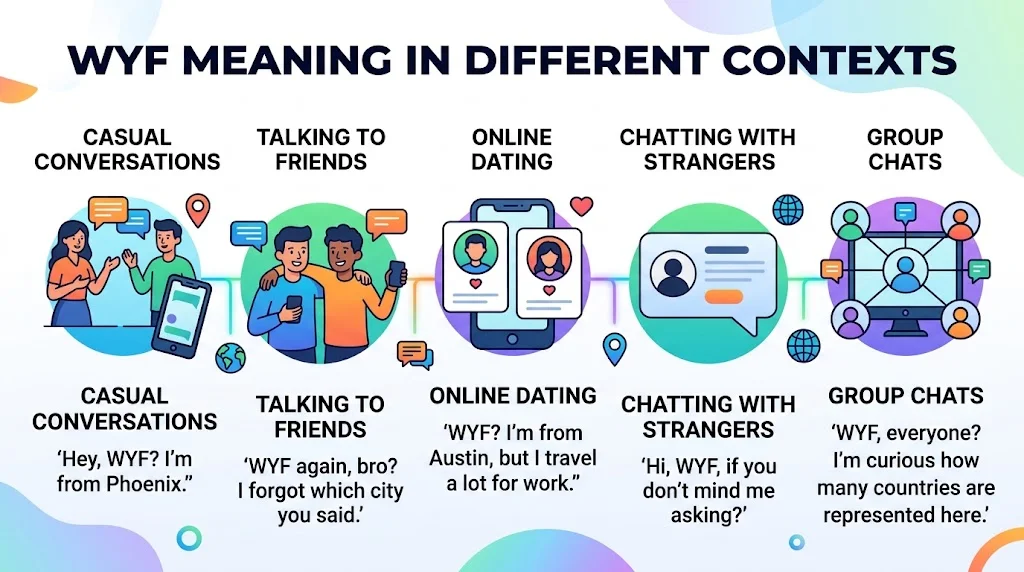
WYF Meaning in Different Contexts
The same abbreviation can feel different depending on who sends it and what the conversation is about. Here’s how to interpret it in common situations.
WYF in Casual Conversations
In everyday chats, WYF is usually a straightforward question about someone’s origin.
Example:
“Hey, WYF? I’m from Phoenix.”
The message is casual and direct. There’s no obvious romantic or negative meaning.
WYF When Talking to Friends
Friends may use WYF when reconnecting, introducing someone to a group, or discussing where they grew up.
Example:
“WYF again, bro? I forgot which city you said.”
Between friends, the abbreviation can sound relaxed and familiar rather than abrupt.
WYF in Online Dating
On dating apps, WYF may help people discover whether they live nearby or share a connection to a particular place.
Example:
“WYF? I’m from Austin, but I travel a lot for work.”
The question can be part of getting to know a potential date. However, WYF alone doesn’t prove romantic interest. Other messages and the overall interaction provide better clues.
WYF When Chatting With Strangers
A stranger may use WYF to introduce themselves or learn more about you. Since you don’t know them well, you can choose how much information to share.
Example:
“Hi, WYF, if you don’t mind me asking?”
You can answer generally, ask why they want to know, or politely decline.
WYF in Group Chats
In a group chat, WYF can help members discover where everyone lives or grew up.
Example:
“WYF, everyone? I’m curious how many countries are represented here.”
This can encourage people to exchange experiences without requiring them to disclose exact addresses or other private details.
69+ WYF Meaning in Text Examples and Conversations
The following examples show how people can use WYF in real-world-style digital conversations. They’re illustrative examples, not quotations from specific users. Each demonstrates the same core meaning in a different situation.
Simple WYF Text Examples
These short messages are common ways to ask the question directly.
- “WYF?”
- “Hey, WYF?”
- “WYF btw?”
- “Just curious, WYF?”
- “WYF originally?”
- “Hi! WYF?”
- “So, WYF?”
- “WYF, if you don’t mind?”
- “Can I ask WYF?”
- “WYF these days?” (This can be ambiguous; the sender may mean where you’re based now.)
WYF Examples With Friends
Friends often use the abbreviation without adding much explanation.
- “WYF, bro?”
- “WYF again? I forgot.”
- “Remind me, WYF originally?”
- “WYF, my friend?”
- “Wait, WYF before you moved?”
- “WYF? We might know the same people.”
- “WYF these days? Haven’t caught up in ages.”
- “WYF when you were growing up?”
- “WYF? I remember you mentioning another city.”
- “WYF originally? I know you don’t live there anymore.”
WYF Examples With Someone New
These examples combine the question with a greeting or a little context.
- “Hey, WYF? Nice to meet you.”
- “WYF? I’m from Dallas.”
- “WYF originally? I’m curious.”
- “Hi! WYF, if you don’t mind me asking?”
- “WYF? I’d love to learn more about you.”
- “Hey there, WYF?”
- “WYF? I just joined this community.”
- “Nice chatting with you! WYF?”
- “WYF? I’m always interested in meeting people from different places.”
- “Hey, where are you from? WYF is easier to type, haha.”
WYF Examples on Snapchat and Instagram
These messages fit conversations that start through stories, profiles, and social interactions.
- “WYF? Saw your story.”
- “WYF? Your profile looks cool.”
- “Hey, WYF? Thanks for the follow.”
- “WYF? I like your content.”
- “WYF? Are you from around here?”
- “WYF? That place in your photo looks familiar.”
- “WYF? Your travel pictures are awesome.”
- “WYF? I came across your video today.”
- “Hey! WYF? I noticed we follow some of the same accounts.”
- “WYF? Your city looks amazing in that reel.”
WYF Examples in Online Dating
These examples show how the question can fit into a dating-app conversation without automatically implying attraction.
- “WYF? I’m new here.”
- “WYF originally?”
- “WYF? Maybe we’re from the same city.”
- “WYF? I travel there sometimes.”
- “WYF? Always nice meeting people from different places.”
- “Hey, WYF? I’m based in Chicago.”
- “WYF? Have you always lived there?”
- “WYF originally? Your profile caught my attention.”
- “WYF? I’m visiting your city next month.”
- “WYF? We might have a few places in common.”
WYF Examples in Group Chats
Use these examples when introducing yourself to people in a shared online community.
- “WYF, everyone?”
- “WYF? I’m from Houston.”
- “WYF originally, guys?”
- “WYF? Let’s see where everyone is from.”
- “WYF? We might be neighbors.”
- “Hey, new members! WYF?”
- “WYF? I’m joining from Pakistan.”
- “WYF, team? Curious about everyone’s time zones.”
- “WYF? Anyone here from Canada?”
- “WYF? I’m from a small town near Seattle.”
WYF Examples With Different Replies
These exchanges show that people can answer the question in several ways.
- A: WYF? B: I’m from Miami.
- A: WYF originally? B: I was born in Boston.
- A: WYF? B: Pakistan. You?
- A: WYF? B: London, but I live in Toronto now.
- A: WYF? B: Why do you ask?
- A: WYF? B: I’m from Nairobi.
- A: WYF originally? B: I grew up in Madrid.
- A: WYF? B: I’m from a town near Manchester.
- A: WYF? B: I’d rather not share that yet.
- A: WYF? B: I’m originally from Lahore, but I study abroad.
WYF Examples in Longer Conversations
Longer exchanges reveal how one simple question can lead to discussions about travel, education, shared interests, and personal experiences.
Conversation A: Discovering a shared hometown
- Alex: Hey, WYF?
- Jamie: I’m from Philadelphia. You?
- Alex: No way! I grew up there too.
- Jamie: That’s awesome. Which neighborhood?
Conversation B: Talking about travel
- Mia: WYF originally?
- Noah: I’m from Melbourne.
- Mia: I’ve always wanted to visit Australia.
- Noah: You should! There’s plenty to explore.
Conversation C: Making a new online friend
- Sam: Hi! WYF?
- Riley: I’m from Calgary.
- Sam: Nice! What do you like doing there?
- Riley: Hiking whenever the weather’s good.
Conversation D: Discussing school
- Taylor: WYF?
- Morgan: I’m from Atlanta, but I’m studying in Boston.
- Taylor: What are you studying?
- Morgan: Computer science.
Conversation E: Keeping things private
- Person A: WYF?
- Person B: I’m from somewhere in the Midwest.
- Person A: Cool! I’m from Ohio.
- Person B: Nice, we’re in the same general region.
Conversation F: Finding a possible connection
- Chris: WYF originally?
- Jordan: Karachi, Pakistan.
- Chris: My family has lived there before.
- Jordan: Really? Which part of the city?
Conversation G: Clarifying current residence
- Person A: WYF?
- Person B: I’m originally from London.
- Person A: Do you still live there?
- Person B: No, I moved to Vancouver last year.
Conversation H: A friendly dating-app chat
- Person A: Hey, WYF?
- Person B: I’m from Austin. What about you?
- Person A: Dallas, actually.
- Person B: Not too far apart!
Conversation I: Joining an international community
- Person A: WYF, everyone?
- Person B: I’m from Pakistan.
- Person C: I’m from Germany.
- Person D: I’m from Brazil.
- Person A: This group is more international than I expected!
Conversation J: Responding cautiously
- Person A: WYF?
- Person B: Why do you ask?
- Person A: Just curious. I’m getting to know people here.
- Person B: Fair enough. I’m from the eastern United States.
These examples demonstrate that WYF is flexible. A conversation can remain casual, become more personal, or stop after a short exchange. You don’t have to provide more information than you want to share.
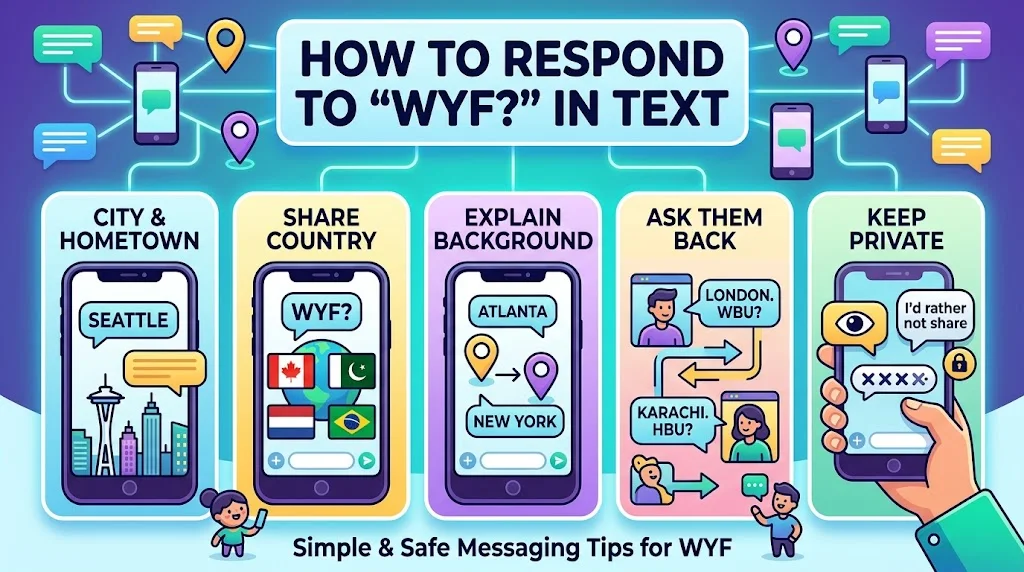
How to Respond to WYF in Text
When someone asks “WYF?”, you can answer in several ways. The best response depends on how well you know the person and how much information you want to share.
Give Your City or Hometown
If you’re comfortable sharing your hometown, keep your answer simple.
Examples:
- “I’m from Seattle.”
- “I’m from Lahore.”
- “I grew up in Atlanta.”
You can also mention your city and invite the other person to answer.
Example: “I’m from Denver. WYF?”
Share Your Country
If you prefer a broader answer, sharing your country may be enough.
Examples:
- “I’m from Pakistan. What about you?”
- “I’m from Canada.”
- “I’m originally from Brazil.”
You don’t need to name your city or neighborhood to answer the question.
Explain Where You Grew Up
Sometimes, your hometown and current residence are different. A short explanation can clear up any confusion.
Example:
“I’m originally from Atlanta, but I live in New York now.”
This response gives the other person a clearer picture of your background without requiring a long explanation.
Ask the Other Person the Same Question
If you want to keep the conversation going, return the question.
Examples:
- “I’m from London. Wbu?”
- “I’m from Karachi. What about you?”
- “I’m originally from Boston. HBU?”
Here, WBU means “What about you?” and HBU means “How about you?” Both are common ways to return a question.
Keep Your Location Private
You don’t have to share your hometown or country with someone you don’t know well. You can respond politely while maintaining your privacy.
Examples:
- “I’d rather not share my location yet.”
- “I’m from somewhere in the US.”
- “I prefer to keep personal details private until I know someone better.”
- “Why do you ask?”
Privacy tip: Avoid sharing your exact address, daily routine, live location, or other identifying details with strangers. A general answer is often enough to keep the conversation friendly.
WYF vs. WYA vs. WBU vs. HBU
Texting abbreviations can look similar, but they serve different purposes. Understanding these differences helps you interpret messages correctly.
| Abbreviation | Common meaning | Typical purpose |
| WYF | Where you from? | Asking about someone’s origin |
| WYA | Where you at? | Asking about someone’s current location |
| WBU | What about you? | Asking for the other person’s response |
| HBU | How about you? | Returning a question |
| WYD | What you doing? | Asking what someone is doing |
| HRU | How are you? | Asking about someone’s well-being |
The most important distinction is between WYF and WYA.
For example, if someone asks WYF, you might say, “I’m from Islamabad.” If they ask WYA, you might reply, “I’m at the library.”
The first question concerns your background. The second usually concerns where you are right now.
WBU and HBU are different because they don’t ask about a particular place. They invite the other person to share their own answer.
Is WYF Flirty, Friendly, or Rude?
WYF isn’t inherently flirty, romantic, or rude. It’s a short question, and its tone depends on the relationship, the surrounding messages, and how the conversation develops.
When WYF Sounds Friendly
A friend or new acquaintance may ask WYF simply to learn more about you.
Example: “Hey, WYF? I’m trying to meet people from different places.”
The wording and context suggest ordinary curiosity.
When WYF May Feel Flirty
On a dating app or during a conversation with someone showing romantic interest, WYF may be part of getting acquainted.
Example: “WYF? I’d love to know more about you.”
The question can support a flirtatious conversation, but it isn’t proof of attraction by itself. Look at the broader interaction rather than one abbreviation.
When WYF Can Sound Abrupt
A message containing only “WYF?” can sometimes feel blunt, especially when it comes from a stranger without a greeting.
That doesn’t necessarily mean the sender is being disrespectful. They might simply be used to brief texting.
If you want to ask the question more politely, try:
- “Hey, where are you from?”
- “If you don’t mind me asking, where are you from?”
- “Hi! Which city are you based in?”
How Tone and Context Change Its Meaning
Consider these two messages:
- “Hey! WYF? Nice to meet you.”
- “WYF. Tell me exactly where you live.”
The first sounds like a normal introduction. The second asks for more specific information and may feel intrusive.
The abbreviation itself doesn’t determine the tone. The sender’s wording, behavior, and respect for your boundaries matter much more.
Does WYF Have Other Meanings?
In casual texting, “Where You From?” is the common interpretation of WYF. However, abbreviations can have different meanings in specialized communities, private jokes, or individual conversations.
For example, a group might use WYF as an inside abbreviation that only its members understand. That doesn’t make the alternative meaning universal.
When you encounter WYF, consider these clues:
- The conversation topic: Are you discussing hometowns, travel, or introductions?
- The platform: Is it a social media DM, a group chat, or a specialized community?
- The surrounding words: Does the message refer to a city, country, or personal background?
- The sender’s explanation: If the meaning remains unclear, ask what they mean.
Unless the context suggests otherwise, interpreting WYF as “Where You From?” is a reasonable starting point.
Is WYF Appropriate for Professional Conversations?
WYF is generally best reserved for informal digital conversations. It may be perfectly understandable among coworkers who communicate casually, but it can look too abbreviated in a formal email, client message, or professional introduction.
Instead of using WYF, choose a complete question that fits the situation.
| Informal wording | More professional alternative |
| WYF? | Where are you from? |
| WYF originally? | Where did you grow up? |
| WYF these days? | Which city are you currently based in? |
| WYF? We’re meeting online. | Which country are you joining us from? |
For example, if you’re welcoming a new colleague to a remote team, you could write:
“Welcome to the team! Which city are you based in?”
This wording is clear, friendly, and appropriate for work.
It’s also important to respect professional boundaries. You may need to know someone’s time zone or work location for scheduling, but you rarely need their exact home address or detailed personal background.
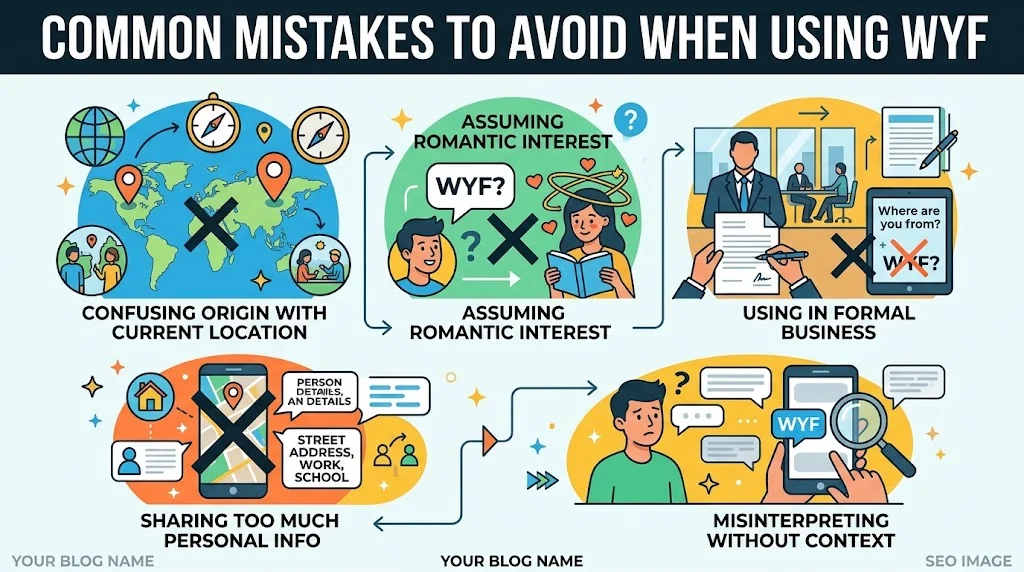
Common Mistakes to Avoid When Using WYF
Although WYF is easy to understand, a few mistakes can lead to confusion or uncomfortable conversations.
Confusing Origin With Current Location
WYF usually asks where someone comes from, not where they’re standing right now.
If you want to know their present location, WYA is generally more appropriate.
Assuming WYF Means Romantic Interest
Someone might ask WYF because they’re curious, friendly, or trying to start a conversation. Don’t interpret the question as a romantic signal without considering the rest of the interaction.
Using WYF in Formal Business Communication
Abbreviations are common in casual messaging, but full questions usually work better in formal writing. Use “Where are you from?” or “Which city are you based in?” when appropriate.
Sharing Too Much Personal Information
You can answer with a city or country without providing your street address, workplace, school, or daily schedule. If a stranger keeps asking for increasingly specific details, it’s reasonable to stop responding.
Misinterpreting the Message Without Context
A short abbreviation can be ambiguous. Read the surrounding messages before deciding what the sender means. If necessary, ask a simple follow-up question rather than guessing.
Frequently Asked Questions
1. What does WYF mean in text?
WYF usually means “Where You From?” in text messages. People use it to ask about your hometown, city, or country, especially when they want to get to know you better.
2. What does WYF mean on Snapchat?
On Snapchat, WYF commonly means “Where You From?” Someone might send it when starting a conversation or getting to know a new friend. The exact meaning depends on the context.
3. What does WYF mean on Instagram?
On Instagram, WYF can mean “Where You From?” It may appear in direct messages, comments, or conversations with new followers. In some situations, it can also mean “What’s Your Favourite?”
4. Does WYF mean “Where You From” or “Who’s Your Favourite”?
It can mean either, depending on the conversation. “Where You From?” is a common interpretation in casual chats, while “Who’s Your Favourite?” may appear in discussions about celebrities, musicians, sports teams, or other interests.
5. Is WYF a flirty abbreviation?
WYF can be flirty, particularly when someone uses it to start a conversation on a dating app. However, it isn’t always romantic. Friends and strangers may use it simply to learn where someone comes from.
6. How do you reply to WYF in a text message?
Your reply depends on what the sender means. If they’re asking where you’re from, you can mention your city or hometown. For example, you could reply, “I’m from Lahore. What about you?”
7. What does WYF mean on TikTok?
On TikTok, WYF may mean “Where You From?” or refer to “What’s Your Favourite?” A content creator might use it in a caption to ask followers about their favorite color, song, or other preferences.
8. Is WYF rude to use in a conversation?
No, WYF isn’t inherently rude. It’s an informal abbreviation commonly used in online conversations. However, asking where someone lives can feel personal, so consider your relationship with the person and how comfortable they seem.
9. What does WYF mean in a dating app conversation?
On a dating app, WYF often means “Where You From?” Someone may ask this to learn about your background, hometown, or location. It can be a simple conversation starter, but it doesn’t automatically mean the person is flirting.
10. What should I do if I don’t understand WYF?
If you’re unsure, ask the sender what they mean. You could say, “What do you mean by WYF?” This simple question avoids confusion and helps you understand the message without making assumptions.
Conclusion
Understanding WYF meaning in text is easier when you consider the conversation and the platform where it appears. Most commonly, WYF means “Where You From?”, but it can also stand for “What’s Your Favourite?” or “Who’s Your Favourite?” on social media and in casual chats.
Whether you see WYF on WhatsApp, Snapchat, Instagram, or TikTok, pay attention to the surrounding messages to identify the intended meaning. When you’re unsure, asking for clarification is perfectly fine. Once you understand the context, you can respond naturally and keep the conversation going.