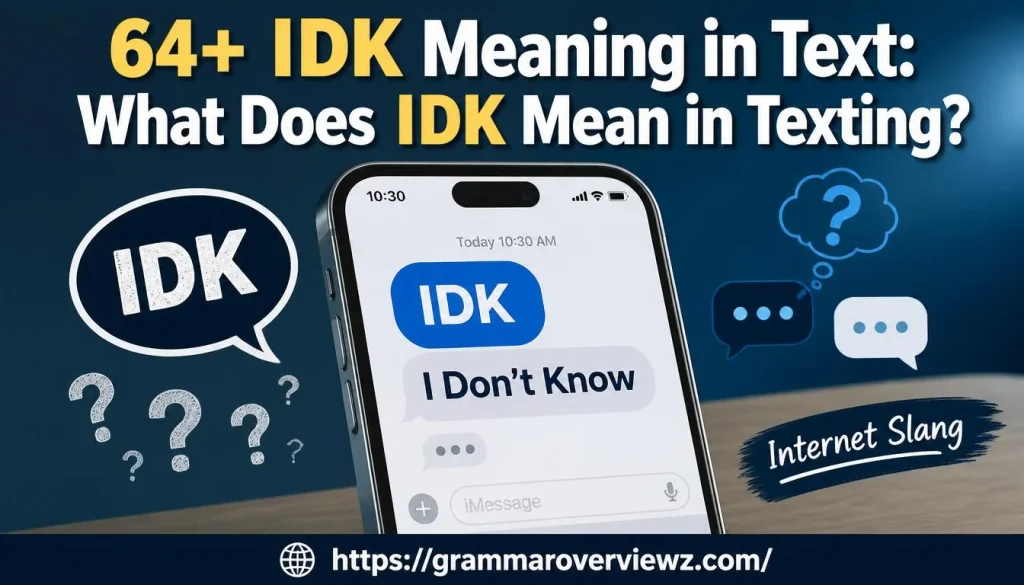

Learn the 64+ IDK Meaning in Text: What Does IDK Mean in Texting? and see how this abbreviation fits casual chats, serious talks, and daily replies.
IDK means I don’t know, a common phrase used as a short form in text speak and SMS language. Idk belongs to a newly developed dialect shaped by informal digital communication, including text messages and instant messages.
This style has existed since at least 2002, making IDK a familiar casual text abbreviation in text-based communication. You can find it in Snapchat chats, TikTok comments, Instagram DMs, WhatsApp messages, and SMS conversations.
The meaning of IDK can shift based on the tone, person, and full message. Someone who feels unsure or confused may use it because they lack a clear answer, while another person may choose it as a simple and harmless response.
However, in serious conversations, IDK can sound cold, lazy, or careless without an extra explanation. The surrounding context helps you understand how someone intends to use the term and whether you should reply naturally or ask for more information.
A useful guide should explain its basic meaning, how people communicate with it, and the possible confusion it can create.
Quick Answer: What Does IDK Mean in Text?
IDK means “I don’t know” in text messages and online conversations.
People use it when they:
- Don’t know an answer
- Feel uncertain
- Haven’t decided something
- Don’t have enough information
- Want to avoid giving a definite answer
- Feel unsure about an opinion
- Respond casually to a question
For example:
Person 1: “What time are they coming?”
Person 2: “IDK.”
Here, IDK simply means “I don’t know.”
However, context can change the tone. If someone writes “IDK lol”, the response may feel playful or relaxed. If they write “IDK…”, it can suggest hesitation or uncertainty.
What Does IDK Mean in Text?
IDK is an abbreviation of the phrase “I don’t know.” Each letter represents part of the original phrase:
| Letter | Word |
| I | I |
| D | Don’t |
| K | Know |
The expression works as a quick response when you don’t have an answer.
For example, imagine a friend asks whether a restaurant is open.
Friend: “Do you know if the restaurant is open?”
Reply: “IDK. You can check.”
The abbreviation doesn’t necessarily mean the person refuses to help. They may genuinely lack the information.
IDK as a Casual Internet Abbreviation
Unlike formal written English, texting often favors speed. Abbreviations such as IDK, LOL, BTW, and TBH let people communicate quickly.
IDK fits especially well into informal conversations because “I don’t know” is already a common everyday phrase.
You’ll often find it in:
- Text messages
- Group chats
- Social media comments
- Instagram DMs
- Snapchat conversations
- TikTok comments
- Discord chats
- Gaming conversations
- Casual workplace messages
What Does IDK Stand For?
IDK stands for “I don’t know.”
The abbreviation removes the need to type the entire phrase. It’s similar to shortening other common expressions into recognizable initials.
The important point is that IDK normally retains the same core meaning. What changes is the emotional tone.
Consider these examples:
- IDK. — Neutral or brief
- idk — Casual
- IDK? — Uncertain or questioning
- IDK lol — Casual or humorous
- IDK, maybe — Unsure but open
- IDK tbh — Frank uncertainty
- IDK anymore — Continued uncertainty or frustration
The surrounding words provide clues about what the sender actually means.
IDK Meaning in Different Contexts
A three-letter response can mean more than simple ignorance. The conversation surrounding it often provides the missing context.
IDK When Someone Truly Doesn’t Know
The most literal use occurs when someone genuinely lacks information.
“Where did Jake go?”
“IDK.”
There isn’t necessarily any hidden message here. The person simply doesn’t know where Jake went.
IDK When Someone Is Unsure
Sometimes IDK means the person hasn’t reached a conclusion.
“Are you going to the party?”
“IDK yet.”
The person isn’t necessarily saying no. They haven’t decided.
In this situation, “I’m not sure” would carry almost the same meaning.
IDK When Someone Doesn’t Want to Answer
Context can make IDK sound evasive.
Suppose someone asks:
“Why did you delete the message?”
“IDK.”
The sender might genuinely have forgotten. They could also be avoiding the subject. The abbreviation itself doesn’t prove which interpretation is correct.
That’s why reading intent into IDK requires caution.
IDK as a Casual or Indifferent Response
Sometimes people use IDK because they don’t have a strong opinion.
“Which movie should we watch?”
“IDK. You pick.”
Here, IDK may communicate something like, “I don’t really mind.”
That differs slightly from IDC, which directly means “I don’t care.”
IDK in a Serious Conversation
A short IDK can feel blunt when the topic is emotional.
“Do you still want to be together?”
“IDK.”
Here, the abbreviation communicates uncertainty, but it doesn’t explain the reason.
A longer response would provide much more information:
“I honestly don’t know how I feel right now.”
The difference isn’t the basic definition. It’s the amount of emotional context.
IDK as Hesitation
People often use IDK when they’re thinking through an answer.
“Should we buy the tickets today?”
“IDK, maybe tomorrow.”
The second part clarifies the hesitation.
How to Use IDK in a Text
IDK works best in informal communication. It’s particularly useful when the person you’re talking to already understands casual texting language.
You can use it when:
- You don’t know the answer.
- You haven’t made a decision.
- You’re unsure about something.
- You need more information.
- You want to give a casual response.
- You’re chatting with friends.
- You’re participating in an informal group conversation.
However, clarity matters in important situations.
Instead of writing:
“IDK.”
you might write:
“I’m not sure yet. Let me check.”
That version tells the other person what happens next.
IDK Examples in Text Messages
Here are practical examples showing how IDK meaning in text changes with context.
| Text Example | Meaning |
| IDK | I don’t know |
| idk | Casual “I don’t know” |
| IDK yet | I haven’t decided |
| IDK maybe | I’m uncertain |
| IDK lol | Casual or humorous uncertainty |
| IDK tbh | Honestly, I don’t know |
| IDK why | I don’t know the reason |
| IDK what to do | I’m unsure about the next step |
| IDK anymore | I’m no longer sure |
| IDK, we’ll see | The outcome isn’t certain |
Making Plans
“Are you free Saturday?”
“IDK yet.”
The person hasn’t confirmed their availability.
Asking for Information
“Who won the game?”
“IDK. I missed it.”
The abbreviation has its direct meaning.
Asking for an Opinion
“Which shirt looks better?”
“IDK. They both look good.”
Here, IDK can suggest that the person doesn’t have a strong preference.
Discussing Feelings
“Do you want to talk about it?”
“IDK.”
This can indicate hesitation. The person may need time before discussing the subject.
IDK in a Conversation: What Does the Tone Mean?
The same abbreviation can sound different depending on punctuation and surrounding words.
| Version | Possible Tone |
| IDK | Neutral, brief |
| idk | Relaxed, casual |
| IDK? | Confused or uncertain |
| IDK! | Emphatic or emotional |
| IDK… | Hesitant or doubtful |
| idk lol | Playful or casual |
| idk tbh | Frank or candid |
| idk, maybe | Uncertain but open |
| IDK anymore | Frustrated or confused |
These interpretations aren’t fixed rules. Text has fewer vocal cues than face-to-face conversation, so readers rely heavily on context.
For example, “IDK” from a close friend may feel completely normal. The same response from someone during a serious discussion may feel noticeably colder.
IDK vs. Similar Texting Abbreviations
Several abbreviations look similar because they appear frequently in casual conversations. Their meanings aren’t interchangeable.
IDK vs. IDC
IDK means “I don’t know.”
IDC means “I don’t care.”
Compare:
“Which restaurant should we choose?”
“IDK.”
This suggests uncertainty.
“Which restaurant should we choose?”
“IDC.”
This suggests the choice doesn’t matter to the sender.
IDK vs. IMO
IMO means “in my opinion.”
IDK expresses uncertainty or lack of knowledge.
“IMO, the first movie was better.”
The sender gives an opinion.
“IDK which movie was better.”
The sender doesn’t have a clear answer.
IDK vs. TBH
TBH means “to be honest.”
It can introduce a candid statement.
“TBH, IDK what happened.”
The sender emphasizes that they’re being honest about not knowing.
IDK vs. IKR
IKR usually means “I know, right?”
That’s almost the opposite conversational function of IDK.
“That movie was amazing.”
“IKR!”
The second person strongly agrees.
IDK vs. NGL
NGL means “not gonna lie.”
It introduces an honest or candid statement.
“NGL, IDK if I like it.”
Here, NGL signals honesty while IDK expresses uncertainty.
Common IDK Combinations and Phrases
People frequently combine IDK with other short expressions.
IDK Tbh
“IDK tbh” means “I don’t know, to be honest.”
“IDK tbh. I haven’t watched it yet.”
It often sounds casual and candid.
IDK Lol
“IDK lol” adds a playful or relaxed tone.
“IDK lol. You decide.”
The lol can soften the short response.
IDK Why
“IDK why” means “I don’t know why.”
“IDK why my phone keeps restarting.”
IDK What to Say
This phrase indicates uncertainty about how to respond.
“IDK what to say after that.”
IDK Maybe
“IDK maybe” suggests uncertainty without completely rejecting an idea.
“Want to go out tonight?”
“IDK maybe.”
IDK Yet
“IDK yet” means the answer hasn’t been determined.
“Are you coming?”
“IDK yet.”
IDK Man
“IDK man” adds an informal conversational tone.
“IDK man. That doesn’t seem right.”
IDK Bro
“IDK bro” is another casual variation, particularly common between friends.
“IDK bro. Ask him.”
IDK Either
“IDK either” means the sender doesn’t know something that another person also doesn’t know.
“Do you know when the store closes?”
“No idea.”
“IDK either.”
IDK What You Mean
This phrase can indicate genuine confusion.
“IDK what you mean. Can you explain?”
Unlike a standalone IDK, it clearly identifies the source of uncertainty.
Is IDK Rude?
IDK isn’t inherently rude. Its tone depends heavily on context.
A friend asking where you are might receive:
“IDK lol, somewhere downtown.”
That sounds casual.
A serious question might receive:
“IDK.”
That could feel dismissive because the sender provides no additional context.
When IDK May Sound Blunt
It can feel less friendly when:
- Someone asks an important question.
- The sender could easily provide more information.
- The conversation is emotionally serious.
- The response ends the discussion.
- The recipient expects a thoughtful answer.
If you want to sound warmer, add a little context.
Instead of:
“IDK.”
try:
“I’m not sure yet. Let me think about it.”
Small additions can make a surprisingly large difference.
Is IDK Professional?
IDK is generally informal and isn’t ideal for formal professional writing.
A quick team chat between coworkers may tolerate casual abbreviations. However, a formal email, report, customer message, application, or business document usually calls for clearer language.
| Casual | More Professional |
| IDK | I don’t know |
| IDK yet | I’m not sure yet |
| IDK, I’ll check | I’m not sure. I’ll check and confirm. |
| IDK what happened | I don’t have the details yet. |
| IDK who handles this | I’m not sure who handles this request. |
The goal isn’t to eliminate informal language everywhere. Match your wording to the audience and situation.
How to Respond When Someone Says IDK
Your response should depend on why they said IDK.
If they genuinely don’t know, you can say:
- “No worries.”
- “That’s okay.”
- “I’ll check.”
- “Let me find out.”
- “Thanks anyway.”
If they seem uncertain, try:
- “Take your time.”
- “Want to think about it?”
- “We can decide later.”
- “What are you leaning toward?”
If you’re trying to solve something together:
“No problem. Let’s figure it out.”
That response keeps the conversation moving instead of turning IDK into a dead end.
What Does IDK Mean From a Guy?
When a guy sends IDK, the abbreviation still generally means “I don’t know.”
It doesn’t have a special universal definition based on gender.
For example:
“Are you coming tonight?”
“IDK yet.”
The message indicates uncertainty about the plans.
If the conversation involves relationships or emotions, context becomes especially important. A single abbreviation can’t reliably establish someone’s feelings or intentions.
What Does IDK Mean From a Girl?
Likewise, when a girl writes IDK, it normally means “I don’t know.”
The surrounding conversation provides more information than gender does.
For example:
“Do you want to watch a movie?”
“IDK, you choose.”
That could simply mean she doesn’t have a preference.
A different conversation could make the same words sound hesitant. The abbreviation itself doesn’t provide enough evidence to determine a hidden meaning.
What Does IDK Mean on Social Media?
On social media, IDK commonly carries the same meaning: “I don’t know.”
You’ll often see it in:
- Comments
- Replies
- Captions
- Direct messages
- Community discussions
- Video comments
- Memes
For example:
“IDK why this is so funny 😂”
The writer means they don’t know why they find something funny.
Another example:
“IDK, this might actually work.”
Here, the person expresses uncertainty while remaining open to the possibility.
IDK on Snapchat, Instagram, TikTok, and Messaging Apps
The abbreviation doesn’t need a different definition simply because it appears on a different platform.
On Snapchat, someone might write:
“IDK where I left it.”
On Instagram:
“IDK why everyone loves this.”
On TikTok:
“IDK but this song is stuck in my head.”
On Discord:
“IDK which server they’re using.”
On WhatsApp:
“IDK what time we’ll arrive.”
The platform changes the setting. The core abbreviation remains the same.
IDK in School and College Texts
Students frequently use IDK in informal conversations about assignments, classes, schedules, and exams.
Examples include:
“IDK when the assignment is due.”
“IDK which chapter we’re studying.”
“IDK if class is canceled.”
Among friends, these messages are perfectly understandable.
However, formal communication with a professor, administrator, or academic department usually benefits from complete sentences.
Instead of:
“IDK when the deadline is.”
write:
“I’m not sure when the deadline is. Could you please confirm it?”
The second version sounds clearer and more respectful.
Related Post: 61+ OP Meaning in Text: Meaning, Uses, Examples, and Context
IDK in Work and Professional Chats
Workplace communication can vary widely. Some teams communicate casually through chat platforms. Others expect formal wording.
IDK can create ambiguity because it doesn’t explain whether the sender will investigate the issue.
Compare:
“IDK.”
with:
“I’m not sure. I’ll check with the team and get back to you.”
The second message gives useful information about the next step.
For workplace conversations, clarity usually matters more than brevity.
IDK in Relationships and Dating
Relationship conversations can make short messages feel more significant.
Suppose someone asks:
“Do you want to see me this weekend?”
A response such as:
“IDK yet.”
clearly communicates uncertainty about the plan.
But consider:
“Do you still want to continue this relationship?”
“IDK.”
That’s a much more serious context.
The abbreviation tells you the person isn’t giving a definite answer. It doesn’t tell you exactly why they’re uncertain.
Avoid treating one short message as a complete explanation of someone’s feelings.
30+ Examples of IDK in Texting
IDK About That
“IDK about that.”
The sender isn’t certain or doesn’t agree enough to give a firm answer.
IDK What You Mean
“IDK what you mean. Can you explain?”
This expresses confusion.
IDK What Happened
“IDK what happened. I wasn’t there.”
The sender lacks information about an event.
IDK Where It Is
“IDK where it is. Check the drawer.”
The sender doesn’t know an object’s location.
IDK When
“IDK when. I’ll let you know.”
The timing remains uncertain.
IDK How
“IDK how that happened.”
The sender doesn’t know how something occurred.
IDK Why
“IDK why she left early.”
The sender doesn’t know the reason.
IDK Who
“IDK who sent this.”
The sender doesn’t know the person’s identity.
IDK Which One
“IDK which one to buy.”
The sender can’t decide between options.
IDK If I Can
“IDK if I can make it tonight.”
The sender isn’t sure about their availability.
IDK If That’s Right
“IDK if that’s right.”
The sender questions whether something is accurate.
IDK What to Do
“IDK what to do next.”
The sender wants direction or feels uncertain.
IDK What to Say
“IDK what to say after hearing that.”
The sender doesn’t know how to respond.
IDK What I Want
“IDK what I want yet.”
The sender hasn’t made a decision.
IDK Yet
“IDK yet. I’ll decide tomorrow.”
The decision remains open.
IDK Maybe
“IDK maybe. I’ll see how I feel.”
The sender hasn’t committed.
IDK Honestly
“IDK honestly.”
This emphasizes genuine uncertainty.
IDK Tbh
“IDK tbh. I haven’t tried it.”
The sender is being candid about not knowing.
IDK Lol
“IDK lol. You pick.”
The response has a relaxed tone.
IDK Man
“IDK man. Something feels strange.”
This sounds informal and conversational.
IDK Bro
“IDK bro. Ask someone else.”
The wording is casual and familiar.
IDK Either
“IDK either.”
The sender also lacks the answer.
IDK Anymore
“IDK anymore.”
This can suggest prolonged uncertainty or frustration.
IDK About You
“IDK about you, but I’m tired.”
The speaker isn’t sure whether the other person feels the same way.
IDK What You Think
“IDK what you think about it.”
The speaker doesn’t know the other person’s opinion.
IDK What You Want
“IDK what you want from me.”
The speaker is uncertain about another person’s expectations.
IDK If That’s a Good Idea
“IDK if that’s a good idea.”
The speaker has doubts about a proposed action.
IDK, We’ll See
“IDK, we’ll see.”
The outcome remains uncertain.
IDK, Maybe Later
“IDK, maybe later.”
The sender isn’t ready to commit to a time.
IDK, Let Me Check
“IDK, let me check.”
The sender doesn’t know immediately but intends to find out.
Common Mistakes When Using IDK
Although IDK is simple, a few mistakes can cause confusion.
Using IDK in Formal Writing
Avoid relying on texting abbreviations in formal documents unless the context specifically allows them.
Assuming IDK Means Someone Doesn’t Care
IDK means “I don’t know.” It doesn’t automatically mean “I don’t care.”
That distinction matters.
Reading Too Much Into Capitalization
IDK and idk usually express the same basic idea. Capitalization alone doesn’t prove a specific emotion.
Using IDK When More Information Is Needed
If someone needs a useful answer, a bare IDK may leave them stuck.
Instead, add context:
“IDK, but I’ll find out.”
Confusing IDK With Similar Abbreviations
Remember:
- IDK = I don’t know
- IDC = I don’t care
- IKR = I know, right?
- IMO = In my opinion
- TBH = To be honest
- NGL = Not gonna lie
Knowing these differences prevents awkward misunderstandings.
FAQs
What does IDK mean in text?
IDK means “I don’t know.” It is a common texting abbreviation used when someone does not know something, feels unsure, or cannot provide a clear answer.
Is IDK a formal abbreviation?
No. IDK is mainly used in informal communication, such as text messages, social media chats, and conversations with friends. It is generally not suitable for formal writing.
Is IDK rude?
IDK is not automatically rude. However, its tone depends on the conversation. In a serious discussion, replying only with “IDK” may sound cold, careless, or dismissive.
Where is IDK commonly used?
You can see IDK in Snapchat chats, TikTok comments, Instagram DMs, WhatsApp messages, SMS conversations, and other online chats.
What is the difference between IDK and IDC?
IDK means “I don’t know,” while IDC means “I don’t care.” One expresses uncertainty or a lack of knowledge. The other expresses a lack of concern or interest.
How should I respond when someone says IDK?
Your response depends on the situation. You can ask a follow-up question, offer more information, or simply move on if the topic is casual. For serious conversations, asking for an explanation can prevent confusion.
Conclusion
IDK is a simple and widely recognized way to say “I don’t know” in digital conversations. Its meaning usually stays the same, but its tone can change depending on the person, situation, and surrounding message. It works naturally in casual chats, although a little extra explanation can make communication clearer when the conversation is important.