
For clear, natural email communication, explore 30 Other Ways to Say ‘Attached Is the Document’ and choose wording that fits your professional tone.
In professional emails, “attached is the document” is clear, concise, direct, and polite, yet using it repeatedly can make email communication feel repetitive, outdated, or impersonal. In 2026, strong professional communication should remain reader-friendly, natural, and contextually suitable.
When sharing a file or attachment through business emails or workplace communication, thoughtful wording can make document sharing smoother. Rather than relying on the standard phrase “please find attached,” you can explore other ways to say it through alternative expressions that sound professionally and naturally written.
Whether you’re writing academic emails, business emails, or messages in broader business settings, you can use varied phrases, modern alternatives, and polished alternatives according to the level of formality required.
This guide offers practical usage tips, explains the meaning of each attachment phrase, and provides natural examples to help you select the right phrase and communicate confidently without depending on repetitive corporate language.
The 30 alternatives include useful expressions such as “I’ve attached the document,” “I’ve included the file,” and “You’ll find the document attached.” These choices keep your language engaging and impactful while making professional correspondence easier for the reader.
Quick Answer
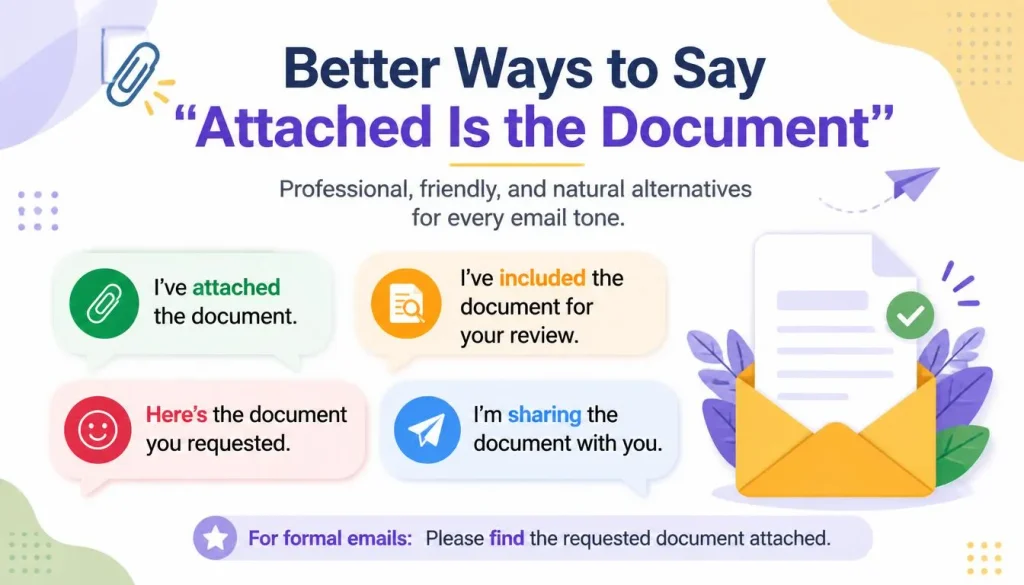
If you want a more natural way to say “Attached Is the Document,” try “I’ve attached the document,” “Please see the attached document,” or “I’ve included the document for your review.” For a warmer tone, you can say “Here’s the document you requested” or “I’m sharing the document with you.” For formal emails, “Please find the requested document attached” works well. The best phrase depends on whether you want to sound professional, friendly, formal, or direct.
What Does “Attached Is the Document” Mean?
“Attached is the document” means that a document has been included with an email or message for the recipient to open, review, download, or use. It is a straightforward way to tell someone that the file they need is included with your message. The phrase is common in professional emails, especially when sending reports, applications, contracts, forms, invoices, or other business documents. While it is perfectly understandable, using different wording can make your communication sound less repetitive and more natural.
Is It Professional or Polite to Say “Attached Is the Document”?
Yes, “Attached is the document” is both professional and polite. It clearly tells the recipient where to find the requested information without adding unnecessary words. However, it can sometimes sound a little formal or mechanical, particularly when used repeatedly. Depending on your relationship with the recipient and the purpose of the email, phrases such as “I’ve attached the document for your review” or “Please find the document attached” may sound warmer and more conversational while remaining professional.
Advantages of Saying “Attached Is the Document”
- Clear and direct: The recipient immediately knows that a document is included.
- Professional: The phrase works well in formal business and workplace communication.
- Concise: It communicates the purpose of the attachment without unnecessary explanation.
Disadvantages of Saying “Attached Is the Document”
- Can sound mechanical: Repeated use may make emails feel impersonal.
- Slightly formal: It may feel stiff in casual workplace conversations.
- Lacks context: It does not explain what the document contains or what the recipient should do with it.
Synonyms for “Attached Is the Document”
- I’ve Attached the Document
- Please Find the Document Attached
- The Document Is Attached
- I’m Attaching the Document for Your Review
- Please See the Attached Document
- I’ve Included the Document for Your Reference
- You’ll Find the Document Attached
- I’ve Attached the Requested Document
- The Requested Document Is Attached
- Please Find the Requested File Attached
- I’ve Included the File With This Email
- The Document You Requested Is Attached
- I’m Sharing the Document With You
- I’ve Sent the Document Along
- Please Refer to the Attached Document
- Kindly Review the Attached Document
- I’ve Attached the File for Your Consideration
- The Relevant Document Is Attached
- Please Have a Look at the Attached Document
- I’ve Included the Attached Document for Your Review
- Here’s the Document You Requested
- I’m Sending Over the Document
- I’ve Provided the Document as an Attachment
- The Document Is Included With This Email
- Please See the File Attached
- I’ve Attached the Document for Your Records
- The File You Need Is Attached
- I’m Sharing the Attached Document for Your Reference
- You Can Find the Document Attached to This Email
- I’ve Included the Document for Your Review
1. I’ve Attached the Document
Meaning: This means you have included the document with your email.
Definition: A simple statement confirming that a file has been attached.
Detailed Explanation: “I’ve attached the document” sounds natural and professional without being overly formal. It works particularly well when the recipient already knows which document you’re referring to.
Scenario Example: “I’ve attached the document we discussed during yesterday’s meeting.”
Best Use: Use it in work emails, follow-ups, and routine correspondence.
Tone: Professional, natural, and friendly.
2. Please Find the Document Attached
Meaning: You are politely directing the recipient to the attached document.
Definition: A formal expression used to identify an attachment.
Detailed Explanation: This traditional email phrase is useful when communicating with clients, managers, or external contacts. It has a polished tone but can feel slightly formal.
Scenario Example: “Please find the document attached for your review.”
Best Use: Use it for formal business emails and official correspondence.
Tone: Formal, polite, and professional.
3. The Document Is Attached
Meaning: The document has been included with your message.
Definition: A direct statement confirming the presence of an attachment.
Detailed Explanation: This is one of the simplest alternatives. It removes unnecessary wording and makes the attachment easy to identify.
Scenario Example: “The document is attached for your records.”
Best Use: Use it when you want to be brief and straightforward.
Tone: Direct, neutral, and professional.
4. I’m Attaching the Document for Your Review
Meaning: You are sending a document and asking the recipient to look it over.
Definition: A polite phrase that combines the attachment notification with its purpose.
Detailed Explanation: This wording is helpful because it gives the recipient context rather than simply mentioning the file.
Scenario Example: “I’m attaching the document for your review before our meeting.”
Best Use: Use it when the recipient needs to check, edit, or approve something.
Tone: Professional, considerate, and clear.
5. Please See the Attached Document
Meaning: You are asking the recipient to look at the attached document.
Definition: A concise instruction directing attention to an attachment.
Detailed Explanation: This phrase works well when the document contains information that supports the main message.
Scenario Example: “Please see the attached document for the updated project details.”
Best Use: Use it for reports, updates, instructions, and supporting information.
Tone: Polite, professional, and concise.
6. I’ve Included the Document for Your Reference
Meaning: You have provided the document so the recipient can consult it when needed.
Definition: A courteous way to explain why the document is attached.
Detailed Explanation: “For your reference” suggests that the recipient may not need to take immediate action. It is especially useful when sharing background information.
Scenario Example: “I’ve included the document for your reference should you need any additional details.”
Best Use: Use it for supporting materials and background documents.
Tone: Helpful, professional, and thoughtful.
7. You’ll Find the Document Attached
Meaning: The recipient can find the document in the email attachment.
Definition: A conversational way to point someone toward an attached file.
Detailed Explanation: This alternative sounds a little warmer than traditional phrases such as “Please find attached.”
Scenario Example: “You’ll find the document attached for your convenience.”
Best Use: Use it in friendly professional emails.
Tone: Warm, natural, and professional.
8. I’ve Attached the Requested Document
Meaning: You have attached the document the recipient previously asked for.
Definition: A direct confirmation that a requested file has been provided.
Detailed Explanation: Adding “requested” makes the connection between the recipient’s earlier request and your response clear.
Scenario Example: “I’ve attached the requested document for your review.”
Best Use: Use it when responding to a request for a file.
Tone: Professional, responsive, and helpful.
9. The Requested Document Is Attached
Meaning: The document the recipient asked for is included.
Definition: A formal confirmation of a requested attachment.
Detailed Explanation: This version is particularly useful when you want to sound precise and businesslike.
Scenario Example: “The requested document is attached for your records.”
Best Use: Use it in formal workplace and client communication.
Tone: Formal, precise, and polite.
See More: 30 Other Ways to Say ‘At Your Convenience’ in an Email
10. Please Find the Requested File Attached
Meaning: You are politely telling the recipient that their requested file is attached.
Definition: A formal attachment notification that identifies the file as previously requested.
Detailed Explanation: This phrase is useful when dealing with documents, forms, records, or administrative requests.
Scenario Example: “Please find the requested file attached to this email.”
Best Use: Use it for formal requests and administrative communication.
Tone: Formal, respectful, and professional.
11. I’ve Included the File With This Email
Meaning: The file has been added to the email.
Definition: A straightforward statement identifying an email attachment.
Detailed Explanation: This phrase sounds natural and avoids some of the stiffness associated with traditional attachment language.
Scenario Example: “I’ve included the file with this email so you have everything you need.”
Best Use: Use it in everyday professional emails.
Tone: Friendly, natural, and helpful.
12. The Document You Requested Is Attached
Meaning: You have provided the exact document the recipient asked for.
Definition: A clear confirmation that a requested document has been included.
Detailed Explanation: This wording is useful when you want to reassure the recipient that you’ve addressed their specific request.
Scenario Example: “The document you requested is attached for your review.”
Best Use: Use it for follow-ups and responses to document requests.
Tone: Clear, professional, and reassuring.
13. I’m Sharing the Document With You
Meaning: You are providing a document for the recipient to access.
Definition: A friendly phrase used when sending a file or information.
Detailed Explanation: “I’m sharing” feels more collaborative than simply saying that something is attached. It works especially well among colleagues.
Scenario Example: “I’m sharing the document with you ahead of tomorrow’s discussion.”
Best Use: Use it for teamwork, collaboration, and internal communication.
Tone: Friendly, collaborative, and professional.
14. I’ve Sent the Document Along
Meaning: You have forwarded or included the document for the recipient.
Definition: A conversational way of saying that a document has been provided.
Detailed Explanation: This phrase feels less formal and works well when you have an established relationship with the recipient.
Scenario Example: “I’ve sent the document along so you can review the latest changes.”
Best Use: Use it in informal or friendly workplace communication.
Tone: Casual, warm, and helpful.
15. Please Refer to the Attached Document
Meaning: You are asking the recipient to use the document for relevant information.
Definition: A formal direction to consult an attached file.
Detailed Explanation: This phrase works best when the attachment contains important details that support your email.
Scenario Example: “Please refer to the attached document for the complete schedule.”
Best Use: Use it for instructions, policies, schedules, and reports.
Tone: Formal, clear, and professional.
16. Kindly Review the Attached Document
Meaning: You are politely asking someone to examine the attached document.
Definition: A courteous request for document review.
Detailed Explanation: The word “kindly” adds politeness, while “review” makes the expected action clear.
Scenario Example: “Kindly review the attached document and let me know if any changes are needed.”
Best Use: Use it when requesting feedback, approval, or corrections.
Tone: Respectful, formal, and courteous.
17. I’ve Attached the File for Your Consideration
Meaning: You have provided a file and would like the recipient to consider its contents.
Definition: A professional phrase used when a document requires thought or evaluation.
Detailed Explanation: This wording is particularly appropriate for proposals, applications, recommendations, or business ideas.
Scenario Example: “I’ve attached the file for your consideration before you make a final decision.”
Best Use: Use it for proposals and decision-making materials.
Tone: Professional, respectful, and thoughtful.
18. The Relevant Document Is Attached
Meaning: The document containing the information related to the matter is included.
Definition: A concise way to identify an important supporting document.
Detailed Explanation: This phrase works when there may be multiple files or documents involved, and you want to highlight the one that matters.
Scenario Example: “The relevant document is attached for further details.”
Best Use: Use it in formal business or administrative communication.
Tone: Professional, precise, and neutral.
19. Please Have a Look at the Attached Document
Meaning: You are politely asking someone to look over the file.
Definition: A friendly request to review an attachment.
Detailed Explanation: This sounds warmer and more conversational than “Please find attached.” It works well when you want to maintain a friendly relationship.
Scenario Example: “Please have a look at the attached document when you have a moment.”
Best Use: Use it with colleagues, clients, and familiar professional contacts.
Tone: Friendly, polite, and approachable.
20. I’ve Included the Attached Document for Your Review
Meaning: You have provided the document and would like the recipient to review it.
Definition: A professional statement explaining both the attachment and its purpose.
Detailed Explanation: This wording provides useful context and clearly communicates that the document deserves attention.
Scenario Example: “I’ve included the attached document for your review before we finalize the agreement.”
Best Use: Use it for documents requiring feedback or approval.
Tone: Professional, considerate, and clear.
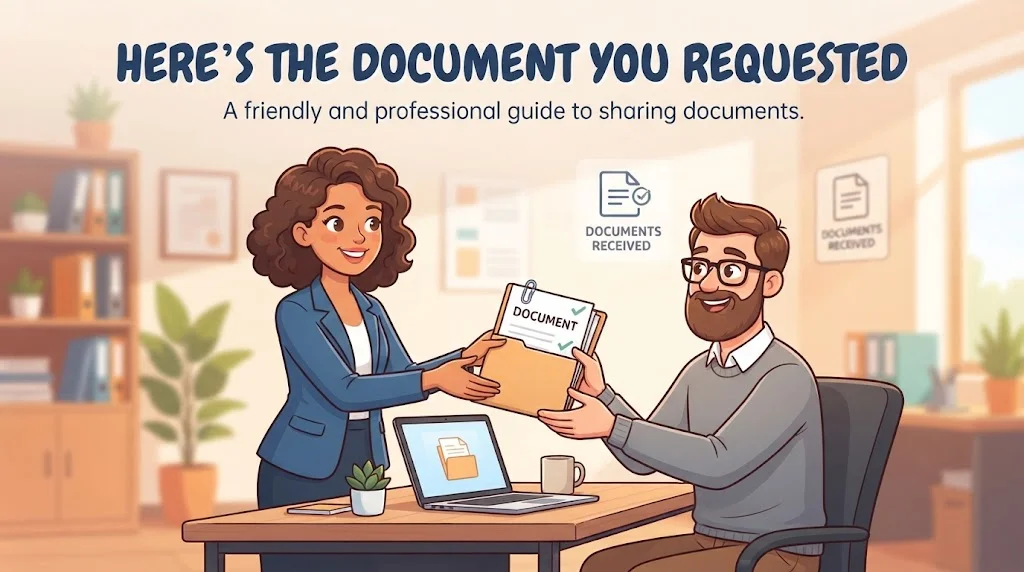
21. Here’s the Document You Requested
Meaning: You are providing the document that someone asked you to send.
Definition: A friendly and direct way to introduce a requested attachment.
Detailed Explanation: Starting with “Here’s” makes the message sound more conversational. It is excellent for people you communicate with regularly.
Scenario Example: “Here’s the document you requested. Let me know if you need anything else.”
Best Use: Use it for friendly professional communication.
Tone: Warm, simple, and helpful.
22. I’m Sending Over the Document
Meaning: You are sending the document to the recipient.
Definition: A conversational expression used when providing a file.
Detailed Explanation: “Sending over” is common in modern workplace communication. It sounds relaxed without becoming unprofessional.
Scenario Example: “I’m sending over the document we discussed during our call.”
Best Use: Use it with colleagues and familiar business contacts.
Tone: Casual, friendly, and professional.
23. I’ve Provided the Document as an Attachment
Meaning: The document has been included as an email attachment.
Definition: A formal statement explaining how the document has been delivered.
Detailed Explanation: This option is especially useful when you need to be precise about where the document can be found.
Scenario Example: “I’ve provided the document as an attachment for your review.”
Best Use: Use it for formal business or administrative emails.
Tone: Formal, precise, and professional.
24. The Document Is Included With This Email
Meaning: The document is part of the email as an attachment.
Definition: A direct statement identifying an included document.
Detailed Explanation: This phrase is simple and avoids overly formal wording. It is a good choice when clarity matters most.
Scenario Example: “The document is included with this email for your reference.”
Best Use: Use it for routine business correspondence.
Tone: Clear, neutral, and professional.
25. Please See the File Attached
Meaning: You are directing the recipient to the attached file.
Definition: A concise request to view an attachment.
Detailed Explanation: This alternative is short and useful when the file itself contains most of the relevant information.
Scenario Example: “Please see the file attached for the updated figures.”
Best Use: Use it for reports, spreadsheets, forms, and supporting files.
Tone: Concise, polite, and professional.
26. I’ve Attached the Document for Your Records
Meaning: You have provided the document so the recipient can keep it for future reference.
Definition: A phrase used when an attachment is being supplied for record-keeping.
Detailed Explanation: “For your records” tells the recipient that immediate action may not be necessary. The document is being shared for future use.
Scenario Example: “I’ve attached the document for your records and future reference.”
Best Use: Use it for receipts, confirmations, agreements, and official records.
Tone: Professional, helpful, and formal.
27. The File You Need Is Attached
Meaning: The file needed by the recipient is included with the email.
Definition: A direct statement confirming that the necessary file has been provided.
Detailed Explanation: This wording reassures the recipient that you’ve included the correct document.
Scenario Example: “The file you need is attached. Please let me know if you have trouble opening it.”
Best Use: Use it when sending a specific requested file.
Tone: Friendly, reassuring, and direct.
28. I’m Sharing the Attached Document for Your Reference
Meaning: You are providing the document so the recipient can consult it when necessary.
Definition: A collaborative phrase explaining the purpose of an attachment.
Detailed Explanation: This wording combines the warmth of “sharing” with the practical purpose of “for your reference.”
Scenario Example: “I’m sharing the attached document for your reference before our next meeting.”
Best Use: Use it for collaboration and background information.
Tone: Warm, professional, and helpful.
29. You Can Find the Document Attached to This Email
Meaning: The document is available as an attachment to the email.
Definition: A conversational direction toward an attached file.
Detailed Explanation: This phrase is especially useful when the attachment may not be immediately obvious.
Scenario Example: “You can find the document attached to this email for your review.”
Best Use: Use it when you want to make the location of the file especially clear.
Tone: Friendly, clear, and professional.
See More: 30 Other Ways to Start an Email to Your Boss
30. I’ve Included the Document for Your Review
Meaning: You have provided a document and would like the recipient to examine it.
Definition: A polite statement that identifies both the attachment and its purpose.
Detailed Explanation: This is one of the most natural alternatives when the recipient needs to read, check, or comment on the document. It sounds professional without feeling overly stiff.
Scenario Example: “I’ve included the document for your review. Please share your thoughts when you have a chance.”
Best Use: Use it when requesting feedback, approval, or comments.
Tone: Professional, warm, and considerate.
Frequently Asked Questions
1. What is another way to say “Attached Is the Document”?
You can say “I’ve attached the document,” “Please see the attached document,” or “I’ve included the document for your review.” These options sound natural and professional.
2. Is “Attached Is the Document” professional?
Yes, “Attached Is the Document” is professional and grammatically clear. However, it can feel somewhat formal or repetitive when used frequently.
3. What is a more natural alternative to “Please Find Attached”?
“I’ve attached the document” is one of the most natural alternatives. It is direct, friendly, and suitable for most workplace emails.
4. How do I politely mention an attachment in an email?
You can write “Please see the attached document for your review” or “I’ve included the document for your reference.” Both phrases clearly identify the attachment while maintaining a polite tone.
5. What can I say when sending a requested document?
Try “I’ve attached the requested document” or “Here’s the document you requested.” The first sounds more formal, while the second feels warmer and more conversational.
6. What is a good phrase for a formal business email?
“Please find the requested document attached” is a suitable choice for formal business communication. You can also use “I’ve provided the document as an attachment for your review.”
7. How can I make an attachment message sound friendly?
Use phrases such as “Here’s the document you requested” or “I’m sharing the document with you.” These expressions feel less robotic while remaining professional.
8. What should I say when I want someone to review an attachment?
You can say “I’ve attached the document for your review” or “Kindly review the attached document.” Both make the requested action clear.
9. Can I use “Please See the Attached Document” in professional emails?
Yes. “Please see the attached document” is clear, polite, and appropriate for workplace, client, and business communication.
10. How do I avoid repeating “Attached Is the Document”?
Use different phrases based on your purpose. For example, choose “for your review,” “for your reference,” “for your records,” or “for your consideration” when each expression matches what you need the recipient to do.
Conclusion
Choosing the right alternative to “Attached Is the Document” can make your emails feel more natural, clear, and thoughtful. While the original phrase is perfectly professional, changing your wording can prevent your messages from sounding repetitive or mechanical. Whether you’re sending a report to a client, sharing a proposal with a colleague, or providing a requested file, match the phrase to your purpose, relationship, and level of formality.
Simple expressions such as “I’ve attached the document,” “Here’s the document you requested,” and “I’ve included the document for your review” can make a noticeable difference. The goal isn’t to use complicated language. It is to choose words that sound professional, human, and appropriate for the situation.