
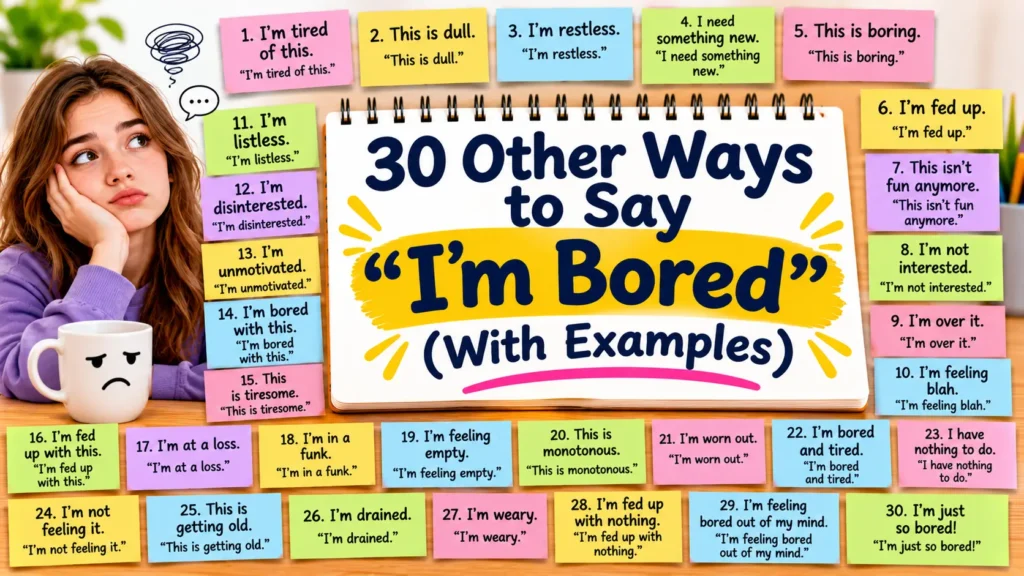

Feeling bored is a common experience, but saying “I’m bored” every time can make your conversations sound repetitive. Whether you’re sitting around with nothing to do, waiting for something exciting to happen, or looking for a way to describe your lack of interest, using different expressions can make your words more engaging. The right phrase can also help others understand exactly how you’re feeling.
There are several ways to express boredom, depending on the situation and your mood. For example, “I’m restless” suggests that you want something to do, while “I’m fed up” can express frustration with a repetitive situation. Other phrases, such as “I’m feeling uninspired,” “I’m not entertained,” “I’m at a loose end,” and “I’m tired of this” communicate different shades of boredom. Some sound casual and friendly, while others express a stronger feeling of dissatisfaction.
In this guide, you’ll discover 30 other ways to say “I’m bored”, along with their meanings and practical examples. Whether you’re chatting with friends, describing your feelings in writing, or looking for a more creative way to express yourself, these alternatives will help you find the right words. You’ll also learn how to communicate boredom naturally without relying on the same familiar phrase.
What Does “I’m Bored” Mean?
The phrase “I’m bored” means that you are feeling uninterested, restless, or dissatisfied because you don’t have anything enjoyable or engaging to do. It often describes a situation where an activity feels repetitive, uninteresting, or mentally unstimulating. People commonly use this expression when they have free time, feel disconnected from their surroundings, or want something exciting to happen. For example, someone might say, “I’m bored sitting at home all day,” to explain that they need an activity to make their day more enjoyable.
Is It Professional or Polite to Say “I’m Bored”?
Saying “I’m bored” is perfectly acceptable in casual conversations with friends, family members, and people you know well. However, it may sound unprofessional in workplace conversations, especially if it suggests that you aren’t interested in your responsibilities. In professional situations, expressions such as “I’d appreciate a new challenge,” or “I’m looking for something more engaging” communicate your feelings more constructively. The best choice depends on your audience, situation, and the impression you want to create.
Advantages and Disadvantages of Saying “I’m Bored”
Advantages
- Honest Communication: Saying “I’m bored” allows you to express your feelings honestly instead of pretending to enjoy something that doesn’t interest you.
- Easy to Understand: It is a simple, familiar expression that helps others understand your emotional state without needing a lengthy explanation.
- Encourages Interaction: Sharing that you’re bored can encourage friends or family members to suggest activities, start conversations, or spend time with you.
Disadvantages
- Can Sound Negative: Repeatedly saying “I’m bored” may make you seem dissatisfied or uninterested in your surroundings.
- May Seem Unprofessional: In workplace or formal situations, this expression might give others the impression that you lack motivation.
- Doesn’t Explain Your Needs: The phrase communicates a feeling but doesn’t explain whether you need entertainment, company, a challenge, or a change of environment.
30 Alternatives to Say “I’m Bored” (With Examples)
Here is the complete list of alternatives you can use to express boredom more naturally. Each expression has a slightly different meaning and tone, making it suitable for particular conversations and situations.
- I’m Feeling Restless
- I Need Something to Do
- I’m Not Entertained
- I’m Getting Tired of This
- I Could Use Some Excitement
- I’m Feeling Uninspired
- Nothing Is Keeping Me Interested
- I’m Looking for Something Fun
- I’m Just Passing the Time
- I’m Feeling a Little Stuck
- This Is Getting Monotonous
- I’m Craving Something Different
- I Have Nothing Interesting Going On
- I’m Feeling Understimulated
- I’m Ready for a Change
- I’m Not Finding This Very Interesting
- I Need a Change of Scenery
- I’m Running Out of Things to Do
- I’m Feeling Unengaged
- I’m Longing for Some Entertainment
- I’m Not Keeping Myself Busy
- I’m Looking for a Distraction
- I’m Feeling a Bit Idle
- This Isn’t Holding My Attention
- I’m Wishing Something Exciting Would Happen
- I’m Getting a Little Fed Up
- I Need Something to Spark My Interest
- I’m Feeling Disconnected
- I’m Desperate for Something Fun
- I’m Counting Down the Minutes
1. I’m Feeling Restless
Meaning: “I’m feeling restless” means you cannot relax comfortably because you want something different or more engaging to happen.
Definition: A feeling of uneasiness or impatience caused by a lack of activity, excitement, or stimulation.
Detailed Explanation: This expression is useful when boredom makes you feel physically or mentally uncomfortable. Instead of simply saying that you have nothing to do, it communicates that you want to move around, explore something, or find a new activity. It sounds natural and gives others a better understanding of your feelings.
Scenario Examples:
- “I’ve been sitting at home all afternoon, and I’m feeling restless.”
- “I’m feeling restless today. Would you like to go for a walk?”
Best Use: Use this expression when you want to describe boredom accompanied by impatience or a desire to do something.
Tone: Casual, honest, and slightly emotional.
2. I Need Something to Do
Meaning: This expression means you have free time and want an activity to keep yourself occupied.
Definition: A statement expressing the desire to find an interesting or useful activity.
Detailed Explanation: Sometimes boredom simply comes from having nothing planned. Saying “I need something to do” makes your feelings clear without sounding overly negative. It can also invite others to suggest an activity or spend time with you. It’s particularly useful in everyday conversations.
Scenario Examples:
- “I’ve finished all my work, and now I need something to do.”
- “It’s such a quiet afternoon. I need something to do before dinner.”
Best Use: Use it when you’re free and looking for an activity, hobby, or way to spend your time.
Tone: Friendly, straightforward, and conversational.
3. I’m Not Entertained
Meaning: “I’m not entertained” means that something isn’t interesting or enjoyable enough to hold your attention.
Definition: An expression indicating that an activity, performance, or situation is failing to provide enjoyment.
Detailed Explanation: This alternative works when you’re watching something, participating in an activity, or listening to a conversation that doesn’t interest you. It can sound humorous among friends, but it may also come across as critical if you use it directly with someone who is trying to entertain you.
Scenario Examples:
- “I’ve watched three episodes, but honestly, I’m not entertained.”
- “Everyone seems to be enjoying the game, but I’m not entertained.”
Best Use: Use it when an activity or experience fails to capture your interest.
Tone: Direct, slightly humorous, and sometimes sarcastic.
4. I’m Getting Tired of This
Meaning: This phrase means that something has become repetitive, frustrating, or uninteresting.
Definition: A statement expressing growing dissatisfaction with an ongoing activity or situation.
Detailed Explanation: Unlike ordinary boredom, this expression can communicate frustration as well. You might use it when you’ve been doing the same task for too long or experiencing the same situation repeatedly. It helps explain that your interest has gradually disappeared.
Scenario Examples:
- “We’ve been playing the same game for hours. I’m getting tired of this.”
- “I’m getting tired of watching the same shows every evening.”
Best Use: Use it when repetition or a lack of variety makes something less enjoyable.
Tone: Casual, frustrated, and straightforward.
5. I Could Use Some Excitement
Meaning: This expression means you would enjoy something interesting, enjoyable, or different happening.
Definition: A polite way of expressing a desire for more excitement or stimulation.
Detailed Explanation: If your routine feels predictable, saying “I could use some excitement” communicates that you want something to brighten your day. It sounds more positive than directly complaining about boredom. You can use it to suggest going somewhere, trying something new, or making spontaneous plans.
Scenario Examples:
- “It’s been a quiet weekend. I could use some excitement.”
- “Let’s plan a little adventure. I could use some excitement today.”
Best Use: Use it when you want to encourage someone to make plans or introduce something enjoyable.
Tone: Warm, optimistic, and inviting.
6. I’m Feeling Uninspired
Meaning: “I’m feeling uninspired” means you aren’t feeling creative, motivated, or interested in doing anything.
Definition: A temporary lack of enthusiasm, creativity, or motivation.
Detailed Explanation: This phrase is particularly useful when boredom affects your ability to think creatively or complete tasks. For example, you might feel uninspired when working on a project, writing something, or trying to develop new ideas. It communicates a deeper lack of mental engagement rather than simply having free time.
Scenario Examples:
- “I’ve been staring at my notebook for an hour. I’m feeling uninspired.”
- “I’m feeling uninspired today, so I think I’ll take a short break.”
Best Use: Use it when you feel mentally disconnected from creative or productive activities.
Tone: Thoughtful, gentle, and reflective.
7. Nothing Is Keeping Me Interested
Meaning: This expression means that you haven’t found anything engaging or enjoyable enough to hold your attention.
Definition: A statement describing a lack of interest in available activities or experiences.
Detailed Explanation: Sometimes you have plenty of things to do, but none of them seem appealing. This phrase explains that your problem isn’t necessarily a lack of options. Instead, nothing around you is capturing your attention. It can help others understand why you’re struggling to enjoy your free time.
Scenario Examples:
- “I’ve tried watching movies and reading, but nothing is keeping me interested.”
- “Nothing is keeping me interested tonight. Maybe we should try something new.”
Best Use: Use it when several activities fail to make you feel engaged.
Tone: Honest, conversational, and slightly disappointed.
8. I’m Looking for Something Fun
Meaning: This phrase means you want to find an enjoyable activity or experience.
Definition: An expression showing interest in entertainment, recreation, or enjoyable experiences.
Detailed Explanation: Instead of focusing directly on boredom, this alternative shifts the conversation toward finding something positive. It sounds welcoming and makes it easier for someone to suggest an activity. You can use it when talking with friends, family members, or people you want to spend time with.
Scenario Examples:
- “I’m looking for something fun to do this weekend. Do you have any ideas?”
- “I’m looking for something fun tonight. Want to go out?”
Best Use: Use it when you want suggestions, entertainment, or company.
Tone: Friendly, cheerful, and inviting.
9. I’m Just Passing the Time
Meaning: “I’m just passing the time” means you’re doing something mainly to occupy yourself while waiting for something else.
Definition: Spending time on an activity without having a particularly important purpose or goal.
Detailed Explanation: This expression is useful when you’re waiting for someone, sitting somewhere, or trying to make an uneventful period feel shorter. It doesn’t always suggest strong boredom, but it can communicate that you’re not particularly engaged in what you’re doing.
Scenario Examples:
- “I’m just passing the time until my friend arrives.”
- “I’ve been scrolling through my phone just to pass the time.”
Best Use: Use it when you’re waiting or occupying yourself without a specific objective.
Tone: Relaxed, casual, and neutral.
10. I’m Feeling a Little Stuck
Meaning: This expression means you feel unable to find something interesting to do or move forward with an activity.
Definition: A temporary feeling of being unable to make progress or find a new direction.
Detailed Explanation: Feeling stuck can sometimes come from boredom, especially when your daily routine feels repetitive. This phrase sounds softer than saying you’re completely uninterested. It can also describe situations where you need fresh ideas, inspiration, or a different approach.
Scenario Examples:
- “I’ve finished everything on my list, and I’m feeling a little stuck.”
- “I’m feeling a little stuck with this project. Maybe I need a fresh perspective.”
Best Use: Use it when you want a change, fresh ideas, or something to help you regain interest.
Tone: Gentle, thoughtful, and slightly uncertain.
11. This Is Getting Monotonous
Meaning: This phrase means something is becoming repetitive and predictable, making it less interesting.
Definition: A statement describing an activity or routine that lacks variety and excitement.
Detailed Explanation: The word monotonous describes something that stays almost the same over time. It is especially useful when talking about repetitive work, daily routines, or activities that no longer challenge you. Rather than simply saying you’re bored, it explains the reason behind your boredom.
Scenario Examples:
- “Doing the same paperwork every day is getting monotonous.”
- “This routine is getting monotonous. We should try something different.”
Best Use: Use it when repetitive tasks or predictable routines become uninteresting.
Tone: Mature, descriptive, and slightly dissatisfied.
12. I’m Craving Something Different
Meaning: This expression means you strongly want a new experience, activity, or change from your usual routine.
Definition: A statement expressing a desire for variety or something unfamiliar.
Detailed Explanation: Sometimes boredom develops because every day feels the same. Saying “I’m craving something different” communicates your desire for a fresh experience without sounding negative. It can be used when discussing entertainment, food, travel, hobbies, or everyday plans.
Scenario Examples:
- “I’ve been staying home every weekend. I’m craving something different.”
- “I’m craving something different tonight. Let’s try a new restaurant.”
Best Use: Use it when you want to break your routine or explore new experiences.
Tone: Positive, enthusiastic, and conversational.
13. I Have Nothing Interesting Going On
Meaning: This phrase means that nothing particularly exciting or engaging is happening in your life at the moment.
Definition: An informal statement describing a lack of interesting activities or events.
Detailed Explanation: You can use this expression when someone asks what you’re doing or how your day is going. It communicates that your schedule is quiet and nothing special is happening. It is also a natural way to start a conversation about making plans.
Scenario Examples:
- “I have nothing interesting going on today. What about you?”
- “My weekend is completely free. I have nothing interesting going on.”
Best Use: Use it when explaining that your day or schedule is uneventful.
Tone: Casual, relaxed, and friendly.
14. I’m Feeling Understimulated
Meaning: “I’m feeling understimulated” means your mind isn’t receiving enough interesting activity or mental engagement.
Definition: A feeling caused by insufficient mental, physical, or sensory stimulation.
Detailed Explanation: This alternative is useful when ordinary activities aren’t providing enough challenge or engagement. You might feel understimulated when doing repetitive tasks, spending too much time alone, or having very little variety in your day. It describes boredom in a more specific and thoughtful way.
Scenario Examples:
- “I’ve been doing simple tasks all morning, and I’m feeling understimulated.”
- “I need a challenging project because I’m feeling mentally understimulated.”
Best Use: Use it when you want more mental stimulation, challenge, or engaging activities.
Tone: Thoughtful, descriptive, and slightly formal.
15. I’m Ready for a Change
Meaning: This expression means you’re interested in changing your current situation, routine, or activity.
Definition: A statement expressing willingness or desire to experience something new.
Detailed Explanation: When your everyday routine becomes boring, you might want a change of scenery, different responsibilities, or new experiences. This phrase communicates that desire in a positive and constructive way. It works particularly well when discussing personal goals, work routines, or weekend plans.
Scenario Examples:
- “I’ve been following the same routine for months. I’m ready for a change.”
- “I’m ready for a change. Let’s take a different route this weekend.”
Best Use: Use it when you want to introduce variety or make a positive change.
Tone: Positive, confident, and hopeful.
16. I’m Not Finding This Very Interesting
Meaning: This phrase means that something isn’t holding your attention or providing much enjoyment.
Definition: A polite expression indicating a lack of interest in a particular activity, subject, or experience.
Detailed Explanation: This alternative is more measured than directly saying “I’m bored.” It can be helpful when discussing a book, movie, presentation, or conversation that doesn’t appeal to you. It also allows you to communicate your opinion without being unnecessarily harsh.
Scenario Examples:
- “I’m not finding this book very interesting, so I might choose another one.”
- “I’m not finding this discussion very interesting. Could we explore another topic?”
Best Use: Use it when you want to express a lack of interest politely.
Tone: Polite, honest, and slightly formal.
17. I Need a Change of Scenery
Meaning: This expression means you want to visit a different place or environment to refresh your mind.
Definition: A desire to experience a different physical setting or surroundings.
Detailed Explanation: Staying in the same environment for too long can make everyday activities feel repetitive. Saying “I need a change of scenery” suggests that a new location might improve your mood and help you feel refreshed. It can refer to something as simple as visiting a café or taking a walk outside.
Scenario Examples:
- “I’ve been working from home all week. I need a change of scenery.”
- “Let’s go somewhere peaceful. I really need a change of scenery.”
Best Use: Use it when you feel bored with your surroundings and want to go somewhere different.
Tone: Relaxed, positive, and refreshing.
18. I’m Running Out of Things to Do
Meaning: This phrase means you’ve completed most of your available activities and are struggling to find something else to occupy your time.
Definition: A statement describing a shortage of available activities or entertainment.
Detailed Explanation: This expression is particularly natural when you’ve already watched your favorite shows, finished your tasks, or tried several activities. It explains that you aren’t necessarily unwilling to do something. You simply haven’t found another interesting option.
Scenario Examples:
- “I’ve cleaned the house and finished my assignments. I’m running out of things to do.”
- “It’s raining outside, and I’m running out of things to do indoors.”
Best Use: Use it when you’ve exhausted your usual entertainment or activities.
Tone: Casual, slightly frustrated, and relatable.
19. I’m Feeling Unengaged
Meaning: “I’m feeling unengaged” means you’re not mentally or emotionally involved in what you’re doing.
Definition: A lack of active interest, attention, or participation in an activity.
Detailed Explanation: This expression is useful when you’re physically present but mentally disconnected. For example, you might attend a meeting, participate in a class, or complete a task without feeling interested. It communicates that something isn’t encouraging your attention or participation.
Scenario Examples:
- “I’m feeling unengaged during these repetitive meetings.”
- “The activity isn’t challenging enough, so I’m feeling unengaged.”
Best Use: Use it in professional, educational, or personal situations where you lack involvement.
Tone: Professional, thoughtful, and neutral.
20. I’m Longing for Some Entertainment
Meaning: This phrase means you strongly want something enjoyable or entertaining to make your time more interesting.
Definition: An expression of desire for amusement, recreation, or enjoyable experiences.
Detailed Explanation: This alternative adds a little personality to an ordinary statement about boredom. It suggests that you’re hoping for something fun, whether that’s watching a movie, playing a game, attending an event, or spending time with someone. It can make a casual conversation feel more expressive.
Scenario Examples:
- “It’s been such a quiet evening. I’m longing for some entertainment.”
- “I’m longing for some entertainment. Do you know of any good movies?”
Best Use: Use it when you’re looking for amusement or something enjoyable to do.
Tone: Expressive, friendly, and slightly playful.
21. I’m Not Keeping Myself Busy
Meaning: This expression means you don’t currently have enough activities or responsibilities to occupy your time.
Definition: A statement describing a lack of productive or recreational activity.
Detailed Explanation: You can use this phrase when your schedule is unusually empty or you haven’t found anything meaningful to do. It is less direct than saying you’re bored and can open the door to conversations about hobbies, projects, or new responsibilities.
Scenario Examples:
- “I have too much free time this week. I’m not keeping myself busy.”
- “I’m not keeping myself busy lately, so I might start learning a new skill.”
Best Use: Use it when explaining that you need more activities or responsibilities.
Tone: Casual, reflective, and constructive.
22. I’m Looking for a Distraction
Meaning: This phrase means you want something to take your mind away from your current situation or thoughts.
Definition: A desire for an activity or experience that shifts your attention elsewhere.
Detailed Explanation: Sometimes boredom isn’t the only reason you want something to do. You might also want to take your mind off a repetitive routine, a stressful day, or an uncomfortable situation. This expression communicates that you’re looking for something to occupy your attention, even temporarily.
Scenario Examples:
- “It’s been a long day, and I’m looking for a distraction.”
- “I’m looking for a distraction. Would you like to watch a movie together?”
Best Use: Use it when you want an activity to redirect your attention.
Tone: Casual, honest, and sometimes reflective.
23. I’m Feeling a Bit Idle
Meaning: “I’m feeling a bit idle” means you aren’t doing much and have little to occupy your time.
Definition: A temporary state of inactivity or having nothing particularly useful or interesting to do.
Detailed Explanation: The word idle describes a lack of activity or work. This expression is a softer way to communicate boredom, especially when you’re having a quiet day. It can also describe situations where you have free time but haven’t decided how to use it.
Scenario Examples:
- “I’ve finished my responsibilities, and I’m feeling a bit idle.”
- “It’s been a slow afternoon. I’m feeling a little idle.”
Best Use: Use it when you have free time and want something productive or enjoyable to do.
Tone: Gentle, understated, and slightly formal.
24. This Isn’t Holding My Attention
Meaning: This expression means that something isn’t interesting enough to keep you focused.
Definition: A statement describing an inability to maintain interest or concentration in an activity.
Detailed Explanation: You can use this phrase when a book, movie, conversation, or task fails to capture your attention. It focuses more on your level of engagement than on the activity itself. It is particularly helpful when you want to explain why you’re losing interest in something.
Scenario Examples:
- “I’ve tried reading this novel, but it isn’t holding my attention.”
- “The presentation is quite repetitive, and it isn’t holding my attention.”
Best Use: Use it when something fails to keep you interested or focused.
Tone: Honest, polite, and descriptive.
25. I’m Wishing Something Exciting Would Happen
Meaning: This phrase means you hope something interesting or unexpected will make your day more enjoyable.
Definition: An expression of anticipation or desire for an exciting experience or event.
Detailed Explanation: This alternative is useful when everything around you feels predictable. Instead of simply complaining about having nothing to do, you’re expressing a hope that something enjoyable will happen. It can make your message sound more imaginative and optimistic.
Scenario Examples:
- “It’s been such an ordinary day. I’m wishing something exciting would happen.”
- “I’m wishing something exciting would happen this weekend. Maybe we should plan a trip.”
Best Use: Use it when you want a little adventure, surprise, or excitement.
Tone: Hopeful, expressive, and playful.
26. I’m Getting a Little Fed Up
Meaning: “I’m getting a little fed up” means you’re becoming frustrated or tired of a situation because it has continued for too long.
Definition: An informal expression describing growing irritation, impatience, or dissatisfaction.
Detailed Explanation: This expression is stronger than ordinary boredom. It suggests that something has become annoying or frustrating, often because of repetition. You might use it when you’re tired of waiting, doing the same task, or experiencing an unchanging situation.
Scenario Examples:
- “I’m getting a little fed up with watching the same programs every evening.”
- “We’ve been waiting for an hour. I’m getting a little fed up.”
Best Use: Use it when boredom has developed into frustration or impatience.
Tone: Informal, frustrated, and direct.
27. I Need Something to Spark My Interest
Meaning: This expression means you want something interesting enough to capture your attention and enthusiasm.
Definition: A statement expressing the desire for a new idea, activity, or experience that creates curiosity.
Detailed Explanation: Sometimes you don’t need more activities; you need something that genuinely interests you. This phrase communicates your desire for inspiration or a new challenge. It works especially well when discussing hobbies, learning opportunities, creative projects, and professional responsibilities.
Scenario Examples:
- “I’ve been doing the same things lately. I need something to spark my interest.”
- “Maybe learning photography will give me something to spark my interest.”
Best Use: Use it when you want inspiration, curiosity, or a more engaging experience.
Tone: Thoughtful, positive, and motivated.
28. I’m Feeling Disconnected
Meaning: “I’m feeling disconnected” means you feel detached from your surroundings, activities, or the people around you.
Definition: A feeling of reduced involvement, connection, or emotional engagement.
Detailed Explanation: This phrase can describe a deeper experience than ordinary boredom. You might feel disconnected when conversations don’t interest you, your routine feels meaningless, or you aren’t enjoying activities that once made you happy. It is useful when you want to communicate your feelings more thoughtfully rather than simply saying you’re bored.
Scenario Examples:
- “I’ve been spending too much time alone, and I’m feeling disconnected.”
- “I’m feeling disconnected from my usual routine and would like to try something new.”
Best Use: Use it when you feel emotionally or mentally detached from your surroundings.
Tone: Thoughtful, vulnerable, and reflective.
29. I’m Desperate for Something Fun
Meaning: This expression means you really want an enjoyable activity because your current situation feels dull or repetitive.
Definition: A strong desire for entertainment, excitement, or an enjoyable experience.
Detailed Explanation: This alternative adds emphasis to your feelings. It suggests that ordinary activities aren’t enough and you’re eager to find something that makes your day more exciting. It is particularly natural in conversations with close friends when discussing spontaneous plans.
Scenario Examples:
- “I’ve been studying all week. I’m desperate for something fun.”
- “I’m desperate for something fun this weekend. Let’s organize a movie night.”
Best Use: Use it when you’re strongly craving entertainment or an exciting activity.
Tone: Energetic, humorous, and expressive.
30. I’m Counting Down the Minutes
Meaning: This phrase means you’re eagerly waiting for a particular moment, often because your current activity feels dull or uninteresting.
Definition: An informal expression describing impatience while waiting for something to end or begin.
Detailed Explanation: When you’re stuck in a long meeting, waiting for school to finish, or sitting through an uninteresting activity, you might find yourself counting down the minutes. This phrase communicates impatience and boredom in a slightly humorous way. However, it can sound disrespectful if used openly during an important professional or formal situation.
Scenario Examples:
- “This meeting is taking forever. I’m counting down the minutes until lunch.”
- “It’s the last hour of class, and I’m counting down the minutes until I can go home.”
Best Use: Use it when you’re waiting for something to finish because you’re eager to move on.
Tone: Casual, humorous, and impatient.
Conclusion
Finding different ways to say “I’m bored” can make your conversations more expressive and interesting. Phrases like “I’m restless,” “I’m feeling uninspired,” “I’m at a loose end,” and “I’m not entertained” help you describe boredom in different ways. Each expression carries a slightly different meaning, allowing you to communicate your feelings more clearly.
Whether you’re talking with friends, writing a message, or describing a dull experience, choosing the right alternative can make your words sound more natural. Try using these 30 alternatives to “I’m bored” to expand your vocabulary and express your feelings with greater confidence.