

Explore 30 Other Ways to Say ‘Just to Clarify’ to use clear communication and confirm details while avoiding misunderstandings in conversations.
The phrase “just to clarify” is a common expression that helps people make sure they fully understand information, remove confusion, and move forward with confidence. From my experience with professional conversations, emails, meetings, chats, and academic writing, this simple and short phrase helps keep communication clear and professional. It is often used to correct information, provide an explanation, and create better understanding.
Using the same phrase repeatedly may sound repetitive, stiff, blunt, or even passive-aggressive in some situations. Word choice directly affects tone, politeness, and professionalism, which changes how others receive messages. By choosing the right expression and exploring alternative ways, you can sound more confident, respectful, natural, and polished. This guide offers 30 thoughtful, reader-friendly ways and human-sounding alternatives to help you express the same idea while matching the purpose, audience, and different contexts.
Quick Answer
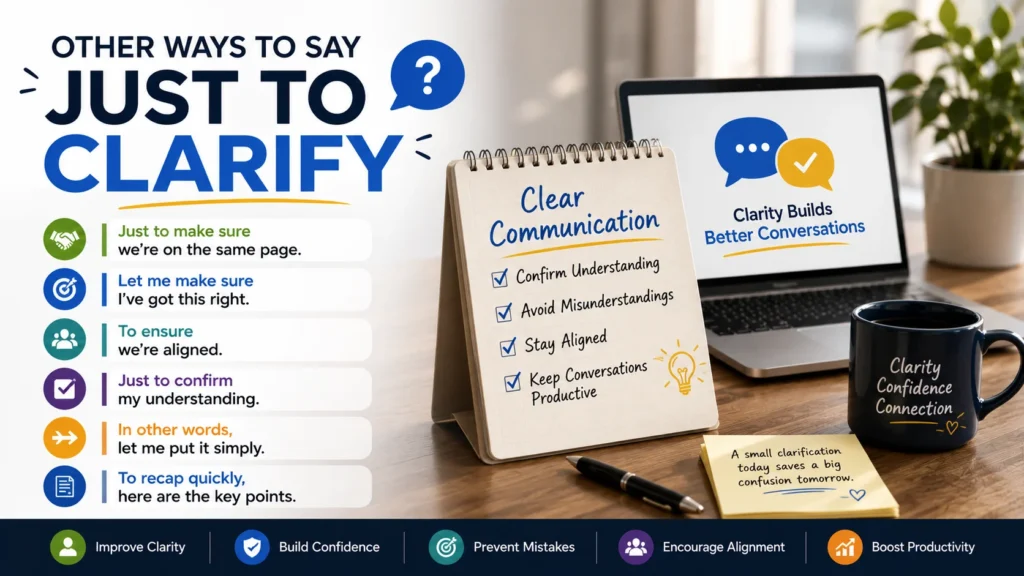
Other ways to say “just to clarify” include “just to make sure we’re on the same page,” “let me make sure I’ve got this right,” “to ensure we’re aligned,” “just to confirm my understanding,” “in other words,” and “to recap quickly.” These alternatives help you communicate with more clarity, confidence, and professionalism while confirming details, avoiding misunderstandings, and keeping conversations productive.
What Does “Just to Clarify” Mean?
The phrase “just to clarify” is a conversational tool used to clear up potential misunderstandings, summarize a point, or confirm shared understanding before moving forward in a conversation. It acts as a gentle pause button, allowing both speakers to align their thoughts without feeling rushed or judged.
Is It Professional and Polite to Say “Just to Clarify”?
Yes, saying “just to clarify” is widely considered professional, polite, and constructive in both workplace settings and personal relationships. It demonstrates active listening and a collaborative mindset, showing that you care deeply about getting things right rather than just rushing to be heard.
Advantage or Disadvantage
Advantages
- They actively prevent costly miscommunications by ensuring all parties share the exact same interpretation before taking action.
- They foster an environment of psychological safety where people feel comfortable asking questions without fear of judgment.
- They build mutual respect by showing that you value the other person’s input enough to check your understanding rather than guessing.
Disadvantages
- Overusing them in fast-paced environments can occasionally make a speaker sound hesitant or lacking in confidence.
- Relying on the exact same phrasing repeatedly can become overly repetitive, which may dilute the impact of your message.
- Using them unnecessarily during brief or straightforward exchanges can slow down conversations that benefit from quick, direct execution.
Synonyms for “Just to Clarify”
- Just to make sure we’re on the same page
- To put it another way
- Let me make sure I’ve got this right
- To ensure we’re aligned
- Just to double-check my understanding
- To put a finer point on it
- In other words
- Just to be completely certain
- To recap quickly
- Let me phrase that differently
- Just to be sure we are reading from the same script
- To rephrase slightly
- Just to ensure we’re on target
- To clarify my own thoughts
- Just to make sure nothing is lost in translation
- To break that down a bit more
- Just to verify my takeaway
- To say it simply
- Just to make sure I’m following you correctly
- To make sure we share the same vision
- Just to confirm my understanding
- To look at it from this angle
- Just to be clear on my end
- To summarize our current standing
- Just to ensure we are moving forward together
- To clarify for my own peace of mind
- Just to make certain we didn’t miss anything
- To state it plainly
- Just to bring everything into focus
- To make sure we are fully synced
1. Just to make sure we’re on the same page
Meaning: A collaborative statement used to ensure mutual agreement and shared understanding.
Definition: Verifying that two or more people share the same interpretation of a situation, goal, or concept.
Detailed Explanation: This phrase shifts the focus away from individual blame and frames the conversation as a team effort to understand a concept together, reducing any defensive feelings.
Scenario Examples: “Just to make sure we’re on the same page, are we launching the new campaign next Tuesday or pushing it back?”
Best Use: Collaborative brainstorming sessions, team meetings, and complex project discussions.
Tone: Warm, cooperative, and inclusive.
2. To put it another way
Meaning: Re-explaining a complex idea using different, simpler terminology.
Definition: Restating a previous thought or concept from a fresh perspective to aid comprehension.
Detailed Explanation: When someone looks confused, this phrase lets you reframe your thoughts gracefully without making the listener feel unintelligent.
Scenario Examples: “To put it another way, if we save on software costs this quarter, we can reinvest that budget into employee wellness.”
Best Use: Explaining technical details, policies, or abstract ideas to others.
Tone: Helpful, clear, and patient.
3. Let me make sure I’ve got this right
Meaning: Taking personal accountability to repeat back what you heard to verify accuracy.
Definition: Paraphrasing another person’s statement to confirm listening comprehension.
Detailed Explanation: This phrase empowers the speaker by showing them that you are actively processing their words and value their input enough to check your own assumptions.
Scenario Examples: “Let me make sure I’ve got this right: you need the final draft by Friday noon so the design team can format it over the weekend.”
Best Use: Receiving instructions, feedback sessions, or sensitive interpersonal talks.
Tone: Attentive, humble, and diligent.
4. To ensure we’re aligned
Meaning: Checking that individual goals and collective directions match up seamlessly.
Definition: Verifying consensus on objectives, expectations, or strategic steps.
Detailed Explanation: Frequently used in professional spaces, this phrase brings focus and structure to a conversation, ensuring everyone is heading toward the exact same finish line.
Scenario Examples: “To ensure we’re aligned, our main priority for this month is improving client retention rather than chasing new sign-ups.”
Best Use: Strategic planning, project kickoffs, and leadership check-ins.
Tone: Professional, organized, and purposeful.
5. Just to double-check my understanding
Meaning: Humbly verifying that your internal interpretation matches external reality.
Definition: Reviewing a shared piece of information a second time to ensure absolute accuracy.
Detailed Explanation: This phrase is wonderful because it takes the pressure off the other person; you are admitting you want to check your own work rather than questioning theirs.
Scenario Examples: “Just to double-check my understanding, does this policy apply to remote workers as well as full-time office staff?”
Best Use: Reviewing guidelines, instructions, or detailed agreements.
Tone: Thorough, polite, and cautious.
6. To put a finer point on it
Meaning: Refining a broad statement into a sharp, specific, and actionable conclusion.
Definition: Clarifying a previous statement by making it more precise and focused.
Detailed Explanation: When conversations wander into vague territory, this phrase helps hone in on the exact core issue that needs addressing.
Scenario Examples: “To put a finer point on it, our current workflow is too slow because of too many approval layers.”
Best Use: Problem-solving sessions, executive summaries, and critical feedback discussions.
Tone: Sharp, direct, and analytical.
7. In other words
Meaning: Condensing or translating a lengthy explanation into a succinct takeaway.
Definition: Expressing the same idea more concisely or differently.
Detailed Explanation: This is a classic bridge phrase that helps simplify narrative flow, allowing both parties to move forward with absolute crystal clarity.
Scenario Examples: “In other words, we exceeded our sales target, but our operational costs went up proportionally.”
Best Use: Summarizing lengthy conversations or clarifying feedback.
Tone: Pragmatic, clear, and efficient.
8. Just to be completely certain
Meaning: Eliminating any lingering doubt or grey areas in a conversation.
Definition: Seeking absolute assurance regarding a fact, timeline, or condition.
Detailed Explanation: Use this when high stakes are involved and even a minor misunderstanding could lead to significant errors or confusion.
Scenario Examples: “Just to be completely certain, the venue rental fee includes setup and teardown services, correct?”
Best Use: Financial contracts, event planning, and critical logistics.
Tone: Careful, thorough, and reassuring.
9. To recap quickly
Meaning: Providing a brief summary of what has been discussed so far.
Definition: Restating the main points of a conversation in a condensed format.
Detailed Explanation: This phrase acts as a mental anchor for listeners, resetting the conversation and ensuring everyone remembers the key milestones covered.
Scenario Examples: “To recap quickly, we agreed on the budget, the timeline, and the primary point of contact.”
Best Use: Wrapping up meetings, phone calls, or long email threads.
Tone: Structured, organized, and helpful.
10. Let me phrase that differently
Meaning: Acknowledging that your initial delivery wasn’t quite clear and trying a new approach.
Definition: Offering an alternative articulation of a thought to improve clarity.
Detailed Explanation: This shows immense grace and self-awareness, letting the listener know that the burden of communication rests on you, not them.
Scenario Examples: “Let me phrase that differently: rather than cutting the budget, we are simply reallocating funds to higher-impact areas.”
Best Use: Correcting a misunderstanding mid-conversation or softening a confusing statement.
Tone: Adaptable, patient, and gracious.
11. Just to be sure we are reading from the same script
Meaning: Ensuring absolute synchronization regarding expectations, rules, or steps.
Definition: Confirming that all participants possess identical information and instructions.
Detailed Explanation: This idiom adds a touch of colloquial charm while firmly establishing that everyone involved knows their exact part in the process.
Scenario Examples: “Just to be sure we are reading from the same script, who is handling the client presentation on Thursday?”
Best Use: Team coordination, event execution, and procedural rollouts.
Tone: Engaging, unified, and practical.
12. To rephrase slightly
Meaning: Making a minor adjustment to your wording for maximum precision.
Definition: Modifying a statement slightly to enhance precision or tone.
Detailed Explanation: Perfect for moments when your first sentence was mostly right, but you want to polish the phrasing so it sounds just right.
Scenario Examples: “To rephrase slightly, I am not saying we shouldn’t do it; I just think we need to time it better.”
Best Use: Professional negotiations, delicate feedback, and editorial reviews.
Tone: Diplomatic, precise, and polite.
13. Just to ensure we’re on target
Meaning: Checking whether current actions align with the overarching goal.
Definition: Verifying that progress is tracking correctly toward a defined objective.
Detailed Explanation: This keeps everyone focused on results and metrics, ensuring that day-to-day work supports the main mission.
Scenario Examples: “Just to ensure we’re on target, are we still aiming to release the beta version by the end of next month?”
Best Use: Project management, status updates, and milestone tracking.
Tone: Goal-oriented, focused, and proactive.
14. To clarify my own thoughts
Meaning: Using speech as a tool to organize your internal reasoning out loud.
Definition: Articulating a developing concept to bring structure to one’s own ideas.
Detailed Explanation: This invites the listener into your thinking process, making them feel like a trusted partner in your creative or analytical journey.
Scenario Examples: “To clarify my own thoughts, I think what bothers me about this design is the lack of negative space.”
Best Use: Creative brainstorming, collaborative problem-solving, and personal reflection.
Tone: Reflective, honest, and collaborative.
15. Just to make sure nothing is lost in translation
Meaning: Ensuring nuance and detail survive the communication process.
Definition: Guarding against misinterpretation across different departments, cultures, or mediums.
Detailed Explanation: Ideal for remote work environments or cross-functional projects where technical jargon or varied communication styles might muddy the message.
Scenario Examples: “Just to make sure nothing is lost in translation, could everyone send a quick bulleted summary of their action items?”
Best Use: Remote meetings, cross-cultural teams, and detailed project handoffs.
Tone: Protective, thorough, and mindful.
See More: 30 Other Ways to Say ‘Talk to You Soon’ (With Examples)
16. To break that down a bit more
Meaning: Expanding a complex concept into smaller, digestible components.
Definition: Dividing a large topic into detailed, sequential parts for better comprehension.
Detailed Explanation: When an idea is overwhelming, this phrase offers mental breathing room, helping listeners absorb information step by step.
Scenario Examples: “To break that down a bit more, let’s first look at the design phase before we discuss marketing strategies.”
Best Use: Training sessions, presentations, and complex instructional guidance.
Tone: Instructive, patient, and clear.
17. Just to verify my takeaway
Meaning: Checking your personal conclusion against what the other person actually meant.
Definition: Confirming the primary lesson or action item derived from a conversation.
Detailed Explanation: This puts the spotlight squarely on results and accountability, ensuring no promises or insights slip through the cracks.
Scenario Examples: “Just to verify my takeaway, my main assignment is to finish the financial audit by Wednesday evening.”
Best Use: Post-meeting wrap-ups, mentorship sessions, and client briefings.
Tone: Diligent, focused, and responsible.
18. To say it simply
Meaning: Stripping away jargon and complexity to reveal the core truth.
Definition: Explaining a concept in plain, accessible language without technical filler.
Detailed Explanation: Great for bridging the gap between experts and novices, this phrase fosters instant understanding and approachability.
Scenario Examples: “To say it simply, if our website loads faster, more visitors will stay and make a purchase.”
Best Use: Customer service, public speaking, and explaining complex concepts to beginners.
Tone: Down-to-earth, clear, and welcoming.
19. Just to make sure I’m following you correctly
Meaning: Expressing genuine engagement while checking your comprehension path.
Definition: Indicating that you are actively listening and tracking the speaker’s narrative arc.
Detailed Explanation: This validates the speaker, making them feel heard and respected while keeping the conversation on a steady, productive path.
Scenario Examples: “Just to make sure I’m following you correctly, the client wants to change the color palette entirely?”
Best Use: Active listening scenarios, consultations, and complex storytelling.
Tone: Attentive, warm, and supportive.
20. To make sure we share the same vision
Meaning: Aligning on the big picture and long-term creative or strategic direction.
Definition: Confirming mutual agreement on the core objective and creative outcome.
Detailed Explanation: This moves beyond minor details to focus on harmony and shared purpose, ensuring everyone values the same ultimate destination.
Scenario Examples: “To make sure we share the same vision, we want this brand redesign to feel modern, clean, and welcoming.”
Best Use: Creative direction, company retreats, and strategic alignment.
Tone: Visionary, inspiring, and collaborative.
21. Just to confirm my understanding
Meaning: A formal yet warm way to verify that you have interpreted instructions accurately.
Definition: Seeking verification that one’s comprehension of a directive is correct.
Detailed Explanation: Strikes a wonderful balance between professional polish and personal care, ensuring zero room for costly errors.
Scenario Examples: “Just to confirm my understanding, should I send the report directly to the director or through your team?”
Best Use: Corporate emails, official requests, and structured meetings.
Tone: Professional, respectful, and precise.
22. To look at it from this angle
Meaning: Introducing a fresh perspective or alternative framework to a discussion.
Definition: Presenting a different viewpoint to illuminate an aspect of a problem.
Detailed Explanation: This helps break mental deadlocks by encouraging both speakers to explore new dimensions of a shared challenge.
Scenario Examples: “To look at it from this angle, what if we marketed this tool directly to freelancers rather than large agencies?”
Best Use: Problem-solving, innovation sessions, and strategic planning.
Tone: Innovative, open-minded, and exploratory.
23. Just to be clear on my end
Meaning: Taking responsibility for ensuring your personal duties and comprehension are transparent.
Definition: Establishing absolute transparency regarding one’s own role or interpretation.
Detailed Explanation: Keeps communication honest and open, ensuring that no unspoken assumptions create friction down the road.
Scenario Examples: “Just to be clear on my end, I will handle the graphics while you write the copy for the landing page.”
Best Use: Division of labor, team collaboration, and accountability agreements.
Tone: Honest, transparent, and grounded.
24. To summarize our current standing
Meaning: Providing a status update that encapsulates where a project or conversation stands.
Definition: Condensing current progress and agreements into a concise overview.
Detailed Explanation: Helps transition a meeting from open-ended discussion to concrete action items and next steps.
Scenario Examples: “To summarize our current standing, phase one is complete, and we are ready to begin user testing.”
Best Use: Status update meetings, executive check-ins, and project reviews.
Tone: Executive, organized, and results-driven.
25. Just to ensure we are moving forward together
Meaning: Emphasizing unity and collaborative momentum as a project progresses.
Definition: Verifying that all participants are synchronized before taking the next collective step.
Detailed Explanation: Cultivates a deep sense of teamwork and shared momentum, ensuring nobody feels left behind or out of the loop.
Scenario Examples: “Just to ensure we are moving forward together, let’s pause here and confirm everyone is happy with these milestones.”
Best Use: Change management, collaborative transitions, and team workshops.
Tone: Encouraging, unified, and thoughtful.
26. To clarify for my own peace of mind
Meaning: Asking a clarifying question purely to soothe your own internal curiosity or anxiety.
Definition: Seeking confirmation to alleviate personal doubt or secure psychological comfort.
Detailed Explanation: This phrase is wonderfully human and empathetic; it disarms tension by admitting your need for clarity stems from a desire for comfort.
Scenario Examples: “To clarify for my own peace of mind, did you receive the confirmation email I sent yesterday?”
Best Use: Sensitive personal conversations, customer reassurance, and gentle follow-ups.
Tone: Vulnerable, gentle, and considerate.
27. Just to make certain we didn’t miss anything
Meaning: Doing a quick quality check to catch overlooked details or hidden flaws.
Definition: Reviewing a plan or outcome collectively to ensure comprehensive coverage.
Detailed Explanation: Acts as a safety net, showing that you value thoroughness and excellence in everything you do together.
Scenario Examples: “Just to make certain we didn’t miss anything, let’s review the checklist one last time before submitting the proposal.”
Best Use: Final audits, pre-launch checks, and comprehensive reviews.
Tone: Diligent, careful, and thorough.
28. To state it plainly
Meaning: Cutting through fluff, ambiguity, or corporate jargon to speak with absolute honesty.
Definition: Expressing a concept directly, without ornament or complex language.
Detailed Explanation: Fosters deep trust through radical clarity and candor, ensuring everyone knows exactly where you stand.
Scenario Examples: “To state it plainly, we need to increase our output next month if we want to hit our quarterly goals.”
Best Use: Direct feedback, crucial conversations, and honest evaluations.
Tone: Candid, straightforward, and sincere.
29. Just to bring everything into focus
Meaning: Gathering scattered thoughts or details and centering them around a main objective.
Definition: Synthesizing disparate points to highlight the core purpose of a discussion.
Detailed Explanation: Perfect for reeling in a wandering conversation and anchoring everyone’s attention on what truly matters.
Scenario Examples: “Just to bring everything into focus, our primary objective today is to finalize the design mockups.”
Best Use: Meeting facilitation, agenda management, and strategic alignment.
Tone: Centered, focused, and grounding.
30. To make sure we are fully synced
Meaning: A modern, collaborative way to confirm complete alignment across all fronts.
Definition: Verifying total synchronization of schedules, ideas, and expectations.
Detailed Explanation: Ideal for fast-forming teams and modern digital workflows where keeping everyone on the exact same beat is essential for success.
Scenario Examples: “To make sure we are fully synced, let’s do a quick five-minute standup tomorrow morning before the client call.”
Best Use: Modern workplaces, remote teams, and fast-paced project environments.
Tone: Modern, collaborative, and upbeat.
FAQs
1. What does “just to clarify” mean?
“Just to clarify” means asking for more information, confirming details, or making sure everyone has the same understanding. It is commonly used to prevent misunderstandings in conversations.
2. Is “just to clarify” professional to use?
Yes, “just to clarify” is considered a professional and polite phrase. It works well in emails, meetings, business communication, and academic writing when used appropriately.
3. Why should I use alternatives to “just to clarify”?
Using different expressions prevents your communication from sounding repetitive or stiff. Alternative phrases help you match the right tone, situation, and audience.
4. Can “just to clarify” sound rude?
Sometimes, depending on the context and tone, it may sound slightly blunt or passive-aggressive. Choosing warmer alternatives can make your message feel more respectful.
5. What are some formal alternatives to “just to clarify”?
Formal alternatives include “for the sake of clarity,” “to confirm my understanding,” “to ensure we are aligned,” and “to provide further explanation.”
6. What are some casual ways to say “just to clarify”?
In casual conversations, you can use phrases like “just checking,” “what did you mean by that?” or “can you explain that a little more?”
7. How does word choice affect communication?
Word choice affects your tone, politeness, and professionalism. The right words help you sound more confident, natural, and respectful.
8. When should I use clarification phrases?
You can use clarification phrases when you need to confirm details, correct information, understand instructions, or remove confusion in important conversations.
9. Are clarification phrases useful in professional settings?
Yes, clarification phrases are very useful in professional settings because they improve teamwork, reduce errors, and help people stay aligned.
10. How can better vocabulary improve communication?
Better vocabulary helps you express the same idea in different ways while adding clarity, personality, and professionalism to your writing and conversations.
Conclusion
Using alternatives to “just to clarify” can make your communication more effective, friendly, and professional. While the phrase is useful for confirming details and avoiding misunderstandings, choosing different expressions helps you adapt your message to different contexts, tones, and audiences.
By learning these 30 thoughtful alternatives, you can communicate with more confidence, show respect for others, and create clearer conversations in professional, academic, and daily situations. The right words do more than explain ideas—they build stronger connections and better understanding.