
The word “okay” is one of the most common expressions we use in everyday conversations. It can show agreement, acceptance, understanding, or approval. However, repeating the same word can sometimes make your responses sound plain or less expressive. Whether you’re replying to a friend, responding to a work request, or accepting someone’s suggestion, using different expressions can make your communication more natural and engaging.
The best alternative depends on the situation and the message you want to convey. For example, “Absolutely” expresses strong agreement, while “Certainly” sounds more polite and professional. Phrases like “Sounds good,” “No problem,” “Understood,” and “That’s fine” can also help you respond naturally in different situations. Some expressions are suitable for casual conversations, while others work better in formal emails and workplace discussions.
In this guide, you’ll discover 30 other ways to say “okay”, along with their meanings and practical examples. Whether you want to agree with someone, acknowledge instructions, accept an invitation, or show that you understand, these alternatives will help you choose the right words. You’ll also learn how to make your responses sound more confident, polite, and appropriate for different situations.
What Does “Okay” Mean?
Okay is a commonly used word that communicates agreement, acceptance, understanding, or approval. It can also mean that something is satisfactory or that everything is going well. For example, when someone asks whether a meeting time works for you, saying “okay” confirms that you accept the arrangement. When a friend shares a concern, it can show that you are listening and understand what they are saying. Its exact meaning depends on the situation, your tone, and the words around it.
Is It Professional or Polite to Say “Okay”?
Yes, okay is generally professional and polite when used in the right context. It works well in everyday workplace conversations, emails, meetings, and messages when you want to acknowledge information or accept a suggestion. However, a short “okay” may sometimes sound distant, uninterested, or unclear, especially when someone expects a more thoughtful response. In those situations, expressions such as “Certainly,” “That works for me,” or “Understood” can communicate your meaning more clearly. Choosing the right alternative helps you sound respectful and considerate.
Advantages of Using “Okay”
1. Simple and Clear: “Okay” is easy to understand and allows you to respond quickly without using complicated language.
2. Versatile: You can use it to express agreement, acknowledge information, accept suggestions, or confirm that something is satisfactory.
3. Natural in Conversation: It is familiar and widely used, making it suitable for casual discussions, text messages, and many professional interactions.
Disadvantages of Using “Okay”
1. Can Sound Uninterested: A short “okay” may make someone think you are not interested in the conversation, even when that is not your intention.
2. Lacks Emotional Warmth: It does not always communicate excitement, appreciation, or reassurance. Someone may expect a more caring response.
3. May Be Ambiguous: Depending on the situation, “okay” can mean agreement, acceptance, understanding, or simple acknowledgment. The other person may not know exactly what you mean.
30 Alternatives to “Okay”
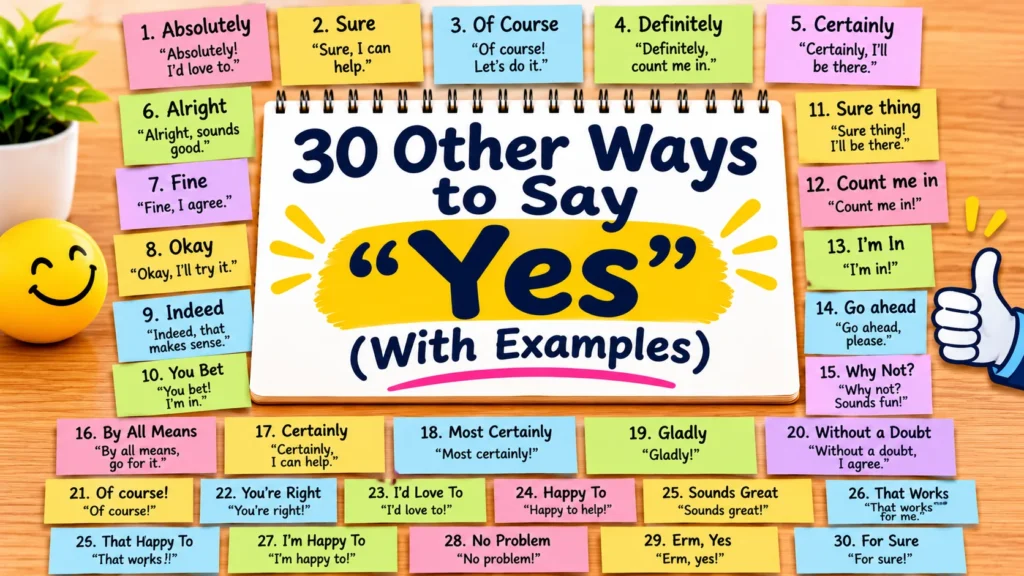
Here is a complete list of 30 other ways to say okay, with options for casual conversations, professional communication, and thoughtful responses.
- All Right
- Sounds Good
- Sure
- Absolutely
- Certainly
- Understood
- Got It
- No Problem
- That Works for Me
- That’s Fine
- Perfect
- Great
- Fair Enough
- I Agree
- I Understand
- Of Course
- No Worries
- Consider It Done
- I’m Fine With That
- Works for Me
- Accepted
- Agreed
- Noted
- Very Well
- That’s Acceptable
- I’m On Board
- You Have My Word
- Happy to Help
- Everything Is Fine
- That’s Settled
1. All Right
Meaning:
All right means that something is acceptable, satisfactory, or agreed upon. It is a natural alternative to “okay” when you want to show that you have no objection.
Definition:
It is an expression used to communicate agreement, acceptance, confirmation, or reassurance that something is satisfactory.
Detailed Explanation:
“All right” is one of the most versatile alternatives to “okay.” You can use it when accepting a suggestion, confirming a plan, or acknowledging someone’s request. It sounds natural in everyday conversations and can also work in informal professional settings. For example, if a colleague suggests moving a meeting to another time, saying “all right” shows that you accept the change. Your tone matters because it can sound either friendly or slightly reluctant.
Scenario Examples:
- “Can we talk about this after lunch?” — “All right, that works for me.”
- “I’ll send you the details tonight.” — “All right, thank you.”
Best Use:
Use all right when accepting arrangements, responding to suggestions, or confirming everyday plans.
Tone:
Natural, relaxed, agreeable, and conversational.
2. Sounds Good
Meaning:
Sounds good means that you like a suggestion or find a proposed arrangement suitable. It shows that you are comfortable with the idea.
Definition:
It is an informal expression used to communicate approval, agreement, or acceptance of a suggestion or plan.
Detailed Explanation:
“Sounds good” is a friendly way to respond when someone proposes an idea or makes plans with you. It feels more engaging than a plain “okay” because it suggests that you find the suggestion appealing. You can use it when arranging a meeting, accepting an invitation, or agreeing to a shared activity. It is also common in workplace messages when confirming a straightforward arrangement. If the decision is important, add a little detail to make your agreement clear.
Scenario Examples:
- “Let’s meet at 5 p.m. tomorrow.” — “Sounds good! I’ll see you then.”
- “I’ll prepare the first draft for your review.” — “Sounds good. Thanks for handling that.”
Best Use:
Use sounds good when accepting plans, suggestions, invitations, or arrangements.
Tone:
Friendly, positive, relaxed, and agreeable.
3. Sure
Meaning:
Sure means yes, certainly, or that something is acceptable to you. It is a simple way to show agreement or willingness.
Definition:
It is an informal expression used to communicate acceptance, permission, or willingness to do something.
Detailed Explanation:
“Sure” works well in everyday conversations because it sounds natural and uncomplicated. You can use it when someone asks for help, invites you somewhere, or suggests a simple change. It can also make you sound approachable and cooperative. However, the way you say it affects how it feels. A cheerful “sure!” sounds welcoming, while a flat “sure” may come across as uninterested. If you want to sound more enthusiastic, try “Absolutely” or “I’d be happy to.”
Scenario Examples:
- “Can you help me with this assignment?” — “Sure! Let’s work on it together.”
- “Would you like to join us for dinner?” — “Sure, I’d love to.”
Best Use:
Use sure in casual conversations, friendly messages, and informal workplace exchanges.
Tone:
Casual, friendly, approachable, and cooperative.
4. Absolutely
Meaning:
Absolutely means completely, certainly, or without hesitation. It expresses strong agreement or enthusiastic acceptance.
Definition:
It is an adverb used to communicate definite approval, confidence, or wholehearted agreement.
Detailed Explanation:
When you say “Absolutely,” your response sounds more confident and enthusiastic than a simple “okay.” It is useful when someone asks whether you support an idea, accept an invitation, or are willing to help. It also works well in professional conversations because it shows a positive attitude. If someone suggests a useful improvement at work, responding with “absolutely” makes your support clear. Use it when you genuinely agree rather than when you feel uncertain.
Scenario Examples:
- “Would you be able to review the proposal?” — “Absolutely! I’ll look at it today.”
- “Should we move forward with this idea?” — “Absolutely. I think it’s worth trying.”
Best Use:
Use absolutely when expressing strong agreement, enthusiasm, or confident acceptance.
Tone:
Confident, enthusiastic, positive, and supportive.
5. Certainly
Meaning:
Certainly means yes, without hesitation or doubt. It is a polite way to accept a request or confirm something.
Definition:
It is an adverb used to express definite agreement, willingness, or confirmation.
Detailed Explanation:
“Certainly” is a good choice when you want your response to sound respectful and professional. It is especially useful when communicating with clients, colleagues, managers, or people you do not know well. Rather than replying with a short “okay,” you show that you are willing to cooperate. It also works well when someone asks you to clarify information or complete a reasonable task. The expression is slightly formal, so it may sound less natural in very casual conversations.
Scenario Examples:
- “Could you share the updated report?” — “Certainly. I’ll send it shortly.”
- “Would you mind explaining the process again?” — “Certainly. Let me walk you through it.”
Best Use:
Use certainly in professional emails, customer service conversations, meetings, and polite everyday interactions.
Tone:
Polite, professional, respectful, and reassuring.
6. Understood
Meaning:
Understood means that you have received and understood the information someone has shared. It confirms that their message is clear to you.
Definition:
It is a word used to acknowledge instructions, information, expectations, or explanations.
Detailed Explanation:
“Understood” is particularly useful when someone gives you instructions or explains what needs to be done. It communicates that you have listened and understand the message. In professional settings, it can sound more precise than “okay,” especially when confirming responsibilities or deadlines. However, it does not always mean that you agree with the information. It simply confirms your understanding. If you also want to show agreement, you can say, “Understood, I’ll take care of it.”
Scenario Examples:
- “Please submit the final document before Friday.” — “Understood. I’ll make sure it’s ready.”
- “The meeting has been moved to the afternoon.” — “Understood. Thanks for letting me know.”
Best Use:
Use understood when acknowledging instructions, confirming information, or showing that you have followed an explanation.
Tone:
Clear, professional, attentive, and composed.
7. Got It
Meaning:
Got it means that you understand or have received the information. It is a casual way to acknowledge a message.
Definition:
It is an informal expression used to confirm understanding, acknowledge instructions, or show that information has been received.
Detailed Explanation:
“Got it” is a natural alternative when someone explains something or gives you a quick instruction. It lets them know that you have understood without requiring a long response. It works especially well in text messages, casual conversations, and informal workplace chats. However, if the information is sensitive or important, a more thoughtful response may be better. For example, “Got it, thanks for explaining” sounds warmer than a short reply on its own.
Scenario Examples:
- “Please remember to bring the documents tomorrow.” — “Got it!”
- “I’ll call you when I reach the office.” — “Got it. Talk to you soon.”
Best Use:
Use got it when acknowledging simple instructions, updates, or information in casual conversations.
Tone:
Casual, direct, friendly, and conversational.
8. No Problem
Meaning:
No problem means that something is not an inconvenience and that you are happy to accept or help.
Definition:
It is an informal expression used to communicate willingness, acceptance, or reassurance.
Detailed Explanation:
“No problem” is a friendly response when someone asks for a favor, apologizes, or expresses concern about inconveniencing you. It reassures them that their request is manageable. For example, if a colleague asks you to send a document again, saying “no problem” makes the exchange feel easy and positive. It can also be used when accepting a small change in plans. In formal settings, “certainly” or “I’d be happy to” may sound more polished.
Scenario Examples:
- “Sorry for asking you to check this again.” — “No problem. I’m happy to help.”
- “Could you send me the link?” — “No problem. I’ll share it now.”
Best Use:
Use no problem when accepting small requests, responding to apologies, or reassuring someone.
Tone:
Friendly, relaxed, reassuring, and helpful.
9. That Works for Me
Meaning:
That works for me means that a suggestion or arrangement is suitable for your needs, preferences, or schedule.
Definition:
It is a conversational expression used to accept a plan, schedule, or practical arrangement.
Detailed Explanation:
“That works for me” is especially helpful when discussing meeting times, deadlines, appointments, or shared plans. It confirms that you are comfortable with the proposed arrangement. Unlike a general “okay,” it makes clear that the suggestion is practical and convenient for you. It is common in professional emails and everyday conversations. You can make it warmer by adding a thank-you or a positive comment.
Scenario Examples:
- “Can we move our meeting to Wednesday morning?” — “That works for me.”
- “I’ll send the revised version by the end of the day.” — “That works for me. Thanks for the update.”
Best Use:
Use that works for me when confirming schedules, arrangements, or practical suggestions.
Tone:
Cooperative, practical, relaxed, and professional.
10. That’s Fine
Meaning:
That’s fine means that something is acceptable or satisfactory to you. It shows that you have no objection to a suggestion or arrangement.
Definition:
It is an expression used to communicate acceptance, approval, or a lack of objection.
Detailed Explanation:
“That’s fine” is a simple way to accept a suggestion or confirm that an arrangement is acceptable. It is useful when someone proposes a different time, asks to make a small change, or checks whether something is suitable. However, tone is important because the phrase can sometimes sound reluctant or dismissive. If you want to make your response warmer, try “That’s perfectly fine with me” or “That works well for me.”
Scenario Examples:
- “Would it be okay if I arrived a little later?” — “That’s fine. Take your time.”
- “Can we discuss this tomorrow instead?” — “That’s fine. Tomorrow works.”
Best Use:
Use that’s fine when accepting minor changes, confirming arrangements, or expressing that something is satisfactory.
Tone:
Neutral, polite, flexible, and accommodating.
11. Perfect
Meaning:
Perfect means that something is exactly right or completely suitable. It shows strong approval of a suggestion or arrangement.
Definition:
It is an adjective commonly used as an informal expression of approval, satisfaction, or enthusiastic agreement.
Detailed Explanation:
“Perfect” is a positive alternative when a plan or suggestion suits you especially well. It is useful when confirming appointments, accepting arrangements, or responding to helpful information. The word adds enthusiasm to your answer and makes the other person feel that their suggestion is appreciated. It is common in casual conversations and informal workplace communication. However, avoid using it when something is only partly acceptable, as it may suggest complete satisfaction.
Scenario Examples:
- “I’ll meet you outside the library at 4 p.m.” — “Perfect! See you there.”
- “I’ve finished the changes you requested.” — “Perfect. Thank you for your work.”
Best Use:
Use perfect when a plan, suggestion, or arrangement suits you very well.
Tone:
Positive, enthusiastic, appreciative, and confident.
12. Great
Meaning:
Great means that something is very good, suitable, or pleasing. It is a cheerful way to express approval or agreement.
Definition:
It is an adjective often used conversationally to show enthusiasm, satisfaction, or acceptance.
Detailed Explanation:
“Great” is a friendly alternative to “okay” when you want to sound more positive. It works well when someone shares good news, suggests a plan, or offers an opportunity. It can also make a simple confirmation feel more encouraging. For example, if a friend suggests meeting for coffee, “great” shows that you welcome the idea. In professional communication, it is suitable for many informal exchanges, although a more specific response may be better for important decisions.
Scenario Examples:
- “Would you like to join the workshop?” — “Great! I’d love to.”
- “The client approved our proposal.” — “Great! That’s wonderful news.”
Best Use:
Use great when expressing positive approval, accepting invitations, or responding to good news.
Tone:
Cheerful, enthusiastic, friendly, and encouraging.
13. Fair Enough
Meaning:
Fair enough means that you accept or understand someone’s point, decision, or explanation. It suggests that their position is reasonable.
Definition:
It is an informal expression used to acknowledge that something is understandable, reasonable, or acceptable.
Detailed Explanation:
“Fair enough” is useful when someone explains a decision or gives a reason you can accept. It does not always mean that you completely agree. Instead, it shows that you understand their perspective and recognize that it makes sense. This makes it helpful during discussions where people have different opinions. It can sound respectful when used sincerely, but a flat delivery may suggest that you are ending the conversation or feel slightly annoyed.
Scenario Examples:
- “I’d rather stay home tonight because I’m tired.” — “Fair enough. We can meet another day.”
- “We need another week to finish the project.” — “Fair enough. Let’s adjust the schedule.”
Best Use:
Use fair enough when acknowledging a reasonable explanation, accepting someone’s decision, or responding to a different viewpoint.
Tone:
Understanding, reasonable, casual, and accepting.
14. I Agree
Meaning:
I agree means that you share someone’s opinion or support their suggestion. It clearly communicates that you have the same view.
Definition:
It is a phrase used to express agreement with another person’s statement, idea, opinion, or decision.
Detailed Explanation:
“I agree” is a useful alternative when someone shares an opinion and wants your response. It is more specific than “okay” because it confirms that you support the point being discussed. You can use it in meetings, group discussions, personal conversations, and professional messages. To make your answer more thoughtful, add a reason for your agreement. This helps the other person understand your perspective and encourages a meaningful discussion.
Scenario Examples:
- “We should give everyone a chance to share their ideas.” — “I agree. Every perspective matters.”
- “This plan will help us save time.” — “I agree. It’s a practical approach.”
Best Use:
Use I agree when responding to opinions, suggestions, proposals, and decisions.
Tone:
Respectful, direct, thoughtful, and cooperative.
15. I Understand
Meaning:
I understand means that you recognize or comprehend what someone is saying. It can also show that you acknowledge their feelings or situation.
Definition:
It is a phrase used to communicate comprehension, awareness, or empathy toward another person’s explanation or experience.
Detailed Explanation:
“I understand” is especially useful when someone explains a problem, shares a concern, or tells you why they made a decision. It sounds more thoughtful than a short “okay” because it acknowledges their message. In emotional conversations, it can help the other person feel heard. However, understanding does not always mean agreeing. If someone is upset, you can add a supportive sentence to show that you care about their experience.
Scenario Examples:
- “I need a little more time to finish this.” — “I understand. Take the time you need.”
- “I’m feeling overwhelmed with everything happening.” — “I understand. I’m here if you need to talk.”
Best Use:
Use I understand when acknowledging explanations, instructions, concerns, or someone’s feelings.
Tone:
Empathetic, thoughtful, respectful, and reassuring.
16. Of Course
Meaning:
Of course means naturally, certainly, or without any objection. It shows that you are willing to accept a request or offer help.
Definition:
It is an expression used to communicate agreement, permission, willingness, or reassurance.
Detailed Explanation:
“Of course” is a warm and natural alternative to “okay.” It works well when someone asks for a favor, requests your help, or checks whether something is acceptable. The phrase can make the other person feel welcome rather than hesitant about asking. It is suitable for personal conversations and many professional situations. When responding to a sensitive request, a kind tone can make the expression feel especially reassuring.
Scenario Examples:
- “Can I ask you something personal?” — “Of course. I’m listening.”
- “Would you mind sharing your notes?” — “Of course! I’ll send them over.”
Best Use:
Use of course when accepting reasonable requests, offering support, or reassuring someone that you are happy to help.
Tone:
Warm, welcoming, reassuring, and polite.
17. No Worries
Meaning:
No worries means that something is not a problem or that you are comfortable with a request or situation.
Definition:
It is an informal expression used to reassure someone, accept a small inconvenience, or respond positively to an apology.
Detailed Explanation:
“No worries” is a relaxed way to communicate that everything is fine. It is often used when someone apologizes for being late, asks for a small favor, or worries about causing inconvenience. The expression can make conversations feel more comfortable because it removes unnecessary tension. It is especially common in friendly messages and casual workplace chats. For formal communication, a phrase such as “That’s perfectly fine” may be more suitable.
Scenario Examples:
- “Sorry I couldn’t reply earlier.” — “No worries. I hope everything is okay.”
- “Would it be possible to change the meeting time?” — “No worries. We can adjust it.”
Best Use:
Use no worries when reassuring someone, accepting minor changes, or responding casually to an apology.
Tone:
Relaxed, friendly, reassuring, and easygoing.
18. Consider It Done
Meaning:
Consider it done means that you accept a task and are confident you will complete it.
Definition:
It is an expression used to confirm responsibility for an action, request, or assignment.
Detailed Explanation:
“Consider it done” is a confident way to respond when someone asks you to handle a specific task. It communicates that you understand the request and are ready to take responsibility. It is particularly useful in workplace conversations when discussing assignments, deadlines, or practical responsibilities. The phrase can reassure the other person that they do not need to worry about the task. However, use it only when you can genuinely follow through on your promise.
Scenario Examples:
- “Could you arrange the meeting room for tomorrow?” — “Consider it done.”
- “Please send the updated presentation to the client.” — “Consider it done. I’ll take care of it.”
Best Use:
Use consider it done when confidently accepting responsibilities or promising to complete a specific task.
Tone:
Confident, decisive, reliable, and professional.
19. I’m Fine With That
Meaning:
I’m fine with that means that you accept a suggestion or arrangement and have no objection to it.
Definition:
It is a conversational expression used to communicate comfort, acceptance, or willingness to agree with a proposal.
Detailed Explanation:
“I’m fine with that” is useful when someone suggests a plan or asks whether you are comfortable with a particular decision. It shows that you are willing to accept the arrangement, even if it is not necessarily your first choice. It is common in everyday conversations and informal workplace discussions. However, it can sometimes sound neutral rather than enthusiastic. If you genuinely like the idea, “That sounds great” may communicate more excitement.
Scenario Examples:
- “Would you prefer to have the meeting online?” — “I’m fine with that.”
- “We may need to change the travel date.” — “I’m fine with that. Just let me know.”
Best Use:
Use I’m fine with that when accepting arrangements, expressing flexibility, or showing that you have no objection.
Tone:
Neutral, flexible, accommodating, and relaxed.
20. Works for Me
Meaning:
Works for me means that a plan or suggestion is suitable and convenient for you.
Definition:
It is an informal expression used to accept an arrangement, schedule, or proposal that meets your needs.
Detailed Explanation:
“Works for me” is a shorter alternative to “that works for me.” It is especially useful when discussing meeting times, appointments, deadlines, or plans with other people. It confirms that the suggestion is practical and acceptable. The expression is common in spoken English and workplace messaging. Although it is clear and natural, it may sound slightly brief in a sensitive conversation where a warmer response is needed.
Scenario Examples:
- “Let’s have lunch at noon.” — “Works for me!”
- “I’ll share the final document this evening.” — “Works for me. Thanks.”
Best Use:
Use works for me when confirming convenient schedules, plans, or practical arrangements.
Tone:
Casual, practical, cooperative, and straightforward.
21. Accepted
Meaning:
Accepted means that you have agreed to receive, approve, or take something. It communicates a clear decision.
Definition:
It is a word used to confirm approval, agreement, or willingness to receive an offer or proposal.
Detailed Explanation:
“Accepted” is a concise response that works particularly well in formal or structured situations. You might use it when responding to an invitation, confirming an offer, or acknowledging a proposal. It sounds direct and leaves little doubt about your decision. However, it can feel cold or overly official in friendly conversations. If you want to sound warmer, you can say, “I’d be happy to accept” or “Thank you, I’d love to.”
Scenario Examples:
- “Your application has been approved. Would you like to accept the offer?” — “Accepted. Thank you.”
- “Can we proceed with the revised terms?” — “Accepted.”
Best Use:
Use accepted in formal exchanges, official confirmations, and situations where a clear decision is required.
Tone:
Formal, direct, decisive, and official.
22. Agreed
Meaning:
Agreed means that you share the same opinion or accept a decision. It confirms that you are in agreement.
Definition:
It is a word used to express mutual understanding, approval, or acceptance of a proposal or decision.
Detailed Explanation:
“Agreed” is useful when you want to confirm that you support a plan or decision. It is common in meetings, negotiations, group discussions, and professional messages. The word can also show that everyone involved has reached a shared understanding. Unlike “okay,” it specifically communicates agreement rather than simple acknowledgment. In personal conversations, it may sound slightly formal, so a more relaxed phrase may be preferable.
Scenario Examples:
- “Let’s finish the research before writing the report.” — “Agreed. That makes sense.”
- “We should discuss the budget before making a final decision.” — “Agreed.”
Best Use:
Use agreed when confirming shared decisions, supporting proposals, or expressing agreement during discussions.
Tone:
Professional, direct, cooperative, and decisive.
23. Noted
Meaning:
Noted means that you have received and acknowledged information. It confirms that you have taken something into consideration.
Definition:
It is a word used to acknowledge instructions, updates, requests, or information that someone has shared.
Detailed Explanation:
“Noted” is common in workplace communication when you want to confirm that you have received a message. It is useful for acknowledging deadlines, changes, reminders, and instructions. However, it does not necessarily mean that you agree with the information or have completed the requested action. It simply shows that you have taken note of it. In friendly or sensitive conversations, it may sound too brief, so consider adding a thank-you or a more personal response.
Scenario Examples:
- “Please remember to update the client records.” — “Noted. I’ll review them today.”
- “The deadline has changed to Monday.” — “Noted. Thank you for the update.”
Best Use:
Use noted when acknowledging information, instructions, or updates in professional communication.
Tone:
Concise, formal, neutral, and professional.
24. Very Well
Meaning:
Very well means all right, certainly, or that you accept something. It can communicate agreement in a composed way.
Definition:
It is an expression used to indicate acceptance, approval, or willingness to proceed with a suggestion or request.
Detailed Explanation:
“Very well” is a slightly formal alternative to “okay.” It is useful when accepting a decision, responding to a request, or agreeing to proceed with an arrangement. It sounds calm and controlled, making it suitable for formal discussions and polite exchanges. However, in casual conversations, it may seem old-fashioned or distant. If you want a more natural everyday response, “all right” or “sounds good” may be better.
Scenario Examples:
- “Let’s begin the discussion after everyone arrives.” — “Very well.”
- “Would you prefer to review the documents tomorrow?” — “Very well. That should be fine.”
Best Use:
Use very well when accepting a suggestion or decision in a formal or composed conversation.
Tone:
Formal, composed, polite, and measured.
25. That’s Acceptable
Meaning:
That’s acceptable means that something meets your requirements or is suitable enough for you to agree to it.
Definition:
It is an expression used to communicate approval or acceptance when a proposal or arrangement meets reasonable expectations.
Detailed Explanation:
“That’s acceptable” is useful when evaluating an offer, proposal, schedule, or set of conditions. It shows that you are comfortable proceeding because the suggestion meets your expectations. The phrase is particularly appropriate in professional discussions, negotiations, and formal exchanges. However, it can sound somewhat distant because it communicates approval without much warmth. If you want to sound friendlier, consider saying, “That works well for me.”
Scenario Examples:
- “We can deliver the order by Thursday instead of Wednesday.” — “That’s acceptable.”
- “Would this revised schedule meet your requirements?” — “That’s acceptable. We can proceed.”
Best Use:
Use that’s acceptable when approving proposals, arrangements, or terms in formal and professional situations.
Tone:
Formal, measured, neutral, and professional.
26. I’m On Board
Meaning:
I’m on board means that you support an idea, agree with a plan, or are willing to participate.
Definition:
It is an informal expression used to communicate agreement, support, and commitment to a shared goal.
Detailed Explanation:
When you say “I’m on board,” you show that you are not only accepting an idea but are also willing to support it. It is especially common in team discussions, collaborative projects, and workplace conversations. The expression can create a sense of shared responsibility and teamwork. It is also useful when someone asks whether you support a new direction or proposal. If the plan involves specific responsibilities, clarify what you are agreeing to contribute.
Scenario Examples:
- “We want to introduce a new customer support system.” — “I’m on board. It could improve our service.”
- “Would you like to help with the community project?” — “I’m on board. Count me in.”
Best Use:
Use I’m on board when supporting a team decision, shared plan, or collaborative project.
Tone:
Supportive, cooperative, enthusiastic, and confident.
27. You Have My Word
Meaning:
You have my word means that you are making a sincere promise or giving someone your assurance.
Definition:
It is an expression used to communicate a firm commitment, guarantee, or promise that you intend to keep.
Detailed Explanation:
“You have my word” is stronger than a simple “okay” because it communicates personal responsibility. It is useful when someone needs reassurance that you will do something or keep a commitment. The phrase can build trust because it suggests that you take your promise seriously. However, it should not be used casually for every small request. Only say it when you genuinely intend to follow through on what you have promised.
Scenario Examples:
- “Will you keep this information private?” — “You have my word.”
- “Can I trust you to finish the task by Friday?” — “You have my word. I’ll complete it.”
Best Use:
Use you have my word when making a sincere promise or reassuring someone about an important commitment.
Tone:
Trustworthy, serious, reassuring, and committed.
28. Happy to Help
Meaning:
Happy to help means that you are pleased and willing to assist someone. It expresses agreement with a helpful and positive attitude.
Definition:
It is an expression used to communicate willingness, kindness, and enthusiasm when offering or accepting an opportunity to help.
Detailed Explanation:
“Happy to help” is a warm alternative when someone asks for assistance or thanks you for doing something. It makes your response feel more personal because it shows that helping is not a burden. It is useful in customer service, workplace conversations, and everyday interactions. You can also use it after completing a task to reassure someone that they are welcome to ask again. It is especially effective when you want to build a friendly and supportive relationship.
Scenario Examples:
- “Could you show me how to use this tool?” — “Happy to help. Let’s go through it.”
- “Thank you for helping me with the presentation.” — “Happy to help! Anytime.”
Best Use:
Use happy to help when accepting requests for assistance or responding warmly to someone’s thanks.
Tone:
Helpful, warm, considerate, and welcoming.
29. Everything Is Fine
Meaning:
Everything is fine means that there is no problem or that a situation is satisfactory. It can reassure someone that things are going well.
Definition:
It is a phrase used to communicate reassurance, satisfaction, or the absence of a problem.
Detailed Explanation:
“Everything is fine” is useful when someone asks whether you are okay or worries that something has gone wrong. It can reassure them that there is no issue and that the situation is under control. However, it is not always a direct replacement for “okay.” It focuses more on describing a situation than accepting a request. Use it when you genuinely want to reassure someone. If something is bothering you, honest communication is better than saying everything is fine when it is not.
Scenario Examples:
- “Are you okay? You seem a little quiet.” — “Everything is fine. I just need a moment.”
- “Did something go wrong with the arrangements?” — “Everything is fine. We’ve taken care of it.”
Best Use:
Use everything is fine when reassuring someone or confirming that a situation is satisfactory.
Tone:
Reassuring, calm, comforting, and positive.
30. That’s Settled
Meaning:
That’s settled means that a decision has been made and the matter is now resolved.
Definition:
It is an expression used to confirm that an agreement, arrangement, or decision has been finalized.
Detailed Explanation:
“That’s settled” is useful when a discussion has reached a clear conclusion. It shows that everyone has agreed on what will happen next. You can use it when finalizing plans, confirming arrangements, or closing a discussion about a decision. It sounds confident and decisive. However, it may feel too final if other people still want to share their opinions. Make sure everyone has had a chance to contribute before using it.
Scenario Examples:
- “So we’re meeting at the office on Monday?” — “That’s settled. I’ll see you there.”
- “We’ll use the second design for the campaign.” — “That’s settled. Let’s move forward.”
Best Use:
Use that’s settled when confirming a final decision, agreement, or arrangement.
Tone:
Decisive, confident, conclusive, and practical.
Conclusion
Finding different ways to say “okay” can make your conversations more natural, polite, and expressive. Phrases like “sounds good,” “absolutely,” “certainly,” “no problem,” and “understood” help you communicate agreement, acceptance, and understanding without repeating the same word. Each alternative has a slightly different tone, making it easier to choose an expression that fits the situation.
Whether you’re responding to a friend, accepting a suggestion, or communicating with colleagues, the right phrase can make your message clearer and more meaningful. Try using these 30 alternatives to “okay” in your everyday conversations and writing to add variety to your vocabulary and express yourself with greater confidence.