
The word “interesting” is a simple way to show that something has caught your attention, but using it repeatedly can make your conversations and writing sound predictable. Whether you’re talking about a new idea, sharing your thoughts, or responding to someone’s story, choosing different words can make your message more natural and engaging. A little variety can help you express exactly what you mean.
Sometimes, interesting means something is exciting or surprising. Other times, it describes an idea that makes you think, a story that holds your attention, or a topic you want to explore further. Words like fascinating, intriguing, thought-provoking, and captivating can communicate these different feelings more clearly. Each alternative adds its own meaning and helps you choose the right expression for the situation.
In this guide, you’ll discover 30 other ways to say “interesting”, along with practical examples to help you use them naturally. Whether you’re writing an email, having a casual conversation, or creating professional content, these alternatives will help you sound more expressive. You’ll also learn how to choose words that make your responses feel genuine rather than repetitive.
What Does “Interesting” Mean?
The word “interesting” describes something that attracts your attention, makes you curious, or encourages you to think about it. It can refer to a person, conversation, idea, experience, subject, or event that holds your attention for some reason. For example, saying “That is an interesting idea” shows that you find someone’s suggestion worth considering. Similarly, describing a book as interesting means that its content keeps you engaged. Depending on the context, “interesting” can express curiosity, admiration, surprise, or intellectual excitement.
Is It Professional or Polite to Say “Interesting”?
Yes, “interesting” is generally professional and polite. It is commonly used in workplace conversations, emails, presentations, and everyday discussions. You can use it to acknowledge someone’s idea or show that you are paying attention. However, the word can sometimes sound vague if you don’t explain what you find interesting. Alternatives such as insightful, thought-provoking, compelling, and fascinating help you give a more specific response. For example, instead of saying “That’s interesting,” you could say, “That’s a thought-provoking perspective.” This makes your response more engaging and meaningful.
Advantages of Using “Interesting”
- Shows curiosity: It communicates that something has caught your attention and makes you want to learn more.
- Encourages conversation: It gives people a positive way to respond to ideas, stories, and experiences.
- Works in different situations: It fits naturally into professional discussions, casual conversations, and written communication.
Disadvantages of Using “Interesting”
- Can sound vague: It may not explain what exactly caught your attention.
- Can become repetitive: Using it too frequently can make your writing feel predictable.
- May sound neutral: Depending on your tone, it might not communicate strong excitement or admiration.
30 Alternatives to “Interesting”
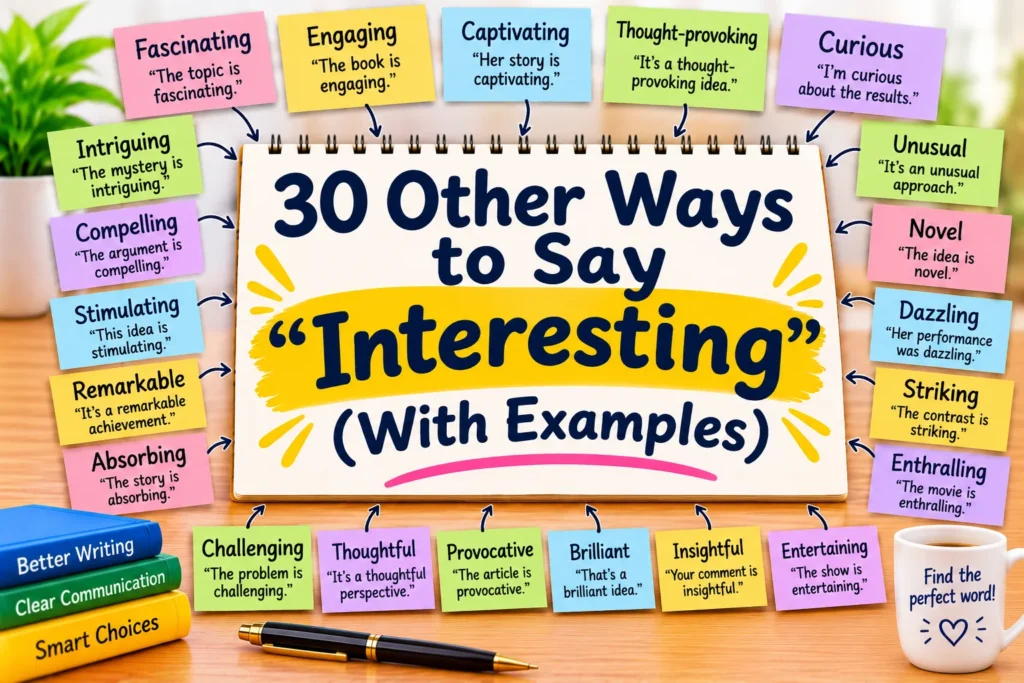
Here is a complete list of 30 alternatives to “interesting.” Each expression has a slightly different meaning, so choose one that matches the idea or experience you’re describing.
- Fascinating
- Intriguing
- Engaging
- Captivating
- Thought-Provoking
- Compelling
- Stimulating
- Insightful
- Informative
- Absorbing
- Engrossing
- Appealing
- Remarkable
- Curious
- Intricate
- Eye-Opening
- Enlightening
- Entertaining
- Noteworthy
- Unusual
- Unconventional
- Impressive
- Riveting
- Mesmerizing
- Thoughtful
- Original
- Fresh
- Surprising
- Worthwhile
- Intriguing to Explore
1. Fascinating
Meaning: Extremely interesting and capable of holding someone’s attention.
Definition: Fascinating describes something that creates strong curiosity, admiration, or excitement.
Detailed Explanation: This is one of the strongest alternatives to “interesting.” It works when something captures your attention so completely that you want to learn more. You can use it when discussing a person’s experiences, a scientific discovery, a book, or an unusual subject. It communicates genuine enthusiasm rather than simple acknowledgment.
Scenario Examples:
- “Your research on human behavior is fascinating.”
- “We had a fascinating conversation about different cultures.”
Best Use: Use fascinating when describing subjects, stories, discoveries, conversations, or experiences that hold your attention.
Tone: Enthusiastic, curious, appreciative, and engaging.
2. Intriguing
Meaning: Interesting in a way that creates curiosity or mystery.
Definition: Intriguing describes something that makes people curious and encourages them to discover more.
Detailed Explanation: Choose this word when something catches your attention because it is unusual, mysterious, or not immediately clear. It works particularly well when discussing new ideas, unexpected behavior, or complex situations. Unlike a general compliment, it suggests that something has made you think and ask questions.
Scenario Examples:
- “You shared an intriguing perspective on the problem.”
- “The novel begins with an intriguing mystery.”
Best Use: Use intriguing when describing unusual ideas, mysteries, theories, or situations that invite further exploration.
Tone: Curious, thoughtful, slightly mysterious, and engaging.
3. Engaging
Meaning: Holding someone’s attention and encouraging involvement.
Definition: Engaging describes something that keeps people interested and makes them want to participate.
Detailed Explanation: This alternative is useful when talking about conversations, presentations, lessons, and people who communicate effectively. It focuses on how something connects with an audience rather than simply being unusual. It is especially helpful in professional feedback because it identifies a positive quality.
Scenario Examples:
- “You gave an engaging presentation that kept everyone involved.”
- “She has an engaging way of explaining difficult topics.”
Best Use: Use engaging when describing speakers, conversations, presentations, classes, and activities.
Tone: Positive, friendly, encouraging, and professional.
4. Captivating
Meaning: So interesting or attractive that it holds your attention completely.
Definition: Captivating describes something that attracts attention and makes it difficult to look away or stop listening.
Detailed Explanation: This word is stronger than “interesting” because it suggests that something has a powerful effect on the audience. It works well for stories, performances, personalities, and visual experiences. It can make your compliment feel more expressive and memorable.
Scenario Examples:
- “Her storytelling was captivating from beginning to end.”
- “The documentary offers a captivating look at ocean life.”
Best Use: Use captivating when describing stories, performances, people, presentations, or experiences that hold attention.
Tone: Expressive, admiring, enthusiastic, and warm.
5. Thought-Provoking
Meaning: Encouraging people to think deeply about something.
Definition: Thought-provoking describes an idea, question, or experience that inspires reflection or careful consideration.
Detailed Explanation: This expression is useful when something challenges your assumptions or encourages you to see a subject differently. It is especially effective when discussing books, films, conversations, research, and social issues. It shows that you appreciate the deeper meaning of what someone has shared.
Scenario Examples:
- “Your comments raised some thought-provoking questions.”
- “The film presents a thought-provoking view of modern society.”
Best Use: Use thought-provoking when discussing meaningful ideas, debates, articles, books, and conversations.
Tone: Reflective, intellectual, respectful, and thoughtful.
6. Compelling
Meaning: So convincing or interesting that it attracts attention.
Definition: Compelling describes something that creates strong interest or makes people want to pay attention.
Detailed Explanation: This word is especially useful when an idea, argument, or story is powerful enough to hold someone’s attention. It can also suggest that an explanation is convincing. In professional communication, it helps you recognize ideas that are both engaging and persuasive.
Scenario Examples:
- “You made a compelling argument during the discussion.”
- “The article tells a compelling story about personal growth.”
Best Use: Use compelling when describing arguments, evidence, stories, presentations, or persuasive ideas.
Tone: Confident, thoughtful, professional, and persuasive.
7. Stimulating
Meaning: Encouraging mental activity, interest, or excitement.
Definition: Stimulating describes something that encourages people to think, learn, or become mentally engaged.
Detailed Explanation: This alternative works well when discussing conversations, learning experiences, creative activities, or challenging ideas. It suggests that something gives your mind fresh material to explore. It is a good choice when you want to praise a discussion that leaves you thinking.
Scenario Examples:
- “The workshop was stimulating and full of practical ideas.”
- “I always enjoy stimulating conversations with curious people.”
Best Use: Use stimulating when describing intellectual discussions, educational activities, creative projects, and challenging experiences.
Tone: Intellectual, energetic, positive, and thoughtful.
8. Insightful
Meaning: Showing a clear and deep understanding of something.
Definition: Insightful describes an idea, comment, or observation that reveals useful understanding.
Detailed Explanation: This word is especially useful when someone shares a thoughtful observation or explains a difficult subject clearly. Rather than simply saying their comments are interesting, you can use insightful to recognize the value of their thinking. It is a strong choice for professional feedback and meaningful conversations.
Scenario Examples:
- “Your feedback was insightful and helped us improve the plan.”
- “She shared an insightful observation about customer behavior.”
Best Use: Use insightful when praising someone’s analysis, advice, feedback, or understanding.
Tone: Respectful, intelligent, appreciative, and professional.
9. Informative
Meaning: Providing useful facts, knowledge, or information.
Definition: Informative describes something that teaches people about a subject or helps them understand it better.
Detailed Explanation: This alternative is useful when a conversation, article, presentation, or experience gives you valuable information. It focuses on what you learn rather than how entertaining something is. It is particularly suitable for educational and professional settings.
Scenario Examples:
- “Your presentation was informative and easy to follow.”
- “I found the discussion about digital marketing very informative.”
Best Use: Use informative when describing lessons, articles, presentations, reports, and discussions that provide knowledge.
Tone: Professional, clear, positive, and educational.
10. Absorbing
Meaning: So interesting that it completely holds your attention.
Definition: Absorbing describes something that keeps someone deeply involved or focused.
Detailed Explanation: This word is particularly useful when describing books, films, activities, and conversations that make you lose track of time. It suggests that the experience is enjoyable enough to hold your attention without much effort. It gives your description more detail than simply calling something interesting.
Scenario Examples:
- “The book was so absorbing that I finished it in one evening.”
- “We had an absorbing discussion about the history of language.”
Best Use: Use absorbing when describing books, films, activities, and conversations that keep you fully engaged.
Tone: Engaged, appreciative, descriptive, and positive.
11. Engrossing
Meaning: Holding someone’s attention completely.
Definition: Engrossing describes something so interesting that a person becomes fully involved in it.
Detailed Explanation: This alternative is similar to “absorbing” and works well when describing stories, films, games, and discussions. It suggests that something has captured your attention for a long time. It is especially useful when you want to explain why an experience was difficult to put aside.
Scenario Examples:
- “The mystery novel was engrossing from the first chapter.”
- “The speaker shared an engrossing account of her travels.”
Best Use: Use engrossing when describing books, stories, films, presentations, or activities that hold attention.
Tone: Enthusiastic, descriptive, appreciative, and expressive.
12. Appealing
Meaning: Attractive, enjoyable, or interesting to someone.
Definition: Appealing describes something that attracts interest because of its qualities, appearance, or benefits.
Detailed Explanation: Choose this word when something catches your attention because it suits your preferences or needs. It can describe ideas, designs, opportunities, plans, and experiences. It is not always a direct substitute for “interesting,” but it works when you want to express positive attraction.
Scenario Examples:
- “Your proposal sounds appealing to our team.”
- “The book has an appealing combination of humor and practical advice.”
Best Use: Use appealing when describing opportunities, suggestions, designs, products, and ideas that attract attention.
Tone: Positive, friendly, thoughtful, and practical.
13. Remarkable
Meaning: Unusual or impressive enough to deserve attention.
Definition: Remarkable describes something that stands out because of its quality, achievement, or unusual nature.
Detailed Explanation: This word works when something catches your attention because it is better or more unusual than expected. It can describe a person’s abilities, a surprising result, or an impressive experience. It adds admiration to your message and makes your response more specific.
Scenario Examples:
- “She has a remarkable ability to explain complex ideas.”
- “The project has made remarkable progress in just a few weeks.”
Best Use: Use remarkable when describing achievements, talents, unusual experiences, or impressive developments.
Tone: Admiring, respectful, confident, and professional.
14. Curious
Meaning: Unusual or interesting enough to make someone want to know more.
Definition: Curious describes something that is strange, unexpected, or likely to create questions.
Detailed Explanation: This word can describe a situation, detail, or behavior that makes you wonder why something happened. It is a little different from “interesting” because it often carries a sense of mystery or surprise. It works well in casual conversations and descriptive writing.
Scenario Examples:
- “That’s a curious way to approach the problem.”
- “I noticed a curious detail in the final chapter.”
Best Use: Use curious when describing unusual details, unexpected situations, or things that invite questions.
Tone: Observant, conversational, thoughtful, and sometimes playful.
15. Intricate
Meaning: Having many connected details or complicated parts.
Definition: Intricate describes something that is detailed, complex, or carefully arranged.
Detailed Explanation: This word is useful when something interests you because of its complexity or craftsmanship. It can describe designs, systems, stories, artwork, and explanations. While it does not directly mean interesting, it works when the detailed nature of something is what makes it worth exploring.
Scenario Examples:
- “The artist created an intricate pattern using simple materials.”
- “The documentary explains the intricate relationships within the ecosystem.”
Best Use: Use intricate when describing complex designs, detailed artwork, systems, or carefully developed ideas.
Tone: Descriptive, thoughtful, analytical, and appreciative.
16. Eye-Opening
Meaning: Revealing something new or changing how someone understands a subject.
Definition: Eye-opening describes an experience or piece of information that gives someone a new perspective.
Detailed Explanation: This expression is useful when something teaches you something unexpected or helps you recognize a different side of an issue. It can make your response more meaningful because it explains how the experience affected your thinking. It works especially well for documentaries, conversations, and educational experiences.
Scenario Examples:
- “The interview was eye-opening and changed how I viewed the issue.”
- “It was an eye-opening experience learning about different cultures.”
Best Use: Use eye-opening when describing discoveries, educational experiences, conversations, or information that changes your perspective.
Tone: Reflective, curious, thoughtful, and appreciative.
17. Enlightening
Meaning: Giving someone greater knowledge or understanding.
Definition: Enlightening describes something that helps people understand a subject more clearly or see it from a new perspective.
Detailed Explanation: Choose this word when a discussion, lesson, or experience teaches you something valuable. It suggests that you gained a deeper understanding rather than simply being entertained. It is particularly effective when expressing appreciation for someone’s knowledge or explanation.
Scenario Examples:
- “Thank you for such an enlightening discussion.”
- “The workshop was enlightening and gave me several new ideas.”
Best Use: Use enlightening when describing educational discussions, informative experiences, and helpful explanations.
Tone: Respectful, appreciative, thoughtful, and educational.
18. Entertaining
Meaning: Enjoyable and capable of keeping people interested.
Definition: Entertaining describes something that provides enjoyment, amusement, or pleasant engagement.
Detailed Explanation: This alternative is suitable when something holds your attention because it is funny, enjoyable, or lively. It is especially useful for describing films, stories, performances, and conversations. Unlike “interesting,” it places more emphasis on enjoyment and amusement.
Scenario Examples:
- “The speaker gave an entertaining presentation.”
- “We watched an entertaining documentary about wildlife.”
Best Use: Use entertaining when describing performances, stories, films, events, or enjoyable conversations.
Tone: Friendly, cheerful, relaxed, and positive.
19. Noteworthy
Meaning: Deserving attention because it is unusual, important, or impressive.
Definition: Noteworthy describes something that stands out and is worth mentioning.
Detailed Explanation: This word is useful when you want to point out a detail or development that deserves recognition. It sounds more formal than “interesting” and works well in reports, presentations, and professional feedback. It helps you communicate that something deserves more than a passing glance.
Scenario Examples:
- “The report includes several noteworthy findings.”
- “Your improvement in communication has been noteworthy.”
Best Use: Use noteworthy when discussing achievements, observations, findings, and developments that deserve attention.
Tone: Professional, thoughtful, measured, and respectful.
20. Unusual
Meaning: Different from what is common or expected.
Definition: Unusual describes something that is not ordinary because it has uncommon or unexpected qualities.
Detailed Explanation: This alternative is helpful when something catches your attention because it is different. It can describe behavior, experiences, designs, or ideas. Depending on the sentence, it can express curiosity, surprise, or admiration, so use it when difference is the main reason something interests you.
Scenario Examples:
- “That’s an unusual approach to solving the problem.”
- “We discovered an unusual plant during our walk.”
Best Use: Use unusual when describing uncommon ideas, unexpected details, or experiences that stand out.
Tone: Neutral, curious, descriptive, and sometimes surprised.
21. Unconventional
Meaning: Different from traditional or commonly accepted ways.
Definition: Unconventional describes an idea, method, or behavior that does not follow usual practices or expectations.
Detailed Explanation: This word is useful when you find something interesting because it challenges traditional thinking. It can describe creative solutions, unusual careers, artistic styles, and new approaches. It often carries a positive meaning when originality and independent thinking are appreciated.
Scenario Examples:
- “She suggested an unconventional solution to the challenge.”
- “The artist is known for an unconventional style.”
Best Use: Use unconventional when discussing original ideas, creative methods, and approaches that challenge expectations.
Tone: Creative, thoughtful, confident, and open-minded.
22. Impressive
Meaning: Causing admiration because of quality, skill, or achievement.
Definition: Impressive describes something that makes a strong positive impression.
Detailed Explanation: This word is useful when something catches your attention because it demonstrates skill, effort, or quality. It is particularly suitable for recognizing someone’s work or achievements. It goes beyond simple curiosity by communicating admiration.
Scenario Examples:
- “Your research findings are impressive.”
- “She shared an impressive collection of photographs.”
Best Use: Use impressive when praising skills, achievements, creative work, and professional performance.
Tone: Appreciative, positive, respectful, and professional.
23. Riveting
Meaning: Extremely interesting and able to hold someone’s attention completely.
Definition: Riveting describes something so engaging that people find it difficult to stop watching, listening, or reading.
Detailed Explanation: This is a strong alternative when describing a story, performance, or presentation that keeps you completely involved. It communicates excitement and sustained attention. It is particularly effective when you want to praise someone’s ability to tell a story or explain an experience.
Scenario Examples:
- “The documentary was riveting from the opening scene.”
- “She gave a riveting account of her journey.”
Best Use: Use riveting when describing films, stories, speeches, performances, and dramatic experiences.
Tone: Enthusiastic, expressive, admiring, and engaging.
24. Mesmerizing
Meaning: So attractive or fascinating that it holds someone’s attention.
Definition: Mesmerizing describes something that creates a powerful sense of fascination or wonder.
Detailed Explanation: This word works particularly well for describing beautiful visuals, performances, music, and natural scenes. It suggests that something has a captivating effect on the viewer or listener. It is more expressive than “interesting” and is best used when something truly holds your attention.
Scenario Examples:
- “The dancer’s performance was mesmerizing.”
- “We watched the mesmerizing colors of the northern lights.”
Best Use: Use mesmerizing when describing performances, scenery, artwork, music, or visually striking experiences.
Tone: Expressive, admiring, emotional, and appreciative.
25. Thoughtful
Meaning: Showing careful consideration, attention, or reflection.
Definition: Thoughtful describes something that demonstrates care, consideration, or meaningful thinking.
Detailed Explanation: This word can describe a comment, question, suggestion, or gesture that makes you stop and think. It is especially useful when you want to appreciate someone’s effort or consideration. Although it does not always mean interesting, it works when an idea attracts attention because it shows depth and care.
Scenario Examples:
- “You asked a thoughtful question during the meeting.”
- “That was a thoughtful observation about the situation.”
Best Use: Use thoughtful when appreciating meaningful comments, considerate gestures, and carefully developed ideas.
Tone: Warm, respectful, reflective, and appreciative.
26. Original
Meaning: New, unique, or different from existing ideas.
Definition: Original describes something that is created independently or has qualities that make it unique.
Detailed Explanation: This alternative works when an idea catches your attention because it is fresh or creative. It is useful when discussing artwork, writing, suggestions, designs, and problem-solving approaches. It allows you to recognize someone’s creativity rather than simply calling their work interesting.
Scenario Examples:
- “You presented an original idea for improving the website.”
- “The story has an original approach to a familiar subject.”
Best Use: Use original when praising creativity, unique ideas, artwork, writing, and innovative solutions.
Tone: Positive, encouraging, thoughtful, and creative.
27. Fresh
Meaning: New, different, or offering a new perspective.
Definition: Fresh describes an idea, approach, or perspective that feels new and different from what is usual.
Detailed Explanation: This word is useful when someone shares an idea that gives you another way to look at a situation. It often communicates appreciation for creativity and new thinking. In professional settings, it can be an encouraging way to recognize someone’s contribution.
Scenario Examples:
- “You brought a fresh perspective to the discussion.”
- “The campaign offers a fresh approach to reaching customers.”
Best Use: Use fresh when describing new ideas, creative approaches, and different perspectives.
Tone: Friendly, positive, encouraging, and open-minded.
28. Surprising
Meaning: Causing unexpected interest, excitement, or amazement.
Definition: Surprising describes something that happens or appears in a way that people did not expect.
Detailed Explanation: This alternative works when something catches your attention because it is unexpected. It can describe discoveries, results, events, and information. It is useful when you want to communicate curiosity along with a sense of surprise.
Scenario Examples:
- “The research revealed some surprising results.”
- “It was surprising to learn how much the town had changed.”
Best Use: Use surprising when describing unexpected information, discoveries, results, or experiences.
Tone: Curious, expressive, neutral, and sometimes excited.
29. Worthwhile
Meaning: Valuable enough to justify the time, effort, or attention given to it.
Definition: Worthwhile describes something that provides enough benefit, meaning, or enjoyment to make it worth doing or experiencing.
Detailed Explanation: This word is useful when you want to explain that a conversation, activity, or experience has genuine value. It focuses on the benefit you receive rather than simply how interesting something seems. It is particularly effective when recommending an activity or discussing a learning experience.
Scenario Examples:
- “The discussion was worthwhile and gave us several useful ideas.”
- “Reading the book was a worthwhile experience.”
Best Use: Use worthwhile when describing valuable discussions, activities, opportunities, and experiences.
Tone: Practical, positive, thoughtful, and encouraging.
30. Intriguing to Explore
Meaning: Worth investigating because it creates curiosity.
Definition: Intriguing to explore describes a subject or idea that encourages further discovery because it contains interesting questions or possibilities.
Detailed Explanation: This phrase works when you want to show that a topic deserves more attention. It is useful in academic discussions, research, creative writing, and conversations about new ideas. It also suggests that your interest goes beyond the first impression and that you would like to learn more.
Scenario Examples:
- “The relationship between language and culture is intriguing to explore.”
- “This topic is intriguing to explore from a historical perspective.”
Best Use: Use intriguing to explore when discussing research topics, complex ideas, new subjects, or questions that invite further investigation.
Tone: Curious, intellectual, thoughtful, and exploratory.
Conclusion
Finding different ways to say “interesting” can make your conversations and writing more engaging, natural, and expressive. Words like fascinating, intriguing, captivating, and thought-provoking help you describe what catches your attention without repeating the same word. Each alternative carries a slightly different meaning, so choosing the right one depends on your message and the situation.
Whether you’re writing a professional email, sharing an opinion, or responding to someone’s idea, the right expression can make your words more meaningful. Try using these 30 alternatives to “interesting” in your everyday communication to expand your vocabulary and express your thoughts with greater confidence.