
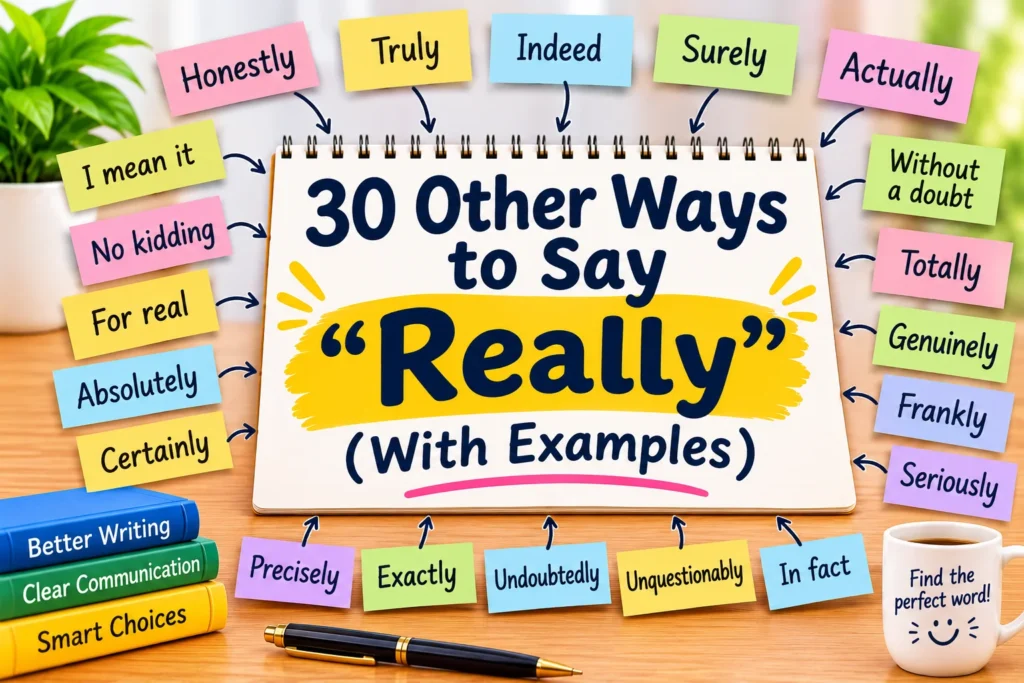

The word “really” is commonly used to add emphasis, express feelings, or show that something is true. While it works well in everyday conversations, using it too often can make your writing sound repetitive or less expressive. Choosing alternative words and phrases can help you communicate your thoughts more naturally and make your sentences more engaging.
Depending on the context, you can replace “really” with expressions like “truly,” “genuinely,” “extremely,” or “without a doubt.” Some alternatives are useful when expressing strong emotions, while others work better in professional emails, academic writing, or casual conversations. Understanding their meanings can help you choose the right expression without changing the message you want to convey.
In this guide, you’ll discover 30 other ways to say “really,” along with simple explanations and practical examples. These alternatives will help you expand your vocabulary, avoid repetitive language, and express yourself with greater confidence. Whether you’re writing an essay, sharing your feelings, or communicating at work, you’ll find useful expressions to make your words clearer and more meaningful.
What Does “Really” Mean?
The word “really” is used to emphasize something, show that a statement is true, or express a strong feeling. It can mean truly, actually, or very, depending on the sentence. For example, when you say, “I really appreciate your help,” you want the other person to understand how grateful you feel. Similarly, “That was really helpful” emphasizes how useful something was. The exact meaning depends on the context, so choosing the right alternative can make your message more precise.
Is It Professional or Polite to Say “Really”?
Yes, “really” is generally polite and acceptable in professional and everyday communication. You can use it in emails, conversations, and workplace messages to add emphasis or express appreciation. However, using it too often may make your writing sound repetitive or overly casual. In formal situations, alternatives such as genuinely, sincerely, particularly, and truly can help you communicate with greater clarity. The best choice depends on your audience, purpose, and the feeling you want to express.
Advantages of Using “Really”
- Adds emphasis: It helps you highlight an important point, feeling, or opinion.
- Sounds natural: It fits easily into everyday conversations and informal writing.
- Expresses strong feelings: It can make appreciation, excitement, concern, or interest more noticeable.
Disadvantages of Using “Really”
- Can sound repetitive: Using it in every other sentence may make your writing less engaging.
- Sometimes lacks precision: It does not always explain how strongly you feel or what you mean.
- May sound too casual: In formal writing, more specific alternatives can create a polished impression.
30 Alternatives to “Really”
Here is the complete list of alternatives you can use instead of “really.” Remember that some expressions work better in particular situations, so choose one that matches your intended meaning.
- Truly
- Genuinely
- Sincerely
- Actually
- Absolutely
- Definitely
- Certainly
- Honestly
- Indeed
- Extremely
- Incredibly
- Deeply
- Entirely
- Completely
- Utterly
- Exceptionally
- Remarkably
- Particularly
- Especially
- Seriously
- Wholeheartedly
- Earnestly
- Without a Doubt
- Undoubtedly
- Very Much
- For Real
- In All Honesty
- Beyond Measure
- Immensely
- Intensely
1. Truly
Meaning: In a genuine, honest, or sincere way.
Definition: Truly means that something is real, honest, or accurate. It can also emphasize how strongly you feel about something.
Detailed Explanation: This is one of the most natural alternatives to “really.” It works well when you want to express genuine appreciation, affection, or belief. It adds warmth without making your message sound overly dramatic.
Scenario Examples:
- “I truly appreciate everything you’ve done for me.”
- “She is truly one of the kindest people I know.”
Best Use: Use truly in heartfelt messages, professional appreciation, and sincere conversations.
Tone: Warm, sincere, respectful, and thoughtful.
2. Genuinely
Meaning: In an honest and authentic way.
Definition: Genuinely describes something that comes from real feelings, intentions, or qualities rather than pretending.
Detailed Explanation: Choose this word when you want people to understand that your feelings are authentic. It is especially useful when expressing interest, gratitude, concern, or admiration. It can make a message sound more personal and trustworthy.
Scenario Examples:
- “I genuinely enjoyed working with your team.”
- “She is genuinely interested in helping others.”
Best Use: Use genuinely in professional communication, personal conversations, and expressions of appreciation.
Tone: Honest, warm, authentic, and reassuring.
3. Sincerely
Meaning: In an honest and heartfelt manner.
Definition: Sincerely means expressing something with genuine feelings or honest intentions.
Detailed Explanation: This alternative is useful when you want to show that your words come from the heart. It works particularly well when expressing thanks, apologies, or support. Unlike “really,” it focuses more on honesty and intention than simply adding emphasis.
Scenario Examples:
- “I sincerely appreciate your time and support.”
- “We sincerely hope everything works out for you.”
Best Use: Use sincerely in formal emails, apologies, thank-you messages, and thoughtful conversations.
Tone: Respectful, genuine, professional, and caring.
4. Actually
Meaning: In fact or in reality.
Definition: Actually is used to introduce a fact, correct an assumption, or emphasize what is true.
Detailed Explanation: This word can replace “really” when you’re talking about something that is true or different from what someone might expect. However, it is not always interchangeable with “really.” It works best when you want to clarify information rather than express strong emotion.
Scenario Examples:
- “I actually enjoyed the presentation more than I expected.”
- “She actually completed the project ahead of schedule.”
Best Use: Use actually when correcting information, sharing facts, or explaining an unexpected situation.
Tone: Conversational, direct, informative, and sometimes surprising.
5. Absolutely
Meaning: Completely or without any doubt.
Definition: Absolutely means entirely, certainly, or with complete agreement.
Detailed Explanation: This is a strong alternative when you want to show confidence or enthusiasm. It can make your response sound more positive and convincing. It is especially useful when agreeing with someone or emphasizing how much you support an idea.
Scenario Examples:
- “I absolutely agree with your suggestion.”
- “Your presentation was absolutely wonderful.”
Best Use: Use absolutely when expressing agreement, excitement, confidence, or strong approval.
Tone: Confident, enthusiastic, positive, and emphatic.
6. Definitely
Meaning: Without uncertainty or hesitation.
Definition: Definitely means that something is certain, clear, or firmly decided.
Detailed Explanation: When you want to emphasize that you are sure about something, definitely is a natural choice. It communicates confidence and removes doubt from your statement. It is common in conversations and works well in professional messages when used appropriately.
Scenario Examples:
- “I will definitely attend the meeting tomorrow.”
- “This is definitely a valuable opportunity.”
Best Use: Use definitely to confirm plans, express certainty, or strongly support an opinion.
Tone: Confident, clear, friendly, and assured.
7. Certainly
Meaning: Without doubt or hesitation.
Definition: Certainly means that something is definite, assured, or accepted without question.
Detailed Explanation: This alternative can make your writing sound more polished than “really.” It is especially helpful when responding positively to a request or emphasizing a fact. It also works well in professional conversations because it sounds courteous and confident.
Scenario Examples:
- “I can certainly help you with that task.”
- “Your feedback is certainly valuable to our team.”
Best Use: Use certainly in workplace emails, formal conversations, and polite responses.
Tone: Courteous, professional, confident, and reassuring.
8. Honestly
Meaning: In a truthful or sincere way.
Definition: Honestly means speaking openly and truthfully without hiding your real thoughts or feelings.
Detailed Explanation: This word is useful when you want to express a personal opinion or make your feelings clear. It can add a sense of openness to your message. However, in some situations, it may sound slightly defensive, so consider your audience.
Scenario Examples:
- “I honestly appreciate how much effort you put into this.”
- “Honestly, I think your idea could make a real difference.”
Best Use: Use honestly in personal conversations, friendly messages, and informal professional discussions.
Tone: Open, direct, sincere, and conversational.
9. Indeed
Meaning: Certainly or in fact.
Definition: Indeed is used to emphasize a statement or confirm that something is true.
Detailed Explanation: This word can add emphasis while keeping your writing composed. It is often used to reinforce an earlier statement or agree with an observation. It may sound more formal than “really,” making it suitable for professional and academic writing.
Scenario Examples:
- “Your contribution was indeed important to the project’s success.”
- “It was indeed a memorable experience.”
Best Use: Use indeed in formal writing, professional communication, and thoughtful statements.
Tone: Formal, assured, composed, and emphatic.
10. Extremely
Meaning: To a very high degree.
Definition: Extremely describes something that has a particularly high level of a quality or condition.
Detailed Explanation: When “really” means “very,” extremely can be a stronger and more specific alternative. It works with adjectives and adverbs to communicate intensity. For example, instead of saying something is “really important,” you can describe it as “extremely important.”
Scenario Examples:
- “Your support has been extremely helpful.”
- “The team was extremely pleased with the results.”
Best Use: Use extremely when emphasizing the degree of a quality, feeling, or condition.
Tone: Strong, clear, expressive, and direct.
11. Incredibly
Meaning: To an unusually high or surprising degree.
Definition: Incredibly means extremely or remarkably, often suggesting that something is impressive or surprising.
Detailed Explanation: This word adds enthusiasm to your message. It works well when describing someone’s abilities, an impressive achievement, or a positive experience. It can make your writing more engaging because it communicates both intensity and admiration.
Scenario Examples:
- “You have been incredibly helpful throughout this process.”
- “Her dedication to the project is incredibly impressive.”
Best Use: Use incredibly when expressing admiration, excitement, or strong appreciation.
Tone: Enthusiastic, appreciative, expressive, and positive.
12. Deeply
Meaning: Strongly or with great emotional intensity.
Definition: Deeply describes a feeling, belief, or reaction that is strongly experienced.
Detailed Explanation: This alternative is particularly effective when discussing emotions or personal values. It communicates more than simple emphasis because it suggests that something matters on a meaningful level. Use it when you want your words to feel thoughtful and heartfelt.
Scenario Examples:
- “I am deeply grateful for your kindness.”
- “Your words deeply touched my heart.”
Best Use: Use deeply when expressing gratitude, concern, affection, respect, or emotional reactions.
Tone: Emotional, thoughtful, caring, and sincere.
13. Entirely
Meaning: Completely or in every part.
Definition: Entirely means fully, wholly, or without leaving anything out.
Detailed Explanation: This word works when “really” is being used to emphasize completeness. It is useful for explaining that something applies to the whole situation rather than only part of it. It can also make your writing more precise.
Scenario Examples:
- “I am entirely comfortable with your decision.”
- “The final result was entirely different from our expectations.”
Best Use: Use entirely when describing complete agreement, understanding, or difference.
Tone: Clear, measured, formal, and precise.
14. Completely
Meaning: Fully or in every possible way.
Definition: Completely means that nothing is missing or unfinished.
Detailed Explanation: This is a familiar alternative that works in both everyday and professional writing. It is especially useful when you want to emphasize that something is finished, understood, changed, or accepted in full. It makes your meaning easy to understand.
Scenario Examples:
- “I completely understand your concerns.”
- “The team completely transformed the presentation.”
Best Use: Use completely when expressing full understanding, agreement, or a total change.
Tone: Direct, natural, reassuring, and clear.
15. Utterly
Meaning: Completely or to the fullest degree.
Definition: Utterly is an adverb used to emphasize that something is complete or extreme.
Detailed Explanation: This word is stronger than many everyday alternatives to “really.” It often appears before adjectives such as ridiculous, amazing, exhausted, or impossible. Because it carries strong emphasis, use it when you want your statement to make a noticeable impression.
Scenario Examples:
- “The kindness you showed was utterly unforgettable.”
- “I was utterly surprised by the thoughtful gesture.”
Best Use: Use utterly in expressive writing and situations that call for strong emphasis.
Tone: Powerful, dramatic, expressive, and emphatic.
16. Exceptionally
Meaning: To an unusually high or outstanding degree.
Definition: Exceptionally describes something that is far above the usual standard.
Detailed Explanation: Choose this word when you want to highlight an impressive quality or achievement. It is especially effective in professional writing because it sounds specific and polished. Instead of saying someone is “really talented,” you can say they are “exceptionally talented.”
Scenario Examples:
- “She is an exceptionally thoughtful and reliable colleague.”
- “Your work on this project has been exceptionally good.”
Best Use: Use exceptionally in performance reviews, recommendations, professional praise, and descriptions of outstanding work.
Tone: Professional, appreciative, polished, and positive.
17. Remarkably
Meaning: In a way that deserves attention or admiration.
Definition: Remarkably describes something that is unusual, impressive, or worth noticing.
Detailed Explanation: This alternative works when you want to emphasize that something stands out from the ordinary. It can make a compliment or observation feel more meaningful. Use it when the quality or result is genuinely noteworthy.
Scenario Examples:
- “You handled that difficult situation remarkably well.”
- “The team made remarkably good progress this month.”
Best Use: Use remarkably when praising achievements, describing unusual results, or highlighting impressive qualities.
Tone: Observant, appreciative, thoughtful, and positive.
18. Particularly
Meaning: Especially or more than others.
Definition: Particularly means to a greater degree in a specific case or situation.
Detailed Explanation: This word is useful when you want to draw attention to one specific detail. It does not always mean the same thing as “really,” but it can replace it when the goal is to emphasize a particular quality. It helps make your message more focused.
Scenario Examples:
- “I particularly enjoyed the way you explained the topic.”
- “Your advice was particularly useful during the planning stage.”
Best Use: Use particularly when highlighting a specific feature, moment, or reason.
Tone: Thoughtful, precise, professional, and appreciative.
19. Especially
Meaning: More than usual or above others.
Definition: Especially is used to identify something that deserves special attention or emphasis.
Detailed Explanation: This alternative helps you show that one person, thing, or situation matters more in a particular context. It works naturally in everyday communication and professional writing. It is useful when you want to make your appreciation or preference more specific.
Scenario Examples:
- “I especially appreciate your patience during this process.”
- “The final section was especially helpful for new employees.”
Best Use: Use especially when emphasizing a specific person, quality, or part of an experience.
Tone: Friendly, appreciative, clear, and natural.
20. Seriously
Meaning: In a genuine, earnest, or important way.
Definition: Seriously means with sincerity, importance, or a lack of joking.
Detailed Explanation: This word can replace “really” in informal expressions when you want to show that you mean what you say. It can also emphasize how important something is. However, it may sound too casual for some formal situations.
Scenario Examples:
- “I seriously appreciate everything you’ve done.”
- “We need to seriously consider your suggestion.”
Best Use: Use seriously in casual conversations and direct discussions about important matters.
Tone: Direct, informal, earnest, and emphatic.
21. Wholeheartedly
Meaning: With complete sincerity and enthusiasm.
Definition: Wholeheartedly means doing or supporting something with full commitment and genuine feeling.
Detailed Explanation: This word is especially useful when expressing strong support or appreciation. It suggests that your feelings are complete and sincere rather than half-hearted. It can make a personal or professional message sound more encouraging.
Scenario Examples:
- “I wholeheartedly support your decision.”
- “We wholeheartedly appreciate your dedication to the team.”
Best Use: Use wholeheartedly when showing support, agreement, gratitude, or commitment.
Tone: Warm, encouraging, sincere, and supportive.
22. Earnestly
Meaning: With genuine seriousness and sincere intention.
Definition: Earnestly means doing or saying something with honesty, seriousness, and real interest.
Detailed Explanation: This alternative is helpful when you want to show that your words are not casual or careless. It communicates genuine effort and intention. It is often suitable for thoughtful conversations, formal statements, and situations where sincerity matters.
Scenario Examples:
- “I earnestly hope you find the opportunity you’re looking for.”
- “She earnestly tried to understand everyone’s concerns.”
Best Use: Use earnestly when expressing sincere wishes, serious intentions, or genuine efforts.
Tone: Sincere, serious, thoughtful, and respectful.
23. Without a Doubt
Meaning: Certainly or with complete confidence.
Definition: Without a doubt is an expression used to show that something is unquestionably true.
Detailed Explanation: This phrase is useful when you want to make your opinion sound firm and confident. It can emphasize a person’s qualities, an achievement, or a strong belief. Unlike “really,” it specifically communicates certainty.
Scenario Examples:
- “She is without a doubt one of our most reliable employees.”
- “This was without a doubt a memorable experience.”
Best Use: Use without a doubt when expressing confidence, admiration, or a strong opinion.
Tone: Assured, confident, emphatic, and positive.
24. Undoubtedly
Meaning: Certainly or beyond reasonable doubt.
Definition: Undoubtedly means that something is true or likely to be true without meaningful uncertainty.
Detailed Explanation: This word is useful when you want to emphasize a statement in a formal or professional way. It communicates confidence and can make your writing sound more authoritative. It is especially suitable for essays, reports, and thoughtful professional messages.
Scenario Examples:
- “Your experience will undoubtedly benefit the entire team.”
- “She is undoubtedly a valuable member of our organization.”
Best Use: Use undoubtedly in formal writing, professional praise, and confident statements.
Tone: Formal, confident, authoritative, and polished.
25. Very Much
Meaning: To a great extent or degree.
Definition: Very much is a phrase used to emphasize the strength of a feeling, preference, or reaction.
Detailed Explanation: This expression is a natural choice when “really” emphasizes appreciation, enjoyment, or interest. It often sounds warmer than a single strong adverb. However, it needs to fit the sentence naturally.
Scenario Examples:
- “I very much appreciate your thoughtful message.”
- “We enjoyed your presentation very much.”
Best Use: Use very much when expressing gratitude, enjoyment, appreciation, or interest.
Tone: Warm, polite, friendly, and appreciative.
26. For Real
Meaning: Seriously or genuinely.
Definition: For real is an informal expression used to confirm that something is genuine or actually happening.
Detailed Explanation: This phrase works well in relaxed conversations with friends, family, or people you know well. It can express surprise, sincerity, or confirmation. However, it is generally not suitable for formal emails or professional reports.
Scenario Examples:
- “Are you for real? That’s wonderful news!”
- “I am happy for you, for real.”
Best Use: Use for real in casual conversations, friendly messages, and informal social communication.
Tone: Casual, playful, conversational, and expressive.
27. In All Honesty
Meaning: Speaking truthfully and openly.
Definition: In all honesty is a phrase used to introduce a sincere opinion or personal statement.
Detailed Explanation: This expression helps you communicate openly, especially when sharing an honest reaction. It can make a difficult message feel more personal, provided you use it respectfully. It is not a direct substitute in every sentence, but it works when “really” introduces a genuine opinion.
Scenario Examples:
- “In all honesty, I think you handled the situation very well.”
- “In all honesty, your support made a difficult day easier.”
Best Use: Use in all honesty when sharing a personal opinion or expressing sincere feelings.
Tone: Open, thoughtful, conversational, and sincere.
28. Beyond Measure
Meaning: To an extent that cannot easily be measured.
Definition: Beyond measure is a phrase that describes something as extremely great or difficult to quantify.
Detailed Explanation: This expression is especially effective when discussing strong emotions or meaningful experiences. It adds a heartfelt quality to your words and can make appreciation sound more personal. It is best used when the feeling is genuinely significant.
Scenario Examples:
- “I appreciate your kindness beyond measure.”
- “Her generosity has helped our family beyond measure.”
Best Use: Use beyond measure in heartfelt messages, expressions of gratitude, and emotional writing.
Tone: Heartfelt, expressive, appreciative, and warm.
29. Immensely
Meaning: To a very great degree.
Definition: Immensely means extremely or to an unusually large extent.
Detailed Explanation: This word is a strong alternative when you want to express how much something matters or how strongly you feel. It works particularly well with words such as grateful, pleased, helpful, and proud. It adds emphasis while keeping your sentence polished.
Scenario Examples:
- “I am immensely grateful for your continued support.”
- “Your advice was immensely helpful during a challenging time.”
Best Use: Use immensely in professional appreciation, personal messages, and descriptions of strong feelings.
Tone: Warm, polished, appreciative, and emphatic.
30. Intensely
Meaning: With great strength or force.
Definition: Intensely describes a feeling, activity, or experience that is strong or concentrated.
Detailed Explanation: This word is useful when you want to emphasize the strength of an emotion or experience. It often works with feelings such as interested, focused, concerned, or passionate. It is more specific than “really,” so use it when you want to communicate intensity rather than general emphasis.
Scenario Examples:
- “She is intensely passionate about helping young people.”
- “He listened intensely to every detail of the discussion.”
Best Use: Use intensely when describing strong emotions, concentration, passion, or reactions.
Tone: Strong, expressive, focused, and serious.
Conclusion
Finding different ways to say “really” can make your writing more expressive, natural, and engaging. Instead of relying on the same word repeatedly, you can use alternatives like “truly,” “genuinely,” “incredibly,” or “without a doubt” to communicate your thoughts more effectively. Each expression has its own meaning and tone, so choosing the right one depends on your situation.
Whether you’re writing a professional email, preparing an essay, or having an everyday conversation, using varied vocabulary helps you express yourself with confidence. Try these 30 alternatives to “really” in your daily communication and discover how a small change in wording can make a big difference.