
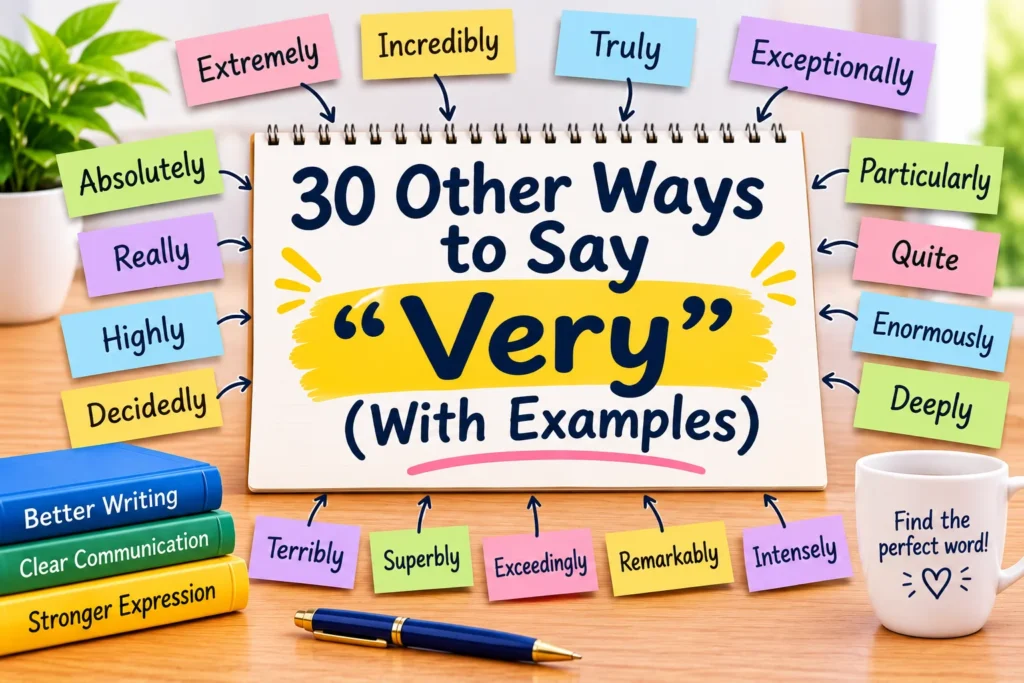

Using the word “very” can help you emphasize feelings, describe things, or make a point stronger. However, repeating it too often can make your writing sound ordinary and less expressive. Finding better alternatives allows you to communicate with more variety and make your sentences more interesting.
Depending on the situation, you can replace “very” with words like “extremely,” “incredibly,” “remarkably,” or “exceptionally.” Some alternatives add stronger emphasis, while others make your descriptions sound more natural and precise. Choosing the right word can also help you express emotions, describe experiences, and communicate professionally without relying on the same expression.
In this guide, you’ll discover 30 other ways to say “very,” along with simple explanations and practical examples. These alternatives will help you expand your vocabulary, improve your writing style, and express your ideas more effectively. Whether you’re writing an essay, preparing a professional email, or having a casual conversation, you’ll find useful words to make your communication clearer and more engaging.
What Does “Very” Mean?
The word “very” is an adverb used to emphasize or strengthen the meaning of an adjective or another adverb. It shows that something has a high degree, intensity, or quality. For example, saying “very happy” means someone feels extremely happy, while “very difficult” describes something that requires considerable effort. People commonly use this word in everyday conversations, emails, professional writing, and personal messages. However, repeating it too often can make writing sound less interesting. Using alternatives such as extremely, incredibly, remarkably, or exceptionally can make your sentences more descriptive and engaging.
Is It Professional or Polite to Say “Very”?
Yes, using “very” is generally professional and polite. It is a familiar word that works well in everyday conversations, workplace emails, academic writing, and formal communication. For example, saying “I am very grateful for your assistance” is perfectly appropriate when expressing appreciation. However, using “very” repeatedly can make professional writing sound less precise or sophisticated. Choosing stronger alternatives, such as highly, exceptionally, or particularly, can help you communicate more confidently. The best choice depends on your audience, the situation, and the message you want to convey.
Advantages of Saying “Very”
- Easy to Understand: “Very” is a simple, familiar word that readers of different ages and backgrounds can understand without difficulty.
- Adds Emphasis: It helps communicate stronger feelings, opinions, and descriptions without requiring complicated vocabulary.
- Works in Different Situations: You can use it in casual conversations, professional emails, personal messages, and everyday writing.
Disadvantages of Saying “Very”
- Can Sound Repetitive: Using “very” in several sentences can make your writing feel predictable and less engaging.
- Weakens Descriptions: Sometimes, a stronger adjective communicates your meaning more effectively than adding “very” before an ordinary adjective.
- Makes Writing Less Expressive: Relying on the same intensifier can limit your vocabulary and make your writing sound less natural.
30 Other Ways to Say “Very”
- Extremely
- Really
- Incredibly
- Exceptionally
- Highly
- Deeply
- Truly
- Remarkably
- Particularly
- Especially
- Exceedingly
- Tremendously
- Immensely
- Profoundly
- Terribly
- Awfully
- Absolutely
- Completely
- Totally
- Utterly
- Intensely
- Extraordinarily
- Unusually
- Seriously
- Significantly
- Considerably
- Exceptionally Well
- Supremely
- Ever So
- So
1. Extremely
Meaning:
Extremely means to a very high degree or an unusually great extent. It emphasizes the intensity of a quality, feeling, or situation.
Definition:
An adverb used to express a particularly high level of something.
Detailed Explanation:
Extremely is one of the strongest and most useful alternatives to “very.” It makes descriptions more powerful and helps readers understand the intensity of a situation. It works particularly well when describing emotions, difficulty, weather, importance, or physical characteristics. For example, instead of saying someone is “very tired,” you can say they are “extremely tired” to communicate a stronger feeling.
Scenario Examples:
- The examination was extremely difficult.
- I am extremely grateful for your support.
- The weather is extremely cold today.
Best Use:
Use it in professional emails, academic writing, everyday conversations, and situations where you want to emphasize something strongly.
Tone:
Strong, clear, professional, and expressive.
2. Really
Meaning:
Really means genuinely, truly, or to a significant degree. It adds emphasis to a statement or describes how strongly someone feels.
Definition:
An adverb used to emphasize the truth, intensity, or seriousness of something.
Detailed Explanation:
Really is a natural alternative to “very,” especially in casual conversations and friendly communication. It makes sentences sound relaxed and personal without being overly formal. You can use it to express excitement, appreciation, concern, or interest. For example, “I am really happy for you” sounds warm and genuine when congratulating someone.
Scenario Examples:
- I am really excited about your new project.
- She is really good at explaining difficult ideas.
- Thank you for being really helpful.
Best Use:
Use it in friendly messages, informal emails, everyday conversations, and personal communication.
Tone:
Friendly, conversational, warm, and natural.
3. Incredibly
Meaning:
Incredibly means to an unusually high degree or in a way that creates strong admiration or surprise.
Definition:
An adverb used to emphasize an impressive, surprising, or extraordinary quality.
Detailed Explanation:
Incredibly is a powerful alternative when you want your words to express admiration or strong emotion. It makes descriptions more memorable and helps communicate that something stands out from the ordinary. It is particularly useful when praising someone’s achievements, describing an impressive experience, or expressing appreciation. For example, calling someone “incredibly talented” communicates genuine admiration.
Scenario Examples:
- You have been incredibly supportive.
- The presentation was incredibly informative.
- She is an incredibly talented writer.
Best Use:
Use it when expressing admiration, describing impressive experiences, or praising someone’s abilities.
Tone:
Enthusiastic, appreciative, expressive, and positive.
4. Exceptionally
Meaning:
Exceptionally means unusually well or to a degree that is better, greater, or more impressive than normal.
Definition:
An adverb used to describe something that stands out because of its outstanding quality.
Detailed Explanation:
Exceptionally works well when you want to describe someone or something as outstanding. It is particularly suitable for professional communication because it sounds polished and thoughtful. Instead of saying someone is “very skilled,” you can describe them as “exceptionally skilled.” This alternative highlights a quality that goes beyond ordinary expectations.
Scenario Examples:
- She is exceptionally good at managing projects.
- Your work has been exceptionally impressive.
- He is an exceptionally thoughtful colleague.
Best Use:
Use it in performance reviews, professional emails, recommendations, and formal writing.
Tone:
Professional, respectful, positive, and sophisticated.
5. Highly
Meaning:
Highly means to a great degree or at a considerable level. It is commonly used to emphasize importance, ability, or quality.
Definition:
An adverb that expresses a significant level of a particular characteristic.
Detailed Explanation:
Highly is a useful alternative to “very” in professional and academic writing. It often appears before adjectives such as effective, recommended, skilled, respected, and successful. It communicates importance or quality without making the sentence sound overly emotional. For example, describing someone as “highly qualified” emphasizes their professional abilities.
Scenario Examples:
- She is a highly respected professional.
- This is a highly effective communication strategy.
- We are highly impressed with your performance.
Best Use:
Use it in business communication, academic writing, professional recommendations, and workplace discussions.
Tone:
Formal, confident, professional, and authoritative.
6. Deeply
Meaning:
Deeply means strongly or intensely, particularly when describing emotions, thoughts, and personal feelings.
Definition:
An adverb used to express a strong emotional or mental connection to something.
Detailed Explanation:
Deeply is especially useful when discussing feelings that go beyond ordinary reactions. It adds emotional meaning to your sentences and helps you communicate sincerity. Instead of saying “I am very grateful,” you can say “I am deeply grateful.” This sounds heartfelt and communicates that your appreciation is meaningful.
Scenario Examples:
- I am deeply thankful for your kindness.
- She was deeply affected by the news.
- We are deeply committed to helping our community.
Best Use:
Use it when expressing gratitude, sympathy, commitment, appreciation, or strong personal emotions.
Tone:
Heartfelt, sincere, emotional, and thoughtful.
7. Truly
Meaning:
Truly means genuinely, sincerely, or in a completely honest way.
Definition:
An adverb used to emphasize the authenticity or sincerity of a statement.
Detailed Explanation:
Truly is a meaningful alternative when you want your words to sound honest and personal. It works especially well when expressing appreciation, admiration, or emotional support. For example, saying “You are truly appreciated” communicates more than ordinary politeness. It makes the other person feel that your words come from a genuine place.
Scenario Examples:
- I am truly grateful for your guidance.
- You are a truly wonderful friend.
- Your support has been truly valuable.
Best Use:
Use it in thank-you messages, personal letters, professional appreciation, and meaningful conversations.
Tone:
Sincere, warm, respectful, and genuine.
8. Remarkably
Meaning:
Remarkably means to an unusual or impressive degree, especially when something deserves attention.
Definition:
An adverb used to emphasize an outstanding or surprising quality.
Detailed Explanation:
Remarkably helps describe something that attracts attention because it is better or more unusual than expected. It is useful when discussing achievements, improvements, performance, or personal qualities. For example, saying someone has made “remarkably good progress” highlights their achievement in a positive and memorable way.
Scenario Examples:
- She has made remarkably good progress.
- The team worked remarkably well together.
- Your explanation was remarkably clear.
Best Use:
Use it when describing achievements, impressive results, improvements, or unexpected positive qualities.
Tone:
Appreciative, descriptive, professional, and impressive.
9. Particularly
Meaning:
Particularly means especially or more than usual in a specific situation or respect.
Definition:
An adverb used to emphasize one specific quality, person, situation, or detail.
Detailed Explanation:
Particularly is a useful alternative when you want to draw attention to a specific aspect of something. Unlike some other alternatives, it does not always communicate extreme intensity. Instead, it highlights what deserves special attention. For example, saying “I am particularly interested in your proposal” shows that the proposal has caught your attention.
Scenario Examples:
- I am particularly impressed with your creativity.
- This lesson is particularly useful for beginners.
- She is particularly thoughtful toward her colleagues.
Best Use:
Use it in professional emails, academic discussions, presentations, and situations where you want to highlight something specific.
Tone:
Polite, thoughtful, professional, and focused.
10. Especially
Meaning:
Especially means more than others or to a greater degree in a particular situation.
Definition:
An adverb used to highlight something that deserves special attention or importance.
Detailed Explanation:
Especially is a natural way to emphasize a person, situation, or quality. It works well in both casual and professional writing. For example, instead of saying “I am very happy to see you,” you could say “I am especially happy to see you today.” It gives your statement a more specific and personal meaning.
Scenario Examples:
- I especially appreciate your honesty.
- This advice is especially helpful for new employees.
- She is especially good at solving problems.
Best Use:
Use it when highlighting a particular person, detail, quality, or situation.
Tone:
Friendly, clear, considerate, and conversational.
11. Exceedingly
Meaning:
Exceedingly means to an unusually high degree or beyond what is normally expected.
Definition:
An adverb used to emphasize an exceptionally high level of a particular quality.
Detailed Explanation:
Exceedingly is a more formal alternative to “very.” It is often used in written communication when you want to express a strong degree of something. Although it may sound slightly traditional in everyday conversation, it can make formal writing more precise. For example, describing a task as “exceedingly important” communicates its significance clearly.
Scenario Examples:
- Your assistance has been exceedingly helpful.
- The instructions were exceedingly clear.
- She is an exceedingly talented researcher.
Best Use:
Use it in formal documents, academic writing, professional correspondence, and descriptive content.
Tone:
Formal, polished, sophisticated, and emphatic.
12. Tremendously
Meaning:
Tremendously means to an extremely great degree or on a very large scale.
Definition:
An adverb used to express considerable strength, impact, growth, or improvement.
Detailed Explanation:
Tremendously is helpful when describing something that has a major effect or produces impressive results. It can communicate enthusiasm, appreciation, and strong positive feelings. For example, saying “Your advice helped me tremendously” shows that someone’s guidance made a significant difference.
Scenario Examples:
- Your encouragement helped me tremendously.
- The business has grown tremendously.
- We are tremendously proud of your achievements.
Best Use:
Use it when discussing progress, success, personal support, improvements, and significant results.
Tone:
Enthusiastic, appreciative, positive, and expressive.
13. Immensely
Meaning:
Immensely means to a very great or enormous degree.
Definition:
An adverb used to describe something with an exceptionally large amount of intensity or importance.
Detailed Explanation:
Immensely is a strong alternative when you want to communicate a considerable level of appreciation, enjoyment, or impact. It is particularly useful when expressing feelings that are difficult to describe with ordinary words. For example, saying “I enjoyed working with you immensely” communicates genuine appreciation and satisfaction.
Scenario Examples:
- I appreciate your efforts immensely.
- We enjoyed the experience immensely.
- Your support means immensely more than you realize.
Best Use:
Use it in appreciation messages, professional communication, personal conversations, and descriptions of meaningful experiences.
Tone:
Warm, expressive, appreciative, and emphatic.
14. Profoundly
Meaning:
Profoundly means deeply or to an extremely significant degree, especially when discussing emotions, thoughts, and effects.
Definition:
An adverb used to express a deep, meaningful, or far-reaching impact.
Detailed Explanation:
Profoundly is a thoughtful alternative when describing strong emotions or meaningful changes. It suggests that something has affected a person or situation in a significant way. For example, saying “Your kindness has profoundly affected me” communicates a deeper emotional response than simply saying “Your kindness was very meaningful.”
Scenario Examples:
- I am profoundly grateful for your kindness.
- The experience profoundly changed her perspective.
- His words had a profoundly positive impact.
Best Use:
Use it in reflective writing, emotional messages, personal stories, and discussions about meaningful experiences.
Tone:
Thoughtful, deep, sincere, and emotional.
15. Terribly
Meaning:
Terribly means extremely or to a considerable degree. Depending on the sentence, it can express either a negative or positive feeling.
Definition:
An adverb used to intensify an adjective or communicate a strong reaction.
Detailed Explanation:
Terribly is commonly used in conversational English to emphasize feelings or conditions. Although it originally carries a negative association, it can also appear in positive expressions. For example, “I am terribly sorry” communicates a strong apology, while “terribly excited” expresses enthusiasm. However, consider your audience because this word can sound dramatic in formal communication.
Scenario Examples:
- I am terribly sorry for the misunderstanding.
- She was terribly excited about the opportunity.
- The room was terribly cold last night.
Best Use:
Use it in informal conversations, apologies, emotional descriptions, and expressive writing.
Tone:
Emotional, conversational, emphatic, and sometimes dramatic.
16. Awfully
Meaning:
Awfully means extremely or very much, especially in informal conversations.
Definition:
An adverb used to intensify a description, feeling, or personal reaction.
Detailed Explanation:
Awfully is a conversational alternative that can make sentences sound friendly and natural. Despite its negative-sounding origin, it is frequently used to express positive feelings. For example, saying “That was awfully kind of you” communicates appreciation in a warm and personal way. It is less suitable for formal business writing.
Scenario Examples:
- That was awfully thoughtful of you.
- I am awfully pleased with the results.
- She looks awfully happy today.
Best Use:
Use it in friendly conversations, casual messages, and informal expressions of appreciation.
Tone:
Friendly, informal, warm, and expressive.
17. Absolutely
Meaning:
Absolutely means completely, entirely, or without any doubt.
Definition:
An adverb used to express complete agreement, certainty, or intensity.
Detailed Explanation:
Absolutely is a strong alternative when you want to communicate complete agreement or emphasize a quality. It is commonly used in both professional and casual communication. For example, “Your suggestion is absolutely brilliant” expresses strong approval. It can also make responses sound confident, especially when agreeing with someone’s ideas.
Scenario Examples:
- Your idea is absolutely wonderful.
- I absolutely agree with your decision.
- She is absolutely delighted with the results.
Best Use:
Use it when expressing agreement, confidence, enthusiasm, or complete certainty.
Tone:
Confident, enthusiastic, positive, and assertive.
18. Completely
Meaning:
Completely means entirely, fully, or without anything missing.
Definition:
An adverb used to emphasize that something is whole, finished, or total.
Detailed Explanation:
Completely is useful when describing a condition, situation, or feeling that has reached its full extent. It is slightly different from “very” because it often emphasizes completeness rather than simply intensity. For example, saying “I am completely satisfied” means that nothing important is missing from your satisfaction.
Scenario Examples:
- I am completely satisfied with your work.
- The project is completely finished.
- She completely understands the situation.
Best Use:
Use it when describing completion, agreement, understanding, satisfaction, or total changes.
Tone:
Clear, direct, confident, and professional.
19. Totally
Meaning:
Totally means entirely, fully, or to the greatest possible extent.
Definition:
An adverb used to emphasize complete agreement, involvement, or a particular condition.
Detailed Explanation:
Totally is a popular alternative in everyday English. It is particularly useful when expressing agreement, excitement, or a strong personal reaction. For example, saying “I totally understand how you feel” sounds supportive and conversational. Although it works well in informal communication, completely or entirely may be better choices in formal documents.
Scenario Examples:
- I totally understand your concerns.
- Your explanation was totally helpful.
- We are totally excited about the upcoming event.
Best Use:
Use it in casual conversations, friendly emails, social media posts, and informal messages.
Tone:
Casual, friendly, enthusiastic, and conversational.
20. Utterly
Meaning:
Utterly means completely or to an absolute degree.
Definition:
An adverb used to emphasize something as total, complete, or extreme.
Detailed Explanation:
Utterly is a strong alternative when you want to communicate an intense reaction or complete condition. It is commonly used with adjectives such as ridiculous, exhausted, wonderful, impossible, and devastated. Depending on the adjective, it can express either positive or negative emotions. For example, “I am utterly delighted” communicates an unusually strong level of happiness.
Scenario Examples:
- I am utterly grateful for your generosity.
- The experience was utterly unforgettable.
- She was utterly exhausted after the journey.
Best Use:
Use it in descriptive writing, emotional communication, storytelling, and situations requiring strong emphasis.
Tone:
Powerful, emphatic, expressive, and sometimes dramatic.
21. Intensely
Meaning:
Intensely means with great strength, concentration, or emotional force.
Definition:
An adverb used to describe something happening or being experienced with considerable intensity.
Detailed Explanation:
Intensely is useful when describing strong emotions, focused attention, or powerful experiences. It gives readers a clearer picture of how strongly someone feels or experiences something. For example, instead of saying “She is very interested in photography,” you can say “She is intensely interested in photography.” This communicates a strong personal passion.
Scenario Examples:
- She is intensely passionate about education.
- He focused intensely on the assignment.
- They felt intensely proud of their achievement.
Best Use:
Use it when describing emotions, concentration, passion, competition, or strong experiences.
Tone:
Strong, focused, emotional, and descriptive.
22. Extraordinarily
Meaning:
Extraordinarily means in an unusual, remarkable, or exceptional way.
Definition:
An adverb used to emphasize something that goes far beyond ordinary expectations.
Detailed Explanation:
Extraordinarily is an excellent alternative when describing unusual achievements, impressive qualities, or exceptional experiences. It makes your writing sound more descriptive and highlights something worth noticing. For example, saying “She is extraordinarily creative” suggests that her creativity stands out from what people normally expect.
Scenario Examples:
- Your work has been extraordinarily helpful.
- She is extraordinarily talented.
- The team achieved extraordinarily good results.
Best Use:
Use it in professional recommendations, descriptive writing, achievement reports, and situations involving exceptional qualities.
Tone:
Impressive, sophisticated, positive, and professional.
23. Unusually
Meaning:
Unusually means in a way that is different from what is normal or expected.
Definition:
An adverb used to emphasize an uncommon quality, condition, or situation.
Detailed Explanation:
Unusually is useful when describing something that stands out because it differs from the ordinary. It does not always mean something is extremely good or bad. Instead, it highlights that a particular quality is unexpected or uncommon. For example, “The weather is unusually warm today” communicates that the temperature is higher than people normally expect.
Scenario Examples:
- She is unusually confident during presentations.
- The instructions were unusually clear.
- He showed unusually strong determination.
Best Use:
Use it when describing unexpected behavior, uncommon qualities, unusual conditions, and surprising situations.
Tone:
Neutral, descriptive, observant, and informative.
24. Seriously
Meaning:
Seriously means to a significant degree or in a way that deserves attention and consideration.
Definition:
An adverb used to emphasize the importance, intensity, or seriousness of something.
Detailed Explanation:
Seriously is commonly used in informal conversations to emphasize a feeling, condition, or opinion. It can also communicate that something deserves genuine attention. For example, saying “I am seriously impressed by your work” expresses strong admiration. However, it should be used carefully in formal writing because it can sometimes sound casual.
Scenario Examples:
- I am seriously impressed by your dedication.
- She is seriously considering the opportunity.
- This is a seriously important decision.
Best Use:
Use it in everyday conversations, informal professional discussions, and situations where you want to emphasize importance.
Tone:
Direct, conversational, emphatic, and confident.
25. Significantly
Meaning:
Significantly means to an important or noticeable degree.
Definition:
An adverb used to describe a meaningful difference, change, improvement, or impact.
Detailed Explanation:
Significantly is particularly useful in professional, academic, and analytical writing. It emphasizes that something has changed or matters in a noticeable way. Unlike “very,” it often suggests measurable importance rather than simply strong emotion. For example, saying “The new strategy significantly improved productivity” communicates a meaningful improvement.
Scenario Examples:
- Her performance has improved significantly.
- The changes made a significantly positive difference.
- The new process is significantly more efficient.
Best Use:
Use it in business reports, research papers, workplace communication, and discussions about progress or results.
Tone:
Professional, analytical, precise, and informative.
26. Considerably
Meaning:
Considerably means by a large amount or to a noticeable degree.
Definition:
An adverb used to express a substantial difference, amount, or improvement.
Detailed Explanation:
Considerably works well when describing changes, improvements, differences, or levels of importance. It is especially helpful in professional and academic writing because it sounds measured and precise. For example, “The new system is considerably faster” communicates a noticeable improvement without sounding exaggerated.
Scenario Examples:
- The project became considerably easier.
- Her communication skills have improved considerably.
- This approach is considerably more effective.
Best Use:
Use it in reports, comparisons, workplace communication, and descriptions of measurable changes.
Tone:
Professional, balanced, clear, and informative.
27. Exceptionally Well
Meaning:
Exceptionally well means performing at a level that is significantly better than ordinary expectations.
Definition:
A phrase used to describe outstanding performance, ability, or results.
Detailed Explanation:
Exceptionally well is a useful alternative when describing how successfully someone performs a task. Rather than simply saying that someone did something “very well,” this expression highlights their outstanding ability. It is particularly useful in performance reviews, recommendations, and professional appreciation. For example, saying “She handled the situation exceptionally well” communicates confidence in her skills.
Scenario Examples:
- You handled the presentation exceptionally well.
- She communicates exceptionally well with clients.
- The team performed exceptionally well under pressure.
Best Use:
Use it in performance evaluations, professional recommendations, workplace feedback, and discussions about achievements.
Tone:
Professional, encouraging, respectful, and positive.
28. Supremely
Meaning:
Supremely means to the highest possible degree or at an exceptional level.
Definition:
An adverb used to emphasize the highest level of a quality or characteristic.
Detailed Explanation:
Supremely is a strong alternative when you want to highlight an outstanding quality. It often appears before adjectives such as confident, talented, important, and successful. It can make descriptions sound more powerful, although it is less common in everyday conversations. For example, describing someone as “supremely talented” suggests an exceptionally high level of ability.
Scenario Examples:
- She is supremely confident in her abilities.
- Your contribution was supremely valuable.
- He is supremely talented in his field.
Best Use:
Use it in descriptive writing, professional praise, formal presentations, and situations involving outstanding qualities.
Tone:
Strong, sophisticated, confident, and emphatic.
29. Ever So
Meaning:
Ever so means very or extremely, usually in a gentle, polite, or expressive way.
Definition:
An informal intensifying phrase used to emphasize a quality or feeling.
Detailed Explanation:
Ever so is a charming alternative that can make your sentences sound softer and more personal. It is more common in British English and often appears in friendly or affectionate expressions. For example, saying “That was ever so kind of you” communicates appreciation in a gentle way. It may sound old-fashioned or unusual in some American English contexts.
Scenario Examples:
- That was ever so thoughtful of you.
- I am ever so grateful for your help.
- She was ever so pleased to see everyone.
Best Use:
Use it in friendly conversations, affectionate messages, personal writing, and gentle expressions of appreciation.
Tone:
Gentle, polite, warm, and slightly traditional.
30. So
Meaning:
So means to a great degree or extent. It is commonly used to emphasize an emotion, quality, or condition.
Definition:
An adverb used to strengthen the meaning of an adjective or another adverb.
Detailed Explanation:
So is one of the simplest and most natural alternatives to “very.” It works particularly well in everyday conversations because it sounds relaxed and expressive. For example, saying “I am so happy for you” communicates excitement and warmth. It can also make personal messages sound more genuine. However, it is generally less suitable for formal academic or business writing.
Scenario Examples:
- I am so proud of everything you have achieved.
- Your message was so thoughtful.
- She is so kind to everyone around her.
Best Use:
Use it in casual conversations, text messages, personal notes, and friendly communication.
Tone:
Warm, simple, friendly, and conversational.
Conclusion
Choosing the right alternative to “very” can make your writing more natural, meaningful, and engaging. Although “very” is useful in everyday communication, relying on it too often can make your sentences sound repetitive. Words such as extremely, incredibly, exceptionally, deeply, and remarkably help you express stronger feelings and describe situations more clearly. Meanwhile, alternatives such as really, so, and ever so are excellent for friendly conversations and personal messages.