
The way you begin a sentence can shape how readers understand your message. “First of all” is a common expression used to introduce the opening point, explain an idea, or organize information. However, using it repeatedly can make your writing sound predictable. Choosing alternative phrases can help your sentences feel smoother, more engaging, and easier to follow.
Depending on the situation, you can use expressions like “to begin with,” “firstly,” “initially,” or “before anything else.” Some alternatives work well in professional emails and academic writing, while others are more suitable for casual conversations and everyday communication. The right choice depends on your tone and what you want to emphasize.
In this guide, you’ll discover 30 other ways to say “first of all,” along with simple explanations and practical examples. These alternatives will help you organize your thoughts, introduce important points, and avoid repetitive language. Whether you’re writing an essay, giving a presentation, or having a conversation, you’ll find useful expressions to make your communication clearer and more natural.
What Does “First of All” Mean?
“First of all” is a common introductory phrase used to present the first point, idea, reason, or item in a discussion. It helps readers understand that you’re beginning a list of thoughts or explaining something in a particular order. People often use it when writing essays, giving presentations, participating in conversations, or explaining a process.
For example, you might say, “First of all, we need to understand the problem before discussing possible solutions.” Here, the phrase signals that you’re introducing the first important point. It can also help organize information and make complicated explanations easier to follow.
Is It Professional or Polite to Say “First of All”?
Yes, “first of all” is generally both professional and polite. It’s widely used in workplace conversations, business emails, presentations, academic writing, and everyday communication. The expression sounds natural when you want to introduce your first thought or highlight an important point.
However, using it repeatedly can make your writing sound repetitive. In formal situations, alternatives such as “to begin with,” “initially,” “as a starting point,” and “first and foremost” may sound more polished. Choosing the right expression depends on your audience, purpose, and overall tone.
Advantages and Disadvantages of Saying “First of All”
Advantages
1. Organizes Ideas: It helps readers understand that you’re introducing the first point in a discussion or explanation.
2. Creates Clarity: It makes conversations, presentations, and written content easier to follow by establishing a clear starting point.
3. Sounds Natural: It’s a familiar expression that works well in everyday conversations and many professional situations.
Disadvantages
1. Can Sound Repetitive: Using “first of all” too frequently can make your writing feel predictable.
2. May Sound Too Conversational: In some formal documents, more polished alternatives may be more appropriate.
3. Can Create Unnecessary Structure: Not every explanation needs an introductory phrase, especially when the first point is already clear.
30 Alternatives to “First of All” (With Examples)
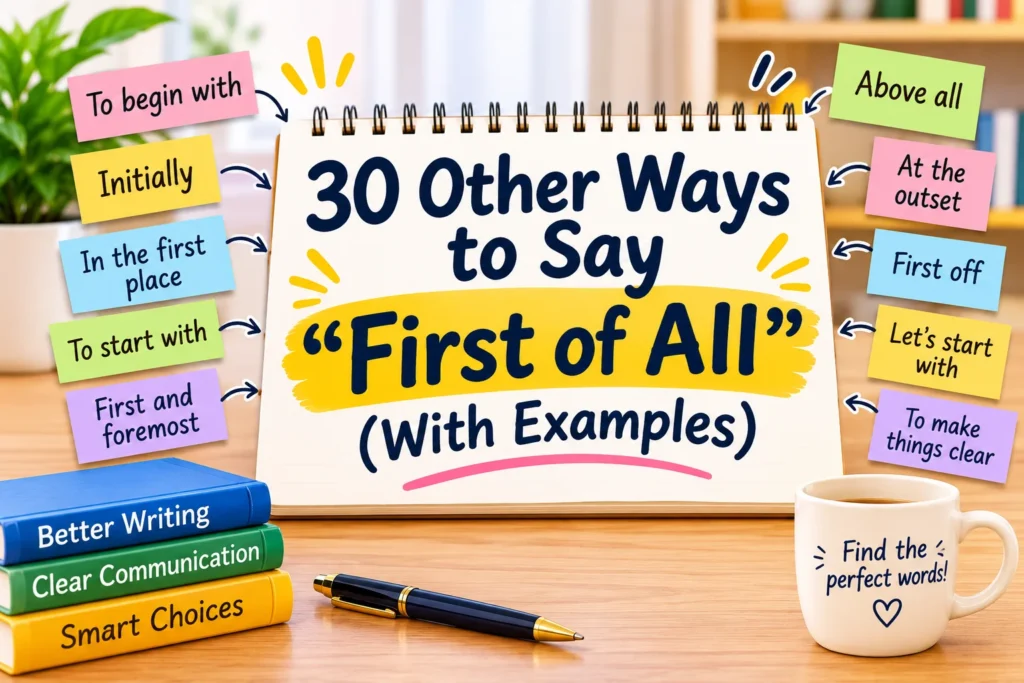
Here is a complete list of useful alternatives you can use instead of “first of all.”
- To Begin With
- First and Foremost
- Initially
- To Start With
- Before Anything Else
- At the Outset
- In the First Place
- As a Starting Point
- First
- Above All
- Let Me Start By Saying
- To Kick Things Off
- The First Thing to Consider
- For Starters
- At First
- To Open With
- As a First Step
- Most Importantly
- To Introduce the Topic
- Beginning With
- Let’s Start With
- At the Beginning
- To Lay the Groundwork
- To Set the Stage
- Before We Go Any Further
- As Our First Point
- The First Matter to Address
- To Get Started
- First Things First
- To Commence With
1. To Begin With
Meaning:
“To begin with” means starting a discussion, explanation, or process by introducing the first point.
Definition:
An introductory expression used to present the first idea or action in an organized way.
Detailed Explanation:
This phrase is a natural alternative to “first of all” when you want your writing to sound clear and well-organized. It works particularly well when explaining several related points. It helps readers understand where your discussion begins without making the sentence sound overly formal.
Scenario Examples:
- Workplace: “To begin with, we should review the project requirements.”
- Everyday conversation: “To begin with, I want to thank everyone for their support.”
- Academic writing: “To begin with, it is important to understand the historical background.”
Best Use: Professional emails, presentations, essays, and structured explanations.
Tone: Natural, polite, clear, and professional.
2. First and Foremost
Meaning:
“First and foremost” means most importantly or before considering other things.
Definition:
An expression used to emphasize the highest priority or most important point.
Detailed Explanation:
Use “first and foremost” when you want to highlight something that deserves special attention. Unlike ordinary sequencing expressions, this phrase places greater emphasis on importance rather than simply indicating order. It works well when discussing priorities, responsibilities, values, and essential considerations.
Scenario Examples:
- Workplace: “First and foremost, customer satisfaction should remain our priority.”
- Personal conversation: “First and foremost, I want you to know how much I appreciate you.”
- Business writing: “First and foremost, our goal is to provide reliable service.”
Best Use: Important announcements, professional discussions, speeches, and persuasive writing.
Tone: Confident, respectful, emphatic, and professional.
3. Initially
Meaning:
“Initially” means at the beginning of something or during its earliest stage.
Definition:
An adverb used to describe the first stage of an event, activity, or process.
Detailed Explanation:
“Initially” is a concise alternative when discussing how something started. It’s especially useful when explaining projects, decisions, plans, or situations that may change over time. Unlike “first of all,” it often describes the beginning of a process rather than introducing the first point in a list.
Scenario Examples:
- Workplace: “Initially, we planned to complete the project within two weeks.”
- Academic writing: “Initially, the researchers focused on a smaller group.”
- Everyday conversation: “Initially, I wasn’t sure whether I wanted to participate.”
Best Use: Reports, business documents, academic writing, and chronological explanations.
Tone: Neutral, informative, and professional.
4. To Start With
Meaning:
“To start with” means introducing the first point or beginning an activity.
Definition:
A conversational introductory phrase used to present the first part of an explanation.
Detailed Explanation:
This expression is simple and friendly. It works when you want to introduce an idea without making your message sound too formal. You can use it in conversations, presentations, and informal business communication. It also makes complicated explanations easier to approach by breaking them into smaller parts.
Scenario Examples:
- Workplace: “To start with, let’s discuss the main objectives.”
- Personal conversation: “To start with, I really appreciate your honesty.”
- Academic writing: “To start with, we need to examine the available evidence.”
Best Use: Everyday conversations, meetings, presentations, and informal writing.
Tone: Friendly, straightforward, and approachable.
5. Before Anything Else
Meaning:
“Before anything else” means doing or considering something before moving on to other matters.
Definition:
An expression that identifies the first priority or action that should receive attention.
Detailed Explanation:
Use this phrase when you want to emphasize that something must happen before everything else. It communicates urgency or priority rather than simply introducing the first item in a list. It’s particularly useful when explaining responsibilities, setting expectations, or discussing important decisions.
Scenario Examples:
- Workplace: “Before anything else, we need to address the client’s concerns.”
- Personal conversation: “Before anything else, I want to apologize for the misunderstanding.”
- Planning: “Before anything else, let’s establish a realistic budget.”
Best Use: Important conversations, planning, instructions, and discussions about priorities.
Tone: Direct, thoughtful, and purposeful.
6. At the Outset
Meaning:
“At the outset” means at the beginning of an event, process, or discussion.
Definition:
A formal expression referring to the initial stage of something.
Detailed Explanation:
This phrase is particularly helpful in professional and academic writing. It gives your sentences a polished feel while clearly identifying the beginning of a process. You can use it when introducing project objectives, explaining research methods, or describing the starting conditions of a situation.
Scenario Examples:
- Workplace: “At the outset, we agreed to complete the project together.”
- Academic writing: “At the outset, the study examined three important questions.”
- Business communication: “At the outset, we established clear expectations for the team.”
Best Use: Formal reports, presentations, business proposals, and academic documents.
Tone: Formal, polished, and professional.
7. In the First Place
Meaning:
“In the first place” means considering something at the beginning or identifying an original reason.
Definition:
An expression used to introduce an initial consideration, reason, or point.
Detailed Explanation:
This phrase can introduce the first reason behind an argument or explain why something happened. However, it also appears in sentences that question an original decision or situation. Context matters because it can sound slightly argumentative when used to challenge someone’s reasoning.
Scenario Examples:
- Workplace: “In the first place, we need to understand the client’s expectations.”
- Personal conversation: “Why did we choose this option in the first place?”
- Discussion: “In the first place, everyone deserves an opportunity to share their opinion.”
Best Use: Explanations, discussions, arguments, and conversations about original reasons.
Tone: Neutral, explanatory, and sometimes questioning.
8. As a Starting Point
Meaning:
“As a starting point” means using something as the foundation for further discussion or action.
Definition:
A phrase identifying the initial step, idea, or reference for developing something further.
Detailed Explanation:
This expression works especially well when you want to introduce an idea that will lead to additional discussion. It suggests that the first point is important but not necessarily the final answer. It’s useful in brainstorming sessions, project planning, and problem-solving conversations.
Scenario Examples:
- Workplace: “As a starting point, let’s review the current marketing strategy.”
- Education: “As a starting point, students should understand the basic concepts.”
- Planning: “As a starting point, we can create a list of achievable goals.”
Best Use: Brainstorming, planning, meetings, and educational discussions.
Tone: Collaborative, practical, and encouraging.
9. First
Meaning:
“First” means before anything else in a particular order or sequence.
Definition:
An adverb or adjective used to identify the earliest item, action, or position.
Detailed Explanation:
Sometimes, the simplest alternative is the most effective. “First” replaces “first of all” without adding unnecessary words. It makes your sentences shorter and more direct. This option works especially well when presenting instructions, listing ideas, or explaining several steps in order.
Scenario Examples:
- Workplace: “First, we need to identify the main problem.”
- Academic writing: “First, consider the evidence presented in the study.”
- Everyday conversation: “First, let me explain what happened.”
Best Use: Instructions, lists, presentations, and straightforward explanations.
Tone: Direct, neutral, and clear.
10. Above All
Meaning:
“Above all” means more importantly than anything else.
Definition:
An introductory expression used to emphasize the most significant consideration.
Detailed Explanation:
Use “above all” when you want to highlight a particular idea as the most important one. Although it can sometimes introduce a main point, it doesn’t necessarily mean the first point in a sequence. It focuses on importance and priority rather than chronological order.
Scenario Examples:
- Workplace: “Above all, we must maintain trust with our customers.”
- Personal conversation: “Above all, remember to take care of yourself.”
- Business writing: “Above all, quality should guide every decision we make.”
Best Use: Persuasive writing, professional communication, advice, and important reminders.
Tone: Emphatic, caring, and confident.
11. Let Me Start By Saying
Meaning:
“Let me start by saying” means introducing an explanation with a particular statement.
Definition:
A conversational phrase used to present an opening thought or acknowledgment.
Detailed Explanation:
This expression makes communication feel more personal because it sounds like you’re speaking directly to your audience. It’s especially useful when beginning a speech, expressing appreciation, offering an apology, or introducing an important message. It creates a natural transition into what you want to say next.
Scenario Examples:
- Workplace: “Let me start by saying that I appreciate everyone’s hard work.”
- Personal conversation: “Let me start by saying how grateful I am for your support.”
- Presentation: “Let me start by saying that this project has been a team effort.”
Best Use: Speeches, meetings, personal messages, and presentations.
Tone: Warm, conversational, appreciative, and sincere.
12. To Kick Things Off
Meaning:
“To kick things off” means to begin an activity, event, or discussion.
Definition:
An informal expression used to introduce the beginning of something.
Detailed Explanation:
This phrase brings energy and enthusiasm to your communication. It’s particularly useful when starting a meeting, launching a project, or introducing an event. It sounds less formal than “to begin with,” so it’s best suited to friendly workplace environments and casual conversations.
Scenario Examples:
- Workplace: “To kick things off, let’s review our goals for this month.”
- Event: “To kick things off, I’d like to welcome everyone.”
- Team meeting: “To kick things off, let’s hear everyone’s suggestions.”
Best Use: Team meetings, events, workshops, and casual presentations.
Tone: Energetic, friendly, and informal.
13. The First Thing to Consider
Meaning:
“The first thing to consider” means identifying the initial factor that deserves attention.
Definition:
A phrase used to introduce the first important consideration in a discussion or decision.
Detailed Explanation:
This expression is useful when explaining complicated matters that require careful thought. It guides readers toward the first factor they should examine before considering other details. You can use it when giving advice, discussing business decisions, or explaining how to approach a problem.
Scenario Examples:
- Workplace: “The first thing to consider is whether the proposed budget is realistic.”
- Education: “The first thing to consider is the student’s current understanding.”
- Personal advice: “The first thing to consider is what makes you genuinely happy.”
Best Use: Problem-solving, decision-making, educational content, and professional explanations.
Tone: Thoughtful, informative, and practical.
14. For Starters
Meaning:
“For starters” means beginning with the first point or introducing an initial example.
Definition:
An informal expression used to introduce the first item in a discussion or list.
Detailed Explanation:
This phrase is a relaxed way to begin an explanation. It works well when you have several reasons, examples, or suggestions to share. It can also introduce a point that supports a larger argument. However, it may sound too casual for highly formal documents.
Scenario Examples:
- Workplace: “For starters, we should improve communication between departments.”
- Personal conversation: “For starters, let’s find a restaurant everyone enjoys.”
- Discussion: “For starters, this approach saves both time and money.”
Best Use: Casual discussions, brainstorming, friendly emails, and informal presentations.
Tone: Casual, approachable, and conversational.
15. At First
Meaning:
“At first” means during the initial stage of something.
Definition:
An expression used to describe how a situation or experience began.
Detailed Explanation:
Although “at first” can sometimes replace “first of all,” the two expressions aren’t always interchangeable. “At first” generally describes an initial condition or reaction that may change later. Use it when discussing experiences, opinions, or situations that develop over time.
Scenario Examples:
- Workplace: “At first, the new system seemed difficult to understand.”
- Personal conversation: “At first, I didn’t realize how important your advice was.”
- Education: “At first, students may find this concept challenging.”
Best Use: Storytelling, personal experiences, and explanations of changing situations.
Tone: Reflective, neutral, and conversational.
16. To Open With
Meaning:
“To open with” means beginning a discussion, presentation, or written message with something specific.
Definition:
An introductory phrase used to identify the first statement or topic.
Detailed Explanation:
This expression is useful when you want to introduce the first part of a presentation or conversation. It helps establish the direction of your message and prepares the audience for what follows. It can also make speeches and written introductions sound more structured.
Scenario Examples:
- Workplace: “To open with, I’d like to share our achievements from last quarter.”
- Presentation: “To open with, let’s examine the current situation.”
- Discussion: “To open with, I want to acknowledge everyone’s contribution.”
Best Use: Presentations, speeches, meetings, and structured discussions.
Tone: Professional, composed, and welcoming.
17. As a First Step
Meaning:
“As a first step” means taking the initial action in a process.
Definition:
A phrase used to identify the first practical action required to achieve a goal.
Detailed Explanation:
Use this expression when explaining a process that involves several actions. It helps readers understand what they should do before moving forward. Unlike some other alternatives, it emphasizes action rather than simply introducing an idea.
Scenario Examples:
- Workplace: “As a first step, we should collect feedback from our customers.”
- Personal development: “As a first step, write down three achievable goals.”
- Education: “As a first step, students should review the basic definitions.”
Best Use: Instructions, project planning, tutorials, and goal-setting.
Tone: Practical, encouraging, and organized.
18. Most Importantly
Meaning:
“Most importantly” means giving attention to the most significant point.
Definition:
An adverbial expression used to emphasize the greatest priority in a discussion.
Detailed Explanation:
This phrase is particularly effective when you want readers to focus on something that matters more than other details. It creates emphasis and makes your message sound purposeful. However, remember that it highlights importance rather than necessarily indicating the first item in a sequence.
Scenario Examples:
- Workplace: “Most importantly, we need to protect our customers’ information.”
- Personal conversation: “Most importantly, I want you to feel supported.”
- Business writing: “Most importantly, our service should meet customer expectations.”
Best Use: Important announcements, advice, professional writing, and persuasive communication.
Tone: Emphatic, sincere, and thoughtful.
19. To Introduce the Topic
Meaning:
“To introduce the topic” means presenting the subject before discussing its details.
Definition:
A phrase used to begin a discussion by establishing its main subject.
Detailed Explanation:
This expression is particularly helpful in academic writing, educational presentations, and formal discussions. It tells your audience that you’re about to explain the central subject. It also provides a smooth transition from an introduction to the main discussion.
Scenario Examples:
- Academic writing: “To introduce the topic, let’s examine the meaning of effective communication.”
- Presentation: “To introduce the topic, I’ll briefly explain why teamwork matters.”
- Classroom: “To introduce the topic, we’ll begin with a simple example.”
Best Use: Essays, lectures, educational content, and formal presentations.
Tone: Educational, structured, and professional.
20. Beginning With
Meaning:
“Beginning with” means starting an explanation or process by focusing on a particular item.
Definition:
A phrase used to identify the first element in a sequence or discussion.
Detailed Explanation:
This expression works when you want to introduce the first subject before moving on to related points. It is particularly helpful when presenting several examples, explaining procedures, or organizing information. It creates a clear connection between the opening idea and the rest of your explanation.
Scenario Examples:
- Workplace: “Beginning with customer feedback, we’ll review each area of the business.”
- Education: “Beginning with basic grammar, students will gradually learn more advanced concepts.”
- Presentation: “Beginning with our main objectives, I’ll explain the project timeline.”
Best Use: Reports, educational explanations, presentations, and step-by-step instructions.
Tone: Organized, neutral, and informative.
21. Let’s Start With
Meaning:
“Let’s start with” means suggesting that a group begin by discussing or doing something.
Definition:
A conversational expression used to introduce the first activity or topic in a shared process.
Detailed Explanation:
This phrase creates a sense of teamwork because it invites other people to participate. It’s especially useful in meetings, collaborative projects, and group discussions. Rather than sounding like you’re giving instructions, it makes the conversation feel more inclusive and cooperative.
Scenario Examples:
- Workplace: “Let’s start with the most important items on today’s agenda.”
- Education: “Let’s start with a simple example before discussing the theory.”
- Personal conversation: “Let’s start with understanding how everyone feels.”
Best Use: Meetings, group discussions, workshops, and collaborative activities.
Tone: Friendly, inclusive, and encouraging.
22. At the Beginning
Meaning:
“At the beginning” means during the starting point or earliest part of something.
Definition:
A phrase referring to the initial stage of an event, activity, or process.
Detailed Explanation:
This expression is useful when describing what happened at the start of a particular situation. It can introduce background information or explain the first stage of a process. Unlike “first of all,” it often refers to time rather than the order of arguments or ideas.
Scenario Examples:
- Workplace: “At the beginning, we had only five members on the team.”
- Personal conversation: “At the beginning, everything seemed unfamiliar.”
- Academic writing: “At the beginning of the study, researchers collected background information.”
Best Use: Storytelling, reports, historical explanations, and chronological writing.
Tone: Neutral, descriptive, and straightforward.
23. To Lay the Groundwork
Meaning:
“To lay the groundwork” means establishing the basic foundation for something that will happen later.
Definition:
An expression describing the preparation or initial work needed before developing a larger plan or idea.
Detailed Explanation:
This phrase is especially useful when the first stage involves preparation rather than immediate action. It suggests that you’re creating the conditions necessary for future success. You can use it when discussing projects, business strategies, research, or personal development.
Scenario Examples:
- Workplace: “To lay the groundwork, we need to define our long-term objectives.”
- Education: “To lay the groundwork, students should understand the fundamental concepts.”
- Planning: “To lay the groundwork, let’s identify the resources we’ll need.”
Best Use: Strategic planning, project proposals, professional discussions, and educational explanations.
Tone: Strategic, thoughtful, and professional.
24. To Set the Stage
Meaning:
“To set the stage” means preparing the situation or introducing information needed for what follows.
Definition:
An expression used to establish the background or context for a discussion, event, or action.
Detailed Explanation:
This phrase works particularly well when you want to provide background information before presenting your main idea. It helps readers understand why the following discussion matters. It’s also useful in speeches and presentations because it creates a smooth transition into the main subject.
Scenario Examples:
- Workplace: “To set the stage, let’s review what happened during the previous quarter.”
- Presentation: “To set the stage, I’ll explain the challenges our team faced.”
- Education: “To set the stage, let’s look at the historical background.”
Best Use: Speeches, presentations, reports, and introductory explanations.
Tone: Engaging, professional, and informative.
25. Before We Go Any Further
Meaning:
“Before we go any further” means addressing something important before continuing.
Definition:
A conversational expression used to introduce a necessary point before moving forward.
Detailed Explanation:
This phrase is helpful when you need to pause a discussion and clarify something first. It can introduce an important reminder, question, warning, or explanation. It also gives readers or listeners a moment to consider an essential detail before continuing.
Scenario Examples:
- Workplace: “Before we go any further, let’s clarify the project deadline.”
- Personal conversation: “Before we go any further, I want to make sure we’re both comfortable.”
- Discussion: “Before we go any further, we should examine the facts.”
Best Use: Meetings, negotiations, important conversations, and detailed explanations.
Tone: Respectful, direct, and considerate.
26. As Our First Point
Meaning:
“As our first point” means introducing the first subject in an organized discussion.
Definition:
A phrase used to identify the initial argument or topic in a structured presentation.
Detailed Explanation:
This expression is useful when discussing several related points in a formal or organized setting. It makes the structure of your explanation clear and helps your audience follow the order of your ideas. It’s particularly appropriate for presentations, debates, and academic discussions.
Scenario Examples:
- Workplace: “As our first point, let’s discuss the importance of customer service.”
- Presentation: “As our first point, we’ll examine the project’s main objectives.”
- Academic discussion: “As our first point, we should consider the available research.”
Best Use: Formal presentations, debates, meetings, and academic writing.
Tone: Structured, formal, and informative.
27. The First Matter to Address
Meaning:
“The first matter to address” means identifying the initial issue that needs attention.
Definition:
A phrase used to introduce the first concern, subject, or responsibility requiring discussion.
Detailed Explanation:
Use this expression when a situation involves multiple issues that need to be handled in order. It helps establish priorities and directs attention toward the matter that should be discussed first. It sounds more formal than everyday expressions such as “to start with.”
Scenario Examples:
- Workplace: “The first matter to address is the delay in project delivery.”
- Business: “The first matter to address is our current customer feedback.”
- Planning: “The first matter to address is how we will manage the available resources.”
Best Use: Business meetings, formal reports, problem-solving, and professional discussions.
Tone: Formal, direct, and responsible.
28. To Get Started
Meaning:
“To get started” means beginning an activity, task, or discussion.
Definition:
A common expression used to introduce the first action or encourage the beginning of something.
Detailed Explanation:
This phrase is friendly and practical. It works when you want to move a conversation from preparation to action. You can use it in everyday communication, team meetings, instructions, and educational content. It sounds approachable without being overly casual.
Scenario Examples:
- Workplace: “To get started, let’s assign responsibilities to each team member.”
- Education: “To get started, open your books to the first chapter.”
- Personal conversation: “To get started, let’s talk about what matters most to you.”
Best Use: Instructions, meetings, tutorials, and everyday conversations.
Tone: Friendly, practical, and encouraging.
29. First Things First
Meaning:
“First things first” means dealing with the most important or immediate matter before anything else.
Definition:
An informal expression used to emphasize priorities and establish the correct order of actions.
Detailed Explanation:
This familiar expression is helpful when you want to organize tasks or remind someone to focus on what matters most. It often sounds more relaxed than “first of all” and works particularly well in everyday conversations. However, it can also be used in professional settings where the communication style is friendly.
Scenario Examples:
- Workplace: “First things first, let’s finish the urgent tasks.”
- Personal conversation: “First things first, let’s make sure everyone is comfortable.”
- Planning: “First things first, we need to decide on a suitable date.”
Best Use: Everyday discussions, informal meetings, planning, and task management.
Tone: Casual, confident, and practical.
30. To Commence With
Meaning:
“To commence with” means beginning something or introducing the first part of an activity.
Definition:
A formal expression used to indicate the starting point of a process or discussion.
Detailed Explanation:
This expression can be used when you want your writing to sound formal and structured. However, it may feel unnecessarily stiff in everyday communication. In most situations, “to begin with” or “to start with” sounds more natural. Choose this phrase when the surrounding writing already uses a formal style.
Scenario Examples:
- Workplace: “To commence with, we will review the company’s annual objectives.”
- Presentation: “To commence with, I’d like to outline the main findings.”
- Formal discussion: “To commence with, we should examine the available information.”
Best Use: Formal speeches, official presentations, and structured business communication.
Tone: Formal, traditional, and authoritative.
Conclusion
Finding the right alternative to “first of all” can make your communication clearer, more engaging, and less repetitive. Although the original expression works well in everyday conversations, using different phrases allows you to adjust your language to suit your audience and purpose.
For professional writing, expressions such as “to begin with,” “at the outset,” and “as a starting point” create a polished impression. If you want a friendlier tone, “let’s start with,” “to get started,” and “to kick things off” are excellent choices. Meanwhile, phrases such as “first and foremost” and “most importantly” help emphasize important ideas.
Remember that the best expression depends on what you’re trying to communicate. Some alternatives introduce the first point, while others highlight priorities or describe the beginning of a process. Choose words that feel natural, fit your message, and help your readers understand your ideas.