
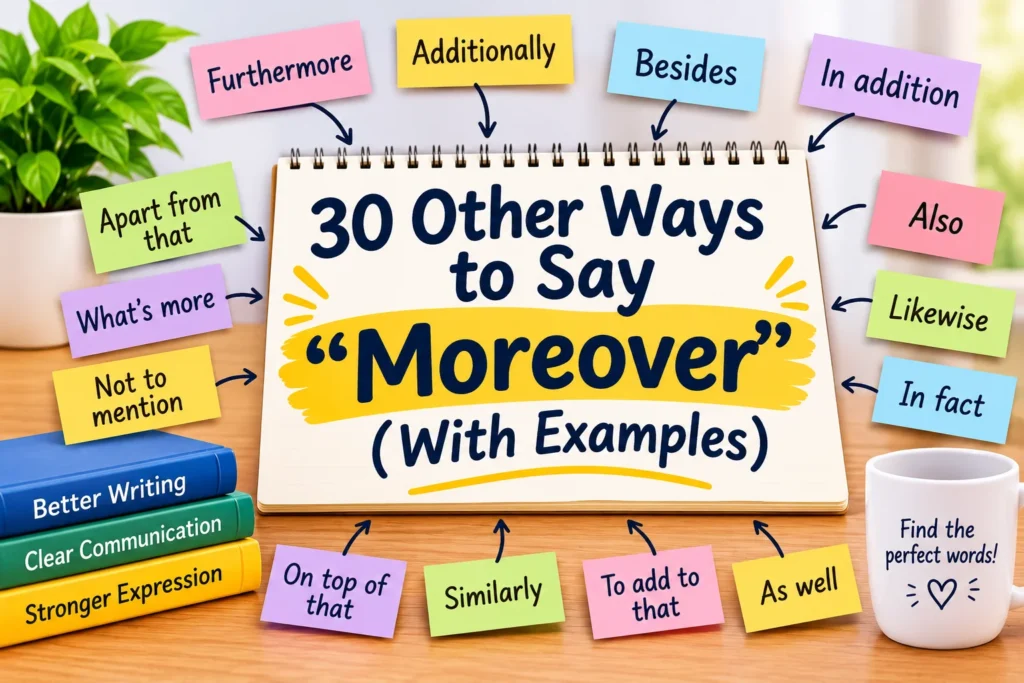

Using the same words repeatedly can make your writing feel less interesting. “Moreover” is a useful transition word when you want to introduce another point, provide extra information, or strengthen an existing argument. However, using it in every paragraph can make your sentences sound repetitive. Choosing different expressions can help your ideas flow more naturally.
There are many ways to replace “moreover” depending on your writing style and situation. Words like “furthermore,” “in addition,” “also,” and “what’s more” can help you connect ideas while keeping your message clear. Some alternatives are better suited to academic writing and professional communication, while others work well in everyday conversations.
In this guide, you’ll discover 30 other ways to say “moreover,” along with simple meanings and practical examples. These alternatives will help you improve your vocabulary, avoid unnecessary repetition, and make your writing more engaging. Whether you’re writing an essay, preparing a business email, or sharing your thoughts, you’ll find useful expressions for every situation.
What Does “Moreover” Mean?
Moreover is an adverb used to introduce additional information that supports, strengthens, or expands on something already mentioned. It helps connect two related ideas while showing that the second point adds value to the first. For example, you might say, “The new software saves time. Moreover, it reduces operating costs.” In this sentence, moreover introduces another benefit and makes the overall argument stronger. It is commonly used in formal writing, academic essays, professional communication, reports, and presentations.
Is It Professional and Polite to Say “Moreover”?
Yes, “moreover” is both professional and polite. It is a useful transition word when you want to introduce another supporting point without interrupting the flow of your writing. It works particularly well in business emails, research papers, formal discussions, and professional reports. However, using it repeatedly can make your writing sound stiff or overly academic. Depending on your audience and message, alternatives such as “also,” “in addition,” “furthermore,” and “on top of that” may sound more natural. Choosing the right expression helps your communication remain clear, respectful, and engaging.
Advantages and Disadvantages of Using “Moreover”
Advantages
- Connects Related Ideas: Moreover helps connect two sentences or arguments, making your writing easier to follow.
- Strengthens Arguments: It introduces additional information that supports or reinforces your previous statement.
- Creates a Professional Tone: It gives academic papers, business reports, and formal communication a polished and organized feel.
Disadvantages
- Can Sound Repetitive: Using moreover too frequently can make your writing predictable and less interesting.
- May Feel Too Formal: In casual conversations, friendly messages, or everyday emails, moreover can sound unnecessarily serious.
- Can Interrupt Natural Flow: When used incorrectly, it may make sentences feel forced instead of creating a smooth connection between ideas.
30 Other Ways to Say “Moreover”
Here is a complete list of useful alternatives to “moreover” that can make your writing clearer, smoother, and more engaging.
- Furthermore
- In Addition
- Also
- Additionally
- Besides
- What’s More
- On Top of That
- As Well
- Not Only That
- Along With That
- Equally Important
- Another Point Is
- To Add to That
- Beyond That
- Plus
- Likewise
- Similarly
- In the Same Way
- Coupled With That
- Together With That
- More Importantly
- Over and Above That
- In Addition to This
- Another Benefit Is
- As a Further Point
- Beyond This
- In Particular
- To Further Emphasize
- Additionally Speaking
- And Another Thing
1. Furthermore
Meaning:
Furthermore means adding another piece of information that supports or strengthens a previous statement.
Definition:
It is a formal transition word used to introduce an additional argument, explanation, or supporting detail.
Detailed Explanation:
Furthermore is one of the closest alternatives to moreover. It works particularly well when you want to develop an argument or provide another reason to support your point. It creates a logical connection between sentences and helps readers understand that the next idea is equally relevant. It is especially useful in academic writing, business reports, and professional discussions.
Scenario Examples:
- The company offers competitive salaries. Furthermore, employees receive excellent career development opportunities.
- The research provides valuable findings. Furthermore, it identifies several areas for future investigation.
Best Use:
Use furthermore in academic essays, professional reports, formal emails, and persuasive writing.
Tone:
Formal, professional, informative, and authoritative.
2. In Addition
Meaning:
In addition means including another fact, point, or piece of information.
Definition:
It is a transitional expression that introduces something extra to what has already been discussed.
Detailed Explanation:
In addition is a simple and effective alternative to moreover. It helps you introduce another idea without making your sentence sound overly complicated. Unlike some highly formal expressions, it works in both professional and everyday writing. You can use it when explaining benefits, listing features, or providing extra details that help readers understand your message.
Scenario Examples:
- The course includes practical exercises. In addition, students receive personalized feedback.
- Our office provides flexible working hours. In addition, employees can work remotely when needed.
Best Use:
Use in addition in emails, reports, presentations, essays, and informational articles.
Tone:
Neutral, professional, clear, and approachable.
3. Also
Meaning:
Also means adding another related fact or idea to something already mentioned.
Definition:
It is an adverb used to show that something is included or true in addition to another thing.
Detailed Explanation:
Also is one of the easiest alternatives to moreover. It makes sentences shorter and more conversational while maintaining a clear connection between ideas. It is particularly helpful when you want your writing to feel natural rather than overly formal. You can place it before the main verb or after the verb “be,” depending on sentence structure.
Scenario Examples:
- She manages the marketing team. She also oversees customer communication.
- The hotel offers comfortable rooms. It also provides free breakfast.
Best Use:
Use also in everyday conversations, emails, blog posts, and general professional writing.
Tone:
Friendly, neutral, simple, and conversational.
4. Additionally
Meaning:
Additionally means introducing another piece of information or an extra point.
Definition:
It is an adverb used to add information that complements or supports an earlier statement.
Detailed Explanation:
Additionally is a polished alternative to moreover that works well when you want to introduce another detail. It helps organize information without making your writing sound repetitive. It is especially useful in professional documents where clarity and logical structure matter. You can use it to introduce another benefit, requirement, explanation, or recommendation.
Scenario Examples:
- The application process is straightforward. Additionally, candidates can complete it online.
- The product is affordable. Additionally, it comes with a two-year warranty.
Best Use:
Use additionally in business communication, academic writing, instructions, and formal reports.
Tone:
Professional, neutral, informative, and polished.
5. Besides
Meaning:
Besides means adding another reason, fact, or consideration to support a statement.
Definition:
It is an adverb or preposition used to introduce additional information beyond what has already been mentioned.
Detailed Explanation:
Besides is a flexible expression that can make your writing sound more natural and conversational. It often introduces another reason for a particular decision or opinion. Although it can be used in professional communication, it generally sounds less formal than moreover. It is especially helpful when you want to explain why something is useful, important, or worth considering.
Scenario Examples:
- The restaurant serves delicious food. Besides, its prices are affordable.
- We should consider this proposal. Besides, it offers a practical solution to our problem.
Best Use:
Use besides in informal discussions, persuasive writing, casual emails, and everyday communication.
Tone:
Conversational, persuasive, friendly, and slightly informal.
6. What’s More
Meaning:
What’s more means introducing another important fact or point that adds value to what you have already said.
Definition:
It is a transitional expression used to emphasize additional information.
Detailed Explanation:
What’s more is a natural alternative to moreover when you want your writing to feel engaging and less formal. It often introduces an extra benefit, surprising detail, or supporting argument. This expression helps maintain readers’ interest because it signals that there is something else worth knowing. It works particularly well in blog posts, storytelling, and persuasive content.
Scenario Examples:
- The apartment is close to public transportation. What’s more, it offers beautiful city views.
- She completed the project ahead of schedule. What’s more, the client praised her work.
Best Use:
Use what’s more in blog articles, presentations, marketing content, and conversational writing.
Tone:
Engaging, friendly, enthusiastic, and informative.
7. On Top of That
Meaning:
On top of that means adding another fact, responsibility, benefit, or situation to something already mentioned.
Definition:
It is an informal transitional phrase used to emphasize additional information.
Detailed Explanation:
On top of that is a conversational alternative to moreover. It helps you introduce another detail while making your writing feel relaxed and relatable. It can highlight positive benefits or additional difficulties, depending on the context. For example, you might use it to describe extra responsibilities at work or additional advantages of a product.
Scenario Examples:
- She works full-time. On top of that, she is studying for her master’s degree.
- The service is affordable. On top of that, customer support is available around the clock.
Best Use:
Use on top of that in casual conversations, personal messages, informal articles, and friendly emails.
Tone:
Casual, expressive, conversational, and natural.
8. As Well
Meaning:
As well means also or in addition to something else.
Definition:
It is an adverbial expression used to show that another person, thing, or action is included.
Detailed Explanation:
As well is a simple way to add information without using formal transition words. It usually appears at the end of a sentence and makes communication feel natural. It works especially well when you are mentioning another feature, responsibility, or activity. Although it does not always replace moreover at the beginning of a sentence, it can communicate the same general idea of addition.
Scenario Examples:
- She writes blog articles and manages social media accounts as well.
- The package includes a laptop, a charger, and a protective case as well.
Best Use:
Use as well in everyday communication, friendly emails, and informal professional messages.
Tone:
Natural, polite, neutral, and conversational.
9. Not Only That
Meaning:
Not only that means introducing another point to emphasize that something else is also true.
Definition:
It is a transitional phrase used to add information and strengthen a previous statement.
Detailed Explanation:
Not only that is useful when you want to emphasize an additional benefit, achievement, or important detail. It creates a stronger connection between ideas and helps readers recognize that your second point deserves attention. This expression often works best when the additional information is particularly impressive or surprising.
Scenario Examples:
- He completed the project before the deadline. Not only that, he also helped his teammates.
- The school provides excellent facilities. Not only that, it offers scholarships to deserving students.
Best Use:
Use not only that in persuasive writing, presentations, storytelling, and informal professional communication.
Tone:
Emphatic, engaging, conversational, and persuasive.
10. Along With That
Meaning:
Along with that means including another thing or detail in addition to what has already been mentioned.
Definition:
It is a transitional phrase used to connect related information or accompanying details.
Detailed Explanation:
Along with that is a helpful expression when you want to mention something that accompanies an existing feature, action, or benefit. It sounds natural and makes your writing feel less rigid. It is particularly effective when discussing services, responsibilities, opportunities, or features that work together.
Scenario Examples:
- The company provides health insurance. Along with that, employees receive paid vacation days.
- She has excellent communication skills. Along with that, she brings valuable leadership experience.
Best Use:
Use along with that in workplace discussions, everyday writing, emails, and descriptive content.
Tone:
Friendly, neutral, informative, and approachable.
11. Equally Important
Meaning:
Equally important means that another point deserves the same level of attention or consideration as the previous one.
Definition:
It is a transitional expression used to introduce information that has comparable importance.
Detailed Explanation:
Equally important is a useful alternative to moreover when you want to show that two ideas deserve similar attention. Rather than simply adding information, it highlights the significance of the next point. It works especially well when discussing priorities, responsibilities, recommendations, or important considerations.
Scenario Examples:
- Experience is valuable when applying for a job. Equally important, employers look for strong communication skills.
- Regular exercise improves physical fitness. Equally important, it supports emotional well-being.
Best Use:
Use equally important in academic writing, professional presentations, reports, and persuasive arguments.
Tone:
Formal, thoughtful, balanced, and authoritative.
12. Another Point Is
Meaning:
Another point is means introducing an additional idea or consideration related to the current discussion.
Definition:
It is a transitional phrase used to bring another argument or detail into a conversation or written explanation.
Detailed Explanation:
Another point is offers a straightforward way to expand your discussion. It is especially useful when presenting several reasons, explaining a decision, or organizing an argument. It helps readers recognize that you are moving to a new but related idea. The expression also makes complex explanations easier to follow.
Scenario Examples:
- The project requires additional funding. Another point is that we need more experienced employees.
- The website needs a better design. Another point is that its loading speed should improve.
Best Use:
Use another point is in discussions, essays, presentations, meetings, and explanatory writing.
Tone:
Neutral, direct, organized, and conversational.
13. To Add to That
Meaning:
To add to that means introducing another detail that supports or expands on something already discussed.
Definition:
It is a transitional expression used to provide additional information or reinforce a previous statement.
Detailed Explanation:
To add to that is a natural alternative to moreover, especially when you want to continue an explanation without sounding too formal. It helps connect related thoughts and gives your writing a conversational rhythm. It is particularly useful when responding to someone else’s point or adding another reason to support your opinion.
Scenario Examples:
- The training program improves employee performance. To add to that, it builds confidence.
- The neighborhood is peaceful. To add to that, schools and shops are nearby.
Best Use:
Use to add to that in discussions, informal emails, presentations, and conversational articles.
Tone:
Friendly, collaborative, natural, and informative.
14. Beyond That
Meaning:
Beyond that means introducing something additional that goes further than the information already provided.
Definition:
It is a transitional phrase used to discuss further details, possibilities, or considerations.
Detailed Explanation:
Beyond that is a flexible expression that helps expand an explanation. It can introduce another benefit, a wider implication, or an additional consideration. It is particularly useful when you want to move from a basic point to a broader discussion. Depending on the context, it can sound either neutral or slightly informal.
Scenario Examples:
- The course teaches basic writing skills. Beyond that, it helps students develop critical thinking.
- The company offers competitive salaries. Beyond that, it creates opportunities for professional growth.
Best Use:
Use beyond that in professional discussions, explanatory articles, reports, and everyday communication.
Tone:
Thoughtful, neutral, explanatory, and conversational.
15. Plus
Meaning:
Plus means adding another fact, benefit, or reason to something already mentioned.
Definition:
It is an informal adverb or preposition used to introduce additional information.
Detailed Explanation:
Plus is a short and simple alternative to moreover. It makes sentences sound relaxed and easy to understand. You can use it to highlight an extra benefit, explain an advantage, or provide another reason for your opinion. Although it is suitable for casual and conversational writing, it may not be appropriate for highly formal academic documents.
Scenario Examples:
- The phone has a powerful camera. Plus, its battery lasts all day.
- The job offers flexible hours. Plus, employees receive paid training.
Best Use:
Use plus in casual emails, blog posts, product descriptions, and everyday conversations.
Tone:
Casual, upbeat, friendly, and straightforward.
16. Likewise
Meaning:
Likewise means in the same way or similarly.
Definition:
It is an adverb used to indicate that something is similar to or applies equally to another situation.
Detailed Explanation:
Likewise can sometimes replace moreover when you are adding a related idea, but it is more accurate when showing similarity rather than simply introducing unrelated additional information. It helps connect two comparable statements and creates a smooth transition. It is useful when discussing similar experiences, actions, responsibilities, or outcomes.
Scenario Examples:
- Employees appreciate flexible schedules. Likewise, managers benefit from improved productivity.
- Reading improves vocabulary. Likewise, regular writing strengthens communication skills.
Best Use:
Use likewise in professional writing, comparisons, academic discussions, and formal conversations.
Tone:
Professional, balanced, neutral, and thoughtful.
17. Similarly
Meaning:
Similarly means in a comparable way or following the same pattern.
Definition:
It is an adverb used to introduce information that resembles or relates closely to a previous point.
Detailed Explanation:
Similarly is useful when you want to connect two ideas that share common features. Although it is not a direct replacement for moreover in every situation, it works well when the additional point follows a comparable pattern. It makes comparisons easier to understand and helps maintain a logical flow.
Scenario Examples:
- The first department improved its productivity. Similarly, the sales team achieved better results.
- Exercise strengthens the body. Similarly, mental activities help keep the brain active.
Best Use:
Use similarly in academic writing, comparison essays, reports, and professional explanations.
Tone:
Formal, analytical, clear, and informative.
18. In the Same Way
Meaning:
In the same way means following a similar approach, pattern, or method.
Definition:
It is a transitional expression used to introduce an idea that resembles something previously discussed.
Detailed Explanation:
In the same way is helpful when explaining relationships between two similar ideas. It allows you to connect examples, actions, or outcomes without repeating the same sentence structure. It is particularly useful in educational content, explanatory articles, and discussions where comparisons help readers understand a topic.
Scenario Examples:
- Parents encourage children to read regularly. In the same way, teachers promote learning through books.
- A healthy diet supports physical health. In the same way, proper sleep improves overall well-being.
Best Use:
Use in the same way in educational writing, comparisons, explanations, and general communication.
Tone:
Clear, explanatory, neutral, and approachable.
19. Coupled With That
Meaning:
Coupled with that means adding something that combines with or strengthens an existing fact.
Definition:
It is a transitional expression used to show how two related factors work together.
Detailed Explanation:
Coupled with that is useful when you want to explain how one feature or condition complements another. It often introduces an additional factor that contributes to a particular result. This expression is especially effective in professional writing, business reports, and discussions about combined benefits or challenges.
Scenario Examples:
- The business has an experienced management team. Coupled with that, it has a strong customer base.
- Regular exercise improves stamina. Coupled with that, a balanced diet supports better health.
Best Use:
Use coupled with that in business reports, analytical writing, presentations, and professional discussions.
Tone:
Professional, analytical, informative, and formal.
20. Together With That
Meaning:
Together with that means including another related thing alongside something already mentioned.
Definition:
It is a transitional phrase used to introduce an additional feature, detail, or consideration.
Detailed Explanation:
Together with that is a useful expression when you want to explain how two things are included or work alongside each other. It can make descriptions more complete by highlighting additional services, benefits, or responsibilities. However, it is often more natural within a sentence than as a standalone transition.
Scenario Examples:
- The company provides technical training. Together with that, it offers career guidance.
- She manages the daily operations. Together with that, she handles customer inquiries.
Best Use:
Use together with that in workplace communication, service descriptions, and explanatory writing.
Tone:
Neutral, professional, descriptive, and cooperative.
21. More Importantly
Meaning:
More importantly means introducing another point that deserves greater attention or carries greater significance.
Definition:
It is a transitional expression used to emphasize information that is more important than the previous detail.
Detailed Explanation:
More importantly is a strong alternative when you want to add information while emphasizing its significance. Unlike moreover, which generally introduces another supporting point, this expression suggests that the new information deserves even more attention. It works well in persuasive writing, presentations, and discussions involving priorities.
Scenario Examples:
- The new system saves money. More importantly, it improves customer satisfaction.
- Good communication reduces misunderstandings. More importantly, it builds trust between team members.
Best Use:
Use more importantly in persuasive essays, business presentations, reports, and professional discussions.
Tone:
Emphatic, professional, persuasive, and confident.
22. Over and Above That
Meaning:
Over and above that means in addition to something that has already been mentioned.
Definition:
It is an expression used to introduce another benefit, feature, or consideration beyond an existing point.
Detailed Explanation:
Over and above that is a slightly formal alternative to moreover. It emphasizes that something extra is being provided or considered beyond what was initially expected. It can be useful when discussing additional services, advantages, responsibilities, or achievements. However, it should be used naturally rather than inserted into every sentence.
Scenario Examples:
- The position offers a competitive salary. Over and above that, employees receive performance bonuses.
- The package includes accommodation. Over and above that, transportation expenses are covered.
Best Use:
Use over and above that in professional communication, formal discussions, and descriptions of additional benefits.
Tone:
Formal, descriptive, professional, and emphatic.
23. In Addition to This
Meaning:
In addition to this means including another point or detail alongside something previously discussed.
Definition:
It is a transitional expression used to introduce extra information connected to an earlier statement.
Detailed Explanation:
In addition to this is a slightly longer version of in addition. It works well when you want to connect an additional detail to a specific statement or situation. It can introduce another advantage, requirement, feature, or supporting argument. The expression is especially useful in formal explanations and structured writing.
Scenario Examples:
- The school provides modern learning facilities. In addition to this, students receive individual academic support.
- The company offers paid leave. In addition to this, employees have access to professional training.
Best Use:
Use in addition to this in academic papers, business reports, formal emails, and detailed explanations.
Tone:
Formal, informative, professional, and clear.
24. Another Benefit Is
Meaning:
Another benefit is means introducing an additional advantage of a particular choice, service, or situation.
Definition:
It is an explanatory phrase used to highlight another positive outcome or useful feature.
Detailed Explanation:
Another benefit is is especially helpful when discussing the advantages of a product, service, decision, or opportunity. It allows you to introduce an extra positive point without repeating the word moreover. It also makes your writing more specific because readers immediately understand that you are discussing another advantage.
Scenario Examples:
- Remote work reduces commuting time. Another benefit is that employees can enjoy a better work-life balance.
- The software organizes important documents. Another benefit is that it makes information easier to find.
Best Use:
Use another benefit is in product descriptions, marketing articles, business presentations, and persuasive writing.
Tone:
Positive, informative, practical, and persuasive.
25. As a Further Point
Meaning:
As a further point means introducing another argument or detail related to an existing discussion.
Definition:
It is a formal transitional expression used to expand an explanation or provide another supporting idea.
Detailed Explanation:
As a further point is useful when you are developing a structured argument and want to introduce another consideration. It helps organize your thoughts and makes it clear that your discussion is continuing. It is particularly appropriate for formal writing, although shorter expressions such as additionally may sound more natural in everyday communication.
Scenario Examples:
- The policy improves workplace safety. As a further point, it encourages employees to report potential hazards.
- The proposal reduces unnecessary expenses. As a further point, it creates opportunities for long-term growth.
Best Use:
Use as a further point in academic essays, formal reports, business proposals, and structured discussions.
Tone:
Formal, analytical, organized, and professional.
26. Beyond This
Meaning:
Beyond this means introducing additional information that extends further than the point already discussed.
Definition:
It is a transitional phrase used to move from an existing idea toward another related detail or broader consideration.
Detailed Explanation:
Beyond this is helpful when you want to expand your discussion or introduce another aspect of a topic. It can be used to explain further opportunities, consequences, or advantages. It creates a natural transition when moving from a specific point to a broader explanation. However, its meaning depends on context, so it should connect logically with the previous sentence.
Scenario Examples:
- The program teaches students basic computer skills. Beyond this, it prepares them for future career opportunities.
- The company focuses on customer satisfaction. Beyond this, it invests in employee development.
Best Use:
Use beyond this in professional articles, reports, educational content, and explanatory writing.
Tone:
Thoughtful, neutral, explanatory, and professional.
27. In Particular
Meaning:
In particular means especially or specifically, highlighting one detail among several possibilities.
Definition:
It is an adverbial expression used to draw attention to a specific person, fact, idea, or example.
Detailed Explanation:
In particular can sometimes introduce additional information, especially when you want to highlight one specific aspect of a broader topic. However, it is not a direct synonym for moreover because it emphasizes specificity rather than simple addition. It works best when the next statement focuses on something especially important or relevant.
Scenario Examples:
- The company values employee development. In particular, it encourages leadership training.
- Several changes improved the website. In particular, the faster loading speed enhanced the user experience.
Best Use:
Use in particular in analytical writing, academic explanations, reports, and professional discussions.
Tone:
Focused, informative, precise, and professional.
28. To Further Emphasize
Meaning:
To further emphasize means adding information to strengthen or highlight an existing point.
Definition:
It is a transitional phrase used to introduce supporting details that reinforce an argument or statement.
Detailed Explanation:
To further emphasize is useful when you want to make an existing argument stronger by adding another explanation or example. It helps readers recognize that the information being introduced is intended to reinforce an earlier point. It is particularly useful in persuasive writing, presentations, and professional explanations.
Scenario Examples:
- Good communication improves teamwork. To further emphasize, it helps prevent unnecessary misunderstandings.
- Regular practice builds confidence. To further emphasize, it helps learners recognize their progress.
Best Use:
Use to further emphasize in persuasive essays, formal presentations, reports, and educational articles.
Tone:
Formal, persuasive, explanatory, and emphatic.
29. Additionally Speaking
Meaning:
Additionally speaking is intended to mean introducing another point or adding further information to a discussion.
Definition:
It is an uncommon expression that attempts to introduce supplementary information.
Detailed Explanation:
Although additionally speaking may seem like a possible alternative to moreover, it is not a natural or widely accepted transition in standard English. Most readers will find additionally, furthermore, or in addition clearer and more professional. If you want your writing to sound fluent and polished, avoid using additionally speaking as a transition. Choose an established expression that communicates your intended meaning directly.
Scenario Examples:
- Additionally, the company offers flexible working arrangements.
- Furthermore, students can access additional learning resources.
Best Use:
Avoid additionally speaking. Use additionally or furthermore in professional writing instead.
Tone:
Unnatural as a transition; the recommended alternatives sound professional, clear, and fluent.
30. And Another Thing
Meaning:
And another thing means introducing one more idea, reason, or detail in a conversation.
Definition:
It is an informal expression used to add another thought to an ongoing discussion.
Detailed Explanation:
And another thing is a conversational alternative to moreover that works well when you want to continue sharing your thoughts. It can introduce another benefit, concern, observation, or reason. However, it may sound too casual for academic papers and formal business documents. In everyday conversations, it creates a relaxed and direct connection between ideas.
Scenario Examples:
- The new restaurant has affordable meals. And another thing, the staff are incredibly friendly.
- The project needs more attention. And another thing, we should review the budget before moving forward.
Best Use:
Use and another thing in casual conversations, informal emails, personal messages, and friendly discussions.
Tone:
Casual, direct, conversational, and expressive.
Conclusion
Finding the right alternative to “moreover” can make your writing more natural, engaging, and easier to understand. Although moreover is an excellent transition word for formal communication, using the same expression repeatedly can make your content feel predictable. Words and phrases such as furthermore, in addition, also, additionally, what’s more, and on top of that help you introduce extra information while maintaining a smooth flow.
The best alternative depends on your audience, purpose, and writing style. For professional documents, choose furthermore or additionally. For everyday communication, also and plus may sound more natural. If you want to emphasize another important idea, consider more importantly or equally important.
Ultimately, good writing is not about using complicated vocabulary. It is about choosing words that communicate your ideas clearly and help readers follow your thoughts. By using these 30 alternatives to moreover, you can make your sentences more varied, thoughtful, and effective.


Pingback: 30 Other Ways to Say “As a Result” (With Examples)