
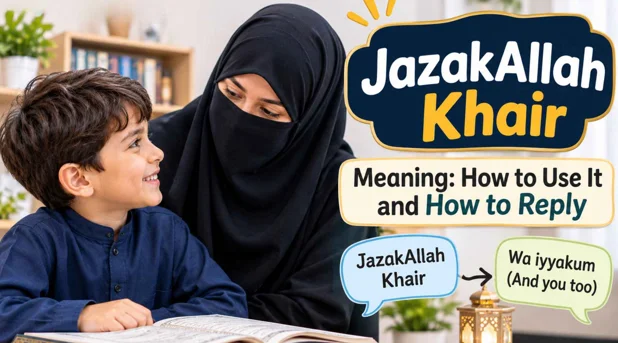

Someone helps you move house. A friend sends you notes before an exam. A colleague covers your shift. Most of us say “thanks” and move on. But if you spend any time around Muslims, you will hear something different: JazakAllah Khair.
It sounds simple, and it is. But there is a lot packed into these two words. Let’s break down the JazakAllah Khair meaning, when to use it, and how to reply without feeling awkward.
What Does JazakAllah Khair Mean?
JazakAllah Khair is an Arabic phrase that means “May Allah reward you with good.”
In Arabic, it is written as:
جَزَاكَ اللّٰهُ خَيْرًا
Transliteration: Jazāka-llāhu khayran
Here is what each part means:
- Jazā – to reward or repay
- ka – you (speaking to one male)
- Allāh – God
- Khayran – with good, or with goodness
So instead of just saying “thank you,” you are making a short dua for that person. You are asking Allah to repay their kindness in a way you never could. That’s a much bigger thank-you than it first looks.
Where Does the Phrase Come From?
This isn’t just a cultural habit. It comes straight from the teachings of the Prophet Muhammad ﷺ.
In a hadith recorded by Imam At-Tirmidhi (Hadith 2035), the Prophet ﷺ said that if someone does you a favour and you say “JazakAllahu khayran” to them, you have praised them in the best possible way.
Think about that for a second. The “best” way to thank someone isn’t a gift card or a long speech. It is a sincere dua.
There is also a beautiful link to the Quran. The word jazā (reward) comes up again and again in it. One of the most well-known verses is in Surah Ar-Rahman:
هَلْ جَزَاءُ الْإِحْسَانِ إِلَّا الْإِحْسَانُ
“Is the reward for good anything but good?” (Quran 55:60)
When you say JazakAllah Khair, you are living that verse in a small way. Someone did good to you, and you are asking Allah to return good to them.
How to Use JazakAllah Khair Correctly
You can use it almost anywhere you would say “thank you.” In a text message, an email, after a class, or when someone holds the door for you.
Writing a formal email in English instead? See our guide to other ways to say “Thank You for Your Time”.
One thing most people don’t know: Arabic changes the word depending on who you are talking to. Here is a quick guide:
| Talking to | Arabic | How to say it |
| One man | جَزَاكَ اللّٰهُ خَيْرًا | Jazāka-llāhu khayran |
| One woman | جَزَاكِ اللّٰهُ خَيْرًا | Jazāki-llāhu khayran |
| Two people | جَزَاكُمَا اللّٰهُ خَيْرًا | Jazākumā-llāhu khayran |
| A group | جَزَاكُمُ اللّٰهُ خَيْرًا | Jazākumu-llāhu khayran |
Don’t stress about it too much, though. In everyday life, most people just say “JazakAllah Khair” to everyone, and nobody will mind.
What About the Spelling?
You will see it written in lots of ways: JazakAllah Khair, Jazakallah Khairan, Jazak Allahu Khayran, or even just JAK in a quick text. They all mean the same thing. The fuller form, JazakAllahu Khayran, is the more grammatically complete one.
A Few Real-Life Examples
- “Thanks for picking up the kids today, JazakAllah Khair!”
- “JazakAllahu khayran for sharing those revision notes, sister.”
- “The iftar was amazing. JazakumAllahu khayran to everyone who helped.”
How to Reply to JazakAllah Khair
This is the part that trips people up. Someone says JazakAllah Khair to you, and you freeze. Do you say “you’re welcome”? “No problem”?
You can, but there are better replies that keep the dua going:
- Wa iyyakum (وَإِيَّاكُمْ) – “And to you too.” This is the most common reply. Short, sweet, and easy to remember.
- Wa antum fa jazakumullahu khayran – “And you too, may Allah reward you with good.” A fuller reply that returns the exact same dua.
- Wa jazakum – “And may He reward you too.” A short version of the one above.
- Ameen, wa iyyak – Some people say “Ameen” first, accepting the dua, then return it.
If you are new to Islam, or still learning, just go with Wa iyyakum. It works for everyone and you can’t really get it wrong.
Want to Understand Phrases Like This Properly?
Here’s the honest truth. Many Muslims, especially those growing up in the UK, USA, Canada, or Australia, say phrases like JazakAllah Khair, InshaAllah, and Alhamdulillah every day without really knowing what the words mean in Arabic.
There is nothing wrong with that. But once you understand the language, these phrases hit differently. A quick “JAK” turns into a real dua you actually feel.
If that is something you want, you can join Urwa Academy. They offer online Quran classes with qualified teachers, one-to-one, at times that fit around school, work, and family life. Along with Quran reading and Tajweed, you can also take an Arabic course to understand the meaning behind what you recite and say.
It is a simple way to learn Quran online from home, whether you are a total beginner, a parent looking for classes for your kids, or someone who wants to finally connect with the words of Allah.
Quick FAQs
Can non-Muslims say JazakAllah Khair?
Yes. It is a kind dua, and most Muslims will be happily surprised to hear it from a non-Muslim friend or colleague.
Is it okay to just say “thank you” instead?
Of course. The Prophet ﷺ also taught that whoever does not thank people has not thanked Allah. Gratitude in any language is good. JazakAllah Khair simply adds a dua on top. If you want more English options, try these other ways to say “Thanks in Advance”.
Is “JAK” disrespectful?
Not really. It is fine in casual texts between friends. In a formal message, writing the full phrase looks more thoughtful.
What is the difference between JazakAllah and JazakAllah Khair?
“JazakAllah” alone means “May Allah reward you.” Adding “Khair” makes it complete: reward you with good.
Final Thoughts
JazakAllah Khair is one of those small phrases with a big heart. It turns a normal thank-you into a prayer, and it reminds both people that the real reward comes from Allah.
So next time someone helps you out, skip the plain “thanks.” Say JazakAllah Khair, mean it, and smile when they reply Wa iyyakum.