
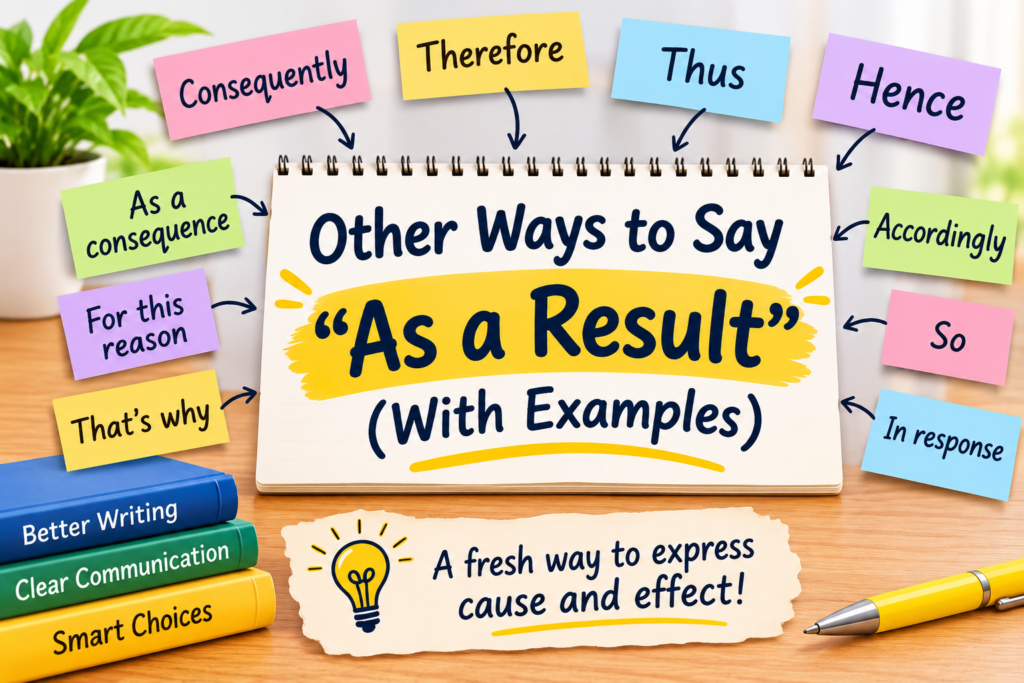

Choosing the right transition words can make your writing clearer and easier to follow. “As a result” is commonly used to explain what happens because of a particular action, event, or situation. However, repeating this phrase too often can make your writing sound less natural. Using different expressions can help you connect ideas while keeping your sentences interesting.
Depending on the context, you can replace “as a result” with expressions like “consequently,” “therefore,” “for this reason,” or “because of this.” Some alternatives are more suitable for formal writing, while others work better in everyday conversations. Understanding these differences helps you choose words that match your message and tone.
In this guide, you’ll discover 30 other ways to say “as a result,” with simple explanations and practical examples. These alternatives will help you avoid repetition, improve your vocabulary, and explain causes and outcomes more effectively. Whether you’re writing an academic essay, a professional email, or a casual message, you’ll find useful expressions to make your communication smoother and more engaging.
What Does “As a Result” Mean?
“As a result” is a phrase used to explain what happens because of a particular action, decision, event, or situation. It connects a cause with its consequence, helping readers understand how one thing leads to another. For example, in the sentence, “She worked hard on her presentation; as a result, she impressed the entire team,” the phrase shows that her hard work led to a positive outcome.
This expression is commonly used in professional writing, academic papers, business communication, and everyday conversations. It helps explain outcomes clearly without making sentences unnecessarily complicated. You can also use similar expressions to make your writing more varied and natural.
Is It Professional or Polite to Say “As a Result”?
Yes, “as a result” is both professional and polite. It is a widely accepted expression that works well in formal reports, business emails, academic assignments, and workplace discussions. It communicates consequences in a straightforward way without sounding rude, overly casual, or emotional.
However, using the same phrase repeatedly can make your writing feel repetitive. Depending on your audience and situation, alternatives such as “consequently,” “therefore,” “thus,” and “because of this” can make your sentences more engaging. The best choice depends on the level of formality and the relationship between the ideas you’re connecting.
Advantages and Disadvantages of Saying “As a Result”
Advantages
1. Clearly Explains Cause and Effect: It helps readers understand how one action or situation leads to a particular outcome.
2. Sounds Professional: It works naturally in business communication, academic writing, reports, and formal discussions.
3. Improves Sentence Flow: It connects related ideas and makes explanations easier to follow.
Disadvantages
1. Can Become Repetitive: Using “as a result” too often may make your writing sound predictable.
2. May Sound Too Formal: In friendly conversations or casual messages, simpler alternatives might feel more natural.
3. Doesn’t Always Express the Exact Relationship: Some situations require a phrase that emphasizes a direct consequence, a logical conclusion, or an unexpected outcome.
30 Other Ways to Say “As a Result”
Here is a complete list of useful alternatives to “as a result” that you can use in professional writing, academic assignments, emails, and everyday conversations.
- Consequently
- Therefore
- Thus
- Hence
- Because of This
- For This Reason
- As a Consequence
- Accordingly
- This Led To
- Due to This
- Subsequently
- In Turn
- Resulting In
- Owing to This
- On Account of This
- That Is Why
- Because of That
- This Means That
- In Response
- As Such
- In Light of This
- This Caused
- This Brought About
- Leading To
- Thereby
- For That Reason
- In Effect
- This Ultimately Led To
- The Outcome Was
- It Followed That
1. Consequently
Meaning: Consequently means something happens because of a previous action, decision, or event.
Definition: An adverb used to introduce a result or consequence that follows from something else.
Detailed Explanation: This is one of the closest alternatives to “as a result.” It is especially useful when you want to explain a direct connection between two events. It sounds polished and professional, making it suitable for academic papers, workplace reports, and formal communication. It also helps you avoid repeating the same expression throughout your writing.
Scenario Examples:
- The company reduced its expenses. Consequently, its profits increased.
- He missed several training sessions. Consequently, he wasn’t selected for the final team.
Best Use: Academic writing, professional reports, formal emails, and business discussions.
Tone: Formal, professional, and informative.
2. Therefore
Meaning: Therefore means something happens or is true because of the information or situation mentioned earlier.
Definition: An adverb that introduces a logical conclusion or result based on previous information.
Detailed Explanation: “Therefore” is a simple and effective alternative when you want to connect an explanation with its logical outcome. It is particularly helpful when presenting arguments, explaining decisions, or making conclusions. Unlike some casual expressions, it gives your writing a clear and organized structure.
Scenario Examples:
- The project is behind schedule. Therefore, we need additional support.
- She completed all the required training. Therefore, she qualifies for the position.
Best Use: Academic essays, professional emails, presentations, and logical arguments.
Tone: Formal, confident, and logical.
3. Thus
Meaning: Thus means in this way or as a consequence of something.
Definition: An adverb used to introduce a result, conclusion, or outcome.
Detailed Explanation: “Thus” is a concise alternative that makes sentences sound direct and polished. It is particularly useful when you want to avoid lengthy explanations. Writers often use it in academic, technical, and professional contexts because it connects ideas without adding unnecessary words. However, it may sound slightly formal in everyday conversation.
Scenario Examples:
- The team improved its communication, thus reducing unnecessary delays.
- The company invested in better equipment and thus increased productivity.
Best Use: Research papers, reports, professional documents, and concise explanations.
Tone: Formal, concise, and authoritative.
4. Hence
Meaning: Hence means for this reason or as a result of something.
Definition: An adverb used to introduce a consequence or conclusion based on previous information.
Detailed Explanation: This expression works well when you want to show that one situation naturally leads to another. It is shorter than “as a result” and can make your writing more compact. It is especially common in academic discussions, business documents, and logical explanations. Use it when the connection between two ideas is clear.
Scenario Examples:
- The deadline was approaching; hence, everyone worked extra hours.
- The demand for the product increased, hence the need for additional production.
Best Use: Academic writing, business reports, technical explanations, and formal discussions.
Tone: Formal, intelligent, and concise.
5. Because of This
Meaning: Because of this means something happened due to a particular action or situation.
Definition: A phrase that introduces the reason behind a consequence or outcome.
Detailed Explanation: “Because of this” is a natural and easy-to-understand alternative to “as a result.” It works especially well when you want your writing to sound conversational without losing clarity. Unlike more formal expressions, it feels approachable and direct. It also helps readers understand exactly which previous situation caused the outcome.
Scenario Examples:
- She regularly practiced her presentation. Because of this, she felt more confident.
- The roads were covered in snow. Because of this, several schools remained closed.
Best Use: Everyday conversations, emails, informal reports, and explanatory writing.
Tone: Natural, friendly, and straightforward.
6. For This Reason
Meaning: For this reason means something happens or is decided because of a previously mentioned situation.
Definition: A transitional phrase used to introduce a conclusion or action based on an earlier explanation.
Detailed Explanation: This phrase is useful when you want to explain why a particular decision was made. It creates a clear connection between the reason and the next statement. You can use it in professional emails, personal explanations, academic writing, and workplace discussions. It sounds thoughtful because it gives readers a clear reason behind an action.
Scenario Examples:
- Customer satisfaction is our priority. For this reason, we regularly improve our services.
- He had several important responsibilities. For this reason, he declined the additional assignment.
Best Use: Business communication, explanations, formal emails, and persuasive writing.
Tone: Professional, thoughtful, and explanatory.
7. As a Consequence
Meaning: As a consequence means something happens because of a particular action, event, or decision.
Definition: A transitional phrase that introduces an outcome resulting from a previous situation.
Detailed Explanation: This is a particularly useful alternative when you want to emphasize the consequences of someone’s actions. It works in both positive and negative situations, although it is often used when discussing serious outcomes. It gives your sentence a formal and deliberate feel, making it appropriate for reports, academic discussions, and professional explanations.
Scenario Examples:
- The company ignored customer complaints. As a consequence, its reputation suffered.
- She consistently delivered excellent work. As a consequence, she received a promotion.
Best Use: Formal reports, academic writing, workplace discussions, and explanations of decisions.
Tone: Formal, serious, and informative.
8. Accordingly
Meaning: Accordingly means in a way that is appropriate because of a particular situation or set of circumstances.
Definition: An adverb used to show that an action or decision follows from previously mentioned information.
Detailed Explanation: “Accordingly” is useful when a person or organization changes its actions based on new information. It doesn’t simply introduce an outcome; it can also show that someone responded appropriately to a situation. This makes it especially valuable in business communication, instructions, and professional reports.
Scenario Examples:
- The client requested several changes. We updated the proposal accordingly.
- The weather conditions changed. The event schedule was adjusted accordingly.
Best Use: Business emails, workplace instructions, reports, and formal communication.
Tone: Professional, polished, and practical.
9. This Led To
Meaning: This led to means a particular action or event caused something else to happen.
Definition: A phrase used to introduce a direct consequence or outcome of a previous situation.
Detailed Explanation: This expression is one of the most natural ways to explain cause and effect. It clearly identifies the previous action as the reason behind the next event. It is also more conversational than expressions such as “consequently” and “therefore.” You can use it when explaining progress, mistakes, achievements, or unexpected situations.
Scenario Examples:
- The team worked together effectively. This led to a successful project.
- Poor communication created confusion. This led to several unnecessary mistakes.
Best Use: Case studies, storytelling, workplace explanations, and everyday writing.
Tone: Natural, explanatory, and direct.
10. Due to This
Meaning: Due to this means something happened because of a specific situation or event.
Definition: A phrase that identifies the reason behind a particular result or consequence.
Detailed Explanation: “Due to this” is a straightforward expression that works well when you want to explain why something happened. It is suitable for both formal and informal communication. It helps establish a connection between two sentences while keeping the explanation easy to follow. However, make sure the situation you’re referring to is clear.
Scenario Examples:
- The supplier experienced unexpected delays. Due to this, our delivery was postponed.
- He improved his communication skills. Due to this, he became more confident during meetings.
Best Use: Business emails, reports, everyday explanations, and professional conversations.
Tone: Neutral, clear, and professional.
11. Subsequently
Meaning: Subsequently means something happens after a particular event or action.
Definition: An adverb used to describe an event that takes place later in time or follows another event.
Detailed Explanation: This alternative is especially useful when explaining a sequence of events. However, it is important to understand that “subsequently” emphasizes what happened afterward rather than necessarily proving that one event caused another. It works well in reports, research papers, and professional descriptions of timelines.
Scenario Examples:
- The company reviewed the application. Subsequently, the candidate received an interview invitation.
- She completed her degree and subsequently started her own business.
Best Use: Timelines, formal reports, academic writing, and event descriptions.
Tone: Formal, chronological, and professional.
12. In Turn
Meaning: In turn means one event produces another effect, often as part of a chain of connected events.
Definition: A transitional expression used to show how one action or result influences another.
Detailed Explanation: “In turn” is useful when explaining a series of connected consequences. It shows how one development influences another situation, which may eventually create additional effects. This makes it particularly helpful when discussing teamwork, business growth, relationships, and cause-and-effect processes.
Scenario Examples:
- Better employee training improved performance, which in turn increased customer satisfaction.
- Regular exercise improves energy levels, which in turn supports productivity.
Best Use: Business reports, explanatory writing, academic discussions, and presentations.
Tone: Professional, analytical, and informative.
13. Resulting In
Meaning: Resulting in means causing or producing a particular outcome.
Definition: A verb phrase used to introduce the consequence of an action, decision, or event.
Detailed Explanation: This phrase is helpful when you want to describe the direct effect of something without starting a completely new sentence. It connects an action with its outcome smoothly and naturally. It is especially common in research writing, reports, and professional explanations where showing the relationship between two events matters.
Scenario Examples:
- The company improved its customer service, resulting in higher customer satisfaction.
- Heavy rainfall damaged the roads, resulting in several traffic delays.
Best Use: Academic papers, business reports, research summaries, and detailed explanations.
Tone: Neutral, analytical, and professional.
14. Owing to This
Meaning: Owing to this means something happened because of a particular reason or circumstance.
Definition: A transitional expression that introduces the cause behind an event or outcome.
Detailed Explanation: “Owing to this” is a more formal way to explain why something happened. It works well in professional documents, academic writing, and formal explanations. It can help your sentences sound varied while maintaining a clear relationship between the original situation and its consequence. Use it when the preceding information provides an obvious reason for the outcome.
Scenario Examples:
- The organization received additional funding. Owing to this, it expanded its services.
- Several employees were unavailable. Owing to this, the meeting was rescheduled.
Best Use: Formal writing, reports, professional communication, and academic discussions.
Tone: Formal, polished, and explanatory.
15. On Account of This
Meaning: On account of this means because of a particular event, action, or situation.
Definition: A prepositional phrase used to identify the reason behind something.
Detailed Explanation: This expression offers a slightly more formal alternative to “because of this.” It is useful when you want to explain the circumstances behind a decision or outcome. Although it may sound a little traditional, it works well in formal letters, reports, and written explanations. Use it when you want to emphasize the reason behind an event.
Scenario Examples:
- The business experienced financial difficulties. On account of this, several projects were delayed.
- She had demonstrated exceptional leadership. On account of this, she was given additional responsibilities.
Best Use: Formal letters, reports, business writing, and detailed explanations.
Tone: Formal, traditional, and explanatory.
16. That Is Why
Meaning: That is why means a particular situation explains the reason something happened.
Definition: A conversational expression used to introduce an outcome or explain the reason behind something.
Detailed Explanation: “That is why” is a friendly and natural alternative that makes explanations easier to understand. It works particularly well when speaking directly to someone or writing an informal message. Instead of sounding overly academic, it creates a simple connection between two ideas. It is also helpful when you want to make your reasoning clear without using complicated vocabulary.
Scenario Examples:
- She prepares for every meeting. That is why her presentations are always organized.
- The store opened earlier than usual. That is why customers arrived before the regular opening time.
Best Use: Everyday conversations, friendly emails, personal messages, and simple explanations.
Tone: Friendly, conversational, and approachable.
17. Because of That
Meaning: Because of that means something happened as a consequence of a previously mentioned situation.
Definition: A conversational phrase that connects a reason with its resulting outcome.
Detailed Explanation: This expression is very similar to “because of this,” but it often refers to something already mentioned in a conversation. It is easy to understand and sounds natural in everyday communication. You can use it when explaining a problem, describing an achievement, or telling someone why a particular decision was made.
Scenario Examples:
- He forgot to save the document. Because of that, he lost his recent changes.
- The team received positive feedback. Because of that, everyone felt more motivated.
Best Use: Casual conversations, emails, personal explanations, and informal writing.
Tone: Natural, friendly, and straightforward.
18. This Means That
Meaning: This means that introduces an explanation of what a particular fact or situation indicates.
Definition: A phrase used to explain the implication or practical significance of previously mentioned information.
Detailed Explanation: “This means that” works well when you want to explain the significance of something rather than simply state its consequence. It helps readers understand what a situation indicates and how it affects the next point. This expression is especially useful in educational content, instructions, presentations, and everyday explanations.
Scenario Examples:
- The deadline has been moved forward. This means that we have less time to finish the project.
- The company has increased its production capacity. This means that it can serve more customers.
Best Use: Educational writing, presentations, instructions, and explanatory discussions.
Tone: Clear, informative, and conversational.
19. In Response
Meaning: In response means something happens as an answer or reaction to a particular action or situation.
Definition: A transitional expression used to introduce an action taken because of something that happened earlier.
Detailed Explanation: This phrase is particularly useful when discussing reactions, decisions, or changes made in response to a specific event. Unlike “as a result,” it focuses more on the reaction to an earlier situation. It works naturally in business communication, customer service messages, reports, and professional discussions.
Scenario Examples:
- Customers expressed concerns about the product. In response, the company introduced several improvements.
- Employees requested flexible schedules. In response, management updated the workplace policy.
Best Use: Customer service emails, business reports, workplace communication, and formal explanations.
Tone: Professional, responsive, and considerate.
20. As Such
Meaning: As such means in that capacity or therefore, depending on the context.
Definition: A transitional expression used to introduce a conclusion or describe something based on its previously stated nature.
Detailed Explanation: “As such” can be useful when you want to connect an earlier fact with a related conclusion. However, it is not always a direct replacement for “as a result.” Its meaning depends on the sentence. In professional writing, it can make explanations concise, especially when discussing someone’s role, responsibilities, or the nature of a situation.
Scenario Examples:
- She is the project manager. As such, she is responsible for coordinating the team.
- The information is confidential. As such, it should not be shared publicly.
Best Use: Professional documents, business communication, formal explanations, and policy writing.
Tone: Formal, precise, and authoritative.
21. In Light of This
Meaning: In light of this means considering the information or circumstances that have just been mentioned.
Definition: A transitional phrase used to introduce a decision, conclusion, or action based on new information.
Detailed Explanation: This phrase is useful when you want to show that a decision or recommendation is based on particular circumstances. It creates a thoughtful connection between the available information and what should happen next. It is especially effective in professional emails, reports, recommendations, and formal discussions where explaining your reasoning matters.
Scenario Examples:
- The company received several customer complaints. In light of this, management decided to review its policies.
- The research revealed unexpected findings. In light of this, the team changed its original approach.
Best Use: Business recommendations, formal emails, reports, and decision-making discussions.
Tone: Thoughtful, professional, and analytical.
22. This Caused
Meaning: This caused means a particular action or event directly made something happen.
Definition: A phrase used to identify the direct cause of a specific result or consequence.
Detailed Explanation: This is a direct alternative when you want to emphasize that one event produced another. It is simple and easy to understand, making it useful in both formal and informal writing. However, it can sound slightly stronger than “as a result” because it explicitly identifies something as the cause. Use it when the relationship between the events is clear.
Scenario Examples:
- The system experienced a technical problem. This caused several hours of downtime.
- Her dedication and consistent effort caused the team’s performance to improve.
Best Use: Reports, explanations of problems, case studies, and everyday communication.
Tone: Direct, clear, and factual.
23. This Brought About
Meaning: This brought about means a particular action or event produced a change or outcome.
Definition: A phrase used to describe something that caused a noticeable development or transformation.
Detailed Explanation: “This brought about” is a useful alternative when discussing meaningful changes or developments. It often works better than a simple cause-and-effect expression when the outcome involves improvement, transformation, or a major shift. You can use it in historical explanations, professional reports, and discussions about personal or organizational growth.
Scenario Examples:
- The new leadership strategy brought about significant improvements in teamwork.
- The community’s combined efforts brought about positive changes in the neighborhood.
Best Use: Business writing, historical discussions, case studies, and descriptions of change.
Tone: Professional, descriptive, and positive.
24. Leading To
Meaning: Leading to means causing or contributing to a particular outcome or development.
Definition: A phrase used to connect an action, situation, or event with its eventual consequence.
Detailed Explanation: This expression is useful when you want to explain how one situation develops into another. It works particularly well when the outcome is part of a longer process rather than an immediate consequence. It can also make sentences flow naturally by connecting several related ideas without repeating the same transition.
Scenario Examples:
- Poor planning created confusion, leading to unnecessary delays.
- Consistent practice improved her confidence, leading to better performance.
Best Use: Academic writing, professional reports, storytelling, and explanations of processes.
Tone: Neutral, explanatory, and natural.
25. Thereby
Meaning: Thereby means by that action or as a result of doing something.
Definition: An adverb used to show how a particular action produces a specific result.
Detailed Explanation: “Thereby” is a concise and formal expression that connects an action with its resulting effect. It is particularly useful when the outcome happens through the action being described. You will often see it in legal documents, academic papers, technical writing, and formal reports. It is less common in casual conversations because it can sound overly formal.
Scenario Examples:
- The company automated several processes, thereby reducing operational costs.
- She organized the information carefully, thereby making the report easier to understand.
Best Use: Academic papers, legal writing, technical documents, and formal reports.
Tone: Formal, precise, and sophisticated.
26. For That Reason
Meaning: For that reason means something happens or is decided because of the situation mentioned earlier.
Definition: A transitional phrase that introduces an outcome or decision based on a previously stated reason.
Detailed Explanation: This phrase is a natural alternative when you want to explain the reasoning behind an action. It is similar to “for this reason,” but it can sound more conversational depending on the sentence. It helps your readers follow your explanation and understand why a particular outcome or decision makes sense.
Scenario Examples:
- The team needed more time to review the proposal. For that reason, the deadline was extended.
- He values honest communication. For that reason, his colleagues trust him.
Best Use: Emails, everyday writing, professional explanations, and persuasive communication.
Tone: Clear, thoughtful, and neutral.
27. In Effect
Meaning: In effect means in practice or as a consequence, depending on the context.
Definition: A transitional expression used to explain the practical outcome or actual impact of a situation.
Detailed Explanation: “In effect” is helpful when you want to explain what something means in practical terms. It can introduce the real impact of a decision, action, or policy. However, it does not always mean exactly the same thing as “as a result.” Choose it when you’re explaining what happens in practice rather than simply connecting two events.
Scenario Examples:
- The company reduced unnecessary meetings. In effect, employees gained more time for important tasks.
- The new policy changed how applications were reviewed. In effect, the process became more consistent.
Best Use: Business reports, policy explanations, professional discussions, and analytical writing.
Tone: Formal, analytical, and informative.
28. This Ultimately Led To
Meaning: This ultimately led to means a particular action or situation eventually produced a specific outcome.
Definition: A phrase used to describe the final consequence of a series of events or developments.
Detailed Explanation: This expression is especially helpful when explaining a long process that eventually produces a result. Unlike “this led to,” it emphasizes the final outcome after several steps or developments. It is useful when discussing business growth, personal achievements, research findings, and historical events.
Scenario Examples:
- She continued improving her skills and building professional relationships. This ultimately led to a successful career.
- The company ignored several warning signs. This ultimately led to major financial difficulties.
Best Use: Case studies, business reports, personal stories, and detailed explanations.
Tone: Reflective, explanatory, and professional.
29. The Outcome Was
Meaning: The outcome was introduces the final result of an action, decision, or situation.
Definition: A phrase used to identify or describe the result of a particular event or process.
Detailed Explanation: This expression is useful when you want to focus attention on the final result rather than the reason behind it. It works especially well when describing completed projects, experiments, workplace decisions, or personal experiences. It also gives you a natural way to introduce a result without relying on common transitional expressions.
Scenario Examples:
- The team spent several weeks improving the proposal. The outcome was a successful client presentation.
- Both departments worked together to solve the problem. The outcome was a more efficient process.
Best Use: Reports, case studies, presentations, project summaries, and storytelling.
Tone: Neutral, descriptive, and informative.
30. It Followed That
Meaning: It followed that means a particular conclusion naturally came from the information or circumstances mentioned earlier.
Definition: A formal expression used to introduce a logical conclusion based on previously established facts.
Detailed Explanation: “It followed that” is a useful expression when explaining a conclusion that logically results from previous information. It is more common in academic, analytical, and formal writing than in everyday conversation. It works particularly well when presenting arguments, discussing research, or explaining a decision based on established facts.
Scenario Examples:
- The data showed a consistent increase in demand. It followed that the company needed to expand production.
- Every applicant had to meet the required qualifications. It followed that incomplete applications could not be accepted.
Best Use: Academic essays, research papers, formal arguments, and analytical reports.
Tone: Formal, logical, and authoritative.
Conclusion
Choosing the right alternative to “as a result” can make your writing clearer, more engaging, and easier to follow. Although the original phrase works well in many situations, using different expressions helps you avoid repetition and communicate your ideas more naturally. Whether you’re writing a professional email, an academic assignment, or a friendly message, the right transition can make a meaningful difference.
Remember that each alternative has its own meaning and tone. “Consequently,” “therefore,” and “hence” are excellent choices for formal writing, while “because of this,” “that is why,” and “because of that” sound more conversational. Expressions such as “this led to” and “this ultimately led to” are useful when explaining how one event produces another.
The most important thing is to choose an expression that fits your sentence and audience. When you understand how these alternatives work, you can explain causes, consequences, and outcomes with greater confidence and variety.