

The phrase “please be advised” is commonly used in formal emails, business emails, workplace messages, and formal notices to share important information.
However, using it too often can make your professional communication feel distant or unnecessarily formal. Choosing suitable phrase alternatives, wording choices, and polite wording helps improve clarity, directness, and respectful communication.
In my experience with professional writing, email etiquette, and business correspondence, natural language and effective messaging make communication easier to understand. The best expression depends on your audience, tone, message, and context, so aim for a balance between formality and friendliness.
Sometimes, “please be advised” sounds like the opening of a cease-and-desist letter because its adversarial tone can create distance between the sender and recipient. In many professional contexts, this level of formality is unnecessary and may create off-putting wording instead of helping the reader understand the message. The advisory framing often adds little when direct wording can communicate the same idea.
For example, instead of writing, “Please be advised that the meeting has been moved to Thursday,” simply say, “The meeting has been moved to Thursday.” This concise writing approach works well in professional emails and everyday email writing because it replaces legalistic language with direct language.
Quick Answer
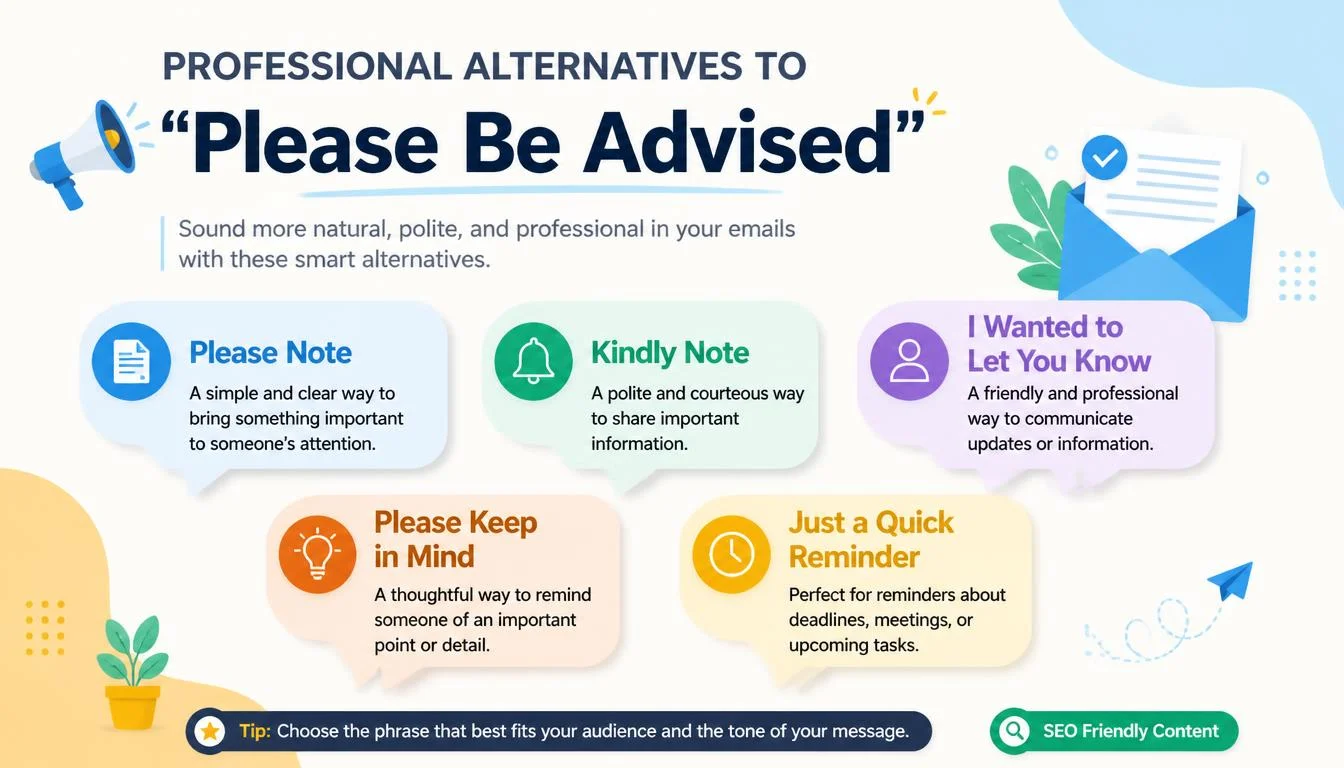
If you want to sound more natural and professional, there are several effective alternatives to “Please Be Advised.” You can use “Please Note,” “Kindly Note,” “I Wanted to Let You Know,” “Please Keep in Mind,” or “Just a Quick Reminder,” depending on your message and audience. These professional email phrases help you share important information, communicate updates, and remind others about deadlines without sounding too formal or impersonal. The best alternative depends on whether you’re writing to a boss, colleague, client, or customer and whether you want your message to sound polite, friendly, direct, or formal.
What Does “Please Be Advised” Mean?
“Please be advised” means that you are informing someone about something important they should know. It is commonly used in business emails, workplace announcements, customer service messages, official notices, and formal correspondence. For example, you might write, “Please be advised that the meeting has been rescheduled.” The phrase signals that the recipient should pay attention to the information that follows. Although it is grammatically correct, it can sound formal or distant in everyday communication.
Is It Professional or Polite to Say “Please Be Advised”?
Yes, “please be advised” is professional and generally polite, especially when communicating official updates, policy changes, deadlines, or important instructions. However, the phrase can sometimes sound overly formal, impersonal, or even stern, depending on the context. If you want your message to feel more approachable, alternatives such as “Please note,” “I wanted to let you know,” or “Just a quick reminder” may work better. The best choice depends on your audience, the importance of the information, and the tone you want to convey.
Advantages and Disadvantages of Saying “Please Be Advised”
Advantages
- Professional tone: It works well in formal emails, business correspondence, and official announcements.
- Clear communication: It signals that the following information deserves the recipient’s attention.
- Useful for important updates: It helps introduce policy changes, deadlines, procedures, and other relevant details.
Disadvantages
- Can sound impersonal: The wording may feel distant when communicating with colleagues, friends, or regular customers.
- May seem stern: In some contexts, recipients might interpret it as a warning or reprimand.
- Can feel unnecessarily formal: Simpler expressions often communicate the same information more naturally and efficiently.
Synonyms for “Please Be Advised”
- Please Note
- Kindly Note
- Please Be Aware
- I Would Like to Inform You
- Please Keep in Mind
- For Your Information
- Just So You Know
- I Wanted to Let You Know
- Please Take Note
- Kindly Be Informed
- Please Remember
- A Quick Reminder
- I’d Like to Bring to Your Attention
- Please Be Informed That
- We Would Like to Notify You
- Just a Heads-Up
- Please Take Into Consideration
- I’d Like to Make You Aware
- It’s Important to Note
- Please Be Mindful
- We Wish to Inform You
- This Is to Inform You
- For Your Awareness
- I’d Like to Highlight
- Please Pay Attention to
- We’d Like to Bring to Your Notice
- Please Bear in Mind
- I Thought You Should Know
- Let Me Draw Your Attention to
- We’d Like to Keep You Updated
1. Please Note
Meaning: To politely direct someone’s attention to important information.
Definition: “Please note” is a concise expression used to highlight a detail, instruction, change, or reminder that the recipient should notice.
Detailed Explanation: This alternative is one of the closest replacements for “please be advised.” It sounds professional without being overly complicated. It works particularly well when communicating deadlines, meeting changes, updated procedures, or important details in a business email.
Scenario Example: “Please note that the office will close at 3 p.m. on Friday.”
Best Use: Professional emails, announcements, schedules, and policy updates.
Tone: Professional, neutral, and polite.
2. Kindly Note
Meaning: To ask someone politely to pay attention to specific information.
Definition: “Kindly note” introduces information that the recipient should remember or consider.
Detailed Explanation: This phrase is especially common in formal business communication. It adds a courteous touch while keeping the message direct. However, in some contexts, it can sound slightly formal or firm, so a simpler alternative may feel more natural in casual conversations.
Scenario Example: “Kindly note that all applications must be submitted by October 15.”
Best Use: Formal emails, administrative notices, and customer correspondence.
Tone: Courteous, formal, and respectful.
3. Please Be Aware
Meaning: To let someone know about a situation, condition, or possible concern.
Definition: “Please be aware” alerts the recipient to information that may affect them or require their attention.
Detailed Explanation: Use this expression when the information involves a potential delay, a change in circumstances, a safety concern, or an important condition. It can sound more serious than “please note,” so choose it when the recipient genuinely needs to be aware of something.
Scenario Example: “Please be aware that road construction may cause delays near the office.”
Best Use: Warnings, service updates, safety notices, and important changes.
Tone: Informative, professional, and sometimes cautionary.
4. I Would Like to Inform You
Meaning: To communicate information to someone in a respectful and formal manner.
Definition: This expression introduces an update, announcement, or piece of information directly to the recipient.
Detailed Explanation: Unlike “please be advised,” this alternative makes the communication feel more personal because it identifies the sender as the person sharing the information. It is useful when announcing a decision, explaining a change, or providing a formal update.
Scenario Example: “I would like to inform you that your application has been approved.”
Best Use: Official emails, workplace announcements, and formal correspondence.
Tone: Respectful, formal, and direct.
5. Please Keep in Mind
Meaning: To ask someone to remember or consider an important detail.
Definition: “Please keep in mind” introduces information that should influence someone’s understanding, decision, or actions.
Detailed Explanation: This phrase feels more conversational than “please be advised.” It is useful when explaining limitations, expectations, deadlines, or circumstances that may affect a decision. It encourages the recipient to consider the information rather than simply acknowledge it.
Scenario Example: “Please keep in mind that the final report must include the updated figures.”
Best Use: Instructions, planning discussions, workplace emails, and helpful reminders.
Tone: Friendly, considerate, and professional.
6. For Your Information
Meaning: To share information that may be useful or relevant to someone.
Definition: “For your information,” often abbreviated as FYI, introduces an update or detail for the recipient’s awareness.
Detailed Explanation: This expression is common in emails and workplace messages. It works well when forwarding documents, sharing updates, or providing background information. However, depending on the wording and context, “FYI” can sometimes sound abrupt, so a complete sentence may be more considerate.
Scenario Example: “For your information, the client has confirmed the revised delivery date.”
Best Use: Email updates, document sharing, and workplace communication.
Tone: Informative, neutral, and professional.
7. Just So You Know
Meaning: To share information informally so that someone understands a situation.
Definition: This conversational expression introduces a detail that the recipient may find useful or important.
Detailed Explanation: “Just so you know” sounds more relaxed and personal than “please be advised.” It is ideal when communicating with familiar colleagues or people you know well. In formal business notices, however, it may sound too casual.
Scenario Example: “Just so you know, the meeting room has changed to Conference Room B.”
Best Use: Team chats, informal emails, and everyday conversations.
Tone: Casual, friendly, and approachable.
8. I Wanted to Let You Know
Meaning: To share information in a considerate and personal way.
Definition: This expression introduces an update while emphasizing the sender’s intention to keep the recipient informed.
Detailed Explanation: It is a warm alternative when you want to avoid sounding too official or distant. It works particularly well for schedule changes, project updates, personal notifications, and messages to colleagues. The wording makes the communication feel more like a helpful update than a formal notice.
Scenario Example: “I wanted to let you know that we have moved the presentation to Thursday.”
Best Use: Colleague emails, customer updates, and friendly professional messages.
Tone: Warm, polite, and conversational.
9. Please Take Note
Meaning: To ask someone to pay particular attention to information.
Definition: “Please take note” emphasizes that a detail should be noticed or remembered.
Detailed Explanation: This phrase is useful when sharing instructions, requirements, or changes that recipients should not overlook. It is somewhat more directive than “please note,” so use it when the information requires particular attention.
Scenario Example: “Please take note of the revised submission guidelines before uploading your assignment.”
Best Use: Instructions, training materials, administrative notices, and formal announcements.
Tone: Direct, formal, and authoritative.
10. Kindly Be Informed
Meaning: To formally communicate information to someone.
Definition: This expression introduces an official update or notice that the recipient should know about.
Detailed Explanation: “Kindly be informed” appears in formal correspondence, particularly in administrative and institutional settings. It communicates the message respectfully, although it may sound stiff in everyday English. In a more natural email, “I wanted to let you know” or “Please note” may be preferable.
Scenario Example: “Kindly be informed that the training session will begin at 10 a.m.”
Best Use: Administrative notices, formal announcements, and institutional emails.
Tone: Formal, courteous, and official.
11. Please Remember
Meaning: To ask someone to keep a particular detail in mind.
Definition: “Please remember” is a polite expression used to emphasize an instruction, responsibility, or important fact.
Detailed Explanation: This alternative is useful when the recipient needs to remember something for a future task or decision. It is straightforward and easy to understand. However, depending on the relationship, it may sound slightly instructive, so adding a friendly explanation can make it softer.
Scenario Example: “Please remember to attach the signed document before sending your application.”
Best Use: Task reminders, instructions, follow-up emails, and everyday professional communication.
Tone: Clear, helpful, and gently directive.
12. A Quick Reminder
Meaning: To remind someone about something important without making the message feel overly formal.
Definition: “A quick reminder” introduces information that the recipient may need to remember or act upon.
Detailed Explanation: This expression is particularly useful when following up on deadlines, meetings, appointments, or pending tasks. It feels less rigid than “please be advised” and often makes workplace communication more approachable. Keep the message friendly and avoid using it in a way that makes the recipient feel blamed.
Scenario Example: “A quick reminder that the project proposal is due by Friday afternoon.”
Best Use: Follow-up emails, team messages, appointment reminders, and deadline notifications.
Tone: Friendly, professional, and considerate.
13. I’d Like to Bring to Your Attention
Meaning: To direct someone’s attention to a specific issue or important detail.
Definition: This phrase formally introduces a matter that deserves consideration or action.
Detailed Explanation: Use this alternative when you need to highlight an issue without sounding unnecessarily harsh. It works well for reporting discrepancies, identifying potential problems, or pointing out an important development. For sensitive topics, briefly explaining why the information matters can make your message more constructive.
Scenario Example: “I’d like to bring to your attention a discrepancy in the latest sales report.”
Best Use: Business correspondence, reports, professional concerns, and formal discussions.
Tone: Respectful, serious, and professional.
14. Please Be Informed That
Meaning: To formally communicate a fact or update to someone.
Definition: “Please be informed that” introduces information the recipient should know.
Detailed Explanation: This expression serves a similar purpose to “please be advised,” particularly in official communications. It can introduce changes to procedures, account information, schedules, or organizational policies. However, it is often more formal than necessary for everyday emails, where simpler wording can improve readability.
Scenario Example: “Please be informed that the customer support team will operate on reduced hours tomorrow.”
Best Use: Official notifications, policy announcements, and administrative correspondence.
Tone: Formal, informative, and official.
15. We Would Like to Notify You
Meaning: To formally communicate an update or announcement.
Definition: This expression introduces information that an organization or team wants to share with its audience.
Detailed Explanation: “We would like to notify you” works especially well when a business communicates with customers, employees, or clients. It sounds more organized and personal than a bare notice because it acknowledges the recipient directly. For routine updates, a shorter expression such as “We wanted to let you know” may sound more natural.
Scenario Example: “We would like to notify you that your scheduled maintenance has been moved to Monday.”
Best Use: Customer service emails, company announcements, and service notifications.
Tone: Professional, courteous, and informative.
See More: 30 Other Ways to Say ‘I Will Get Back to You’ Best Uses
16. Just a Heads-Up
Meaning: To give someone an informal warning or helpful update in advance.
Definition: “Just a heads-up” is a conversational expression that prepares someone for information or a possible change.
Detailed Explanation: This alternative is ideal when you want to keep a colleague informed without making the message sound like an official announcement. It works for schedule changes, upcoming deadlines, and potential delays. Because it is informal, it is generally better suited to familiar workplace relationships than legal notices or formal policy communications.
Scenario Example: “Just a heads-up: the client may request a few changes to the presentation.”
Best Use: Team chats, casual work emails, and informal project updates.
Tone: Friendly, relaxed, and helpful.
17. Please Take Into Consideration
Meaning: To ask someone to consider a particular factor before making a decision.
Definition: This phrase introduces information that may affect a decision, plan, or course of action.
Detailed Explanation: Unlike “please be advised,” which mainly communicates information, this expression encourages the recipient to think about a specific circumstance. It is especially useful when discussing budgets, timelines, resources, or individual needs. Make the relevant factor clear so the recipient understands why it matters.
Scenario Example: “Please take into consideration the additional time required for quality testing.”
Best Use: Project planning, proposals, negotiations, and decision-making discussions.
Tone: Thoughtful, professional, and persuasive.
18. I’d Like to Make You Aware
Meaning: To inform someone about a situation they may not know about.
Definition: This expression introduces information that could be relevant to the recipient’s understanding or actions.
Detailed Explanation: “I’d like to make you aware” offers a professional yet personal way to raise an issue. It is useful when discussing a concern, explaining a change, or sharing information that could affect someone’s work. It can also soften the delivery of sensitive information when followed by a calm, factual explanation.
Scenario Example: “I’d like to make you aware that the latest software update may affect older devices.”
Best Use: Workplace updates, customer communications, and professional concerns.
Tone: Considerate, informative, and professional.
19. It’s Important to Note
Meaning: To emphasize a detail that deserves special attention.
Definition: “It’s important to note” introduces a significant fact, limitation, or condition.
Detailed Explanation: This expression helps distinguish essential information from less important details. It works well when explaining requirements, clarifying expectations, or presenting findings. It is especially effective in longer emails and reports because it signals that the following point should not be overlooked.
Scenario Example: “It’s important to note that the quoted price excludes installation fees.”
Best Use: Reports, proposals, instructions, business emails, and explanatory documents.
Tone: Clear, informative, and authoritative.
20. Please Be Mindful
Meaning: To encourage someone to consider a situation, responsibility, or possible impact.
Definition: This expression asks the recipient to remain conscious of a particular detail when acting or making decisions.
Detailed Explanation: “Please be mindful” can communicate a reminder without sounding as rigid as an official notice. It is useful when discussing shared responsibilities, deadlines, workplace etiquette, or other people’s needs. Because it can sometimes sound like a reprimand, explain the reason for the request in a respectful way.
Scenario Example: “Please be mindful of the team’s workload when requesting last-minute revisions.”
Best Use: Team communication, workplace etiquette, collaborative projects, and considerate reminders.
Tone: Respectful, thoughtful, and gently directive.
21. We Wish to Inform You
Meaning: To communicate information formally on behalf of a group or organization.
Definition: This phrase introduces an official announcement or update from the sender.
Detailed Explanation: It is appropriate when an organization needs to communicate a decision, change, or announcement to a wider audience. Although the wording is polite, it can sound ceremonial or distant in routine business communication. For ordinary updates, “We wanted to let you know” often creates a friendlier impression.
Scenario Example: “We wish to inform you that registration for the upcoming workshop is now open.”
Best Use: Institutional announcements, formal letters, and organizational communications.
Tone: Formal, respectful, and official.
22. This Is to Inform You
Meaning: To formally state that the recipient is being given specific information.
Definition: “This is to inform you” introduces a direct notice about a situation, decision, or change.
Detailed Explanation: This phrase is commonly used in formal letters, administrative notices, and official workplace communication. It is clear and direct, although it can sound impersonal when used for routine messages. Consider whether the subject requires a formal announcement or simply a brief, friendly update.
Scenario Example: “This is to inform you that the scheduled inspection will take place on October 12.”
Best Use: Official letters, administrative announcements, and formal notifications.
Tone: Formal, direct, and neutral.
23. For Your Awareness
Meaning: To share information so that someone understands a relevant situation.
Definition: This expression introduces information provided primarily to keep the recipient informed.
Detailed Explanation: “For your awareness” can work in workplace messages when no immediate action is required but the information may be useful. It is less common in everyday conversation than “for your information.” For a more natural tone, consider using “I wanted to make you aware” or “Just so you know.”
Scenario Example: “For your awareness, the vendor has updated its delivery schedule for next week.”
Best Use: Internal business updates, project communications, and informational emails.
Tone: Neutral, professional, and informative.
24. I’d Like to Highlight
Meaning: To draw attention to a particular point or important detail.
Definition: This expression emphasizes information that the recipient should notice or understand.
Detailed Explanation: Use “I’d like to highlight” when explaining key findings, emphasizing a project milestone, or pointing out an important requirement. It sounds collaborative and works well in professional discussions because it focuses attention without necessarily implying a warning.
Scenario Example: “I’d like to highlight the progress the team has made toward meeting our quarterly goals.”
Best Use: Presentations, reports, project updates, and business discussions.
Tone: Positive, professional, and focused.
25. Please Pay Attention to
Meaning: To ask someone to focus on a particular detail or instruction.
Definition: This expression directly requests that the recipient concentrate on specific information.
Detailed Explanation: It is useful when missing a detail could lead to an error or misunderstanding. However, it is more commanding than “please note,” so it may sound harsh in routine emails. When communicating with colleagues or customers, explain the importance of the information to keep the wording respectful.
Scenario Example: “Please pay attention to the updated safety instructions before operating the equipment.”
Best Use: Safety instructions, training, urgent reminders, and detailed procedures.
Tone: Direct, firm, and instructive.
26. We’d Like to Bring to Your Notice
Meaning: To formally direct someone’s attention to a matter.
Definition: This expression introduces an issue or detail that an organization wants the recipient to recognize.
Detailed Explanation: The phrase is used in some varieties of formal business English, particularly in South Asian administrative correspondence. However, it can sound less natural to some international audiences. “We’d like to bring this to your attention” is generally a smoother alternative for global business communication.
Scenario Example: “We’d like to bring to your notice that the submitted form is missing a required signature.”
Best Use: Administrative letters, formal notices, and official correspondence.
Tone: Formal, serious, and respectful.
27. Please Bear in Mind
Meaning: To ask someone to remember a detail while considering a situation.
Definition: “Please bear in mind” introduces information that should remain in consideration during a decision or action.
Detailed Explanation: This phrase is a natural alternative when the recipient needs to consider a limitation, condition, or expectation. It sounds less rigid than “please be advised” while remaining suitable for professional communication. It is especially useful when offering context rather than issuing a strict instruction.
Scenario Example: “Please bear in mind that the final schedule may change depending on client availability.”
Best Use: Planning emails, project discussions, recommendations, and professional advice.
Tone: Considerate, practical, and professional.
28. I Thought You Should Know
Meaning: To share information because you believe it may matter to someone.
Definition: This expression introduces information that the sender considers relevant to the recipient.
Detailed Explanation: “I thought you should know” feels personal and approachable. It is useful for sharing updates that could affect a colleague, friend, or client. Depending on the subject, it may also introduce sensitive information, so choose wording that respects the recipient’s feelings and avoids creating unnecessary concern.
Scenario Example: “I thought you should know that the client has requested a different delivery date.”
Best Use: Personal updates, colleague messages, and informal professional communication.
Tone: Warm, considerate, and conversational.
29. Let Me Draw Your Attention to
Meaning: To direct someone’s focus toward a specific issue or detail.
Definition: This expression introduces information that the sender wants the recipient to examine carefully.
Detailed Explanation: It is especially useful in presentations, reports, meetings, and formal discussions. The wording is clear and deliberate, making it appropriate when a particular point deserves more attention than the surrounding information. For a more relaxed message, “I’d like to highlight” may sound friendlier.
Scenario Example: “Let me draw your attention to the revised payment terms outlined in section three.”
Best Use: Presentations, formal meetings, reports, and detailed business correspondence.
Tone: Professional, deliberate, and authoritative.
30. We’d Like to Keep You Updated
Meaning: To let someone know that you intend to share relevant information as a situation develops.
Definition: This expression communicates a commitment to provide ongoing updates about a matter.
Detailed Explanation: While “please be advised” usually introduces a specific notice, “we’d like to keep you updated” emphasizes continued communication. It is especially effective when customers, clients, or colleagues are waiting for progress reports or decisions. It builds trust by showing that you intend to keep the recipient informed rather than leave them wondering.
Scenario Example: “We’d like to keep you updated as we work toward resolving the service issue.”
Best Use: Customer support, project management, ongoing issues, and client relationships.
Tone: Reassuring, professional, and helpful.
Frequently Asked Questions
1. What does “Please Be Advised” mean?
“Please be advised” means you are formally informing someone about important information, an update, or a decision. It commonly appears in professional emails, business correspondence, and official notices.
2. What is another way to say “Please Be Advised”?
You can say “Please note,” “For your information,” “Just a heads-up,” “Please keep in mind,” or “I wanted to let you know.” The best alternative depends on your audience and the situation.
3. Is “Please Be Advised” professional?
Yes, “please be advised” is considered professional in formal emails and workplace communication. However, using it too often may make your writing sound stiff or overly formal.
4. Is “Please Be Advised” rude?
No, the phrase is not inherently rude. However, it can sound cold, strict, or authoritative depending on the context, the message, and your relationship with the recipient.
5. Is “Please Be Advised” outdated?
The phrase is still used in formal and official communication. However, many modern workplaces prefer direct, natural wording that communicates information without unnecessary formality.
6. How can I use “Please Be Advised” in an email?
You can use it to introduce an important announcement or update. For example: “Please be advised that the meeting has been rescheduled to 3 PM.” For a more direct approach, write, “The meeting has been rescheduled to 3 PM.”
7. What is a polite alternative to “Please Be Advised”?
“Please note” is a polite and professional alternative. You can also use “I wanted to let you know” when you want your message to sound warmer and more conversational.
8. Can I use “Just a Heads-Up” in a professional email?
Yes, “just a heads-up” works well in friendly workplace emails and informal messages to colleagues. For formal notices, client communication, or senior-level correspondence, a more formal alternative may be appropriate.
9. Should I use “Please Be Advised” in business emails?
You can use it when sharing official information or a serious update. However, direct wording often makes business emails easier to read. Choose a phrase that matches the importance of your message and your relationship with the recipient.
10. How do I make my emails sound less formal?
Use clear, direct language, shorter sentences, and a natural tone. Replace phrases such as “Please be advised that the meeting has been moved to Thursday” with “The meeting has been moved to Thursday.” This approach keeps your communication professional without making it sound distant.
Conclusion
“Please be advised” remains useful in formal emails, business correspondence, and official notices, but it isn’t always the best choice for everyday communication. The right alternative depends on your audience, purpose, and desired tone. Phrases such as “Please note,” “I wanted to let you know,” and “Just a heads-up” can make your messages sound more natural while maintaining professionalism. By choosing clear wording, avoiding unnecessary formality, and considering how your message may sound to the reader, you can make your professional communication more effective, polite, and approachable.