

To write clear, polite replies, 30 Other Ways to Say ‘I Will Get Back to You’ can help you choose a phrase that fits each audience and situation.
“I will get back to you” is a common English phrase and one of the most familiar common expressions in English. It is used when you need time to think, check information, confirm details, review a request, or speak with someone before replying. However, without a specific timeline, the recipient may face uncertainty about the response.
Words such as tomorrow, next week, by Friday, or after the next board meeting create a clearer expectation. In professional emails and business communication, a clear timeframe can feel more helpful than a general promise. It also tells recipients when to expect a reply, update, or proper response, which can prevent unnecessary follow-up emails.
The main problem is vagueness. The phrase can sound like a soft deferral when someone has no idea when they will follow up. Even when it represents a genuine commitment, it may feel dull or unprofessional in certain contexts. The best alternatives explain what you need to do, such as “I’ll review this and send an update,” or identify a next touchpoint, such as “I’ll follow up shortly.”
The 30 ways in this guide show how to say the same idea across work, support, meetings, text messages, updates, essays, and casual conversation. A good alternative can sound clearer, polite, and tailored to your audience. In a casual setting, “I’ll hit you up later” may fit, while a business email usually needs a more polished tone. Choosing the right words can boost confidence, improve tone, and help you convey your meaning and usage more naturally.
Quick Answer
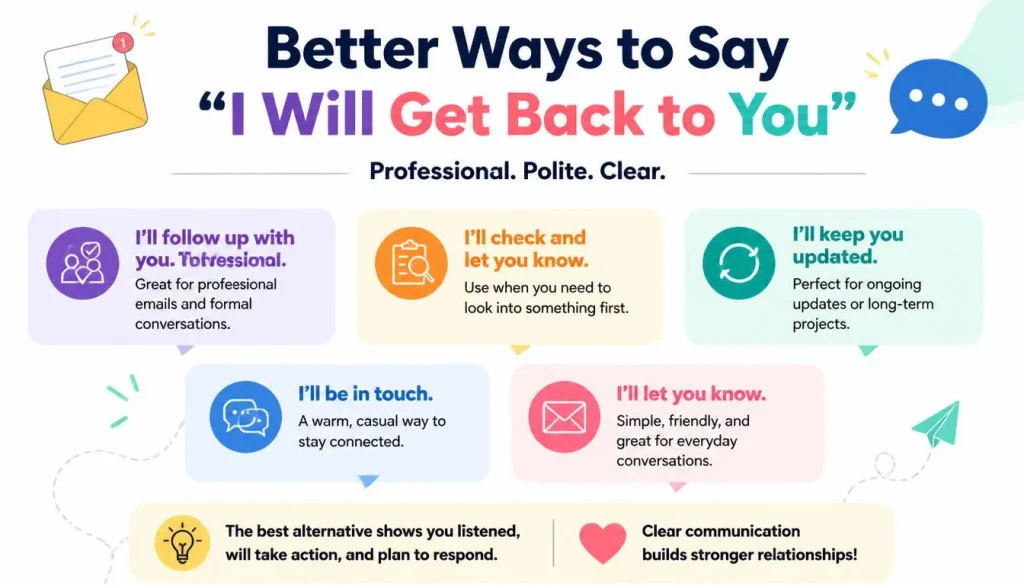
If you want alternatives to “I will get back to you,” choose a phrase that matches the situation and the amount of detail you need to provide. For a professional email, “I’ll follow up with you” or “I’ll review this and follow up” sounds polished and responsible. If you need to check something first, “I’ll check and let you know” is clear and natural. For ongoing updates, “I’ll keep you updated” or “I’ll keep you informed” works well. In more casual conversations, “I’ll be in touch” or “I’ll let you know” feels warmer and less formal. The best alternative makes it clear that you heard the person, will take the necessary action, and intend to respond.
What Does “I Will Get Back to You” Mean?
“I will get back to you” means that you will respond to someone at a later time, usually after you have gathered information, considered something carefully, or become available to continue the conversation. It is commonly used in emails, workplace conversations, customer service, meetings, and everyday communication. The phrase tells the other person that you have received their message and intend to provide a response rather than leaving them wondering whether you will reply.
For example, if someone asks you about a meeting schedule and you need to check your calendar first, you might say, “I will get back to you once I confirm my availability.” The phrase can therefore communicate acknowledgment, responsibility, and willingness to follow up.
Is It Professional or Polite to Say “I Will Get Back to You”?
Yes, “I will get back to you” is professional and polite in most situations. It is especially common in workplace emails, business communication, customer service, and conversations where you need additional time before giving an accurate answer. However, the phrase can sometimes sound generic or vague if you do not explain when or why you will respond.
A more thoughtful alternative can make your communication feel clearer and more considerate. For example, saying “I’ll review the details and follow up with you tomorrow” gives the recipient useful information and shows that you are taking their request seriously.
Advantages of Saying “I Will Get Back to You”
- It gives you time to respond thoughtfully: You do not have to provide an immediate answer when you need more information.
- It shows accountability: The phrase indicates that you intend to continue the conversation and provide a response.
- It works in many situations: You can use it with clients, coworkers, managers, customers, friends, or acquaintances.
Disadvantages of Saying “I Will Get Back to You”
- It can sound vague: The recipient may not know when they should expect your response.
- It can feel repetitive: Using the same phrase in every email may make your communication sound formulaic.
- It may seem impersonal: In sensitive or important conversations, a more specific response can feel warmer and more attentive.
Synonyms for “I Will Get Back to You”
- I’ll Follow Up With You
- I’ll Get Back to You Shortly
- I’ll Be in Touch
- I’ll Follow Up Soon
- I’ll Respond Once I Have More Information
- I’ll Get Back to You as Soon as Possible
- I’ll Check and Let You Know
- I’ll Look Into It and Get Back to You
- I’ll Keep You Posted
- I’ll Let You Know
- I’ll Reach Out Once I Know More
- I’ll Get in Touch With You
- I’ll Follow Up Once I’ve Reviewed It
- I’ll Check on This and Update You
- I’ll Give You an Update Soon
- I’ll Get Back to You Once I’ve Checked
- I’ll Review This and Follow Up
- I’ll Keep You Updated
- I’ll Be in Touch With an Update
- I’ll Respond After I’ve Looked Into This
- I’ll Confirm and Let You Know
- I’ll Get Back to You With More Details
- I’ll Follow Up When I Have an Answer
- I’ll Touch Base With You Soon
- I’ll Reach Out With an Update
- I’ll Get Back to You Once I Have Confirmation
- I’ll Take a Look and Let You Know
- I’ll Follow Up as Soon as I Can
- I’ll Contact You Once I Have More Information
- I’ll Keep You Informed
1. I’ll Follow Up With You
Meaning: This means you intend to contact the person again after reviewing something or taking the next step.
Definition: “I’ll follow up with you” is a professional way to promise a future response or update.
Detailed Explanation: This phrase is especially useful when a conversation requires additional action. It sounds organized and shows that you are taking responsibility for continuing the discussion.
Scenario Example: “I’ll review the proposal this afternoon, and I’ll follow up with you tomorrow.”
Best Use: Professional emails, business discussions, meetings, and client communication.
Tone: Professional, responsible, and courteous.
2. I’ll Get Back to You Shortly
Meaning: You will respond again after a short amount of time.
Definition: This phrase communicates that your response is coming soon.
Detailed Explanation: It works well when you do not need much time but cannot answer immediately. However, avoid saying “shortly” if you expect a long delay.
Scenario Example: “I need to confirm one detail. I’ll get back to you shortly.”
Best Use: Emails, workplace chats, customer service, and quick conversations.
Tone: Polite, efficient, and reassuring.
3. I’ll Be in Touch
Meaning: You intend to contact the person again.
Definition: “I’ll be in touch” is a natural way of saying that you will communicate with someone again.
Detailed Explanation: This alternative sounds less formal than “I will get back to you,” making it suitable for both professional and personal conversations.
Scenario Example: “Thank you for sharing your information. I’ll be in touch once I’ve reviewed everything.”
Best Use: Professional follow-ups and friendly conversations.
Tone: Warm, natural, and professional.
4. I’ll Follow Up Soon
Meaning: You will provide another response or update in the near future.
Definition: It is a concise promise to continue communication soon.
Detailed Explanation: This phrase is useful when you want to reassure someone without making a specific deadline.
Scenario Example: “I’ll check with the team and follow up soon.”
Best Use: Work emails, project updates, and business communication.
Tone: Professional and reassuring.
5. I’ll Respond Once I Have More Information
Meaning: You need additional information before giving a complete answer.
Definition: This phrase clearly explains that your response depends on receiving or checking more details.
Detailed Explanation: It is more transparent than simply saying “I will get back to you.” The recipient understands why you cannot answer immediately.
Scenario Example: “I’m checking the availability now. I’ll respond once I have more information.”
Best Use: Professional situations requiring research or confirmation.
Tone: Clear, honest, and professional.
6. I’ll Get Back to You as Soon as Possible
Meaning: You will respond at the earliest practical opportunity.
Definition: This phrase expresses your intention to respond quickly.
Detailed Explanation: It can be helpful when the matter is important, but it should not be used when you cannot reasonably promise a quick response.
Scenario Example: “I understand this is important, and I’ll get back to you as soon as possible.”
Best Use: Urgent workplace requests and customer communication.
Tone: Helpful, respectful, and attentive.
7. I’ll Check and Let You Know
Meaning: You will verify something before providing an answer.
Definition: It means you will check the relevant information and then respond.
Detailed Explanation: This sounds natural and conversational. It is particularly useful when someone asks a question you cannot answer from memory.
Scenario Example: “I’m not sure whether that room is available. I’ll check and let you know.”
Best Use: Everyday conversations and workplace communication.
Tone: Friendly, practical, and helpful.
8. I’ll Look Into It and Get Back to You
Meaning: You will investigate or examine an issue before responding.
Definition: This phrase means you will take time to understand a situation and provide an answer later.
Detailed Explanation: It shows that you are not dismissing the person’s concern. Instead, you are willing to investigate it properly.
Scenario Example: “I’ll look into the billing issue and get back to you.”
Best Use: Customer service, workplace problems, and business communication.
Tone: Responsible, professional, and reassuring.
9. I’ll Keep You Posted
Meaning: You will continue giving someone updates as a situation develops.
Definition: “I’ll keep you posted” means you will inform the person about important developments.
Detailed Explanation: This is less formal than many alternatives, but it feels friendly and natural. It works especially well when there may be several updates rather than one final response.
Scenario Example: “We’re waiting for the final approval. I’ll keep you posted.”
Best Use: Coworkers, friends, ongoing projects, and informal professional communication.
Tone: Friendly, relaxed, and reassuring.
See More: 30 Other Ways to Say ‘Thank You for Asking’ Best Uses
10. I’ll Let You Know
Meaning: You will tell the person when you have an answer.
Definition: This simple phrase means you will provide information once you know it.
Detailed Explanation: It is short and natural. You can use it when the situation is straightforward and does not require a highly formal response.
Scenario Example: “I’ll check my schedule and let you know.”
Best Use: Everyday conversations, texts, emails, and workplace chats.
Tone: Simple, friendly, and direct.
11. I’ll Reach Out Once I Know More
Meaning: You will contact the person after gaining additional information.
Definition: It promises future communication after you have more clarity.
Detailed Explanation: This is useful when you do not yet have enough information to give a meaningful answer.
Scenario Example: “I’m waiting for the manager’s response. I’ll reach out once I know more.”
Best Use: Professional emails and business communication.
Tone: Professional and considerate.
12. I’ll Get in Touch With You
Meaning: You will contact the person again.
Definition: “I’ll get in touch with you” is a polite promise of future communication.
Detailed Explanation: It is flexible enough for professional and personal situations. Adding a timeframe can make it even clearer.
Scenario Example: “I’ll get in touch with you later this week to discuss the details.”
Best Use: Emails, phone conversations, and business communication.
Tone: Polite, warm, and professional.
13. I’ll Follow Up Once I’ve Reviewed It
Meaning: You will respond after carefully examining something.
Definition: This phrase tells the recipient that your response will come after a review.
Detailed Explanation: It works particularly well when someone sends you a document, proposal, application, or report.
Scenario Example: “Thank you for sending the proposal. I’ll follow up once I’ve reviewed it.”
Best Use: Business emails, reports, proposals, and workplace communication.
Tone: Professional, thoughtful, and organized.
14. I’ll Check on This and Update You
Meaning: You will investigate something and then provide new information.
Definition: This phrase communicates action followed by an update.
Detailed Explanation: It is useful when the recipient wants reassurance that their question or concern is being handled.
Scenario Example: “I’ll check on this with the accounting team and update you.”
Best Use: Customer service and workplace communication.
Tone: Helpful, responsible, and reassuring.
15. I’ll Give You an Update Soon
Meaning: You will provide new information in the near future.
Definition: It promises a future status update or response.
Detailed Explanation: This is particularly useful when you do not yet have a final answer but expect to know more soon.
Scenario Example: “We’re waiting for the supplier’s confirmation. I’ll give you an update soon.”
Best Use: Projects, work emails, and ongoing situations.
Tone: Professional and reassuring.
16. I’ll Get Back to You Once I’ve Checked
Meaning: You will respond after verifying the relevant information.
Definition: This phrase explains that you need to check something before responding.
Detailed Explanation: It is clearer than giving a vague promise because it tells the recipient what you need to do first.
Scenario Example: “I’ll get back to you once I’ve checked the meeting schedule.”
Best Use: Workplace communication and scheduling.
Tone: Clear, practical, and polite.
17. I’ll Review This and Follow Up
Meaning: You will examine something and contact the person afterward.
Definition: It means you will review the information before providing your response.
Detailed Explanation: This phrase sounds professional without being unnecessarily formal. It is a strong choice when someone expects thoughtful feedback.
Scenario Example: “I’ll review this and follow up with my comments tomorrow.”
Best Use: Documents, proposals, projects, and professional emails.
Tone: Professional, careful, and responsible.
18. I’ll Keep You Updated
Meaning: You will continue sharing relevant information.
Definition: This phrase promises ongoing communication about changes or progress.
Detailed Explanation: It works best when a situation is still developing and the person may need more than one update.
Scenario Example: “The project is still under review, but I’ll keep you updated.”
Best Use: Projects, workplace communication, and customer service.
Tone: Professional, reassuring, and supportive.
19. I’ll Be in Touch With an Update
Meaning: You will contact the person again with new information.
Definition: This phrase combines a promise of future contact with a specific purpose.
Detailed Explanation: It sounds warmer and more purposeful than a vague promise to respond.
Scenario Example: “I’m checking the final numbers and will be in touch with an update.”
Best Use: Business emails and professional follow-ups.
Tone: Warm, polished, and professional.
20. I’ll Respond After I’ve Looked Into This
Meaning: You will investigate an issue before answering.
Definition: This means you will review or research the matter before responding.
Detailed Explanation: It is especially useful when someone raises a question that requires careful attention rather than an immediate answer.
Scenario Example: “Thank you for bringing this to my attention. I’ll respond after I’ve looked into this.”
Best Use: Complaints, questions, workplace issues, and customer service.
Tone: Professional, serious, and attentive.
21. I’ll Confirm and Let You Know
Meaning: You will verify information and then provide an answer.
Definition: This phrase promises to confirm a detail before responding.
Detailed Explanation: It is excellent for scheduling, reservations, availability, deadlines, and other situations where accuracy matters.
Scenario Example: “I’ll confirm the appointment time and let you know.”
Best Use: Scheduling, business communication, and arrangements.
Tone: Clear, reliable, and professional.
22. I’ll Get Back to You With More Details
Meaning: You will provide additional information later.
Definition: This phrase promises a future response containing more complete information.
Detailed Explanation: It is helpful when you have received a question but need time to gather all the relevant details.
Scenario Example: “I’m gathering the specifications now. I’ll get back to you with more details.”
Best Use: Business emails, technical discussions, and customer service.
Tone: Professional and informative.
23. I’ll Follow Up When I Have an Answer
Meaning: You will contact the person once you know the answer.
Definition: This phrase connects your future response directly to having sufficient information.
Detailed Explanation: It avoids making an unrealistic promise about timing while still reassuring the recipient that you will respond.
Scenario Example: “I need to speak with the team first. I’ll follow up when I have an answer.”
Best Use: Workplace questions and decision-making situations.
Tone: Honest, professional, and reassuring.
24. I’ll Touch Base With You Soon
Meaning: You will contact the person again soon.
Definition: “Touch base” means to communicate briefly about a matter or provide an update.
Detailed Explanation: This is a common workplace expression. It sounds natural in professional settings but may be less suitable for highly formal writing.
Scenario Example: “I’ll touch base with you soon to discuss the next steps.”
Best Use: Work emails, meetings, and team communication.
Tone: Friendly, casual-professional, and approachable.
25. I’ll Reach Out With an Update
Meaning: You will contact someone when you have new information.
Definition: This phrase communicates a promise of future contact and an update.
Detailed Explanation: It is a polished alternative when you want to sound proactive without making the message overly formal.
Scenario Example: “I’m waiting for confirmation from the supplier. I’ll reach out with an update.”
Best Use: Professional emails and client communication.
Tone: Professional, proactive, and courteous.
26. I’ll Get Back to You Once I Have Confirmation
Meaning: You will respond after something has been officially verified.
Definition: It means you will provide an answer after receiving confirmation.
Detailed Explanation: This is useful when accuracy depends on another person, department, company, or source.
Scenario Example: “I’m waiting for HR to confirm the date. I’ll get back to you once I have confirmation.”
Best Use: Workplace communication, scheduling, and business arrangements.
Tone: Reliable, precise, and professional.
27. I’ll Take a Look and Let You Know
Meaning: You will examine something and then provide your response.
Definition: This phrase means you will review something before giving an answer.
Detailed Explanation: It sounds natural and friendly. It is a good option when the situation does not require highly formal language.
Scenario Example: “Send me the document, and I’ll take a look and let you know.”
Best Use: Coworker messages, emails, texts, and everyday conversations.
Tone: Friendly, relaxed, and helpful.
28. I’ll Follow Up as Soon as I Can
Meaning: You will respond at the earliest opportunity available to you.
Definition: This phrase communicates an intention to follow up promptly.
Detailed Explanation: It is useful when you cannot give an exact deadline but want the person to know that you will not unnecessarily delay your response.
Scenario Example: “I’m tied up with another meeting right now, but I’ll follow up as soon as I can.”
Best Use: Workplace messages and time-sensitive conversations.
Tone: Polite, considerate, and professional.
29. I’ll Contact You Once I Have More Information
Meaning: You will reach out after receiving or gathering additional information.
Definition: This phrase clearly promises future communication based on new information.
Detailed Explanation: It is a straightforward alternative that works well when the reason for the delay needs to be clear.
Scenario Example: “We’re waiting for the final report. I’ll contact you once I have more information.”
Best Use: Professional emails, customer service, and formal communication.
Tone: Clear, respectful, and professional.
See More: 30 Other Ways to Say ‘Attached Is the Document’
30. I’ll Keep You Informed
Meaning: You will make sure the person knows about important developments.
Definition: “I’ll keep you informed” means you will provide relevant information as the situation progresses.
Detailed Explanation: This phrase sounds dependable and is particularly useful when someone has a genuine interest in the outcome of a situation.
Scenario Example: “We’re still reviewing the application, and I’ll keep you informed of any changes.”
Best Use: Formal emails, business communication, projects, and important updates.
Tone: Professional, dependable, and reassuring.
Frequently Asked Questions
1. What does “I will get back to you” mean?
It means you need more time before giving someone a response. You may need to check information, think about a request, or speak with someone first.
2. Is “I will get back to you” professional?
Yes, it is generally professional, especially in emails and workplace conversations. However, it can sound vague if you do not provide a clear timeline.
3. What is a more professional way to say “I will get back to you”?
You can say, “I’ll follow up shortly,” “I’ll review this and respond,” or “I’ll get back to you by Friday.” These options make your expectation clearer.
4. How can I avoid sounding vague?
Include a specific timeframe whenever possible. Instead of saying, “I’ll get back to you,” say, “I’ll get back to you tomorrow afternoon.”
5. Can I use “I will get back to you” in an email?
Yes. It works well in professional emails, especially when you need time to review details or confirm information before replying.
6. Is “I’ll get back to you soon” polite?
Yes, but soon does not provide an exact timeline. If the timing matters, mention a specific day or time instead.
7. What can I say instead of “I’ll get back to you later”?
You could say, “I’ll follow up later today,” “I’ll respond when I have more information,” or “I’ll send you an update tomorrow.”
8. Is “I’ll hit you up later” professional?
No. “I’ll hit you up later” is casual and better suited to friends or informal conversations. It is usually not appropriate for formal workplace communication.
9. Why is giving a timeline important?
A specific timeline reduces uncertainty and tells the other person when they can expect your reply or update. It can also reduce unnecessary follow-up messages.
10. What is the best alternative to “I will get back to you”?
The best alternative depends on the situation. “I’ll review this and get back to you” works well when you need to check something, while “I’ll follow up by Friday” is better when you can provide a firm deadline.
Conclusion
“I will get back to you” is simple, familiar, and useful, but it does not always give the other person enough information. Adding a specific timeline, explaining what you need to do, or identifying the next step can make your message feel more clear, polite, and professional.
Whether you are writing a business email, answering a support request, speaking in a meeting, or sending a casual text, the right alternative depends on your audience, tone, and situation. Choosing more precise words helps you communicate with confidence while making sure the recipient knows what to expect.