

Explore 30 Other Ways to Say ‘Thank You for Asking’ to choose warm, polite phrases for personal, professional, and conversational situations.
When someone checks in or asks a thoughtful question, showing appreciation can turn a small gesture into a big difference in building warm communication and respectful communication. If you are worried that thank you for asking sounds rude or impolite, the best way to decide is to consider the situation, who you are speaking with, and the tone you use.
In most cases, it is polite and gives you a natural way to thank someone for showing concern or interest. However, repeating the same phrase may feel less natural, so a variety of phrases gives you more options for personal, professional, and conversational communication.
The English language lets you enjoy the joys of changing your tone to adjust the meaning slightly. For example, thanks for asking can sound more relaxed, while I appreciate you asking may feel more professional.
In email communication, you can say I appreciate you asking when you want a thoughtful response, or Thanks for asking when the relationship is casual. Expressing appreciation naturally is often more effective than searching for one perfect replacement. This article will explore these choices and help you understand which response best fits the moment.
Quick Answer
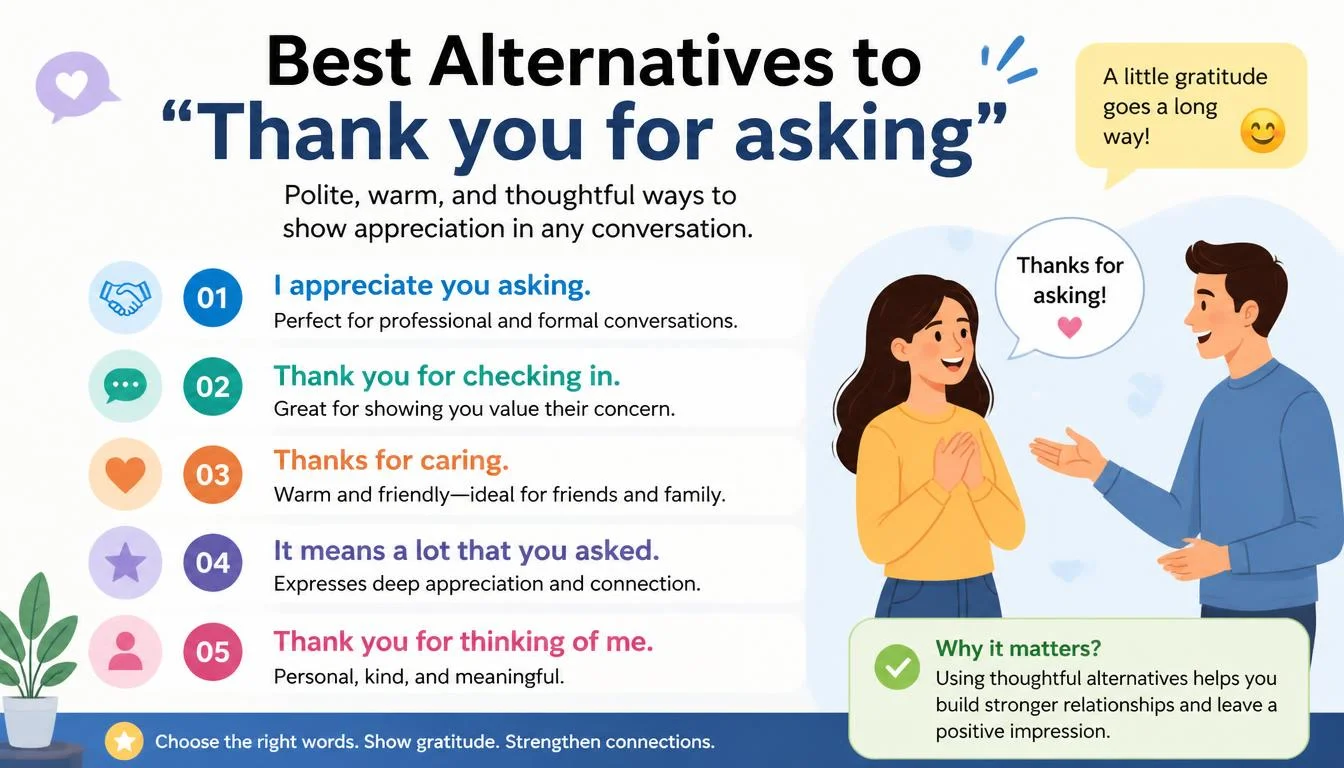
The best alternative to “Thank you for asking” depends on the situation and how much warmth you want to show. For professional communication, try “I appreciate you asking,” “Thank you for checking in,” or “I appreciate your interest.” For friends and family, warmer choices such as “Thanks for caring,” “It means a lot that you asked,” or “Thank you for thinking of me” can feel more personal. These alternatives help you express gratitude, care, and appreciation without sounding repetitive.
What Does “Thank You for Asking” Mean?
“Thank you for asking” is a polite expression used to show appreciation when someone takes the time to ask about you, your situation, your feelings, or something important to you. It tells the other person that you noticed and appreciated their interest or concern. For example, if a colleague asks how your presentation went, you might say, “Thank you for asking. It went really well.” The phrase can work in casual conversations, professional emails, messages, and more personal situations.
Is It Professional or Polite to Say “Thank You for Asking”?
Yes, “Thank you for asking” is both polite and professional in most situations. It is especially useful when someone shows genuine interest in your work, health, plans, feelings, or circumstances. However, the phrase can sometimes sound a little standard or predictable when used repeatedly. In professional communication, alternatives such as “I appreciate you asking” or “Thank you for checking in” can sound more natural and thoughtful, depending on the situation.
Advantages of Saying “Thank You for Asking”
- Shows appreciation: It lets the other person know that you value their concern or interest.
- Works in many situations: You can use it with friends, family members, coworkers, clients, or managers.
- Keeps communication positive: The phrase creates a warm and respectful tone without sounding overly emotional.
Disadvantages of Saying “Thank You for Asking”
- Can sound repetitive: If you use it frequently, it may feel like a routine response.
- May feel slightly formal: In very casual conversations, a more relaxed alternative may sound more natural.
- Does not always express depth: When someone has shown significant care, a stronger phrase may better communicate your gratitude.
Synonyms for “Thank You for Asking”
- I Appreciate You Asking
- Thanks for Checking In
- Thank You for Checking on Me
- I’m Glad You Asked
- Thanks for Caring
- I Appreciate Your Concern
- Thank You for Your Concern
- Thanks for Reaching Out
- I’m Grateful You Asked
- Thank You for Taking an Interest
- I Appreciate Your Interest
- Thanks for Being Thoughtful
- Thank You for Thinking of Me
- I Appreciate You Checking In
- Thanks for Your Kindness
- It Means a Lot That You Asked
- I’m Touched That You Asked
- Thank You for Caring Enough to Ask
- I’m Glad You Checked In
- Thanks for Taking the Time to Ask
- I Appreciate You Taking the Time
- Thank You for Being So Considerate
- Thanks for Showing You Care
- I’m Thankful You Asked
- Your Concern Means a Lot
- I Really Appreciate You Asking
- Thank You for Reaching Out to Me
- It’s Kind of You to Ask
- I’m Grateful for Your Concern
- Thank You for Checking on How I’m Doing
1. I Appreciate You Asking
Meaning: This means you are grateful that someone took the time to ask about something.
Definition: “I appreciate you asking” is a warm and polite way to acknowledge someone’s interest or concern.
Detailed Explanation: This alternative sounds slightly more thoughtful than the standard phrase. It works particularly well when you want to recognize that someone made an effort to check on you.
Scenario Example: Your coworker asks whether your job interview went well. You can say, “I appreciate you asking. I think it went really well.”
Best Use: Use it in professional emails, workplace conversations, and personal messages.
Tone: Warm, polite, professional, and appreciative.
2. Thanks for Checking In
Meaning: This means you appreciate someone contacting you to see how you are doing.
Definition: “Thanks for checking in” expresses gratitude for someone’s effort to follow up or see how things are going.
Detailed Explanation: This is a natural alternative when someone contacts you after knowing that you were dealing with something difficult, stressful, or important.
Scenario Example: A friend sends a message after your exam and asks how you feel. You reply, “Thanks for checking in. I’m feeling much better now.”
Best Use: Use it for texts, chats, emails, coworkers, friends, and family.
Tone: Friendly, caring, and conversational.
3. Thank You for Checking on Me
Meaning: You are thanking someone for making sure you are okay.
Definition: This phrase expresses gratitude when someone checks your condition or well-being.
Detailed Explanation: It feels more personal than “Thank you for asking.” It is particularly appropriate when someone has genuinely been concerned about you.
Scenario Example: After you miss work, your manager asks whether everything is okay. You respond, “Thank you for checking on me. I really appreciate it.”
Best Use: Use it when discussing well-being, difficult circumstances, or personal situations.
Tone: Caring, sincere, and personal.
4. I’m Glad You Asked
Meaning: You are pleased that someone brought up the subject.
Definition: “I’m glad you asked” shows that you welcome the question and are comfortable discussing the answer.
Detailed Explanation: This phrase is useful when you have something you genuinely want to explain or share. It can also make the conversation feel more open.
Scenario Example: Someone asks whether you need help with a project. You say, “I’m glad you asked. I could actually use some help.”
Best Use: Use it when you want to continue the conversation.
Tone: Open, positive, friendly, and conversational.
5. Thanks for Caring
Meaning: You appreciate someone showing genuine concern for you.
Definition: This phrase directly recognizes another person’s care and emotional support.
Detailed Explanation: “Thanks for caring” is short but meaningful. It is usually more personal than “Thank you for asking” because it focuses on the person’s feelings rather than simply their question.
Scenario Example: A close friend asks how you are coping after a stressful week. You say, “Thanks for caring. It really means a lot.”
Best Use: Use it with friends, family, or people with whom you have a close relationship.
Tone: Warm, heartfelt, and personal.
6. I Appreciate Your Concern
Meaning: You are grateful that someone is concerned about your situation.
Definition: This phrase acknowledges and appreciates another person’s concern or care.
Detailed Explanation: It sounds more formal than “Thanks for caring,” making it useful in professional situations. It can also be appropriate when discussing a serious matter.
Scenario Example: A colleague asks whether a difficult project is causing you problems. You respond, “I appreciate your concern. I have everything under control.”
Best Use: Use it in professional conversations and serious situations.
Tone: Professional, respectful, and sincere.
7. Thank You for Your Concern
Meaning: You are expressing gratitude for someone’s concern about you or a situation.
Definition: This is a polite expression that recognizes someone’s attention and care.
Detailed Explanation: It works well when you want to maintain a respectful tone. However, depending on context, it can sound somewhat formal, so a warmer alternative may be better for close relationships.
Scenario Example: A client asks whether an unexpected delay has caused problems. You reply, “Thank you for your concern. We’re working to resolve the issue.”
Best Use: Use it in formal emails, business communication, and serious discussions.
Tone: Formal, polite, and respectful.
8. Thanks for Reaching Out
Meaning: You appreciate someone contacting you.
Definition: “Thanks for reaching out” expresses gratitude for someone initiating communication.
Detailed Explanation: It does not necessarily mean they asked a question. It can acknowledge a message, email, phone call, or other effort to connect.
Scenario Example: A former coworker messages you to ask how your new job is going. You reply, “Thanks for reaching out. It’s been a great experience so far.”
Best Use: Use it in emails, professional messages, networking, and casual conversations.
Tone: Friendly, professional, and welcoming.
9. I’m Grateful You Asked
Meaning: You feel genuinely thankful that someone asked.
Definition: This phrase expresses a stronger level of gratitude and appreciation.
Detailed Explanation: “I’m grateful you asked” is useful when the person’s question has emotional importance. It can show that their concern made you feel supported.
Scenario Example: Someone asks how you are handling an important personal decision. You say, “I’m grateful you asked. I’ve actually been thinking about it a lot.”
Best Use: Use it for meaningful personal conversations.
Tone: Heartfelt, sincere, and appreciative.
See More: 30 Other Ways to Say ‘Per Our Conversation’ with Examples
10. Thank You for Taking an Interest
Meaning: You appreciate someone showing interest in you or something you are doing.
Definition: This expression thanks someone for taking the time to learn more about a subject, project, or person.
Detailed Explanation: It is especially useful when someone asks thoughtful questions about your work, hobbies, plans, or achievements.
Scenario Example: A mentor asks several questions about your new project. You say, “Thank you for taking an interest in my work.”
Best Use: Use it in professional, academic, and networking situations.
Tone: Polite, thoughtful, and professional.
11. I Appreciate Your Interest
Meaning: You are thankful that someone is interested in you, your work, or your situation.
Definition: This phrase formally acknowledges someone’s interest and attention.
Detailed Explanation: It is a strong choice for business settings because it sounds polished without being overly formal.
Scenario Example: A potential client asks several questions about your services. You reply, “I appreciate your interest and would be happy to provide more information.”
Best Use: Use it in business emails, customer communication, and professional discussions.
Tone: Professional, courteous, and polished.
12. Thanks for Being Thoughtful
Meaning: You appreciate someone making a considerate effort.
Definition: This phrase recognizes another person’s thoughtfulness and kindness.
Detailed Explanation: It works particularly well when someone’s question shows that they remembered something important about you.
Scenario Example: A colleague remembers that you had an important presentation and asks how it went. You say, “Thanks for being thoughtful and checking how it went.”
Best Use: Use it with coworkers, friends, and acquaintances.
Tone: Warm, friendly, and appreciative.
13. Thank You for Thinking of Me
Meaning: You appreciate being remembered.
Definition: This phrase expresses gratitude when someone remembers you or takes your situation into consideration.
Detailed Explanation: It is especially meaningful when someone reaches out unexpectedly or remembers something that matters to you.
Scenario Example: A friend messages you before an important exam and asks how you are feeling. You reply, “Thank you for thinking of me. That means a lot.”
Best Use: Use it in personal messages, cards, texts, and heartfelt conversations.
Tone: Warm, affectionate, and sincere.
14. I Appreciate You Checking In
Meaning: You are grateful that someone followed up with you.
Definition: This expression thanks someone for making an effort to see how you are doing.
Detailed Explanation: It is a slightly more polished version of “Thanks for checking in.” It works particularly well in workplace communication.
Scenario Example: Your manager follows up after you have been working on a challenging task. You say, “I appreciate you checking in. Everything is progressing well.”
Best Use: Use it in professional emails and workplace conversations.
Tone: Professional, warm, and respectful.
15. Thanks for Your Kindness
Meaning: You are grateful for someone’s kind behavior.
Definition: This phrase acknowledges a person’s kindness and considerate attitude.
Detailed Explanation: It can respond to a question when the question itself shows genuine care. It is also useful when thanking someone for broader support.
Scenario Example: A coworker asks if you need anything after a stressful day. You say, “Thanks for your kindness. I really appreciate it.”
Best Use: Use it in personal and professional situations.
Tone: Warm, gracious, and sincere.
16. It Means a Lot That You Asked
Meaning: You are saying that the person’s concern has emotional importance to you.
Definition: This phrase emphasizes that someone’s question made you feel valued or supported.
Detailed Explanation: It carries more emotional weight than a simple “thank you.” Use it when you genuinely want someone to know that their concern mattered.
Scenario Example: A friend asks how you are coping after a difficult week. You say, “It means a lot that you asked. I really appreciate your support.”
Best Use: Use it in heartfelt and personal conversations.
Tone: Deeply appreciative, warm, and sincere.
17. I’m Touched That You Asked
Meaning: You feel emotionally moved by someone’s concern.
Definition: This expression communicates that someone’s question made a meaningful emotional impression.
Detailed Explanation: It is stronger than ordinary expressions of gratitude, so it is best reserved for moments when someone’s care genuinely affects you.
Scenario Example: A former colleague contacts you during a difficult period and asks how you are doing. You reply, “I’m touched that you asked. Thank you for thinking of me.”
Best Use: Use it for meaningful personal moments.
Tone: Heartfelt, emotional, and genuine.
18. Thank You for Caring Enough to Ask
Meaning: You appreciate that someone cared enough to ask about you.
Definition: This phrase directly connects the person’s question with their genuine concern.
Detailed Explanation: It can make your response feel especially personal because it recognizes the effort and care behind the question.
Scenario Example: A close friend checks on you after a difficult conversation. You say, “Thank you for caring enough to ask. I really needed that.”
Best Use: Use it with close friends, family, or trusted people.
Tone: Heartfelt, intimate, and sincere.
19. I’m Glad You Checked In
Meaning: You are pleased that someone contacted you to see how you are doing.
Definition: This phrase expresses appreciation for someone’s follow-up and concern.
Detailed Explanation: It sounds natural and conversational. It can also subtly invite the other person to continue the conversation.
Scenario Example: A coworker messages you after an important meeting. You say, “I’m glad you checked in. The meeting went better than expected.”
Best Use: Use it in casual workplace conversations, texts, and messages.
Tone: Friendly, positive, and conversational.

20. Thanks for Taking the Time to Ask
Meaning: You appreciate that someone made time to ask about you.
Definition: This phrase emphasizes the person’s effort and time.
Detailed Explanation: It is useful when someone could have easily overlooked your situation but deliberately took a moment to check in.
Scenario Example: A busy manager asks how you are handling a demanding assignment. You say, “Thanks for taking the time to ask. I’m managing it well.”
Best Use: Use it in professional and respectful communication.
Tone: Grateful, professional, and thoughtful.
21. I Appreciate You Taking the Time
Meaning: You are grateful that someone spent time communicating with you.
Definition: This expression recognizes someone’s time and effort.
Detailed Explanation: It is broader than “Thank you for asking,” so it can work when someone asks questions, listens, or follows up on a matter.
Scenario Example: A client takes time to discuss your concerns. You say, “I appreciate you taking the time to discuss this with me.”
Best Use: Use it in business emails, meetings, and professional conversations.
Tone: Polished, respectful, and professional.
22. Thank You for Being So Considerate
Meaning: You appreciate someone’s thoughtful treatment of you.
Definition: This phrase thanks someone for showing consideration and awareness of your feelings or circumstances.
Detailed Explanation: It is particularly appropriate when someone asks about something because they understand that it may matter to you.
Scenario Example: A colleague knows you have been preparing for an important event and asks how everything went. You say, “Thank you for being so considerate.”
Best Use: Use it in professional and personal situations.
Tone: Gracious, warm, and respectful.
23. Thanks for Showing You Care
Meaning: You appreciate someone demonstrating genuine concern.
Definition: This phrase acknowledges someone’s actions as evidence of care.
Detailed Explanation: It feels more personal than simply thanking someone for asking. It is best when the person’s question clearly comes from genuine concern.
Scenario Example: A friend repeatedly checks on you during a difficult week. You say, “Thanks for showing you care. I really appreciate it.”
Best Use: Use it with friends, family, and close relationships.
Tone: Warm, personal, and heartfelt.
24. I’m Thankful You Asked
Meaning: You feel grateful that someone asked about you.
Definition: This phrase directly expresses thankfulness for another person’s question or concern.
Detailed Explanation: It sounds sincere and slightly more emotional than the standard phrase. It can be used when you want your gratitude to feel more deliberate.
Scenario Example: Someone asks how you are doing after a challenging experience. You reply, “I’m thankful you asked. I’ve been doing much better.”
Best Use: Use it in personal conversations and thoughtful messages.
Tone: Sincere, warm, and appreciative.
25. Your Concern Means a Lot
Meaning: You are saying that another person’s concern has real emotional value to you.
Definition: This phrase emphasizes the importance of someone’s care and support.
Detailed Explanation: It is a strong choice when you want to communicate that the person’s concern made you feel supported rather than simply acknowledged.
Scenario Example: A friend checks on you during a stressful period. You say, “Your concern means a lot. Thank you for being there.”
Best Use: Use it in personal, emotional, or supportive conversations.
Tone: Heartfelt, sincere, and appreciative.
26. I Really Appreciate You Asking
Meaning: You are emphasizing how much you value the person’s question.
Definition: This phrase adds emphasis to the standard expression of appreciation.
Detailed Explanation: Adding “really” makes the response sound more personal and genuine. It is still simple enough for everyday conversations.
Scenario Example: Your coworker remembers an important appointment and asks how it went. You say, “I really appreciate you asking. Everything went well.”
Best Use: Use it in everyday conversations, emails, and messages.
Tone: Warm, genuine, and conversational.
27. Thank You for Reaching Out to Me
Meaning: You appreciate someone making an effort to contact you.
Definition: This phrase expresses gratitude for someone’s direct effort to connect with you.
Detailed Explanation: It works particularly well when someone sends an email, calls, or messages you after some time apart.
Scenario Example: A former colleague contacts you to ask how your career is progressing. You reply, “Thank you for reaching out to me. It’s wonderful to hear from you.”
Best Use: Use it for emails, professional networking, and reconnecting with people.
Tone: Polite, welcoming, and professional.
28. It’s Kind of You to Ask
Meaning: You are saying that the person’s question was thoughtful and considerate.
Definition: This phrase acknowledges the kindness behind someone’s interest.
Detailed Explanation: It is a graceful alternative when you want to keep your response short while still recognizing the person’s concern.
Scenario Example: A neighbor asks whether you need help after a busy week. You say, “It’s kind of you to ask. I’m doing fine, thank you.”
Best Use: Use it in polite conversations, workplace situations, and everyday interactions.
Tone: Courteous, warm, and gracious.
29. I’m Grateful for Your Concern
Meaning: You deeply appreciate someone’s concern about your situation.
Definition: This phrase expresses sincere gratitude for another person’s care and attention.
Detailed Explanation: It is especially suitable when someone’s concern has been meaningful during a challenging situation. It sounds more heartfelt than a routine thank-you.
Scenario Example: Someone asks how you are managing after a difficult event. You say, “I’m grateful for your concern. Your support has helped a lot.”
Best Use: Use it for serious conversations, personal messages, and supportive situations.
Tone: Sincere, heartfelt, and respectful.
See More: 30 Other Ways to Say ‘At Your Convenience’ in an Email
30. Thank You for Checking on How I’m Doing
Meaning: You appreciate someone making an effort to find out how you are.
Definition: This phrase directly thanks someone for checking on your well-being and current situation.
Detailed Explanation: It is more specific than “Thank you for asking.” Because it mentions how you are doing, it feels particularly appropriate when someone is concerned about your emotional or personal well-being.
Scenario Example: After a difficult week, a friend asks how you are holding up. You say, “Thank you for checking on how I’m doing. I’m feeling much better now.”
Best Use: Use it in personal conversations, supportive messages, and caring check-ins.
Tone: Warm, caring, sincere, and personal.
FAQs
1. Is “Thank You for Asking” polite?
Yes, “Thank You for Asking” is generally polite and respectful. It shows that you appreciate someone taking the time to ask about you, your situation, or something that matters to you.
2. Can I say “Thank You for Asking” in a professional email?
Yes. It works well in professional emails, especially when a coworker, manager, client, or business contact shows interest or concern.
3. Does “Thanks for Asking” sound rude?
No, “Thanks for Asking” is not normally rude. It is simply more casual than “Thank You for Asking,” so it may be better suited to friendly conversations or relaxed workplace messages.
4. What is a warmer way to say “Thank You for Asking”?
You can say “It Means a Lot That You Asked,” “Thanks for Caring,” or “Thank You for Thinking of Me.” These choices show more personal warmth and emotional appreciation.
5. What is a professional alternative to “Thank You for Asking”?
“I Appreciate You Asking” is an excellent professional alternative. You can also use “I Appreciate Your Interest” or “Thank You for Checking In.”
6. Can I use “Thank You for Asking” with a friend?
Absolutely. The phrase is natural with friends, especially when they ask about your well-being, plans, feelings, or personal situation.
7. Is “I Appreciate You Asking” better than “Thank You for Asking”?
Neither is always better. “I Appreciate You Asking” can sound slightly more thoughtful or professional, while “Thank You for Asking” is simple, familiar, and versatile.
8. How can I avoid repeating “Thank You for Asking”?
Use different expressions according to the situation. Try “Thanks for Checking In,” “I’m Glad You Asked,” “Thanks for Caring,” or “It’s Kind of You to Ask.” This keeps your communication natural.
9. What should I say when someone asks if I am okay?
You can respond with “Thanks for Checking In,” “Thank You for Checking on Me,” or “I Appreciate Your Concern.” Choose a warmer expression when the person has shown genuine personal care.
10. What is the most heartfelt alternative to “Thank You for Asking”?
“It Means a Lot That You Asked” is one of the most heartfelt choices. It tells the other person that their concern made you feel valued, supported, and remembered.
Conclusion
“Thank You for Asking” is a simple, polite, and flexible expression, but you do not have to use the same phrase every time. The right alternative depends on your relationship, the situation, and the tone you want to create. For professional communication, “I Appreciate You Asking” works well, while personal moments may call for “It Means a Lot That You Asked” or “Thanks for Caring.” Choosing words that match the moment can make your message feel more natural, thoughtful, and sincere.