

The 30 Other Ways to Say ‘Please Be Reminded’ help you choose natural wording for friendly, clear, and professional reminders in any setting.
On a busy Monday morning, a workplace email that starts with “Please Be Reminded” may feel formal, cold, repetitive, or overly formal. In modern workplaces, professionals, students, and ESL learners can use alternative expressions to deliver the same message with a different tone, whether it is friendly, polite, respectful, warm, casual, or playful.
A simple “Just a reminder” may feel more natural in an email, work email, team message, or workplace message, while thoughtful wording can significantly impact how a message is received. When you need to gently remind someone about a deadline, task, upcoming event, meeting update, appointment, payment, or important details, a more helpful expression can prevent the reminder from sounding bossy.
These other ways to say please be reminded also work in professional communication, announcements, structured reminders, and everyday conversations, including writing a memo, texting a friend, group chat, DMs, and texts. Commonly used choices include “Please remember,” “I wanted to remind you,” “A quick reminder,” and “Please keep in mind,” while “Just a friendly reminder” and “Just to remind you” can create a more natural vibe.
These tips help you use effectively the right expression instead of repeating the same phrase, especially when discussing deadlines, meetings, payments, or events and keeping everyone aligned through clear communication.
Quick Answer
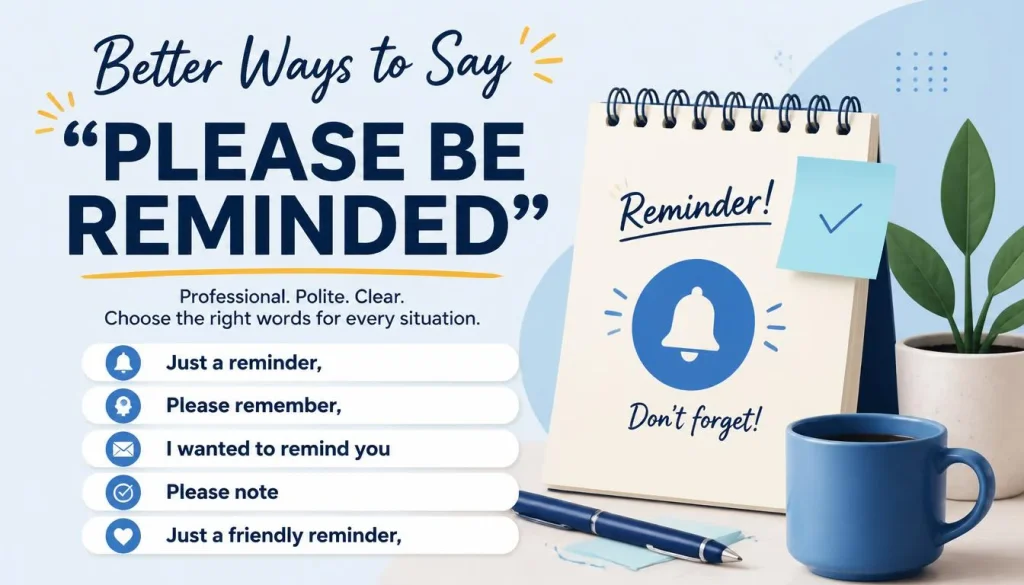
If you’re looking for a more natural way to say “Please be reminded,” there are plenty of options depending on the tone you want. For everyday professional messages, “Just a reminder,” “Please remember,” and “I wanted to remind you” sound clear and natural. If you’re writing a formal email, notice, or official message, “Please note,” “I’d like to remind you,” or “This is a reminder that” may be more suitable.
For a warmer and friendlier approach, you can use “Just a friendly reminder,” “A gentle reminder,” or “Just to remind you.” These phrases can make a reminder feel less demanding while still making the important information clear. The best alternative depends on your audience, the situation, and how formal or personal you want the message to sound.
What Does “Please Be Reminded” Mean?
“Please be reminded” is a polite expression used to bring someone’s attention back to information they may already know. It usually introduces a reminder about an appointment, deadline, payment, meeting, event, rule, instruction, or important task. For example, “Please be reminded that your appointment is tomorrow” means the recipient is being politely asked to remember that the appointment is scheduled for the following day.
The phrase does not necessarily mean the person has forgotten. Instead, it simply highlights information that is worth keeping in mind. It is especially common in business emails, official notices, school communications, workplace messages, and administrative correspondence.
Is It Professional or Polite to Say “Please Be Reminded”?
Yes, “Please be reminded” is generally polite and professional, especially in formal written communication. It creates a respectful tone and avoids sounding like a direct command. However, it can feel somewhat formal, passive, or impersonal in everyday conversation.
For a friendly email or personal message, expressions such as “Just a reminder,” “Please remember,” or “I wanted to remind you” often sound more natural. The best choice depends on your relationship with the reader, the importance of the information, and how formal the situation is.
Advantages and Disadvantages of Saying “Please Be Reminded”
Advantages
- Professional tone: It works well in formal emails, notices, and workplace communication.
- Polite wording: The word “please” softens the reminder and makes it less commanding.
- Clear purpose: It immediately signals that the following information is something the reader should remember.
Disadvantages
- Can sound stiff: In casual conversations, it may feel overly formal.
- Slightly impersonal: The passive construction can create distance between the sender and recipient.
- May feel repetitive: If used frequently in workplace messages, it can sound like standard administrative language.
Synonyms for “Please Be Reminded”
- Just a Reminder
- Please Remember
- I Wanted to Remind You
- A Quick Reminder
- Just a Friendly Reminder
- Please Keep in Mind
- Don’t Forget
- I’d Like to Remind You
- This Is a Reminder That
- Kindly Remember
- Please Keep This in Mind
- As a Reminder
- I’m Writing to Remind You
- A Gentle Reminder
- Just to Remind You
- Please Take Note
- Keep in Mind That
- Remember That
- I’d Like to Bring to Your Attention
- Please Note
- Just a Quick Reminder
- I Hope You’ll Remember
- I Wanted to Bring This to Your Attention
- Please Bear in Mind
- Don’t Lose Sight of
- As a Friendly Reminder
- I’m Reaching Out to Remind You
- This Is Just to Let You Know
- A Little Reminder
- Please Keep This on Your Radar
1. Just a Reminder
Meaning: “Just a reminder” gently brings something important back to someone’s attention.
Definition: It is a short, natural phrase used before information that the recipient should remember.
Detailed Explanation: This is one of the most flexible alternatives to “please be reminded.” It sounds professional without being overly formal. It also works well in emails, text messages, workplace chats, and personal conversations.
Scenario Example: “Just a reminder that the project report is due on Friday.”
Best Use: Use it for deadlines, appointments, meetings, payments, and everyday tasks.
Tone: Friendly, neutral, and professional.
2. Please Remember
Meaning: “Please remember” politely asks someone to keep something in mind.
Definition: A direct but courteous expression used when an important detail needs attention.
Detailed Explanation: This phrase is clearer and more active than “please be reminded.” It works especially well when you want the reader to take responsibility for remembering something.
Scenario Example: “Please remember to bring your identification to the appointment.”
Best Use: Use it for instructions, responsibilities, appointments, and important details.
Tone: Polite, direct, and respectful.
3. I Wanted to Remind You
Meaning: The sender is politely informing someone about something they should remember.
Definition: A personal reminder phrase that explains the sender’s purpose for contacting the recipient.
Detailed Explanation: This wording feels warmer because it uses a personal subject, “I.” It is particularly useful when writing directly to a colleague, customer, friend, or client.
Scenario Example: “I wanted to remind you that our meeting starts at 10 a.m. tomorrow.”
Best Use: Use it in emails, personal messages, and workplace communication.
Tone: Warm, polite, and conversational.
4. A Quick Reminder
Meaning: A short reminder about something important.
Definition: A concise phrase that signals that the following information should be remembered.
Detailed Explanation: “A quick reminder” suggests that the message will be brief. It is ideal when you do not want your reminder to feel heavy or demanding.
Scenario Example: “A quick reminder: Please submit your timesheet by 5 p.m.”
Best Use: Use it for short workplace emails, messages, and deadline reminders.
Tone: Casual, professional, and efficient.
5. Just a Friendly Reminder
Meaning: A reminder delivered in a warm and approachable way.
Definition: A phrase used to make a reminder sound less strict and more considerate.
Detailed Explanation: Adding “friendly” makes the message feel softer. It can be useful when reminding someone about something they may have overlooked.
Scenario Example: “Just a friendly reminder that registration closes tomorrow.”
Best Use: Use it for customers, colleagues, community groups, and informal professional communication.
Tone: Friendly, warm, and polite.
6. Please Keep in Mind
Meaning: A polite request for someone to remember or consider specific information.
Definition: An expression asking the recipient to retain something in their thoughts when making decisions or taking action.
Detailed Explanation: This alternative works particularly well when the information is not simply a deadline. It can introduce conditions, expectations, policies, or helpful considerations.
Scenario Example: “Please keep in mind that the office will be closed on Monday.”
Best Use: Use it for policies, schedules, conditions, and important considerations.
Tone: Professional, considerate, and clear.
7. Don’t Forget
Meaning: A direct reminder to remember something.
Definition: A common expression used to tell someone not to overlook a task or detail.
Detailed Explanation: This is much more conversational than “please be reminded.” However, the wording can sound slightly commanding depending on your relationship with the recipient. Adding “please” can soften it.
Scenario Example: “Don’t forget to send me the final document tonight.”
Best Use: Use it with friends, family, classmates, and familiar coworkers.
Tone: Casual, direct, and familiar.
8. I’d Like to Remind You
Meaning: A polite and formal way to bring information back to someone’s attention.
Definition: A professional expression that clearly identifies the purpose of a message.
Detailed Explanation: This phrase maintains the formal quality of “please be reminded” while making the sentence more active and personal.
Scenario Example: “I’d like to remind you that all applications must be submitted by June 30.”
Best Use: Use it in formal emails, business correspondence, and official communication.
Tone: Formal, respectful, and professional.
9. This Is a Reminder That
Meaning: The message is intended to remind the recipient about specific information.
Definition: A formal introductory phrase used before a reminder.
Detailed Explanation: This wording is straightforward and works particularly well in notices. It keeps the focus on the information rather than the relationship between the sender and recipient.
Scenario Example: “This is a reminder that your subscription will renew on August 1.”
Best Use: Use it for official notices, automated emails, and administrative communication.
Tone: Formal, neutral, and clear.
10. Kindly Remember
Meaning: A courteous request asking someone to remember something.
Definition: A polite expression combining a reminder with the respectful word “kindly.”
Detailed Explanation: “Kindly remember” is common in formal communication. It can sound respectful, although it may feel slightly traditional in casual American English.
Scenario Example: “Kindly remember to bring the completed form with you.”
Best Use: Use it for formal requests, workplace communication, and official messages.
Tone: Polite, formal, and respectful.
11. Please Keep This in Mind
Meaning: A request for someone to remember a particular fact or condition.
Definition: A courteous phrase used to emphasize information that may affect future actions.
Detailed Explanation: This expression sounds natural and thoughtful. It is useful when you want someone to consider information rather than simply memorize a date.
Scenario Example: “Please keep this in mind when planning your schedule for next week.”
Best Use: Use it for advice, policies, instructions, and planning.
Tone: Thoughtful, polite, and professional.
12. As a Reminder
Meaning: The information is being provided again so the recipient can remember it.
Definition: A concise introductory phrase used to identify reminder information.
Detailed Explanation: “As a reminder” is useful when the recipient has probably received the information before. It avoids implying that they have forgotten.
Scenario Example: “As a reminder, the training session begins at 9 a.m.”
Best Use: Use it in emails, announcements, newsletters, and workplace notices.
Tone: Neutral, professional, and concise.
13. I’m Writing to Remind You
Meaning: The purpose of the message is to remind the recipient about something.
Definition: A formal opening that clearly explains why the sender is contacting someone.
Detailed Explanation: This phrase is useful when writing a longer email. It establishes the purpose immediately without sounding unnecessarily forceful.
Scenario Example: “I’m writing to remind you about your upcoming appointment.”
Best Use: Use it for formal emails, customer communication, and business correspondence.
Tone: Formal, courteous, and professional.
14. A Gentle Reminder
Meaning: A soft and considerate reminder.
Definition: A phrase that presents important information without creating a harsh or demanding impression.
Detailed Explanation: “A gentle reminder” is helpful when the recipient may have overlooked something. The word “gentle” signals that the sender wants to remain considerate.
Scenario Example: “This is a gentle reminder to complete your registration before Friday.”
Best Use: Use it when you want to sound patient and understanding.
Tone: Warm, considerate, and polite.
15. Just to Remind You
Meaning: A casual way to bring something back to someone’s attention.
Definition: A conversational phrase used before a reminder.
Detailed Explanation: This expression feels less formal than “please be reminded.” It works naturally in both spoken and written communication.
Scenario Example: “Just to remind you, we’re meeting at the library at 3 p.m.”
Best Use: Use it with friends, coworkers, classmates, and familiar contacts.
Tone: Casual, friendly, and natural.
See More: 30 Other Ways to Say ‘Thank You for Your Continued Support’
16. Please Take Note
Meaning: A polite request for someone to pay attention to important information.
Definition: A formal expression asking the recipient to notice and remember a particular detail.
Detailed Explanation: “Please take note” is useful when the information deserves attention. It is often stronger and more formal than a simple reminder.
Scenario Example: “Please take note of the revised submission deadline.”
Best Use: Use it for official notices, workplace policies, and important updates.
Tone: Formal, direct, and professional.
17. Keep in Mind That
Meaning: Remember or consider a particular fact.
Definition: An expression used to introduce information that should influence someone’s thinking or actions.
Detailed Explanation: This phrase is especially useful when explaining circumstances. It feels more conversational than many formal reminder expressions.
Scenario Example: “Keep in mind that parking may be limited during the event.”
Best Use: Use it for advice, planning, warnings, and practical information.
Tone: Conversational, helpful, and neutral.
18. Remember That
Meaning: A direct instruction to keep something in mind.
Definition: A simple expression used to emphasize an important fact or responsibility.
Detailed Explanation: This phrase is short and powerful. It can sound warm or firm depending on the surrounding words and the relationship between the sender and recipient.
Scenario Example: “Remember that the office closes early on Friday.”
Best Use: Use it for instructions, advice, personal reminders, and important facts.
Tone: Direct, clear, and conversational.
19. I’d Like to Bring to Your Attention
Meaning: The sender wants the recipient to notice something important.
Definition: A formal expression used to highlight information that deserves attention.
Detailed Explanation: This phrase is not strictly a reminder, but it serves a similar purpose. It is especially useful when introducing a new issue, change, policy, or important detail.
Scenario Example: “I’d like to bring to your attention the updated attendance policy.”
Best Use: Use it in formal workplace, academic, and administrative communication.
Tone: Formal, respectful, and serious.
20. Please Note
Meaning: A polite request for someone to pay attention to specific information.
Definition: A concise formal expression used to highlight an important fact.
Detailed Explanation: “Please note” is one of the cleanest replacements for “please be reminded.” It works particularly well when you want to draw attention to a change or requirement.
Scenario Example: “Please note that the deadline has been extended until Monday.”
Best Use: Use it for notices, emails, instructions, and announcements.
Tone: Professional, concise, and neutral.
21. Just a Quick Reminder
Meaning: A brief and friendly reminder.
Definition: An informal variation of “a quick reminder” that emphasizes brevity.
Detailed Explanation: This phrase makes the reminder feel light and uncomplicated. It is excellent when you want to avoid making a routine reminder sound overly serious.
Scenario Example: “Just a quick reminder that our team call starts in 15 minutes.”
Best Use: Use it for work chats, text messages, meetings, and routine tasks.
Tone: Friendly, casual, and efficient.
22. I Hope You’ll Remember
Meaning: A gentle expression showing that the sender hopes the recipient will keep something in mind.
Definition: A softer reminder that avoids sounding like a command.
Detailed Explanation: This wording can make a sensitive reminder feel more considerate. It focuses on goodwill rather than obligation.
Scenario Example: “I hope you’ll remember to bring your notes to tomorrow’s session.”
Best Use: Use it for personal messages, gentle requests, and supportive communication.
Tone: Warm, gentle, and caring.
23. I Wanted to Bring This to Your Attention
Meaning: The sender wants the recipient to notice or consider something.
Definition: A personal and professional phrase for highlighting important information.
Detailed Explanation: This expression works well when the information is slightly more significant than an ordinary reminder. It allows you to explain an issue without sounding confrontational.
Scenario Example: “I wanted to bring this to your attention before the report is finalized.”
Best Use: Use it for workplace issues, updates, corrections, and important details.
Tone: Professional, respectful, and thoughtful.
24. Please Bear in Mind
Meaning: Please remember or consider something carefully.
Definition: A formal expression asking someone to keep particular information in consideration.
Detailed Explanation: “Please bear in mind” has a polished and professional quality. It is useful when a reminder relates to circumstances, limitations, expectations, or consequences.
Scenario Example: “Please bear in mind that processing times may vary during the holiday period.”
Best Use: Use it for formal correspondence, explanations, policies, and professional advice.
Tone: Formal, thoughtful, and respectful.
25. Don’t Lose Sight of
Meaning: Do not forget or stop considering something important.
Definition: An expressive phrase used to encourage someone to continue remembering a goal, fact, or priority.
Detailed Explanation: This alternative is more figurative than “please be reminded.” It works especially well when discussing goals or priorities rather than simple dates.
Scenario Example: “Don’t lose sight of the main goal while working through the smaller tasks.”
Best Use: Use it for goals, priorities, projects, and motivational communication.
Tone: Encouraging, direct, and thoughtful.
26. As a Friendly Reminder
Meaning: A reminder presented in a warm and non-demanding way.
Definition: A phrase that frames reminder information as a courteous message.
Detailed Explanation: This is particularly helpful when you want to preserve a positive relationship. It can make a potentially awkward reminder feel less uncomfortable.
Scenario Example: “As a friendly reminder, please submit your form before the end of the week.”
Best Use: Use it for customers, coworkers, students, community groups, and everyday professional messages.
Tone: Friendly, warm, and respectful.
27. I’m Reaching Out to Remind You
Meaning: The sender is contacting someone specifically to remind them about something.
Definition: A modern professional phrase used to explain the purpose of an email or message.
Detailed Explanation: This expression sounds natural in business communication. It is more personal than a passive construction and can transition smoothly into the reminder itself.
Scenario Example: “I’m reaching out to remind you about tomorrow’s scheduled interview.”
Best Use: Use it for professional emails, customer service, appointments, and business communication.
Tone: Professional, courteous, and approachable.
28. This Is Just to Let You Know
Meaning: The sender is providing information so the recipient is aware of it.
Definition: A casual phrase used to communicate information without making the message sound demanding.
Detailed Explanation: This is not a direct synonym for “please be reminded,” but it can work when the main purpose is simply keeping someone informed.
Scenario Example: “This is just to let you know that the meeting room has changed.”
Best Use: Use it for updates, schedule changes, announcements, and informal notifications.
Tone: Casual, friendly, and informative.
29. A Little Reminder
Meaning: A small or gentle reminder about something.
Definition: A warm expression that makes a reminder sound light and approachable.
Detailed Explanation: “A little reminder” works particularly well in personal or friendly communication. It suggests that the sender is not trying to pressure the recipient.
Scenario Example: “Just a little reminder that your book is still with me.”
Best Use: Use it for friends, family, familiar coworkers, and informal messages.
Tone: Warm, gentle, and casual.
30. Please Keep This on Your Radar
Meaning: Please stay aware of or remember something that may become important.
Definition: A modern idiomatic expression asking someone to continue paying attention to an issue or upcoming event.
Detailed Explanation: “Keep this on your radar” is more conversational and contemporary than “please be reminded.” It suggests that the recipient does not necessarily need to act immediately but should remain aware of the matter.
Scenario Example: “Please keep the upcoming policy changes on your radar.”
Best Use: Use it for workplace discussions, projects, upcoming changes, and ongoing responsibilities.
Tone: Modern, conversational, and professional.
FAQs
1. Is “Please Be Reminded” grammatically correct?
Yes, “Please Be Reminded” is grammatically acceptable and commonly used in formal notices and professional communication. However, it can sound somewhat stiff or passive in everyday English.
2. What is the most natural alternative to “Please Be Reminded”?
“Just a reminder” is one of the most natural alternatives. It works well in emails, workplace messages, texts, and casual communication without sounding too formal.
3. How can I say “Please Be Reminded” professionally?
You can say “Please note,” “I’d like to remind you,” “This is a reminder that,” or “I’m writing to remind you.” These options are suitable for formal emails and workplace communication.
4. What is a friendly way to say “Please Be Reminded”?
Try “Just a friendly reminder,” “A gentle reminder,” or “Just to remind you.” These phrases make the message feel warmer and less demanding.
5. Can I use “Please Remember” instead of “Please Be Reminded”?
Yes. “Please remember” is more direct and active. It works particularly well when you want someone to remember a task, appointment, deadline, or important instruction.
6. Is “Kindly Remember” formal?
Yes, “Kindly remember” has a formal and respectful tone. It can work in professional or official communication, although it may sound slightly traditional in casual American English.
7. How do I remind someone without sounding bossy?
Choose softer expressions such as “Just a reminder,” “A gentle reminder,” or “I wanted to remind you.” You can also explain the reason for the reminder and use polite, straightforward wording.
8. Can “Please Be Reminded” be used in an email?
Yes, but the best alternative depends on the email’s purpose. “Please note” works well for important updates, while “I wanted to remind you” sounds more personal and conversational.
9. What is a casual alternative to “Please Be Reminded”?
For casual conversations, “Don’t forget,” “Just to remind you,” or “A little reminder” can work well. Your choice should depend on how familiar you are with the person.
10. What should I use instead of “Please Be Reminded” at work?
For workplace communication, consider “Just a reminder,” “Please keep in mind,” “Please note,” “I’d like to remind you,” or “I’m reaching out to remind you.” Each option offers a slightly different level of formality.
Conclusion
“Please Be Reminded” is polite and professional, but it is not the only way to remind someone. Depending on your situation, you can choose a phrase that feels more natural, friendly, clear, or formal. “Just a reminder” works well for everyday workplace messages, while “Please note” suits formal updates. For a warmer approach, “A gentle reminder” or “Just a friendly reminder” can soften the message.
The key is to match your wording with the audience, situation, and tone. A thoughtful reminder does more than repeat information—it helps the reader understand what matters without feeling pressured.