

RSVP Meaning: Simple Guide, Real Examples, and Modern Usage explains what RSVP means, why it appears on invitations, and how to respond politely.
RSVP is a short form from the French phrase “répondez s’il vous plaît,” meaning “please respond.” It is a polite request asking whether you will attend an event. You may see RSVP on wedding invitations, birthday party cards, office invitations, dinner invitations, and conference invitations. Although it has a French origin, RSVP is now common in everyday English and modern communication.
The RSVP meaning is simple: the host wants you to confirm attendance so they can manage the guest list and plan the event. You can accept an invitation by replying, “Yes, I will come,” or decline an invitation by saying, “No, I cannot come.”
Proper RSVP etiquette means replying before the deadline, whether you receive a formal invitation, text message, or online invitation. For event planning, tools such as Sogolytics RSVP form templates can simplify response collection and guest list management. A timely reply helps hosts organize events and keeps communication clear.

Quick Answer: What Does RSVP Mean?
RSVP means “Please respond.” It comes from the French phrase Répondez s’il vous plaît. When someone asks you to RSVP, they want you to confirm whether you’ll attend an event or decline the invitation.
For example, if a birthday invitation says “Please RSVP by Friday,” you should tell the host whether you plan to attend by that deadline.
Remember these key points:
- Full form: Répondez s’il vous plaît
- English meaning: Please respond.
- Main purpose: To confirm attendance or communicate that you cannot attend.
- Common uses: Weddings, birthday parties, dinners, business meetings, conferences, and online events.
- Expected response: Usually a clear yes or no, although some digital invitations offer a “Maybe” option.
Important: RSVP doesn’t mean you must attend. It means you should communicate your decision to the host.
What Does RSVP Stand For?
RSVP stands for the French expression Répondez s’il vous plaît, which translates into English as “Please respond.” English speakers adopted this expression through formal invitation customs, particularly in settings where hosts needed guests to confirm their attendance.
Today, RSVP is widely understood in English-speaking countries. You don’t need to speak French to recognize it on an invitation or understand what the sender expects.
The Full French Phrase: Répondez s’il vous plaît
Each part of the expression contributes to its meaning:
- Répondez: Respond or reply.
- S’il: If it.
- Vous plaît: Pleases you.
Together, the phrase conveys the polite request “Please respond.” The French expression is a conventional way to ask someone for a reply, rather than a word-for-word English sentence.
For example, a formal wedding invitation might include:
Kindly RSVP by May 15.
This means the couple would like you to confirm your attendance by May 15. Your response helps them plan seating, catering, and other arrangements.
Is RSVP an Acronym or an Abbreviation?
RSVP is an initialism derived from a French phrase. Each letter represents the first letter of a word in Répondez s’il vous plaît.
People sometimes call RSVP an acronym, but there’s a small technical difference. An initialism is usually pronounced letter by letter, as in “R-S-V-P,” while an acronym is generally pronounced as a word, such as NASA.
In everyday English, however, people commonly use the word abbreviation for RSVP. You don’t need to worry about the technical label when responding to an invitation.
What Does RSVP Mean in Texting?
In texting, RSVP still means that someone wants you to confirm whether you’ll attend. It doesn’t have a separate hidden meaning or function as typical internet slang. Instead, people use it as a convenient way to organize plans through messages and group chats.
For example, a friend might send this message:
Friend: “We’re having dinner Saturday at 7. Please RSVP by Thursday so I can book the table.”
You: “Count me in! I’ll be there.”
Your reply gives the organizer a clear answer. If you can’t attend, you can simply say, “Thanks for inviting me, but I won’t be able to make it.”
People commonly use RSVP in messages about:
- Birthday celebrations and family gatherings
- Dinner reservations and weekend plans
- Office parties and team meetings
- School events and community activities
- Weddings, engagement parties, and other celebrations
In casual conversations, you may also see phrases like “Let me know if you’re coming” or “Can you confirm by Friday?” These expressions communicate the same basic request without using the abbreviation.
RSVP Texting Examples
Example: Birthday party
“Hey! I’m celebrating my birthday on Sunday. Please RSVP by Friday.”
Suitable reply: “Thanks for inviting me! I’ll be there.”
Example: Group dinner
“Everyone, RSVP for Saturday’s dinner so we know how many seats to book.”
Suitable reply: “I’m in. Please count me as one.”
Example: Work gathering
“Please RSVP to the team dinner invitation before Wednesday.”
Suitable reply: “Thank you for the invitation. I’ll attend.”
These examples show that the wording changes with the situation, but the purpose stays consistent: give the organizer a clear answer.

What Does RSVP Mean on an Invitation?
On an invitation, RSVP tells guests that the host wants a response about attendance. This information helps the organizer estimate the number of people who will participate and prepare accordingly.
The exact details depend on the event. A wedding may require meal selections, while a birthday party may simply need a headcount. A professional conference may also ask attendees to register separately.
RSVP on Wedding Invitations
Wedding invitations often include an RSVP deadline because couples must coordinate several details before the ceremony and reception.
An accurate guest count can affect:
- Catering quantities and meal choices
- Table arrangements and seating plans
- Venue capacity and seating availability
- Printed place cards and guest lists
- Transportation or accommodation arrangements, when provided
For example, an invitation might say:
“Kindly respond by August 10. Please indicate your attendance and meal preference.”
If you plan to attend, confirm your attendance and select a meal if requested. If you cannot attend, decline promptly so the couple can update its plans.
Wedding etiquette tip: Respond for the guests actually listed on your invitation. Don’t assume you can bring a partner, friend, or child unless the invitation permits it.
RSVP on Birthday and Party Invitations
Birthday parties and informal celebrations also benefit from timely responses. Hosts may need to order food, prepare party favors, reserve a venue, or arrange activities for a specific number of guests.
Consider this invitation:
“Join us for Alex’s birthday party on June 12. Please RSVP by June 5.”
The host wants to know how many people will attend before making final arrangements. A short text confirming your attendance is usually sufficient unless the invitation requests additional information.
If you can’t attend, a polite decline still helps the host plan accurately.
RSVP for Business Events
In professional settings, RSVP appears on invitations to conferences, workshops, networking events, company dinners, and business meetings.
Organizers may use responses to estimate attendance, arrange refreshments, prepare name badges, or determine room capacity. Some events also request job titles, dietary requirements, or accessibility needs.
For example:
“Please RSVP by November 3 to confirm your attendance at the annual networking reception.”
A suitable response might be:
“Thank you for the invitation. I confirm that I’ll attend the networking reception.”
RSVP and registration aren’t always the same thing. An RSVP may confirm your attendance, while registration can involve completing a form, selecting sessions, or paying a fee. Always follow the instructions provided by the organizer.
How to RSVP: Accepting, Declining, or Responding Later
Responding to an invitation doesn’t need to be complicated. A good RSVP communicates your decision clearly, uses an appropriate tone, and arrives before the stated deadline.
How to Accept an Invitation
When you plan to attend, thank the host and confirm your attendance. You can keep the response short for casual events or slightly more formal for professional occasions.
Casual example:
“Thanks for inviting me! I’d love to come.”
Formal example:
“Thank you for the invitation. I confirm that I’ll attend the event.”
Wedding example:
“Thank you for inviting us to celebrate your wedding. We are pleased to confirm that we’ll attend.”
If the invitation asks for a meal selection or another detail, include that information in your response.
How to Decline an Invitation
Sometimes you can’t attend because of work, family commitments, travel, or another scheduling conflict. You don’t need to provide a lengthy explanation unless the situation calls for one.
A polite decline should acknowledge the invitation and clearly state that you won’t attend.
Casual example:
“Thanks for inviting me! Unfortunately, I can’t make it this time.”
Professional example:
“Thank you for the invitation. Unfortunately, I won’t be able to attend due to a prior commitment.”
Wedding example:
“Thank you for thinking of us. We’re sorry we can’t join you, but we wish you a wonderful celebration.”
The goal is to be respectful without making your response unnecessarily complicated.
How to Ask for More Time
If you’re unsure about your schedule, don’t ignore the invitation. Contact the host before the deadline and ask whether you can confirm later.
For example:
“Thanks for inviting me! I’m checking my schedule. Would it be okay if I confirmed by Tuesday?”
This approach gives the host a chance to explain whether a later answer will work. However, don’t assume the organizer can accommodate a delay, especially when catering or seating arrangements require a firm headcount.
How to Respond When You Cannot Attend
Declining an invitation and failing to respond are two different things. A decline gives the host useful information, while silence leaves them guessing.
If you already know you can’t attend, reply as soon as reasonably possible. If you’ve missed the deadline, acknowledge the delay and give your answer directly.
For example:
“I’m sorry for the late reply. Unfortunately, I won’t be able to attend. Thank you for including me.”
If you’ve already accepted but your plans change, inform the organizer promptly. A quick update is more helpful than allowing the host to discover your absence at the last minute.
Related Post: 1437 Meaning: Complete Guide, Origin, Usage, and Examples
Real RSVP Examples for Different Situations
The best RSVP response depends on the event, your relationship with the host, and the information requested. These examples show how to reply naturally without sounding stiff.
Wedding Invitation Example
Invitation:
“Please RSVP by September 10. Kindly indicate whether you’ll attend the reception and select your preferred meal.”
Accepting:
“Thank you for inviting me. I’ll be delighted to attend the reception. My meal preference is vegetarian.”
Declining:
“Thank you for the invitation. Unfortunately, I won’t be able to attend, but I wish you both a beautiful wedding day.”
Birthday Party Text Example
Invitation:
“I’m having a birthday party next Saturday at 5 p.m. Please RSVP by Thursday!”
Reply:
“Happy early birthday! Thanks for inviting me. I’ll be there on Saturday.”
This response works well because it’s friendly, clear, and appropriate for an informal celebration.
Professional Event Email Example
Subject: RSVP: Annual Business Conference
Email:
Hello Jordan,
Thank you for the invitation to the annual business conference. I’m writing to confirm that I’ll attend.
I look forward to participating.
Best regards,
Taylor
This format works for professional events because it clearly identifies the purpose of the message and confirms attendance.
Casual Group Chat Example
Organizer: “We’re meeting at the park on Sunday. Please RSVP by Friday so we can plan the picnic.”
Guest: “Count me in! I’ll bring drinks.”
The reply confirms attendance and offers additional information that helps the organizer coordinate the event.
Digital Invitation Example
An online invitation might provide three options:
- Accept: You plan to attend.
- Decline: You won’t attend.
- Maybe: You’re uncertain about your plans.
If you select “Maybe,” check whether the organizer expects a final answer later. A tentative response can help initially, but it may not provide the firm headcount required for food, seating, or venue arrangements.
What Does “Please RSVP” Mean?
“Please RSVP” means “Please respond to this invitation.” The sender wants you to communicate whether you’ll attend, rather than leaving them uncertain.
The phrase doesn’t mean that you must accept. You can RSVP by saying yes or no, depending on your availability.
For example:
“Please RSVP for our graduation dinner by Friday.”
The host needs your response by Friday to finalize the guest list. If you can’t attend, a polite decline still fulfills the request.
Although the phrase may sound formal, it’s widely accepted in both personal and professional communication.
What Does “RSVP by [Date]” Mean?
When an invitation says “RSVP by [date],” it gives you a deadline for responding. The date usually marks the last day the host wants to receive your attendance decision.
For example:
“RSVP by October 15 for the event on October 25.”
Here, October 15 is the response deadline, while October 25 is the event date. You should confirm your attendance by October 15 rather than waiting until the day of the event.
Hosts set deadlines because they may need to:
- Submit final guest counts to venues or caterers
- Arrange seating and meal selections
- Prepare event materials or name badges
- Finalize transportation or other logistics
Practical tip: Reply before the deadline whenever possible. Early responses give organizers more time to handle changes and complete their arrangements.
What Does “Regrets Only” Mean?
“Regrets only” means you should respond only if you cannot attend. Unlike a standard RSVP request, which generally expects a reply from everyone invited, this instruction asks guests to contact the host only when they must decline.
For example, an invitation might state:
“Join us for the annual holiday reception on December 12. Regrets only by December 5.”
If you plan to attend, you generally don’t need to reply. If you cannot attend, notify the organizer before December 5.
Hosts sometimes use this approach for events where they expect most invited guests to attend. However, follow any additional instructions on the invitation because response procedures can vary.
RSVP Etiquette: Rules You Should Know
Good RSVP etiquette helps hosts plan confidently and allows guests to communicate respectfully. You don’t need elaborate wording; a timely and clear answer usually does the job.
Here are the most important rules to remember:
- Respond before the deadline: Don’t wait until the host follows up with you.
- Reply even when declining: A clear no is more helpful than silence, unless the invitation says “regrets only.”
- Follow guest restrictions: Attend only with the people included in your invitation.
- Provide requested details: Submit meal preferences, accessibility needs, or other information when requested.
- Update the host if plans change: Notify the organizer as soon as you know you can no longer attend.
- Avoid last-minute cancellations: If an unexpected problem arises, communicate promptly.
- Don’t assume an invitation includes a plus-one: Ask the host if the guest policy isn’t clear.
- Keep your response appropriate: A casual text works for friends, while a professional event may call for an email.
Why Timely RSVPs Matter
Imagine a host preparing dinner for 30 guests. If several people fail to respond, the host may order too much food, reserve too many seats, or struggle to accommodate unexpected attendees.
Now consider a wedding where the venue requires a final headcount before the ceremony. A late response could affect seating arrangements or meal planning.
These situations explain why an RSVP is more than a formality. Your reply gives the organizer practical information they need to manage the event.
How to RSVP by Text, Email, or Online
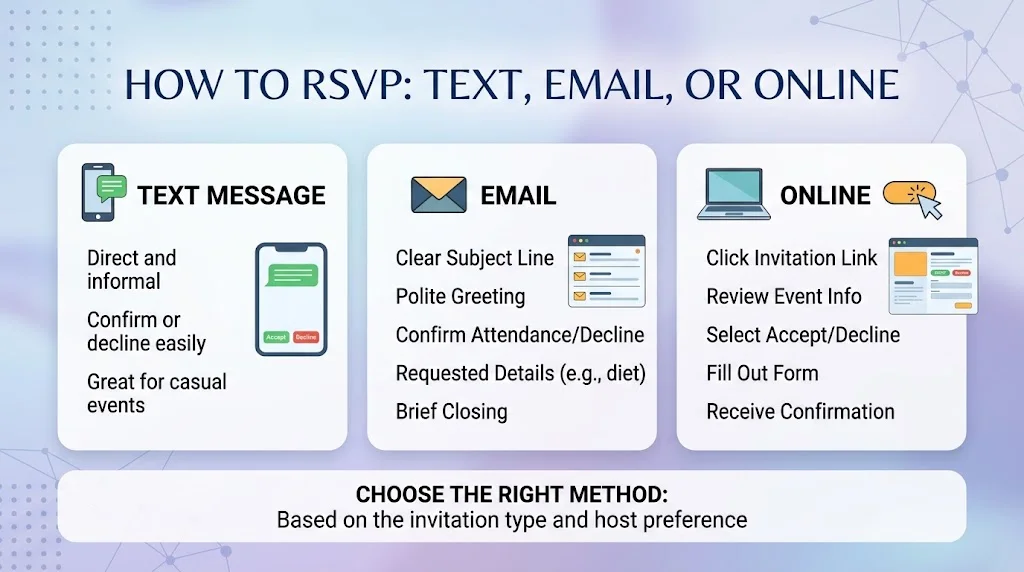
You can RSVP through several channels. The right method depends on how the invitation arrived and whether the organizer specified a preferred response method.
How to RSVP by Text Message
Text messages work well for informal invitations and events organized through messaging apps.
Keep your response direct. Confirm whether you’re attending and include any requested details.
Accepting:
“Thanks for inviting me! I’ll be there.”
Declining:
“Thanks for thinking of me. Sorry, I can’t make it this time.”
Requesting more time:
“Thanks for the invitation! Can I confirm by Wednesday?”
For casual events, a short message is usually enough. However, if the host asks you to complete an online form, follow that instruction rather than relying only on a text.
How to RSVP by Email
Email is common for weddings, corporate functions, formal dinners, and professional conferences.
A useful RSVP email usually includes:
- A clear subject line
- A polite greeting
- Your attendance decision
- Any requested details
- A brief closing
Example:
Subject: RSVP for the Annual Conference
Hello Morgan,
Thank you for the invitation. I’m pleased to confirm that I’ll attend the annual conference on November 18.
I look forward to the event.
Best regards,
Alex
If you cannot attend, replace the confirmation with a brief, polite decline. There’s no need to write a long explanation unless the situation requires one.
How to RSVP Online
Digital invitations often let you respond through a website, event platform, or registration form. You may see options such as Accept, Decline, or Maybe.
Follow these steps:
- Open the invitation or event link.
- Review the date, time, location, and attendance instructions.
- Select the appropriate response.
- Enter any requested information.
- Submit your response and check for confirmation if the platform provides it.
If the event requires separate registration, make sure you complete that process too. Clicking “Accept” on a calendar invitation doesn’t always register you for the event itself.
Is RSVP Formal or Informal?
RSVP works in both formal and informal situations. The abbreviation itself is common across different types of invitations, but the surrounding language determines how formal the request sounds.
| Situation | Example | Typical tone |
| Wedding invitation | “Kindly RSVP by June 10.” | Formal |
| Birthday party | “Please RSVP by Friday!” | Friendly |
| Business conference | “Please confirm your attendance.” | Professional |
| Group chat | “RSVP for Saturday’s dinner.” | Casual |
| Online event | “Select Accept or Decline.” | Direct and practical |
For a formal invitation, phrases such as “Kindly respond by” or “We request your response by” may suit the occasion. With friends, “Let me know if you’re coming” sounds more natural.
The important point is that RSVP doesn’t automatically make a message formal. Context, wording, and your relationship with the recipient shape the overall tone.
Common RSVP Mistakes to Avoid
Even a simple invitation can create confusion when guests misunderstand the request. Avoid these common mistakes to make event planning easier for everyone.
Ignoring the Invitation
Not responding leaves the host uncertain about your plans. If you know your answer, send it promptly rather than waiting for a reminder.
Responding After the Deadline
Late responses can disrupt catering, seating, and other arrangements. If you miss the deadline, contact the organizer as soon as possible and ask whether they can still accommodate you.
Assuming RSVP Means You Must Attend
RSVP asks for a response, not automatic acceptance. You can decline politely when you’re unavailable.
Giving an Unclear Answer
Replies such as “I’ll try” or “Maybe I’ll come” may not provide the certainty a host needs. If you’re unsure, explain when you can confirm and ask whether that timeline works.
Changing Your Plans Without Notifying the Host
If you accepted an invitation but can no longer attend, tell the organizer. This is especially important when the event involves reserved seats, paid tickets, or prepared meals.
Bringing Unlisted Guests
An RSVP confirms your own attendance and any guests specifically included in the invitation. It doesn’t automatically give you permission to bring additional people.
A simple rule: Read the invitation carefully, answer clearly, and tell the host promptly if anything changes.
RSVP vs. Regrets Only: What’s the Difference?
Both expressions appear on invitations, but they establish different expectations for guests.
| Feature | Standard RSVP | Regrets only |
| Meaning | Please respond | Respond only if you cannot attend |
| If attending | Usually send a confirmation | Generally no response is needed |
| If declining | Send a polite decline | Notify the host |
| Main purpose | Collect attendance responses | Identify guests who cannot attend |
| Best approach | Follow the stated instructions | Follow the stated instructions |
For example, “Please RSVP by Friday” generally means the host wants to hear from you regardless of your decision.
By contrast, “Regrets only by Friday” generally means you should contact the host only if you cannot attend.
When in doubt, read the complete invitation. The organizer’s specific instructions take priority over assumptions about the abbreviation.
Frequently Asked Questions
1. What does RSVP mean?
RSVP comes from the French phrase “répondez s’il vous plaît,” which means “please respond.” It asks guests to confirm whether they will attend an event.
2. What does RSVP stand for in English?
RSVP means “please respond” in English. It asks you to tell the host whether you plan to attend an invitation.
3. How do you respond to an RSVP request?
You can reply with a simple message, such as “Yes, I will attend” or “Sorry, I cannot make it.” Always respond before the stated deadline.
4. Is RSVP formal or informal?
RSVP works for both formal and informal invitations. You may see it on wedding cards, birthday invitations, office events, and dinner invitations.
5. What happens if you don’t RSVP?
If you don’t reply, the host may struggle with event planning, food arrangements, seating, and the guest list. Responding promptly helps avoid confusion.
6. Can you RSVP through a text message?
Yes, you can RSVP by text message, email, or an online form. Choose the method provided by the host and clearly confirm whether you will attend.
Conclusion
Understanding the RSVP meaning makes responding to invitations simple and polite. Whether you receive a wedding invitation, birthday card, or professional event request, reply before the deadline. A quick RSVP response helps the host manage attendance, organize arrangements, and plan the event smoothly. Remember, a clear confirmation or polite decline is always better than leaving the host waiting.