

What Does SOS Mean? Simple Meaning, Origin, and Examples explains how this distress signal helps people request urgent assistance in emergencies.
SOS meaning is commonly associated with the phrase “I need help.” In simple words, SOS is a short signal used to request urgent help or immediate assistance when someone faces danger or a crisis.For example, ships at sea may send SOS during a maritime emergency or other sea emergencies, while pilots may use it during an aviation emergency.
People on land can also send an SOS to seek urgent assistance. Although many people believe that the letters SOS stand for Save Our Souls or Save Our Ship, these phrases are not the original meaning of the abbreviation. In reality, SOS does not represent any specific words; it is a recognized signal for distress and a call for help.
The SOS origin is closely connected to Morse code, a transmission method that uses dots and dashes to communicate messages. The SOS history includes its distinctive sequence of three dots, three dashes, and three dots (… — …). This repeating sequence is easy to recognize and easy to transmit, making signal recognition more reliable in emergencies.
Through this method of signal transmission, SOS became an internationally recognized distress signal and an important emergency signal in maritime communication and ship communication. Today, the SOS abbreviation appears in books, TV shows, films, and songs, making it familiar through popular culture, media, and entertainment.
Overall, SOS remains a widely recognizable form of distress communication.
Quick Answer: What Does SOS Mean?
SOS is an internationally recognized distress signal used to request help during a serious emergency. It originated in maritime radio communication and is traditionally represented in Morse code as three dots, three dashes, and three dots.
In texting and online conversations, SOS usually means “I need help,” “This is urgent,” or “I’m overwhelmed.” People may also use it humorously when dealing with everyday problems.
Although many people associate SOS with “Save Our Souls” or “Save Our Ship,” these expressions were attached to the signal later. The letters were selected for their distinctive Morse code pattern, not as an abbreviation for a particular phrase.
What Does SOS Mean?
SOS means a distress signal that communicates danger and a need for assistance. Its traditional role is to alert others that someone faces a serious emergency and requires help.
The signal became widely known through maritime communication, where ships needed a clear way to report danger over long distances. A standardized signal helped operators recognize distress without depending on a shared spoken language.
Today, SOS has two common uses:
- Emergency communication: A distress signal associated with serious danger and the need for assistance.
- Everyday communication: An informal expression people use when they urgently need help or feel overwhelmed.
For example, a sailor might transmit a distress signal after a vessel suffers severe damage. A student might text “SOS, I don’t understand this question” before an exam.
Both situations involve a need for help, but the surrounding circumstances determine the urgency.
What Does SOS Mean in Simple Words?
In simple words, SOS means “Help me!” It signals that someone needs assistance, although the exact seriousness depends on the context.
Consider these examples:
- “SOS! My car broke down on an empty road.” This could indicate a genuine safety concern.
- “SOS, what should I wear to the party?” This is probably a casual request for advice.
- “The ship sent an SOS after losing power.” This describes a serious emergency.
The key is to consider the situation rather than interpreting every SOS message literally.
What Does SOS Stand For?
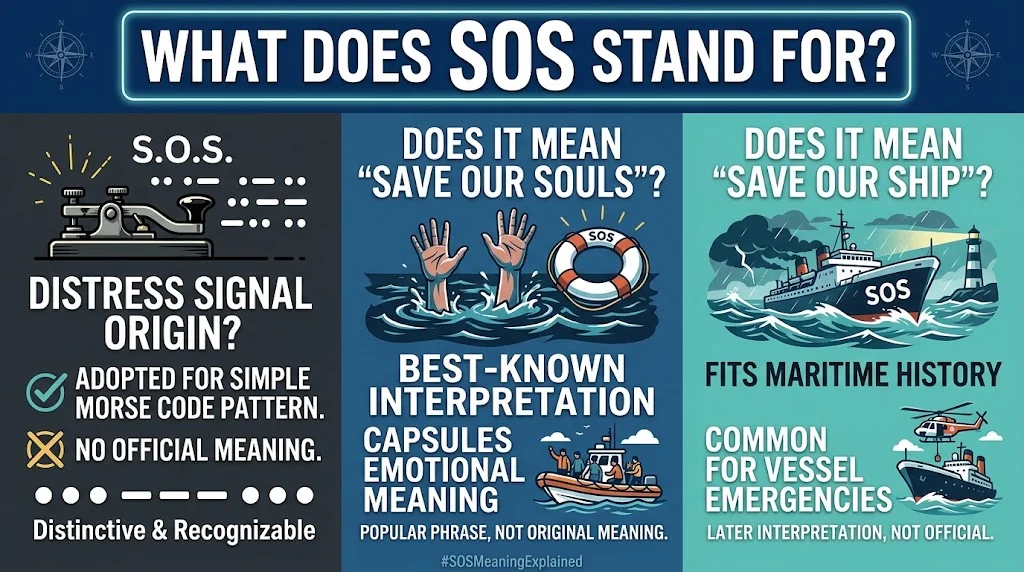
One of the biggest misconceptions about SOS is that the letters officially stand for a specific sentence. In reality, SOS was adopted as a distinctive distress signal rather than an abbreviation.
Its simple, recognizable Morse code pattern made it useful for emergency communication. The letters later inspired several memorable phrases that helped people understand or remember the signal.
Does SOS Stand for Save Our Souls?
“Save Our Souls” is one of the best-known interpretations of SOS. The phrase expresses a desperate request for rescue, especially when someone’s life is at risk.
Its emotional meaning makes it easy to associate with emergencies. However, it wasn’t the original official expansion of SOS.
For example, someone might explain the signal to a child by saying, “SOS means Save Our Souls, which is a way to ask for help.” This explanation captures the general idea, but it doesn’t accurately describe the signal’s historical origin.
Does SOS Mean Save Our Ship?
“Save Our Ship” is another popular phrase associated with SOS. It fits the signal’s maritime history because ships were among the main users of early distress communication.
Imagine a vessel experiencing engine failure during a storm. Its crew needs other ships or coastal stations to recognize the emergency and coordinate assistance. The phrase “Save Our Ship” seems like a natural description of that situation.
Nevertheless, the phrase is a later interpretation, not the signal’s original official meaning.
What About Other SOS Interpretations?
Some people use alternative phrases, such as “Save Our Spirits,” to explain SOS. These interpretations may appear in informal discussions, jokes, or creative writing.
However, they aren’t official definitions.
| Phrase | What it suggests | Official expansion of SOS? |
| Save Our Souls | A desperate request for rescue | No |
| Save Our Ship | A vessel needs assistance | No |
| Save Our Spirits | A figurative request for encouragement | No |
| SOS | A recognized distress signal | The signal itself, not an abbreviation |
Remember: SOS doesn’t need an expanded phrase to communicate its meaning. Its established purpose is to signal distress.
What Does SOS Mean in Texting?
In text messages, SOS usually means “I need help right now” or “I’m dealing with a difficult situation.” Unlike its traditional emergency use, texting SOS often describes ordinary problems rather than life-threatening danger.
Friends may send it when they need advice, feel stressed, or want someone to respond quickly. The meaning depends on their relationship, the conversation, and the problem they’re facing.
Common SOS Meanings in Text Messages
People commonly use SOS in four ways:
- Asking for help: Someone needs assistance with a task or problem.
- Expressing panic: A person feels overwhelmed and wants support.
- Requesting urgent advice: Someone needs a quick answer before making a decision.
- Making a joke: A person exaggerates a small problem for humorous effect.
For example, consider this conversation:
Alex: SOS, I accidentally deleted my presentation.
Jordan: Check the recycle bin first. You might be able to restore it.
Here, Alex uses SOS to communicate urgency and ask for practical help.
Now consider another example:
Mia: SOS, my favorite show ended on a cliffhanger.
Taylor: I know! That ending was unbelievable.
In this conversation, SOS expresses excitement and frustration rather than an actual emergency.
SOS Meaning in Different Texting Situations
| Situation | Example message | Likely meaning |
| School | “SOS, explain question four.” | Help me understand something |
| Work | “SOS, the file won’t open.” | I need urgent technical assistance |
| Friendship | “SOS, what should I reply?” | Give me advice quickly |
| Relationships | “SOS, I don’t know what to say to them.” | Help me handle an awkward conversation |
| Daily life | “SOS, I can’t find my keys.” | I’m frustrated and need help |
The abbreviation saves time because it communicates urgency in just three letters. However, it doesn’t automatically mean the sender faces serious danger.
What Does SOS Mean When a Girl or Guy Sends It?
When a girl or guy sends you SOS, they usually want help, advice, attention, or emotional support. The message doesn’t have a fixed romantic meaning.
For instance, someone might text SOS because they need help responding to a crush. Another person might use it when they’re nervous about meeting a new friend or attending an important event.
Look at the surrounding messages before drawing conclusions. If the person describes a dangerous situation, take the message seriously and ask what help they need.
What Does SOS Mean on Social Media?
On social media, SOS is a short way to express urgency, distress, confusion, or a need for help. Users include it in captions, comments, direct messages, and posts because the abbreviation quickly attracts attention.
Its meaning can range from a genuine request for assistance to a playful reaction to something unexpected.
SOS Meaning on Snapchat
On Snapchat, people may use SOS in private messages, group chats, or captions. The abbreviation often appears when someone wants immediate advice from a friend.
Examples include:
- “SOS, what do I say back?”
- “SOS, I sent the message to the wrong person.”
- “SOS, help me choose between these two outfits.”
In these examples, SOS indicates urgency or embarrassment. It doesn’t necessarily suggest a serious emergency.
SOS Meaning on TikTok
On TikTok, SOS can appear in video captions, comments, and text overlays. Creators may use it to dramatize a funny situation, react to an unexpected event, or ask viewers for suggestions.
For example:
- “SOS, why is this song stuck in my head?”
- “SOS, I need the name of this movie.”
- “SOS, the ending left me with more questions.”
The abbreviation helps convey a strong reaction in a few characters. Its precise meaning still depends on the video or conversation.
SOS Meaning on Instagram and WhatsApp
On Instagram, users might include SOS in a Story or direct message when asking for recommendations or reacting to a stressful situation.
On WhatsApp, the abbreviation often appears in personal chats and group conversations.
For example, a person might write, “SOS, does anyone have today’s lecture notes?” This message asks the group for quick assistance.
Important distinction: An SOS post can be humorous, but context matters. If someone describes immediate danger or asks for protection, don’t assume they’re joking simply because they used an abbreviation.
Related Post: 1437 Meaning: Complete Guide, Origin, Usage, and Examples
What Is the Origin of SOS?
The history of SOS begins with the development of wireless communication and the need for a reliable maritime distress signal. Before modern satellite systems and digital communication, ships depended heavily on radio operators to exchange urgent information.
A clear distress signal could help distinguish an emergency from routine traffic. It also needed to be recognizable under difficult communication conditions.
When Was SOS First Adopted?
Germany adopted the SOS distress signal in 1905, and an international radiotelegraphy agreement reached in 1906 helped establish it as an international standard.
The signal became associated with maritime radio communication because ships needed a consistent method to communicate distress across national boundaries.
SOS was especially useful because its Morse code pattern was simple and distinctive. Operators could recognize the signal without needing to interpret a long sentence first.
Why Was SOS Important for Ships?
Maritime emergencies can develop quickly. A vessel might experience flooding, a fire, equipment failure, or dangerous weather far from shore.
A standardized distress signal helped crews communicate that they needed assistance. Other vessels and coastal radio stations could then respond according to the circumstances.
SOS also reduced dependence on language. Although radio operators still needed to exchange further information, a recognizable distress pattern provided an initial warning.
How Did the Titanic Disaster Affect SOS?
The sinking of the RMS Titanic on April 15, 1912, helped bring public attention to maritime distress communication.
During the disaster, wireless operators transmitted distress messages, including CQD and SOS. The use of both signals reflected the transition between established and newer distress practices.
However, the Titanic did not invent SOS. The signal had already been adopted and standardized years earlier.
The disaster demonstrated how important reliable communication could be when a ship faced a life-threatening emergency. It also became a lasting part of the public history surrounding maritime rescue.
SOS History at a Glance
| Year | Historical event |
| 1905 | Germany adopted SOS as a maritime distress signal |
| 1906 | An international radiotelegraphy agreement established SOS as a standard distress signal |
| 1912 | The Titanic disaster brought widespread attention to distress signaling |
| Today | SOS remains a widely recognized symbol of distress and a common expression in everyday language |
The main historical lesson is straightforward: SOS emerged to make distress communication clear and recognizable, not to abbreviate a particular sentence.
What Does SOS Look Like in Morse Code?
SOS in Morse code follows the pattern three dots, three dashes, and three dots. This distinctive sequence made it suitable for sending distress messages through early wireless communication systems.
The standard written representation is:
SOS Morse code: … — …
The pattern contains nine basic marks: three short signals, three long signals, and three short signals. In actual Morse transmission, dots represent short signals and dashes represent longer ones.
How to Read SOS in Morse Code
| Morse element | Letter representation | Signal pattern |
| First group | S | Three dots |
| Middle group | O | Three dashes |
| Final group | S | Three dots |
There is one important historical detail: the distress signal is transmitted as a continuous sequence without the ordinary gaps separating individual letters. This distinguishes the distress signal from simply spelling the three letters S, O, and S separately.
Why Was This Morse Code Pattern Chosen?
The pattern was useful because it was simple, recognizable, and relatively easy to transmit. In an emergency, operators needed a signal that could stand out from routine radio traffic.
Three short signals followed by three long signals and another three short signals created a distinctive rhythm. Operators could send it using radio equipment, while other signaling methods could communicate the same recognizable pattern.
SOS also became memorable because its Morse code pattern corresponds to the letters S-O-S when the signals are read as individual letters. That convenience helped the signal become widely recognized.
How Is SOS Used Today?
Although SOS originated in early maritime communication, its meaning has expanded beyond ships and radio operators. Today, people recognize it as a general symbol of distress, urgent assistance, or a need for rescue.
However, recognizing SOS does not mean every emergency system uses the same procedure. Modern safety services rely on specific equipment, communication protocols, and emergency response systems.
SOS in Maritime and Emergency Signaling
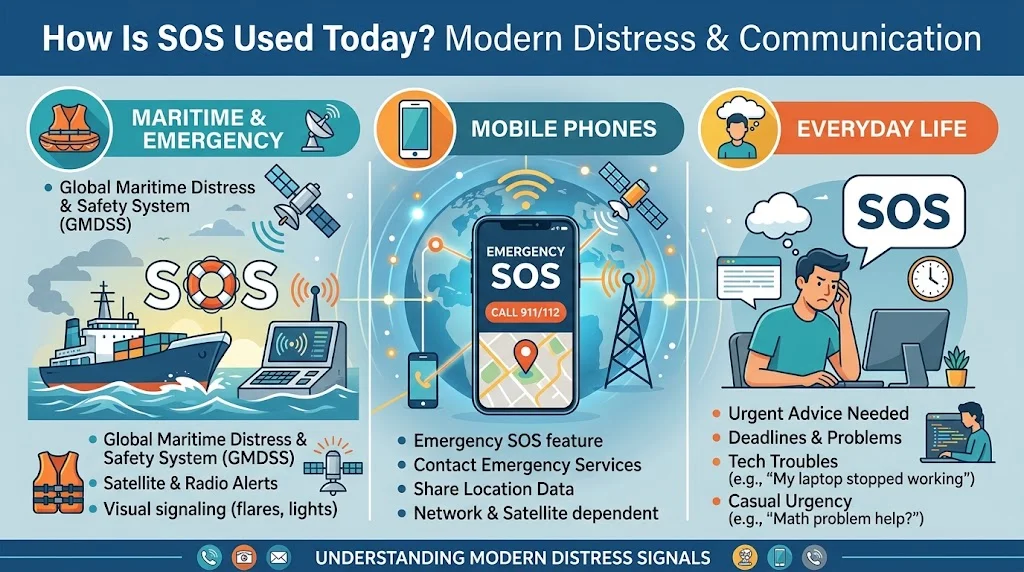
SOS remains a recognized distress signal. Maritime distress communication now relies heavily on modern systems, including the Global Maritime Distress and Safety System (GMDSS).
These systems can use radio equipment, satellite communications, and digital alerts to help ships communicate emergencies and coordinate rescue operations.
SOS may also appear in visual signaling. For example, a person in a remote location might use a light or another signaling method to attract attention when conventional communication isn’t available.
SOS on Mobile Phones
Many smartphones include emergency features labeled Emergency SOS. Depending on the device, region, and settings, these features may help users contact emergency services, notify emergency contacts, or share location information.
However, a phone’s Emergency SOS feature is not identical to the traditional Morse code distress signal.
Before relying on a device during an emergency, check its instructions and available features. Network coverage, satellite availability, regional support, and device settings can affect how emergency communication works.
SOS in Everyday Life
Outside formal emergency situations, SOS has become a familiar expression in daily conversation.
People use it when they need immediate advice, feel overwhelmed, or want someone to help solve a problem.
Examples include:
- “SOS, I forgot about the deadline.”
- “SOS, can someone explain this math problem?”
- “SOS, my laptop stopped working before the meeting.”
- “SOS, I need help finding my way.”
In these situations, the abbreviation communicates urgency without necessarily indicating danger.
What Are Examples of SOS in Sentences?
The easiest way to understand SOS meaning and usage is to see how people use it in different situations. The same abbreviation can describe a genuine emergency, an urgent work problem, or a humorous everyday inconvenience.
SOS in Emergency Situations
“The crew sent an SOS after the vessel began taking on water.”
Here, SOS refers to a serious maritime distress signal. The crew needs assistance because the vessel may be in danger.
“A stranded hiker used a signaling device to communicate distress.”
This example describes the broader purpose of SOS: making others aware of a dangerous situation and the need for help.
SOS in Text Messages
“SOS, can you help me finish this assignment?”
The sender needs academic assistance and wants a quick response.
“SOS, I don’t know how to reply to this message.”
Here, SOS expresses uncertainty and asks a friend for advice.
SOS at Work
“SOS! The presentation file won’t open, and the meeting starts in five minutes.”
The message communicates an urgent technical problem. The sender needs someone to help before the meeting begins.
“SOS, the client needs the revised document today.”
This example uses SOS to highlight a pressing deadline.
SOS on Social Media
“SOS, I have no idea what to wear tonight.”
The person wants suggestions or reassurance about an outfit.
“SOS, somebody tell me the name of this song.”
This message asks viewers to identify a song quickly.
SOS in Casual Conversation
“I need an SOS coffee before I can function.”
This playful expression suggests that the speaker feels tired and wants coffee.
“SOS, I accidentally spoiled the ending for myself.”
The speaker uses SOS to dramatize a minor disappointment.
These examples show that context determines whether SOS sounds serious, urgent, or humorous.
Is SOS Only Used for Emergencies?
No. Although SOS originated as a formal distress signal, people now use it in many informal situations.
In everyday language, SOS can describe almost any moment when someone feels stuck and needs assistance. The meaning may be literal or figurative, depending on the circumstances.
Literal Meaning vs. Figurative Meaning
A literal use refers to an actual distress situation. For example, a person trapped in a dangerous location might signal SOS to request rescue.
A figurative use expresses a less serious problem. Someone who writes “SOS, my internet is slow” usually wants technical advice rather than emergency rescue.
| Feature | Literal SOS | Figurative SOS |
| Main purpose | Signal serious distress | Request help or express frustration |
| Common setting | Emergency signaling | Texting, social media, daily conversations |
| Typical example | A vessel signals distress | A student asks for homework help |
| Level of urgency | Potentially life-threatening | Depends on the problem |
| Appropriate response | Emergency assistance when needed | Practical help or advice |
How Can You Tell What Someone Means?
Look at the details surrounding the message.
If someone mentions an accident, immediate danger, violence, or being stranded, take the situation seriously. Ask whether they’re safe and what assistance they need.
If someone complains about a difficult assignment or an outfit, they’re probably using SOS casually.
Still, don’t rely on the abbreviation alone. A short message can hide a serious problem, especially when someone is frightened or unable to explain what’s happening.
What Is the Difference Between SOS and Mayday?
SOS and Mayday are both distress signals, but they use different communication methods. SOS is traditionally associated with Morse code, while Mayday is a spoken distress call used in radiotelephony.
Both communicate serious danger and a need for assistance, but each has its own place in emergency communication.
SOS vs. Mayday: Key Differences
| Feature | SOS | Mayday |
| Communication method | Traditionally Morse code | Spoken radio communication |
| Historical association | Maritime wireless telegraphy | Radiotelephony distress calls |
| Signal form | Three dots, three dashes, three dots | The spoken word “Mayday” |
| Main purpose | Signal distress and the need for help | Communicate serious danger requiring immediate assistance |
| Modern context | Recognized distress signal; also used informally | Formal spoken distress procedure in relevant radio services |
When Is Mayday Used?
Mayday is used in relevant radio communication when a person or vessel faces grave and imminent danger and needs immediate assistance.
For example, a pilot facing a life-threatening aircraft emergency may use a Mayday call according to the applicable radio procedures.
SOS, by contrast, is widely recognized through its distinctive Morse code pattern and broader association with distress.
The distinction matters because formal emergency communication follows established procedures. Someone should use the appropriate distress method for the communication system involved rather than treating every signal as interchangeable.
Read More: Soft Launch Meaning: A Complete Beginner-Friendly Guide
What Should You Do If Someone Sends You SOS?
When someone sends SOS, your response should depend on what they say and the circumstances. They might need a quick answer about a minor problem, or they might be asking for help during a dangerous situation.
Start by checking whether the person is safe. If the message is unclear, ask a direct question rather than assuming the problem is harmless.
Steps to Take When You Receive SOS
- Read the context: Check the previous messages and look for details about the problem.
- Ask a clear question: Try “Are you safe?” or “What happened?”
- Offer specific help: If they need advice, provide a practical answer or connect them with someone who can help.
- Respond promptly to danger: If they describe an immediate threat, contact the appropriate local emergency service when possible.
- Respect their privacy: Avoid sharing sensitive details or screenshots with others unless doing so is necessary to protect someone’s safety.
A Practical Example
Imagine receiving this message from a friend:
Friend: SOS. I’m stranded, and my phone battery is almost dead.
A useful response would be:
You: Are you somewhere safe? Send me your location if you can, and tell me what help you need.
This response checks immediate safety and asks for information that can guide the next step.
Now imagine a different message:
Friend: SOS, I can’t understand this assignment.
You could respond by asking which question is causing trouble and offering to explain it.
The same three letters require different responses because the situations differ.
What If the SOS Message Suggests Immediate Danger?
If someone reports a serious accident, a threat to their safety, or another life-threatening emergency, don’t dismiss the message as slang.
Contact the appropriate local emergency service if needed. Share useful information, such as the person’s location, if you know it and can provide it safely.
If the person cannot communicate clearly, keep your questions short and focused. Above all, prioritize immediate safety rather than trying to interpret every detail of the abbreviation.
Frequently Asked Questions
1. What does SOS mean?
SOS is an internationally recognized distress signal used to request urgent help or immediate assistance during an emergency.
2. Does SOS stand for Save Our Souls?
Save Our Souls is a popular phrase associated with SOS, but the letters don’t officially stand for these words. SOS was chosen as a recognizable Morse code signal.
3. What does SOS stand for in Morse code?
In Morse code, SOS is represented by three dots, three dashes, and three dots: … — …. This simple sequence is easy to recognize and transmit.
4. Why do people use SOS?
People use SOS to signal danger and request help during serious emergencies. It is especially associated with maritime emergencies, but it can also apply to situations on land or in the air.
5. Is SOS still used today?
Yes, SOS remains a widely recognized distress signal. It also appears in text messages, books, movies, TV shows, and songs to communicate a need for help.
6. How can I use SOS in a sentence?
You can use SOS when describing an emergency or asking for help. For example, “The stranded hikers sent an SOS when they realized they were lost.”
Conclusion
SOS is a simple but powerful distress signal that communicates the need for help. Its distinctive Morse code sequence of three dots, three dashes, and three dots makes it easy to recognize and transmit. Although people often associate SOS with Save Our Souls or Save Our Ship, these phrases aren’t its official meaning. Understanding the SOS meaning, origin, and examples helps you recognize how this important signal is used in emergencies and everyday communication.