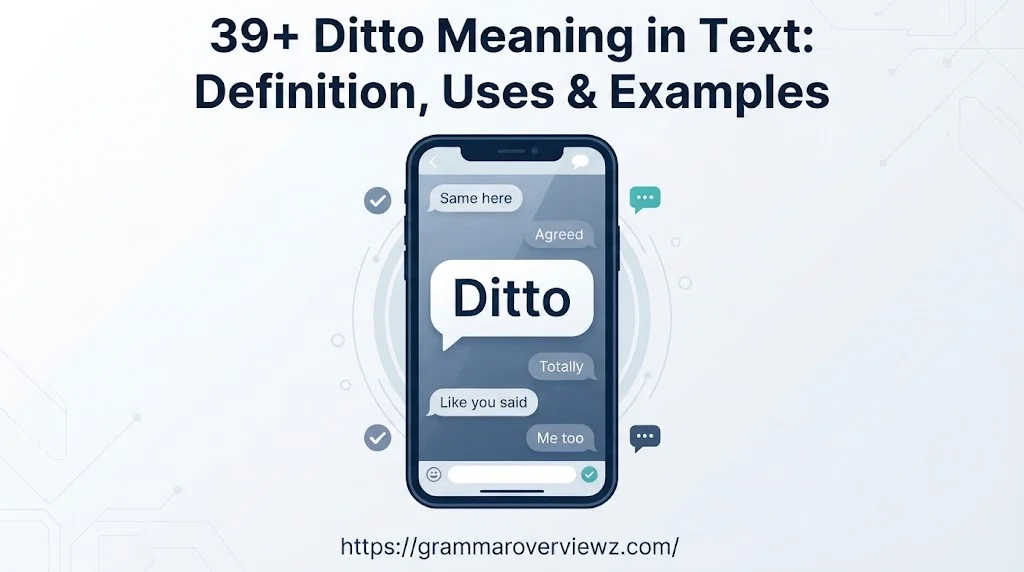

Understanding 39+ Ditto Meaning in Text helps users quickly understand how ditto works in texting, online conversations, and social media replies.
In today’s digital age, fast-paced communication often uses shorthand to save time. Ditto is a commonly used word that expresses agreement, repetition, or acknowledgment without repeating a previous statement.
You may see it on WhatsApp, Instagram, Snapchat, TikTok, and other messaging apps. Its meaning of ditto is usually simple: “I agree” or “the same applies to me.”
The usage of ditto can vary by context. It works naturally in casual chats, informal texting, social media, and everyday communication, while professional communication, technical contexts, and structured communication may require more formal wording.
Understanding its background, origin, and word meaning can help prevent misunderstandings and improve communication clarity. Whether you encounter it in text messages, dating app interactions, digital environments, or offline communication, knowing the context-based meaning makes it easier to respond correctly and effectively.
Quick Answer: What Does Ditto Mean in Text?
In texting, “ditto” usually means “same,” “me too,” or “I agree.” It tells the other person that the statement, feeling, opinion, or situation they just mentioned also applies to you.
For example:
Person A: “I really need a vacation.”
Person B: “Ditto.”
Here, ditto means “I really need a vacation too.”
The word doesn’t always express agreement with an opinion. Sometimes it simply indicates a shared feeling, experience, preference, or situation. Context determines exactly what is being repeated.
Ditto Meaning in Text at a Glance
| Expression | Meaning | Typical Tone |
| Ditto | Same as what you said | Casual |
| Same | I feel the same | Very casual |
| Me too | That applies to me too | Friendly |
| Likewise | The same applies to me | Polished |
| I agree | I share your opinion | Direct |
| Exactly | I strongly agree | Emphatic |
| Same here | My situation is similar | Casual |
The simplest way to remember ditto meaning in texting is this:
Someone says something. You say “ditto.” You mean that the same thing applies to you.
What Does “Ditto” Actually Mean?
The word ditto means that something previously mentioned should be repeated or applies again. In everyday conversation, it works almost like a verbal copy-and-paste function.
Imagine that your friend says:
“I’m craving pizza.”
You could answer:
“I’m craving pizza too.”
Or you could make things shorter:
“Ditto.”
Both responses communicate essentially the same idea.
However, ditto can refer to more than personal feelings. It can also respond to opinions, plans, experiences, and statements.
Ditto Meaning “Me Too”
One of the most common uses is “me too.”
“I’m so tired after work.”
“Ditto.”
The second person isn’t merely agreeing with the sentence. They are saying that they share the same experience.
Ditto Meaning “I Agree”
Sometimes ditto expresses agreement with an opinion.
“That movie was surprisingly good.”
“Ditto.”
In this case, the speaker means:
“I agree. I also think the movie was surprisingly good.”
Ditto Meaning “Same Here”
The word can also mean “same here.”
“I’m working from home today.”
“Ditto.”
The response means that the second person is in the same situation.
Ditto Meaning “The Same Applies”
A longer statement can also receive a “ditto” response.
“I have a meeting at 9, a deadline at noon, and another call at three.”
“Ditto.”
Here, the second person is indicating that the same general situation applies to them.
39+ Ditto Examples in Text Messages
Real examples make the meaning much easier to understand. The following conversations show how ditto meaning in text changes slightly depending on context.
Ditto in Everyday Conversations
Example 1
“I’m tired today.”
“Ditto.”
Meaning: I’m tired too.
Example 2
“I need some coffee.”
“Ditto.”
Meaning: I need coffee too.
Example 3
“I could sleep for ten hours.”
“Ditto.”
Meaning: I feel exactly the same.
Example 4
“I can’t believe it’s already Friday.”
“Ditto.”
Meaning: I feel the same surprise.
Example 5
“I really need a break.”
“Ditto.”
Meaning: I need a break too.
Ditto for Opinions and Agreement
Example 6
“That restaurant was excellent.”
“Ditto.”
Meaning: I agree that it was excellent.
Example 7
“We should leave early tomorrow.”
“Ditto.”
Meaning: I agree with that plan.
Example 8
“That was the funniest scene in the movie.”
“Ditto.”
Meaning: I have the same opinion.
Example 9
“I think this is our best option.”
“Ditto.”
Meaning: I agree.
Example 10
“This restaurant is worth visiting again.”
“Ditto.”
Meaning: I agree and would visit again.
Ditto for Feelings
Example 11
“I miss those old days.”
“Ditto.”
Meaning: I miss them too.
Example 12
“I’m nervous about tomorrow.”
“Ditto.”
Meaning: I’m nervous too.
Example 13
“I’m really excited about the trip.”
“Ditto!”
Meaning: I’m equally excited.
Example 14
“I feel much better now.”
“Ditto.”
Meaning: I feel better too.
Example 15
“I’m stressed about the deadline.”
“Ditto.”
Meaning: I share that stress.
Ditto Between Friends
Example 16
“Let’s order pizza tonight.”
“Ditto.”
Meaning: I want pizza too.
Example 17
“I don’t feel like going out tonight.”
“Ditto.”
Meaning: I feel the same way.
Example 18
“That song has been stuck in my head all day.”
“Ditto.”
Meaning: The same thing has happened to me.
Example 19
“We should do this again sometime.”
“Ditto.”
Meaning: I agree and want to do it again.
Example 20
“I could really use a quiet weekend.”
“Ditto.”
Meaning: I want the same thing.
Ditto in Romantic Texting
A romantic conversation can give ditto a warmer meaning.
Example 21
“I miss you.”
“Ditto.”
Meaning: I miss you too.
Example 22
“I’m thinking about you.”
“Ditto.”
Meaning: You’re on my mind too.
Example 23
“I had such a great time with you.”
“Ditto.”
Meaning: I enjoyed the time together too.
Example 24
“I can’t wait to see you.”
“Ditto.”
Meaning: I’m equally excited to see you.
Example 25
“You make me happy.”
“Ditto.”
Meaning: You make me happy too.
Still, context matters. A one-word response doesn’t automatically become romantic simply because two people are dating. The previous message and overall relationship provide the emotional meaning.
Ditto on Social Media
Example 26
“This post describes my life perfectly.”
“Ditto.”
Meaning: I relate to this too.
Example 27
“I need a vacation immediately.”
“Ditto.”
Meaning: I need one too.
Example 28
“This is exactly how I feel.”
“Ditto.”
Meaning: I feel exactly the same.
Example 29
“I could watch this movie all day.”
“Ditto.”
Meaning: I could too.
Example 30
“Everyone needs a little more free time.”
“Ditto.”
Meaning: I completely agree.
Ditto in Work and School Chats
Example 31
“This deadline came around quickly.”
“Ditto.”
Meaning: I feel the same about the deadline.
Example 32
“I’ll finish my part tonight.”
“Ditto.”
Meaning: I’ll do the same.
Example 33
“That meeting could have been an email.”
“Ditto.”
Meaning: I completely agree.
Example 34
“I think the second option is better.”
“Ditto.”
Meaning: I have the same opinion.
Example 35
“I’m still working on the report.”
“Ditto.”
Meaning: I’m in the same situation.
More Context-Dependent Examples
Example 36
“I don’t understand this question.”
“Ditto.”
Meaning: I don’t understand it either.
Example 37
“I’ve never been to that city.”
“Ditto.”
Meaning: Neither have I.
Example 38
“I’d rather stay home tonight.”
“Ditto.”
Meaning: I want to stay home too.
Example 39
“Something about this situation feels strange.”
“Ditto.”
Meaning: I have the same feeling.
Example 40
“I’d choose the second option.”
“Ditto.”
Meaning: I would choose it too.
Example 41
“I feel exactly the same way.”
“Ditto.”
Meaning: I feel the same.
Is “Ditto” Positive, Negative, or Neutral?
Interestingly, ditto itself isn’t positive or negative. Its emotional tone comes from the statement it refers to.
Consider these three examples:
| Original Message | Reply | Tone |
| “I love this song.” | “Ditto.” | Positive |
| “I hate waiting in traffic.” | “Ditto.” | Negative |
| “I’m working from home today.” | “Ditto.” | Neutral |
This makes ditto a flexible word. It simply mirrors the previous statement.
Think of it like an echo. An echo doesn’t create a new message. It reflects something that was already said.
Can “Ditto” Sound Rude or Dismissive?
Usually, ditto isn’t rude. However, a short response can sometimes feel dismissive because it gives the other person very little conversational material.
Compare:
“I miss you.”
“Ditto.”
with:
“I miss you too. I really wish you were here.”
Both responses express a shared feeling. The second one simply provides more emotional detail.
Tone also changes with punctuation.
- “Ditto!” can sound enthusiastic.
- “Ditto.” can sound neutral or matter-of-fact.
- “Ditto ❤️” can sound affectionate when the relationship supports that interpretation.
- “Ditto 😂” can make the response playful.
These aren’t strict rules. Texting tone depends heavily on the people involved.
See More: 36+ TMP Meaning in Text: What Does TMP Mean in Text?
What Does “Ditto” Mean From a Guy or Girl?
The word ditto doesn’t have a different dictionary meaning based on gender.
If a guy texts “ditto,” it generally means the same thing it would mean if a girl sent it: “same,” “me too,” or “I agree.”
Instead of focusing on gender, examine the conversation.
Ask:
- What did the person respond to?
- What is the relationship between you?
- Was the previous message emotional?
- Did they use an emoji?
- Were they agreeing with an opinion?
- Were they describing a shared experience?
For example, if someone says “I miss you” and receives “ditto,” the response usually indicates shared feelings. If someone says “That restaurant was expensive” and receives “ditto,” the response simply expresses agreement.
What Does “Ditto” Mean in a Relationship?
In relationships, ditto often acts as a quick way to mirror an emotion.
Suppose one partner writes:
“I had such a wonderful day with you.”
The other might reply:
“Ditto ❤️”
That response means they had the same positive experience.
However, there’s an important nuance. Ditto mirrors emotion rather than expanding it. Someone who wants a deeper conversation might appreciate a more personal response.
For example:
“I miss you.”
A simple “Ditto” communicates mutual longing. A response like “I miss you too. I can’t wait until we can spend time together again” adds more emotional depth.
Neither response is automatically better. The right choice depends on the relationship and the moment.
What Does It Mean When Someone Replies With Just “Ditto”?
When someone sends only “Ditto,” look at the message immediately before it.
That’s usually enough.
“I’m exhausted.”
“Ditto.”
Here, the meaning is obvious: “I’m exhausted too.”
Now consider:
“I think we should cancel the trip because the weather looks terrible.”
“Ditto.”
The meaning becomes broader. The person likely agrees with the whole idea, not merely one isolated word.
If the previous message contains several unrelated points, however, “ditto” can become ambiguous.
How to Reply When Someone Says “Ditto”
You don’t always need a clever response. In many conversations, “ditto” simply confirms that you share the same thought.
To Keep the Conversation Going
Ask a natural follow-up question.
“Ditto. What do you want to do about it?”
For a Casual Conversation
A simple response works:
“Haha, same!”
For a Romantic Conversation
You might respond with more warmth:
“Glad we’re on the same page.”
When the Meaning Isn’t Clear
If you genuinely can’t tell what they mean, ask:
“Same as what?”
That’s better than guessing, especially when the previous message contained multiple ideas.
Ditto vs. Same vs. Me Too vs. Likewise
These expressions overlap, but they aren’t identical in tone.
| Phrase | Main Meaning | Tone | Example |
| Ditto | Same as what was said | Casual | “I’m tired.” → “Ditto.” |
| Same | I feel the same | Very casual | “I need coffee.” → “Same.” |
| Me too | That applies to me | Natural | “I love this.” → “Me too.” |
| Same here | My situation is similar | Casual | “I’m staying home.” → “Same here.” |
| Likewise | The same applies to me | Polished | “Nice meeting you.” → “Likewise.” |
| I agree | I share your opinion | Direct | “We should wait.” → “I agree.” |
| Exactly | Strong agreement | Emphatic | “That was unfair.” → “Exactly.” |
Ditto sits somewhere between “same” and “me too.” It can feel slightly more distinctive because it has a long history outside modern texting.
Where Did the Word “Ditto” Come From?
The history of ditto goes back much further than smartphones, social media, and instant messaging.
English borrowed the word from Italian ditto, which means roughly “said” or “aforesaid.” The Italian term is related to detto, the past participle of dire, meaning “to say.”
English speakers began using ditto to avoid repeating information that appeared immediately above it. This was especially useful in lists, records, accounts, and other written material.
Over time, the word moved beyond record-keeping. People began using it in ordinary conversation to mean that the same statement or condition applied again.
So, when someone sends “Ditto” today, they’re using a word with a much older history than modern texting.
What Is a Ditto Mark?
The historical idea behind ditto also produced the ditto mark, commonly represented as:
〃
The mark indicates that the same information as above should be repeated.
For instance, in an old-style list, a ditto mark could indicate that the same location, description, or other entry applies to the next line.
This explains why the modern conversational meaning makes intuitive sense. “Ditto” essentially tells you to carry the previous information forward.
Is “Ditto” Slang?
Ditto is not simply slang. It is an established English word with recognized dictionary uses.
That said, its use as a one-word reply is generally informal and conversational.
There’s an important distinction here:
- Established word: A recognized English word with standard meanings.
- Slang: Informal vocabulary often associated with particular groups or situations.
- Texting abbreviation: A shortened form such as “IDK” or “BRB.”
Ditto belongs primarily to the first category, even though people frequently use it in informal digital communication.
Is “Ditto” an Acronym?
No. “Ditto” isn’t an acronym.
An acronym normally comes from the initial letters of multiple words. For example, NASA comes from the National Aeronautics and Space Administration.
“Ditto” doesn’t work that way. It is a standalone word with its own historical origin.
Therefore, searching for a supposed “full form of ditto” can be misleading. There is no standard expanded phrase behind the word.
How Is Ditto Used in Modern Texting?
Modern texting has made short responses especially useful. People often don’t want to repeat a sentence when one word can communicate the same idea.
That’s where ditto in text messages fits naturally.
You may see it in:
- Private text messages
- Group chats
- Social media comments
- Casual online conversations
- Friend-to-friend messaging
- Informal workplace chats
- Everyday spoken conversations
The medium may change, but the basic meaning stays remarkably stable:
“What you just said applies to me too.”
When Should You Use “Ditto”?
“Ditto” works well when the connection between your response and the previous message is obvious.
Use it when:
- You share someone’s feeling.
- You agree with their opinion.
- You have the same experience.
- You support the same plan.
- You have the same preference.
- You want to avoid repeating the same sentence.
- The conversation has a casual tone.
For example:
“I’m going to watch the game tonight.”
“Ditto.”
There’s little room for confusion because the response clearly refers to the activity.
When Should You Avoid “Ditto”?
Although the word is useful, it isn’t ideal everywhere.
Avoid it when:
- You’re writing a formal business document.
- You’re preparing an academic paper.
- The previous message contains several unrelated ideas.
- The situation requires a detailed explanation.
- Someone is sharing something emotionally serious and needs more than a quick acknowledgment.
- Your response could easily be misunderstood.
For example, replying “ditto” to a complicated work instruction could create unnecessary confusion.
In professional communication, a precise response such as “I agree with this approach” or “I’ll follow the same process” usually works better.
Common Misunderstandings About Ditto
Several misconceptions appear when people encounter the word for the first time.
“Ditto Is an Acronym”
False. It is a standalone English word.
“Ditto Always Means I Agree”
Not exactly. It can mean agreement, but it can also mean “me too” or “same here.”
“Ditto Is Only Texting Slang”
False. The word has been part of English for centuries.
“Ditto Always Sounds Romantic”
No. Romantic meaning comes from the surrounding conversation.
“Ditto Always Sounds Rude”
No. It can sound friendly, humorous, affectionate, neutral, or dismissive depending on context.
“Ditto Has Only One Meaning”
Its central idea is repetition or sameness. However, the practical meaning can vary depending on what the speaker is responding to.
How to Understand the Tone of “Ditto”
When you’re trying to interpret ditto meaning in chat, use this simple framework:
Previous message → Relationship → Situation → Ditto → Intended meaning
For example:
“I can’t wait for our vacation!”
“Ditto!”
The exclamation mark suggests enthusiasm.
Now compare:
“That meeting lasted two hours.”
“Ditto.”
Here, “ditto” probably means “Mine did too” or “I experienced the same thing.”
The word itself hasn’t changed. The context has.
Ditto in Formal vs. Informal English
The appropriateness of ditto depends strongly on the setting.
| Situation | Appropriate? | Better Choice |
| Texting a close friend | Yes | Ditto |
| Casual group chat | Yes | Ditto / Same |
| Social media comment | Usually | Ditto / Same |
| Casual workplace chat | Sometimes | I agree / Same here |
| Formal email | Usually avoid | I agree / Likewise |
| Academic writing | No | Similarly / The same applies |
| Formal report | Usually avoid | State the information directly |
This isn’t about the word being grammatically wrong. It’s about register.
A word can be perfectly correct yet still feel out of place in a particular setting.
A Practical Case Study: Understanding “Ditto” From Context
Consider this short conversation:
Maya: “I can’t believe how quickly this week went.”
Jordan: “Ditto.”
Maya: “And I still have so much work left.”
Jordan: “Ditto.”
In the first exchange, Jordan shares Maya’s feeling about the week passing quickly.
In the second exchange, Jordan indicates that the same situation applies: Jordan also has a lot of work left.
Notice how the word doesn’t require a fixed translation. Its meaning comes from the statement it echoes.
That’s the central rule behind ditto meaning in text.
Quick Facts About “Ditto”
- Ditto is an established English word.
- It generally expresses sameness or repetition.
- In texting, it often means “same,” “me too,” or “I agree.”
- It isn’t an acronym.
- It isn’t exclusively a texting term.
- The word has Italian roots.
- It has historical connections with written repetition and ditto marks.
- Its emotional tone depends on the message it responds to.
- It can work in casual conversations but may sound too informal in formal writing.
- “Ditto” can describe agreement without repeating the original sentence.
Final Takeaway: What Does Ditto Mean in Text?
So, what does ditto mean in text? In most conversations, it means “same,” “me too,” “same here,” or “I agree.” It lets you respond to someone’s statement without repeating the entire thought.
The real trick is to examine the message before it. If someone says, “I’m exhausted,” then “ditto” means “I’m exhausted too.” If they say, “That was a great movie,” it probably means “I agree.” If they say, “I miss you,” the response can mean “I miss you too.”
In other words, ditto works like a conversational echo. It takes the meaning already on the table and applies it to the person responding. That’s why this small, centuries-old word still feels remarkably useful in today’s fast-moving world of text messages and online conversations.
FAQs
1. What does ditto mean in text?
Ditto usually means “I agree,” “same here,” or “the same applies to me.” People use it in text messages, chats, and social media to avoid repeating what someone has already said.
2. Is ditto a formal or informal word?
Ditto is generally more common in casual and informal communication. Although it can appear in professional settings, phrases such as “I agree” or “the same applies to me” may sound clearer and more appropriate in formal writing.
3. Can ditto mean “same”?
Yes. In many texting conversations, ditto is used to mean “same” or “same here.” For example, if someone says, “I love this movie,” replying “Ditto!” means that you feel the same way.
4. How do you use ditto in a text message?
You can use ditto as a short response when you agree with someone’s previous statement. For example, if a friend texts, “I’m really tired today,” you can reply, “Ditto!” to say that you are also tired.
5. Is ditto rude in texting?
Usually, ditto is not rude. It is a simple way to show agreement or acknowledgment. However, depending on the conversation, replying with only “ditto” may sound brief or less personal, so a warmer response may be better in sensitive situations.
6. What is another way to say ditto?
Common alternatives to ditto include “same here,” “I agree,” “me too,” “likewise,” “exactly,” “same,” and “I feel the same way.” The best choice depends on the context and tone of the conversation.
Conclusion
Understanding 39+ Ditto Meaning in Text makes it easier to recognize this simple but useful expression in texting, social media, and everyday digital communication. Ditto usually communicates agreement, similarity, repetition, or acknowledgment without requiring you to repeat the entire statement. Its short and convenient nature makes it especially useful in casual conversations.
When using ditto, always consider the context and relationship between the people communicating. It can sound friendly and natural in a text to a friend, while “I agree” or “the same applies to me” may be better for professional communication. Knowing these small differences can help you communicate more clearly, naturally, and effectively.