
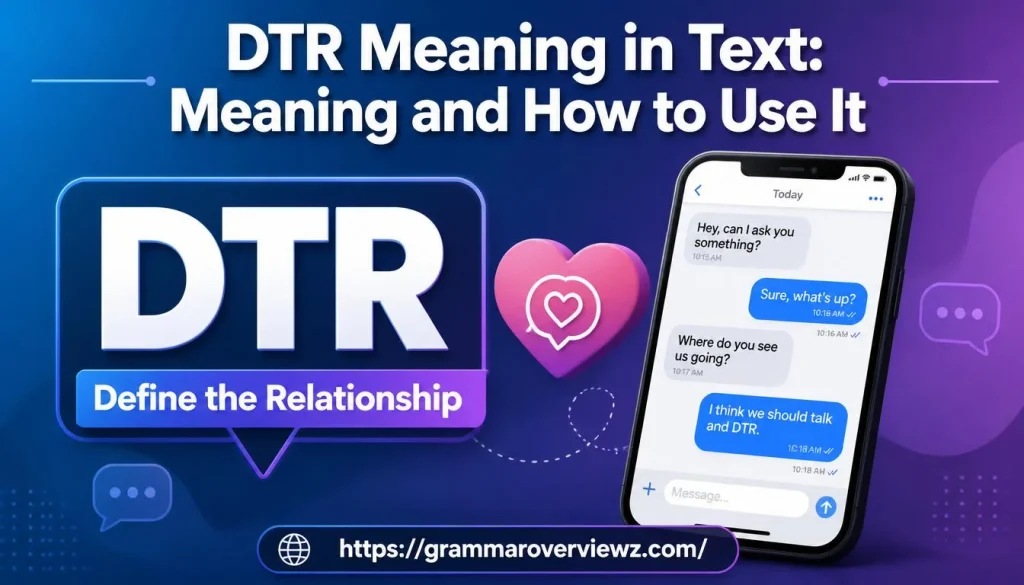

DTR Meaning in Text: Meaning and How to Use It explains how people define romantic relationships through honest conversations and shared expectations.
DTR stands for Define The Relationship, a common abbreviation used in texting, casual conversations, and online chats. The DTR meaning in text refers to discussing your romantic connection, relationship status, and expectations with a dating partner.
A DTR conversation helps them talk openly about what they are to each other, whether they want casual dating, exclusive dating, or a serious relationship. This discussion builds relationship clarity, mutual understanding, and emotional connection.
People use DTR when questions about commitment, exclusivity, and romantic intentions arise. An honest conversation allows partners to discuss relationship goals, boundaries, expectations, and the future of their connection. Asking a direct question can prevent misunderstandings when dating starts feeling more serious.
Although DTR slang commonly appears in text messages and dating conversations, abbreviations can have different meanings depending on the context. Understanding the surrounding conversation helps you interpret the intended meaning and communicate your expectations clearly.
Related Post: What Does ALR Mean? Complete Guide
Quick Answer: What Does DTR Mean?
DTR stands for “Define the Relationship.” In texting and dating, it refers to a conversation in which two people clarify their relationship status, expectations, and intentions.
For example, if someone texts, “I think we need to DTR,” they’re suggesting that you talk about what your relationship means and where it’s going.
A DTR conversation might cover whether you’re officially dating, whether you want to be exclusive, or whether you’d prefer to keep things casual. It doesn’t automatically mean you must become a couple. Instead, the goal is to understand each other’s feelings and expectations.
What Does DTR Mean in Text?
In text messages, DTR is a shorthand way to talk about defining a romantic connection. Instead of typing the entire phrase, someone can use the three letters when discussing relationship status or asking where things are heading.
Here are a few ways people use DTR in everyday messages:
- “I think we need to DTR.” — The sender wants to clarify the relationship.
- “Have you two had the DTR talk yet?” — The sender asks whether the couple has discussed their status.
- “We finally DTR’d last night.” — The two people finally talked about what their connection means.
- “I’m nervous about asking him to DTR.” — The sender feels anxious about starting the conversation.
Notice that DTR can work as an abbreviation within a sentence or as a label for the conversation itself. People may say they need to “DTR,” have “the DTR talk,” or discuss “their DTR.”
Is DTR an Acronym or an Abbreviation?
DTR is an initialism formed from the first letters of “Define the Relationship.” People generally pronounce each letter separately rather than saying it as one word.
In casual messages, you’ll usually see it written in capital letters as DTR. However, the full phrase is also common when someone wants to avoid confusion.
What Does DTR Mean in Dating?
In dating, DTR means discussing what two people are to each other. The conversation becomes relevant when romantic feelings or shared experiences develop, but neither person knows exactly how to describe the connection.
Imagine you’ve been seeing someone for six weeks. You text every day, go out together on weekends, and act like a couple when you’re together. However, you’ve never discussed whether you’re officially dating or still keeping your options open.
That uncertainty is precisely where a DTR conversation can help.
A couple might use the discussion to settle questions such as:
- Relationship status: Are we casually dating, or are we officially together?
- Exclusivity: Are we still seeing other people?
- Commitment: Do we want to build a serious relationship?
- Expectations: How much time and communication do we expect from each other?
- Future intentions: Are we interested in seeing where this relationship leads?
Not every DTR conversation needs to answer every question. Two people might simply agree to call each other partners. Others may need a longer discussion about boundaries and future plans.
The important point is that DTR doesn’t automatically mean commitment. It means having an honest conversation about what each person wants and whether those expectations match.
What Is a DTR Conversation?
A DTR conversation is often called “the talk” or the “what are we?” conversation. It helps two people move away from assumptions and toward a shared understanding of their relationship.
Although some people find the discussion uncomfortable, it doesn’t have to become a dramatic event. A calm, honest conversation can clarify things that hints, flirting, and frequent texting cannot.
When Should You Have the DTR Talk?
There’s no fixed number of dates or weeks that makes a DTR conversation necessary. The right time depends on your feelings, expectations, and circumstances.
You might consider having the conversation when:
- You’ve been dating consistently and want to know whether the connection is exclusive.
- Your feelings have grown, and you want to understand the other person’s intentions.
- You’re making plans that suggest a deeper commitment.
- You’re uncomfortable with uncertainty about your relationship status.
- You want to date seriously but don’t know whether the other person feels the same way.
For example, meeting someone’s friends doesn’t necessarily mean you’re officially a couple. Likewise, texting every morning doesn’t prove that either person expects exclusivity.
Look at the overall relationship rather than one isolated sign. If the uncertainty affects your decisions or emotional well-being, a direct conversation may be more helpful than trying to interpret every message.
What Should You Discuss During a DTR?
You don’t need a formal script, but a few key topics can help keep the conversation clear.
| Topic | Question to ask |
| Relationship status | “How would you describe what we have?” |
| Exclusivity | “Are we both comfortable focusing on each other?” |
| Commitment | “Are you interested in a serious relationship?” |
| Boundaries | “What does being exclusive mean to you?” |
| Future plans | “What would you like this connection to become?” |
Listen carefully to the answers instead of focusing only on the label. Two people might both say they’re dating but have different ideas about exclusivity, communication, or commitment.
Why Is the DTR Talk Important?
A DTR conversation gives both people an opportunity to express what they want. Without that discussion, one person might assume the relationship is exclusive while the other continues dating casually.
Clear communication can help you:
- Reduce misunderstandings about relationship status.
- Express your needs and boundaries openly.
- Decide whether your expectations are compatible.
- Avoid making important decisions based on assumptions.
- Recognize when you want different things.
A successful DTR doesn’t require both people to want the same outcome. It requires both people to communicate honestly and respect the other’s answer.
DTR Meaning in Text Messages: Examples and Their Meanings
The easiest way to understand DTR is to see how people use it in different conversations. These examples illustrate common texting situations and the meaning behind each message.
| Text message | What it means |
| “We need to DTR.” | We should clarify our relationship status. |
| “Are you ready to DTR?” | Are you ready to discuss what we are? |
| “When are we going to DTR?” | When will we talk about our relationship? |
| “We finally had the DTR talk.” | We discussed and clarified our connection. |
| “I think we should DTR soon.” | I want to talk about our expectations. |
| “Should we DTR or keep things casual?” | Should we define the relationship or continue casually? |
| “I’m scared to bring up DTR.” | I’m nervous about discussing our status. |
| “After our DTR, we’re officially together.” | The conversation led to an agreed relationship label. |
A Realistic Example of DTR in a Conversation
Consider this fictional exchange between two people who have been dating for several weeks.
Alex: “We’ve been hanging out a lot lately. Can I ask what you’re looking for?”
Jordan: “I’ve been wondering the same thing. I like you, and I’d like to see where this goes.”
Alex: “Would you want to be exclusive?”
Jordan: “Yes, I’d be comfortable with that. Let’s talk about what that means for both of us.”
This exchange illustrates the purpose of a DTR conversation. Neither person relies on guesses, and both have an opportunity to explain their expectations.
The outcome doesn’t have to be an official relationship. Even if the two people decide to remain casual, they can leave the conversation with a clearer understanding.
How to Respond When Someone Says DTR
If someone texts you about DTR, don’t assume they’re demanding a commitment. They may simply want to understand your feelings or discuss where the relationship stands.
Your response should reflect what you genuinely want. Here are a few ways to handle different situations.
If You Want a Serious Relationship
When you’re ready for commitment, tell the other person directly. You don’t need to make a grand speech or hide your feelings behind jokes.
Example response:
“I really like what we have, and I’d like to build a serious relationship with you. How do you feel about becoming exclusive?”
This response expresses your intentions while leaving room for an honest answer.
If You’re Not Ready to Commit
You can care about someone without feeling ready for a defined relationship. Be honest about that rather than agreeing to something you may later regret.
Example response:
“I like spending time with you, but I’m not ready to commit just yet. I’d rather be honest about where I am emotionally.”
If you need more time, explain what you’re unsure about. However, avoid promising a future commitment unless you genuinely believe it’s possible.
If You Prefer to Keep Things Casual
Some people enjoy dating without wanting a serious relationship. That’s a valid preference when everyone understands the arrangement and agrees to it.
Example response:
“I’m enjoying our connection, but I’m looking for something casual right now. I want to make sure we’re both comfortable with that.”
Clear communication helps the other person decide whether the arrangement suits their needs.
If You Need Time to Think
You don’t have to answer every relationship question immediately. If the conversation catches you off guard, ask for a little time to consider your feelings.
Example response:
“I care about this, and I want to give you an honest answer. Can we talk about it tomorrow after I’ve had some time to think?”
Taking time to reflect is different from avoiding the conversation indefinitely. If you agree to revisit the topic, follow through.
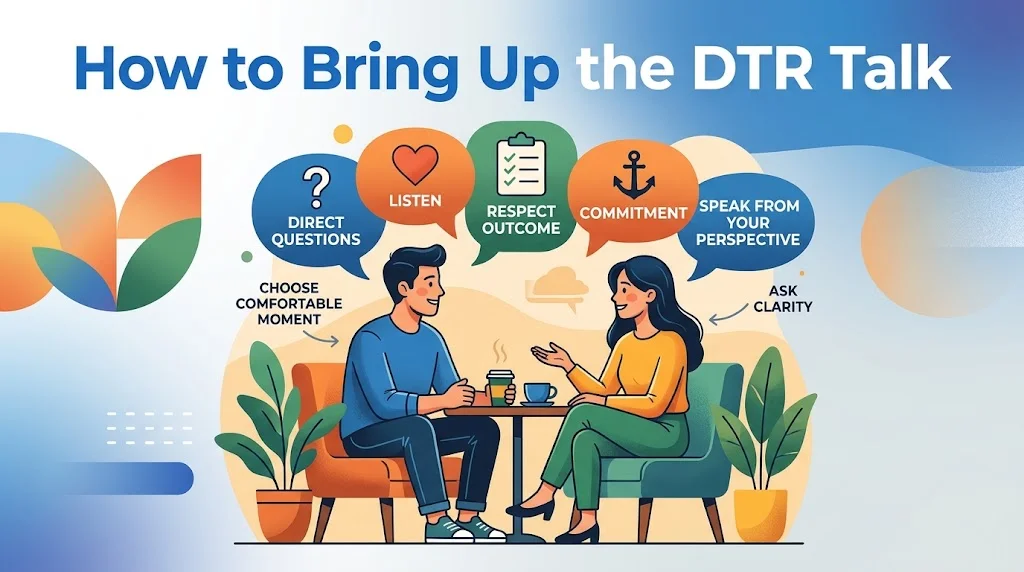
How to Bring Up the DTR Talk
Starting the conversation can feel awkward, especially if you’re worried about rejection. However, you don’t need perfect wording. You need a clear question and a willingness to listen.
Here are practical ways to approach it.
- Choose a comfortable moment. Find a time when you can talk without rushing or dealing with constant interruptions.
- Speak from your own perspective. Explain what you feel and want instead of accusing the other person of being unclear.
- Ask direct questions. Simple questions often work better than hints or tests.
- Listen to the answer. Give the other person room to explain their feelings, even when they differ from yours.
- Respect the outcome. A conversation should help both people make informed choices, not pressure someone into commitment.
Try opening with one of these questions:
- “How do you feel about where this is going?”
- “What are you looking for between us?”
- “I’d like to understand whether we’re on the same page.”
- “Do you see this becoming a committed relationship?”
- “Would you like to talk about being exclusive?”
You can also start with a simple statement: “I enjoy spending time with you, and I’d like to talk about what we’re building together.”
Remember that you can ask for clarity without demanding a particular answer. Your goal is to understand each other, not to force a label.
Is DTR the Same as Being Exclusive?
No. DTR and exclusivity are related, but they don’t mean the same thing.
DTR describes a conversation about relationship status and expectations. Exclusivity describes an agreement about whether either person will date or pursue other romantic partners.
For example, two people might agree not to date anyone else while they decide whether they’re ready for an official relationship. They may be exclusive without using labels such as boyfriend, girlfriend, or partner.
Another couple might agree that they’re officially dating but still need to discuss exactly what exclusivity means to them.
| DTR | Exclusivity |
| A conversation about relationship status and expectations. | An agreement about dating or romantic involvement with other people. |
| Can cover casual dating, commitment, labels, and future intentions. | Focuses on the boundaries both people agree to follow. |
| Doesn’t automatically establish exclusivity. | Doesn’t automatically establish a long-term commitment. |
The key takeaway: Never assume that a label answers every question. Discuss the expectations that matter to both of you.
DTR vs. Situationship vs. Talking Stage
DTR, situationship, and talking stage often appear in the same dating conversations, but each term serves a different purpose.
Understanding the differences helps you interpret messages more accurately.
| Term | Meaning | Example |
| DTR | A conversation to clarify relationship status and expectations. | “We should DTR and decide what we want.” |
| Situationship | A romantic or intimate connection without a clearly defined relationship status. | “We act like a couple, but we’ve never discussed labels.” |
| Talking stage | An early phase when two people explore romantic interest and get to know each other. | “We’re still in the talking stage.” |
How Do These Terms Connect?
The talking stage may develop into regular dating. As feelings grow, one or both people might want to have a DTR conversation.
That discussion can lead to a committed relationship, an exclusive but not formally labeled connection, or an agreement to keep things casual. Sometimes, the two people discover that they want different things and decide not to continue dating.
However, a situationship isn’t automatically unhealthy. The important question is whether both people understand and accept the arrangement. Problems can arise when their expectations differ or one person feels unable to express what they need.
Where Is DTR Used?
Although DTR is closely associated with dating, the abbreviation can appear across different forms of digital communication.
- Text messages: Someone might ask to DTR after weeks of regular conversations or dates.
- Dating apps: People may discuss DTR after meeting and discovering mutual romantic interest.
- Instagram and Snapchat: The term can appear in direct messages, stories, or conversations about dating.
- TikTok and Reddit: Users may discuss the DTR talk while sharing dating experiences or asking for relationship advice.
- Everyday conversations: Someone might ask a friend whether they’ve had the DTR talk with their partner.
The wording can change slightly depending on the situation. One person might write, “We need to define the relationship,” while another simply says, “It’s time to DTR.”
Both expressions communicate the same general idea: it’s time to clarify what the relationship means.
These are examples of common contexts rather than measured rankings of platform usage. The abbreviation isn’t exclusive to any particular app or social media service.
Does DTR Have Other Meanings?
Yes. Like many abbreviations, DTR can have different meanings in specialized contexts. However, “Define the Relationship” is the relevant interpretation when people discuss dating, romantic feelings, or relationship status.
In medical settings, DTR can stand for deep tendon reflex, referring to a reflex tested during a physical examination.
Context helps you distinguish between the meanings:
- “We should DTR before things get more serious.” — Define the relationship.
- “The clinician checked the patient’s DTRs.” — Deep tendon reflexes.
If someone uses DTR in a romantic conversation, you generally don’t need to search for an alternative meaning. The surrounding words usually make the intended meaning clear.
FAQs About DTR Meaning in Text
1. What Does DTR Mean in Text?
DTR stands for “Define The Relationship.” People use it in text messages to clarify their romantic connection, relationship status, and expectations.
2. What Does DTR Mean in Dating?
In dating, DTR means having an honest conversation about a relationship. Partners discuss commitment, exclusivity, and whether they want a serious relationship.
3. How Do You Use DTR in a Text Message?
You can use DTR when you want to discuss your relationship openly. For example, “We’ve been seeing each other for a while. I think we should DTR and talk about what we both want.”
4. When Should You Have a DTR Conversation?
Consider having a DTR conversation when your connection becomes more serious, you want exclusivity, or you’re unsure about your partner’s intentions. Choose a comfortable time to discuss your feelings honestly.
5. Does DTR Mean You’re Officially in a Relationship?
Not necessarily. DTR means discussing or defining your relationship. The conversation may lead to commitment or exclusivity, but both partners must agree on what their relationship means.
6. Can DTR Have Other Meanings?
Yes. Although DTR usually means “Define The Relationship” in dating and texting, it can have different meanings in other contexts. Check the surrounding conversation to understand the intended meaning.
Conclusion
Understanding DTR meaning in text helps you recognize when someone wants clarity about a romantic connection. A Define The Relationship conversation allows both partners to discuss their feelings, expectations, and commitment openly. Whether you’re casually dating or hoping for something serious, honest communication can prevent confusion and help you understand where your relationship is heading.



Pingback: Touch Grass Meaning: Definition, Usage, Examples, and Origin