

This guide to 30 Other Ways to Say ‘Please Let Me Know at Your Earliest Convenience’ offers clear options for polite, natural workplace messages.
In emails and other forms of professional communication, the phrase “please let me know at your earliest convenience” is useful when you are waiting for a reply. Its meaning is to politely ask the recipient to do something or respond as soon as they reasonably can.
The expression is polite and formal, so it fits formal correspondence, meetings, and texts. Still, it may sound overly formal, repetitive, formulaic, or vague in modern workplace communication. In my experience, a clear, respectful, and natural message with the right professional tone usually feels easier to understand.
There are 30+ ways to say this idea through alternative phrases suited to different contexts. A softer request, such as “Please let me know when you can,” can sound more friendly, while a direct reminder may work better when you need an answer sooner.
These alternatives let you vary your wording and avoid making an email sound repetitive. The best wording depends on your relationship with the recipient and how quickly you need a reply. The helpful tips and examples throughout this article can help you choose language that feels natural when you end an email.
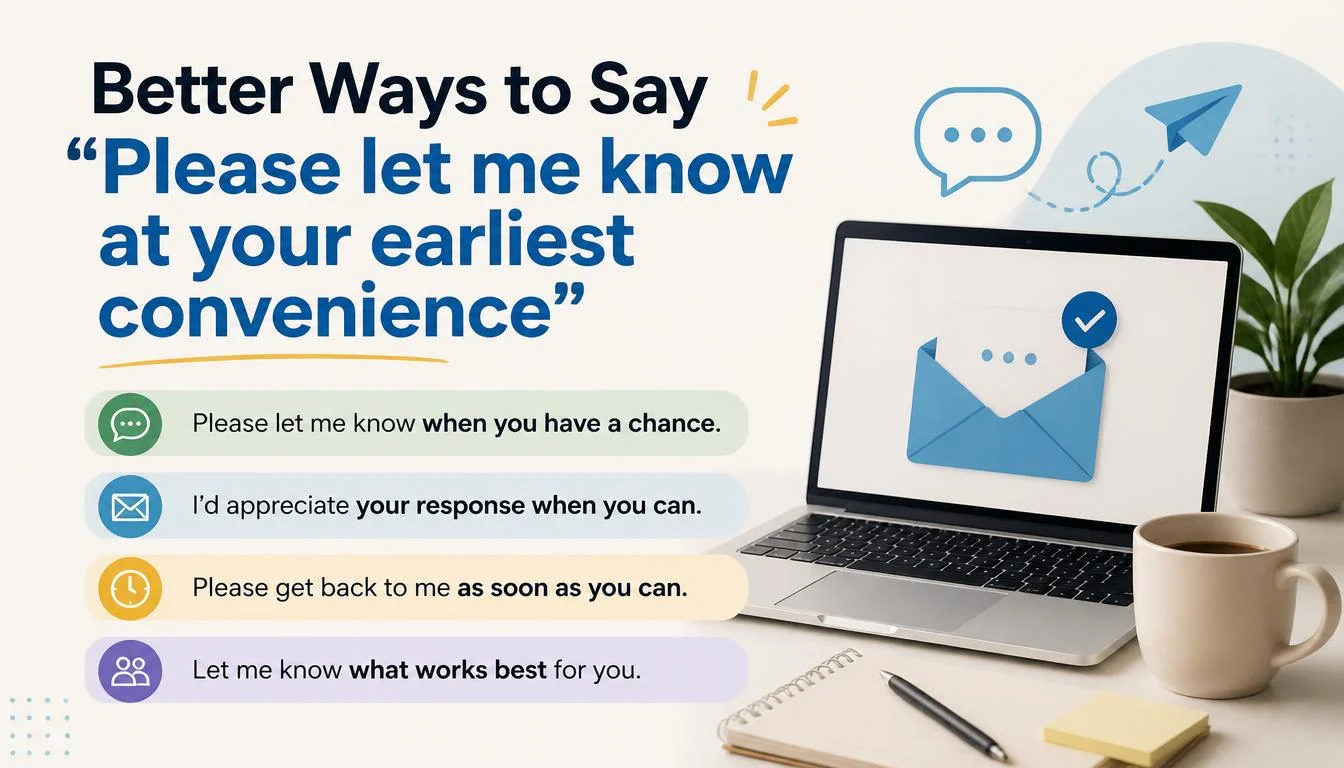
Quick Answer
The best alternative to “Please let me know at your earliest convenience” depends on how formal or urgent you want to sound. For a friendly, natural message, try “Please let me know when you have a chance.” For professional emails, “I’d appreciate your response when you can” works well. If you need a faster reply, “Please get back to me as soon as you can” makes the urgency clearer without sounding rude.
What Does “Please Let Me Know at Your Earliest Convenience” Mean?
“Please let me know at your earliest convenience” means that you are asking someone to provide you with information or a response as soon as they reasonably can, without demanding an immediate reply. The phrase recognizes that the other person may be busy and gives them some flexibility about when to respond. It is commonly used in professional emails, workplace communication, customer service, and formal requests.
The expression combines a polite request with consideration for someone’s schedule. However, “earliest convenience” can sometimes sound formal or slightly old-fashioned, so a more natural alternative may work better in casual or modern professional conversations.
Is It Professional or Polite to Say “Please Let Me Know at Your Earliest Convenience”?
Yes, “Please let me know at your earliest convenience” is generally considered professional and polite. It communicates that you would appreciate a response while avoiding the direct pressure of saying “respond immediately.” It works especially well when you do not have a strict deadline.
However, the phrase can sound somewhat formal or impersonal depending on the situation. If you are writing to a colleague, friend, client, or someone you know well, alternatives such as “Please let me know when you have a chance” or “I’d appreciate your response when you can” may sound more natural and conversational.
Advantages and Disadvantages
Advantages
- Polite and respectful: It acknowledges that the recipient has their own schedule.
- Professional: The phrase works well in business emails and formal communication.
- Flexible: It requests a timely response without necessarily demanding an immediate answer.
Disadvantages
- Can sound formal: “Earliest convenience” may feel somewhat stiff in casual conversations.
- May lack urgency: The recipient might not realize that you need an answer quickly.
- Can feel repetitive: Using the phrase frequently in emails may make your communication sound formulaic.
Synonyms for “Please Let Me Know at Your Earliest Convenience”
- Please let me know when you have a chance
- I’d appreciate your response when you can
- Please get back to me when convenient
- Let me know when you’re available
- Please respond when you have a moment
- I’d be grateful if you could let me know soon
- When you have a chance, please let me know
- Please keep me updated when you can
- I look forward to hearing from you soon
- Please share your thoughts when you can
- Let me know at your convenience
- I’d appreciate an update when possible
- Please get back to me as soon as you can
- Whenever you have a moment, please let me know
- Please let me know when it works for you
- I’d appreciate hearing from you when you have time
- Please provide an update when you’re able
- Let me know when you get a chance
- I’d welcome your response when convenient
- Please reach out when you’re available
- I’d appreciate it if you could let me know soon
- Please let me know when you’re able
- I look forward to your update
- Please keep me posted when you can
- Let me know whenever you’re ready
- I’d appreciate your feedback when possible
- Please respond when it’s convenient for you
- Feel free to let me know when you can
- I’d be happy to hear from you when you have time
- Please get in touch when you have a chance
1. Please Let Me Know When You Have a Chance
Meaning: This asks someone to provide information when they have free time.
Definition: A polite request for a response without placing unnecessary pressure on the recipient.
Detailed Explanation: This is one of the most natural and friendly alternatives to “please let me know at your earliest convenience.” It works especially well in everyday workplace messages because it respects the person’s schedule.
Scenario Example: “Please let me know when you have a chance if the meeting time works for you.”
Best Use: Professional emails, workplace chats, and casual requests.
Tone: Friendly, polite, and relaxed.
2. I’d Appreciate Your Response When You Can
Meaning: You would be thankful if the person responded when they were able.
Definition: A courteous way to request a response while recognizing the recipient’s availability.
Detailed Explanation: This phrase sounds respectful without being overly formal. It is useful when you want to make your request feel considerate rather than demanding.
Scenario Example: “I’d appreciate your response when you can regarding the revised proposal.”
Best Use: Professional communication and business emails.
Tone: Respectful, warm, and professional.
3. Please Get Back to Me When Convenient
Meaning: You are asking someone to respond when they have a suitable opportunity.
Definition: A flexible request that gives the recipient freedom to choose when to reply.
Detailed Explanation: This alternative is concise and practical. It works well when the matter is important but does not require an immediate response.
Scenario Example: “Please get back to me when convenient so we can finalize the details.”
Best Use: Work emails and professional messages.
Tone: Polite, flexible, and professional.
4. Let Me Know When You’re Available
Meaning: You want the person to tell you when they have time.
Definition: A direct but courteous request for information about someone’s availability.
Detailed Explanation: This phrase is particularly useful when you are trying to schedule a meeting, call, or conversation.
Scenario Example: “Let me know when you’re available, and we can discuss the project.”
Best Use: Scheduling and workplace communication.
Tone: Direct, friendly, and professional.
5. Please Respond When You Have a Moment
Meaning: You are asking someone to reply when they have a little free time.
Definition: A gentle request for a response that avoids sounding demanding.
Detailed Explanation: “When you have a moment” makes the request feel less formal and more human. It is useful for short messages where you want to acknowledge the person’s busy schedule.
Scenario Example: “Please respond when you have a moment and let me know what you think.”
Best Use: Emails, messaging apps, and workplace communication.
Tone: Warm, considerate, and casual.
6. I’d Be Grateful If You Could Let Me Know Soon
Meaning: You would appreciate receiving an answer relatively soon.
Definition: A polite expression combining gratitude with a request for a timely response.
Detailed Explanation: This option communicates a little more urgency than simply asking someone to respond when convenient.
Scenario Example: “I’d be grateful if you could let me know soon whether you’ll be attending.”
Best Use: Important requests that need a reasonably quick response.
Tone: Grateful, polite, and moderately urgent.
7. When You Have a Chance, Please Let Me Know
Meaning: You are asking for information whenever the person has an opportunity.
Definition: A considerate request that gives the recipient flexibility.
Detailed Explanation: This wording sounds natural in both professional and personal communication. It is a good choice when you want to avoid sounding too formal or demanding.
Scenario Example: “When you have a chance, please let me know if the documents arrived.”
Best Use: Everyday professional and personal messages.
Tone: Friendly, relaxed, and considerate.
8. Please Keep Me Updated When You Can
Meaning: You want the person to continue giving you information as things develop.
Definition: A polite request for future updates when they become available.
Detailed Explanation: This is especially useful when a situation is ongoing rather than requiring only one response.
Scenario Example: “Please keep me updated when you can regarding the delivery.”
Best Use: Projects, orders, applications, and ongoing situations.
Tone: Professional, patient, and supportive.
9. I Look Forward to Hearing From You Soon
Meaning: You expect or hope to receive a response soon.
Definition: A courteous closing that expresses anticipation of future communication.
Detailed Explanation: This phrase is common in professional emails and gives the message a polished ending. Unlike “at your earliest convenience,” it can sound slightly warmer.
Scenario Example: “Thank you for reviewing the proposal. I look forward to hearing from you soon.”
Best Use: Formal emails and business correspondence.
Tone: Professional, positive, and courteous.
10. Please Share Your Thoughts When You Can
Meaning: You are inviting someone to give their opinion when they have time.
Definition: A polite request for feedback or personal input.
Detailed Explanation: This is a strong alternative when you want feedback rather than factual information. It feels open and collaborative.
Scenario Example: “Please share your thoughts when you can on the new design.”
Best Use: Feedback, brainstorming, and collaborative work.
Tone: Open, friendly, and collaborative.
11. Let Me Know at Your Convenience
Meaning: You are asking someone to respond whenever it suits their schedule.
Definition: A concise expression that gives the recipient flexibility about when to reply.
Detailed Explanation: This is very close in meaning to the original phrase but slightly shorter. It is appropriate when you want to sound formal without being overly wordy.
Scenario Example: “Let me know at your convenience if you would like to discuss this further.”
Best Use: Professional correspondence.
Tone: Polite, formal, and flexible.
12. I’d Appreciate an Update When Possible
Meaning: You would be thankful for an update when the person is able to provide one.
Definition: A courteous request for information at a suitable time.
Detailed Explanation: This wording is useful when you are waiting for progress or status information. It communicates interest without creating unnecessary pressure.
Scenario Example: “I’d appreciate an update when possible regarding the application.”
Best Use: Workplace updates and formal requests.
Tone: Professional, patient, and respectful.
13. Please Get Back to Me as Soon as You Can
Meaning: You want a response relatively quickly.
Definition: A direct request for a timely reply.
Detailed Explanation: This phrase carries more urgency than “at your earliest convenience.” Use it when waiting too long could cause a delay.
Scenario Example: “Please get back to me as soon as you can so we can confirm the booking.”
Best Use: Time-sensitive but non-emergency matters.
Tone: Direct, polite, and urgent.
14. Whenever You Have a Moment, Please Let Me Know
Meaning: You are asking someone to respond during a free moment.
Definition: A gentle and flexible request for information.
Detailed Explanation: This phrase sounds particularly considerate and conversational. It recognizes that the recipient may have other priorities.
Scenario Example: “Whenever you have a moment, please let me know how the presentation went.”
Best Use: Friendly workplace and personal communication.
Tone: Warm, gentle, and thoughtful.
15. Please Let Me Know When It Works for You
Meaning: You want the person to respond at a time that suits them.
Definition: A flexible request that centers the recipient’s availability.
Detailed Explanation: This is especially helpful when discussing meetings, appointments, calls, or plans.
Scenario Example: “Please let me know when it works for you, and I’ll arrange the call.”
Best Use: Scheduling and coordination.
Tone: Flexible, friendly, and respectful.
See More: 30 Other Ways to ‘Acknowledge an Email From Your Boss’
16. I’d Appreciate Hearing From You When You Have Time
Meaning: You would value receiving a response when the person has time.
Definition: A courteous request that combines appreciation with flexibility.
Detailed Explanation: This alternative sounds warm and personal while remaining appropriate for professional situations.
Scenario Example: “I’d appreciate hearing from you when you have time to discuss the proposal.”
Best Use: Professional relationships and thoughtful requests.
Tone: Warm, respectful, and patient.
17. Please Provide an Update When You’re Able
Meaning: You are asking for an update whenever the person is able to provide one.
Definition: A formal request that gives the recipient flexibility.
Detailed Explanation: This phrase works well in situations where you are waiting for progress, confirmation, or additional information.
Scenario Example: “Please provide an update when you’re able regarding the status of the request.”
Best Use: Formal workplace communication.
Tone: Professional, neutral, and respectful.
18. Let Me Know When You Get a Chance
Meaning: You want someone to respond whenever they have an opportunity.
Definition: An informal and friendly request for information.
Detailed Explanation: This is one of the most natural alternatives for everyday communication. It sounds less stiff than “at your earliest convenience.”
Scenario Example: “Let me know when you get a chance if you’ve reviewed the document.”
Best Use: Casual emails, chats, and friendly workplace messages.
Tone: Casual, friendly, and relaxed.
19. I’d Welcome Your Response When Convenient
Meaning: You would be pleased to receive a response when it suits the person.
Definition: A polite invitation for someone to reply at a convenient time.
Detailed Explanation: “I’d welcome your response” sounds thoughtful and slightly formal. It can help make a request feel inviting rather than demanding.
Scenario Example: “I’d welcome your response when convenient so we can move forward.”
Best Use: Formal and professional communication.
Tone: Polished, respectful, and welcoming.
20. Please Reach Out When You’re Available
Meaning: You are asking someone to contact you when they have time.
Definition: A friendly request for future communication.
Detailed Explanation: This works especially well when you want the other person to initiate the next conversation.
Scenario Example: “Please reach out when you’re available, and we can go over the details.”
Best Use: Calls, meetings, consultations, and follow-ups.
Tone: Friendly, professional, and open.
21. I’d Appreciate It If You Could Let Me Know Soon
Meaning: You would be thankful for a response in the near future.
Definition: A polite expression of appreciation combined with a request for timely information.
Detailed Explanation: This wording balances courtesy and urgency. It is useful when you need an answer but still want to remain respectful.
Scenario Example: “I’d appreciate it if you could let me know soon whether the schedule works.”
Best Use: Time-sensitive professional requests.
Tone: Polite, appreciative, and moderately urgent.
22. Please Let Me Know When You’re Able
Meaning: You are asking for a response whenever the recipient is able to provide it.
Definition: A flexible and considerate request for information.
Detailed Explanation: This phrase is useful when you want to show that you understand the other person may be busy.
Scenario Example: “Please let me know when you’re able if you need any additional information.”
Best Use: Professional emails and supportive communication.
Tone: Patient, considerate, and professional.
23. I Look Forward to Your Update
Meaning: You are expecting or hoping to receive new information.
Definition: A concise professional expression showing anticipation of an update.
Detailed Explanation: This is particularly useful at the end of messages involving projects, applications, deliveries, or decisions.
Scenario Example: “Thank you for looking into this. I look forward to your update.”
Best Use: Business emails and follow-ups.
Tone: Professional, concise, and positive.
24. Please Keep Me Posted When You Can
Meaning: You want the person to keep you informed when they have updates.
Definition: A friendly request for ongoing communication.
Detailed Explanation: “Keep me posted” sounds more conversational than “provide an update.” It is ideal for informal professional relationships.
Scenario Example: “Please keep me posted when you can about the project’s progress.”
Best Use: Work chats, team communication, and informal emails.
Tone: Friendly, casual, and supportive.
25. Let Me Know Whenever You’re Ready
Meaning: You are giving someone permission to respond when they feel prepared.
Definition: A patient invitation for someone to communicate when they are ready.
Detailed Explanation: This wording is particularly useful when the person may need time to think, prepare, or make a decision.
Scenario Example: “Let me know whenever you’re ready to discuss the proposal.”
Best Use: Personal conversations and thoughtful decisions.
Tone: Patient, supportive, and warm.
26. I’d Appreciate Your Feedback When Possible
Meaning: You would value the person’s opinion when they have an opportunity to provide it.
Definition: A courteous request for feedback without imposing a strict deadline.
Detailed Explanation: This is a useful professional alternative when the goal is to gather opinions, suggestions, or constructive criticism.
Scenario Example: “I’d appreciate your feedback when possible on the first draft.”
Best Use: Reviews, projects, and collaborative work.
Tone: Professional, appreciative, and collaborative.
27. Please Respond When It’s Convenient for You
Meaning: You are asking the recipient to respond at a time that suits them.
Definition: A polite request that emphasizes flexibility.
Detailed Explanation: This phrase directly communicates respect for the recipient’s schedule. It is useful when there is no strict deadline.
Scenario Example: “Please respond when it’s convenient for you, and we can discuss the next steps.”
Best Use: Professional and personal communication.
Tone: Respectful, flexible, and considerate.
28. Feel Free to Let Me Know When You Can
Meaning: You are inviting someone to share information whenever they are able.
Definition: A relaxed request that removes pressure from the recipient.
Detailed Explanation: “Feel free” makes the message sound welcoming and approachable. It is especially useful when you want the other person to feel comfortable responding.
Scenario Example: “Feel free to let me know when you can if you have any questions.”
Best Use: Friendly professional messages and customer communication.
Tone: Warm, relaxed, and inviting.
29. I’d Be Happy to Hear From You When You Have Time
Meaning: You would welcome a response whenever the person has time.
Definition: A warm expression of openness to future communication.
Detailed Explanation: This alternative adds a little more personal warmth than a standard business phrase. It works well when maintaining a positive relationship matters.
Scenario Example: “I’d be happy to hear from you when you have time to discuss your ideas.”
Best Use: Friendly professional and personal communication.
Tone: Warm, welcoming, and thoughtful.
30. Please Get in Touch When You Have a Chance
Meaning: You are asking someone to contact you when they have an opportunity.
Definition: A friendly request for future communication without imposing a strict deadline.
Detailed Explanation: This phrase is natural and versatile. It can replace the original expression when you want something less formal and more conversational.
Scenario Example: “Please get in touch when you have a chance, and we’ll arrange a time to talk.”
Best Use: Emails, messages, follow-ups, and professional conversations.
Tone: Friendly, polite, and approachable.
FAQs
1. What does “Please Let Me Know at Your Earliest Convenience” mean?
It means you are politely asking someone to respond or provide information as soon as they reasonably can. It gives the recipient some flexibility while still suggesting that you would appreciate a timely response.
2. Is “Please Let Me Know at Your Earliest Convenience” professional?
Yes. It is a professional and polite phrase commonly used in business emails, workplace communication, and formal correspondence. However, it can sound somewhat formal in casual conversations.
3. Is “Please Let Me Know at Your Earliest Convenience” too formal?
It can be, depending on the situation. With close colleagues or friends, phrases such as “Let me know when you have a chance” may sound more natural and relaxed.
4. What is a friendlier way to say “Please Let Me Know at Your Earliest Convenience”?
You can say “Please let me know when you have a chance.” This keeps the request polite while making it sound warmer and more conversational.
5. What is a more direct alternative?
“Please get back to me as soon as you can” is more direct. It communicates that you would like a response relatively soon without necessarily demanding an immediate reply.
6. Can I use this phrase in an email?
Yes. “Please let me know at your earliest convenience” works well in professional emails, especially when there is no strict deadline but you still need a response.
7. What does “at your convenience” mean?
“At your convenience” means the recipient can respond when it fits their schedule. It is flexible and generally places less emphasis on responding quickly.
8. How can I avoid repeating this phrase in emails?
Try alternatives such as “I’d appreciate your response when you can,” “Please get back to me when convenient,” or “I look forward to your update.” Choosing different wording can make your communication feel more natural.
9. Does “earliest convenience” mean immediately?
Not necessarily. It generally means as soon as reasonably possible, while recognizing that the recipient may have other responsibilities. If you have a specific deadline, it is better to state the date or time clearly.
10. What is the best alternative for everyday workplace communication?
“Please let me know when you have a chance” is a natural choice for many workplace situations. It sounds polite, friendly, and respectful without being unnecessarily formal.
Conclusion
Choosing the right alternative to “Please Let Me Know at Your Earliest Convenience” can make your communication sound more natural and appropriate. The original phrase remains useful for formal emails and professional requests, but it is not always the best fit for every situation.
For a friendly tone, try “Please let me know when you have a chance.” For more urgency, use “Please get back to me as soon as you can.” If you simply want to respect someone’s schedule, “Let me know at your convenience” works well. The key is to match your wording with the context, relationship, and urgency of your message.