
The 30 Other Ways to Say ‘Cheers’ guide helps you find friendly phrases for celebrations, thanks, conversations, and everyday social moments.
Cheers is a widely used expression in English and many cultures. You may use it while raising a glass at a celebration, thanking someone during everyday conversation, or celebrating a small win. Although it is simple, friendly, and effective, repeating the same word or same phrase can feel ordinary, predictable, or less expressive.
Using other ways to say cheers gives you more options when you want your conversations to sound interesting, appropriate, and natural across different situations, from formal gatherings to casual moments with friends and coworkers.
From my experience, choosing the right alternative depends on the situation and the feeling behind your words. Practical phrases can replace cheers when you want your message to feel more personal, creative, or engaging. In formal settings, polished expressions may work better, while casual phrases can bring humor and creativity into the conversation.
Funny alternatives add a playful twist that can lighten the mood, break the ice, and make everyday expressions more memorable and enjoyable. A warm toast suits drinking and social occasions, while thanks can make expressing thanks more meaningful. Clear meanings, useful usage tips, and real-life examples also help you use each phrase naturally, whether the moment is informal, special, or part of a casual professional setting.
Quick Answer
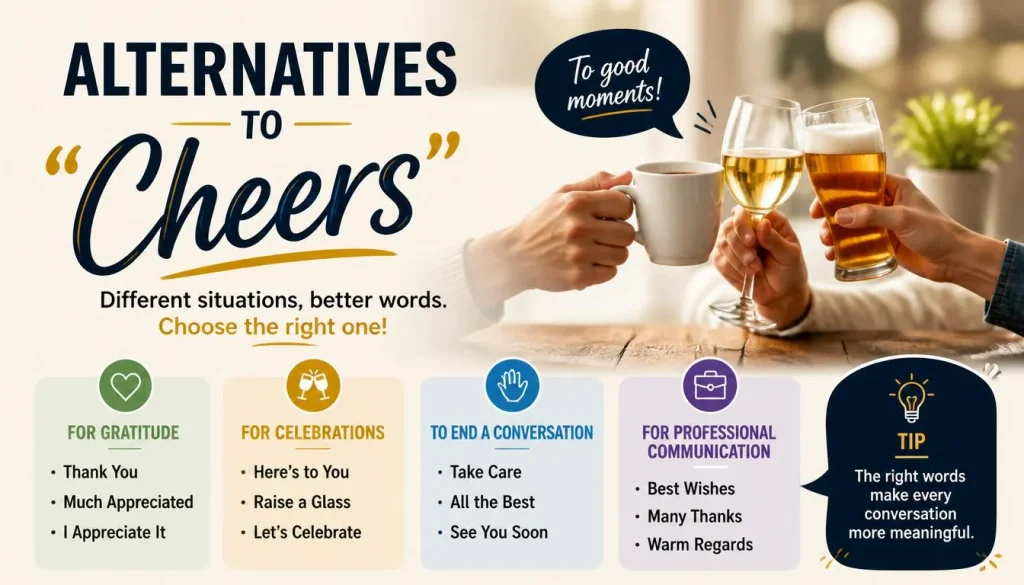
“Cheers” can mean thank you, goodbye, or a toast, so the best alternative depends on the situation. For gratitude, try “Thank You,” “Much Appreciated,” or “I Appreciate It.” For celebrations, “Here’s to You,” “Raise a Glass,” or “Let’s Celebrate” works well. If you’re ending a conversation, “Take Care,” “All the Best,” or “See You Soon” feels more natural. For professional communication, “Best Wishes,” “Many Thanks,” or “Warm Regards” can sound more polished.
What Does “Cheers” Mean?
“Cheers” is a flexible expression with several meanings depending on the situation. When people raise their glasses and say “Cheers,” they usually express a toast, celebration, goodwill, or shared happiness. In everyday British and Australian English, “cheers” can also mean “thank you,” especially in casual conversations. It may also be used informally as a way to say goodbye or end a message.
The meaning depends heavily on context and tone. For example, saying “Cheers!” before drinking expresses a toast, while saying “Cheers for helping me” means thank you. Because the word has several uses, choosing a more specific alternative can sometimes make your message clearer and more meaningful.
Is It Professional or Polite to Say “Cheers”?
“Cheers” is generally polite, but its professionalism depends on where and how you use it. In casual conversations, friendly emails, messages, and informal workplaces, “Cheers” can sound natural and approachable. It is especially common in British English and is often used instead of “Thanks” or “Goodbye.”
However, you may want a more formal expression in a business email, professional letter, formal announcement, or serious conversation. Alternatives such as “Thank you,” “Best wishes,” “Much appreciated,” or “Kind regards” can sound more appropriate. If you’re using “Cheers” as a toast, it is perfectly polite in social settings.
Advantages and Disadvantages
Advantages
- Short and versatile: “Cheers” can express thanks, celebration, goodwill, or farewell in just one word.
- Friendly and warm: It creates a casual, approachable tone that works well with friends, coworkers, and familiar contacts.
- Easy to remember: Because it is simple, “Cheers” fits naturally into conversations, texts, cards, and informal emails.
Disadvantages
- Can be ambiguous: The word may mean thank you, goodbye, or a toast, so its meaning depends on context.
- Not ideal for every professional setting: Some formal audiences may prefer clearer and more traditional wording.
- May sound too casual: In serious or emotional situations, “Cheers” can sometimes feel too lighthearted.
Synonyms for “Cheers”
- To Good Times
- Here’s to You
- Bottoms Up
- Raise a Glass
- To Your Health
- Celebrate
- Best Wishes
- Thank You
- Much Appreciated
- Thanks a Lot
- I Appreciate It
- Many Thanks
- All the Best
- Take Care
- Have a Great One
- Goodbye
- See You Soon
- Until Next Time
- Here’s to Success
- To New Beginnings
- Let’s Celebrate
- A Toast to You
- Salud
- To Happiness
- Good Health
- Congratulations
- Well Done
- Best of Luck
- Warm Regards
- Here’s to Many More
1. To Good Times
Meaning: “To Good Times” expresses a wish for happy moments, enjoyable experiences, and positive memories.
Definition: It is a celebratory phrase used when people want to acknowledge the good times they have shared or hope to enjoy.
Detailed Explanation: This phrase works beautifully when you’re celebrating friendship, a milestone, a gathering, or simply enjoying the moment. It carries the same celebratory spirit as “Cheers” without sounding repetitive.
Scenario Example: “We’ve made so many great memories together. To good times!”
Best Use: Use it at parties, dinners, reunions, and celebrations.
Tone: Warm, celebratory, friendly, and nostalgic.
2. Here’s to You
Meaning: “Here’s to You” means this celebration, good wish, or toast is dedicated to you.
Definition: It is a personal expression used to honor or celebrate another person.
Detailed Explanation: This alternative feels more personal than simply saying “Cheers.” It directs the positive attention toward someone who deserves recognition.
Scenario Example: “You worked incredibly hard to reach this goal. Here’s to you!”
Best Use: Use it for birthdays, achievements, promotions, and personal milestones.
Tone: Personal, affectionate, appreciative, and celebratory.
3. Bottoms Up
Meaning: “Bottoms Up” is a playful encouragement to finish your drink.
Definition: It is an informal drinking expression traditionally used before people quickly finish their beverages.
Detailed Explanation: This phrase has a much more specific meaning than “Cheers.” It is best reserved for casual social gatherings where drinking is part of the occasion.
Scenario Example: “Everyone has their glasses ready. Bottoms up!”
Best Use: Use it at casual parties or lively gatherings.
Tone: Playful, energetic, humorous, and informal.
4. Raise a Glass
Meaning: “Raise a Glass” means to celebrate, honor, or remember someone or something with a drink.
Definition: It refers to lifting a glass as part of a toast or celebration.
Detailed Explanation: This expression can sound more thoughtful than “Cheers.” You can use it for happy occasions, achievements, anniversaries, or even respectful remembrance.
Scenario Example: “Let’s raise a glass to everyone who helped make this project successful.”
Best Use: Use it for toasts, formal celebrations, dinners, and ceremonies.
Tone: Respectful, celebratory, warm, and polished.
5. To Your Health
Meaning: “To Your Health” expresses a wish for someone’s health and well-being.
Definition: It is a traditional toast wishing another person good health.
Detailed Explanation: This phrase has a classic quality and works especially well when making a traditional toast. It focuses on well-being rather than simply drinking.
Scenario Example: “You’ve come a long way this year. To your health and happiness!”
Best Use: Use it for traditional toasts, dinners, and meaningful celebrations.
Tone: Warm, sincere, traditional, and respectful.
6. Celebrate
Meaning: “Celebrate” encourages people to enjoy and recognize a special achievement or occasion.
Definition: It is a direct expression inviting people to acknowledge something positive.
Detailed Explanation: Instead of focusing on the drink itself, this word focuses on the reason for the gathering. It works well when you want your message to feel energetic and positive.
Scenario Example: “We reached our goal. Now let’s celebrate!”
Best Use: Use it for achievements, milestones, parties, and victories.
Tone: Energetic, positive, joyful, and encouraging.
7. Best Wishes
Meaning: “Best Wishes” expresses good intentions and positive hopes for someone’s future.
Definition: It is a polite phrase used to wish someone happiness, success, or well-being.
Detailed Explanation: This is a useful alternative when “Cheers” means goodwill rather than a drinking toast. It works particularly well in cards, emails, farewell messages, and professional communication.
Scenario Example: “Congratulations on your new opportunity. Best wishes for everything ahead.”
Best Use: Use it in messages, cards, professional notes, and farewells.
Tone: Polite, warm, thoughtful, and professional.
8. Thank You
Meaning: “Thank You” directly expresses gratitude and appreciation.
Definition: It is a standard phrase used to acknowledge someone’s help, kindness, time, or generosity.
Detailed Explanation: When “Cheers” is being used to mean thanks, “Thank You” is usually clearer. It works in almost any setting and removes ambiguity.
Scenario Example: “You helped me finish this on time. Thank you so much.”
Best Use: Use it when expressing direct gratitude.
Tone: Polite, sincere, appreciative, and universal.
9. Much Appreciated
Meaning: “Much Appreciated” means your help or effort is genuinely valued.
Definition: It is a concise expression of gratitude that emphasizes appreciation.
Detailed Explanation: This phrase is especially useful when you want to thank someone without sounding overly emotional. It can work well in workplace communication and casual messages.
Scenario Example: “Thanks for sending the documents so quickly. Much appreciated.”
Best Use: Use it in emails, workplace messages, and helpful exchanges.
Tone: Professional, concise, grateful, and friendly.
10. Thanks a Lot
Meaning: “Thanks a Lot” expresses stronger or enthusiastic gratitude.
Definition: It is an informal phrase used to show appreciation for someone’s help or kindness.
Detailed Explanation: The phrase sounds natural between people who already have a comfortable relationship. Depending on tone, however, it can occasionally sound sarcastic, so context matters.
Scenario Example: “You saved me a lot of time today. Thanks a lot!”
Best Use: Use it in casual conversations, texts, and friendly messages.
Tone: Friendly, casual, enthusiastic, and warm.
11. I Appreciate It
Meaning: “I Appreciate It” means I recognize and value what you have done for me.
Definition: It is a sincere expression of personal gratitude.
Detailed Explanation: This alternative feels slightly more heartfelt than a simple “Thanks.” It shows that you noticed the person’s effort or kindness.
Scenario Example: “Thanks for staying late to help me. I appreciate it.”
Best Use: Use it when acknowledging help, support, effort, or kindness.
Tone: Sincere, personal, respectful, and grateful.
12. Many Thanks
Meaning: “Many Thanks” means thank you very much.
Definition: It is a polite expression used to communicate appreciation.
Detailed Explanation: “Many Thanks” can replace “Cheers” when you’re ending an informal or semi-professional message. It feels friendly while remaining reasonably polished.
Scenario Example: “Many thanks for getting back to me so quickly.”
Best Use: Use it in emails, notes, messages, and polite requests.
Tone: Polite, friendly, appreciative, and professional.
13. All the Best
Meaning: “All the Best” expresses good wishes for someone’s future.
Definition: It is a friendly closing phrase wishing someone positive outcomes.
Detailed Explanation: This is one of the most versatile alternatives when “Cheers” is being used as a farewell or email closing. It sounds warm without being overly formal.
Scenario Example: “It was great working with you. All the best for your new role.”
Best Use: Use it for farewells, emails, and friendly professional communication.
Tone: Warm, polite, friendly, and professional.
14. Take Care
Meaning: “Take Care” expresses a friendly wish for someone’s well-being.
Definition: It is commonly used when saying goodbye or ending a conversation.
Detailed Explanation: This phrase adds a small touch of concern and kindness. It is especially useful when you want your farewell to feel more personal and caring.
Scenario Example: “Thanks for everything. Take care, and I’ll talk to you soon.”
Best Use: Use it in casual conversations, texts, and farewells.
Tone: Caring, friendly, warm, and personal.
15. Have a Great One
Meaning: “Have a Great One” means have a great day, evening, weekend, or experience.
Definition: It is an informal farewell wishing someone a pleasant experience.
Detailed Explanation: The phrase is flexible because “one” can refer to whatever period or occasion is understood from the conversation.
Scenario Example: “Thanks for stopping by. Have a great one!”
Best Use: Use it in casual conversations and friendly messages.
Tone: Relaxed, upbeat, friendly, and casual.
See More: 30 Other Ways to Say ‘Happy Christmas Night’ (With Examples)
16. Goodbye
Meaning: “Goodbye” directly signals the end of a conversation or meeting.
Definition: It is a standard farewell expression.
Detailed Explanation: When someone uses “Cheers” as a casual goodbye, “Goodbye” is the clearer alternative. It works almost everywhere, although it can sound slightly more formal or direct.
Scenario Example: “Thanks for your time. Goodbye, and have a wonderful evening.”
Best Use: Use it for clear and direct farewells.
Tone: Neutral, polite, and straightforward.
17. See You Soon
Meaning: “See You Soon” expresses the expectation that you will meet again shortly.
Definition: It is a friendly farewell that suggests another meeting is likely.
Detailed Explanation: This alternative feels warmer than a simple goodbye because it emphasizes future connection.
Scenario Example: “It was great catching up. See you soon!”
Best Use: Use it with friends, coworkers, relatives, and familiar people.
Tone: Friendly, optimistic, warm, and casual.
18. Until Next Time
Meaning: “Until Next Time” means goodbye until another meeting or occasion.
Definition: It is a farewell that leaves the door open for future interaction.
Detailed Explanation: This phrase has a slightly polished and memorable quality. It works particularly well after a shared experience or gathering.
Scenario Example: “Thanks for a wonderful evening. Until next time!”
Best Use: Use it for farewells, events, gatherings, and social messages.
Tone: Warm, thoughtful, polished, and friendly.
19. Here’s to Success
Meaning: “Here’s to Success” is a toast wishing someone achievement and positive results.
Definition: It is a celebratory expression focused on future success.
Detailed Explanation: This phrase is ideal when someone has started a new job, launched a business, completed a project, or reached an important milestone.
Scenario Example: “You’ve launched your new company. Here’s to success!”
Best Use: Use it for career achievements, business milestones, and new ventures.
Tone: Motivational, celebratory, optimistic, and confident.
20. To New Beginnings
Meaning: “To New Beginnings” celebrates a fresh chapter or new opportunity.
Definition: It is a toast or expression of goodwill toward a new stage in life.
Detailed Explanation: This phrase works beautifully when someone is starting something different. It recognizes both the past and the possibilities ahead.
Scenario Example: “You’re starting a new chapter tomorrow. To new beginnings!”
Best Use: Use it for new jobs, moves, graduations, relationships, and life changes.
Tone: Hopeful, meaningful, warm, and inspirational.
21. Let’s Celebrate
Meaning: “Let’s Celebrate” invites everyone to share happiness about a special event or achievement.
Definition: It is a direct invitation to enjoy and acknowledge something positive.
Detailed Explanation: This phrase shifts attention from the traditional toast toward shared excitement. It works well when you want everyone involved.
Scenario Example: “The project is finally complete. Let’s celebrate!”
Best Use: Use it for parties, achievements, milestones, and victories.
Tone: Excited, energetic, joyful, and inclusive.
22. A Toast to You
Meaning: “A Toast to You” means this celebration or drink is dedicated to you.
Definition: It is a personalized expression used to honor someone.
Detailed Explanation: This alternative makes the person being celebrated the center of attention. It can feel especially meaningful during birthdays, retirements, promotions, and achievements.
Scenario Example: “For all your hard work this year, a toast to you!”
Best Use: Use it for personal celebrations and recognition.
Tone: Heartfelt, celebratory, respectful, and personal.
23. Salud
Meaning: “Salud” literally means “health” in Spanish and is commonly used as a drinking toast.
Definition: It is a traditional toast expressing a wish for good health.
Detailed Explanation: “Salud” is widely recognized in social settings and carries a simple message of well-being and goodwill.
Scenario Example: Everyone raised their glasses and said, “Salud!”
Best Use: Use it for casual toasts and multicultural celebrations.
Tone: Festive, friendly, traditional, and social.
24. To Happiness
Meaning: “To Happiness” expresses a wish for joy, contentment, and positive experiences.
Definition: It is a toast dedicated to happiness and emotional well-being.
Detailed Explanation: This phrase feels especially fitting when celebrating relationships, weddings, new chapters, or personal accomplishments.
Scenario Example: “May this new chapter bring you everything you’ve hoped for. To happiness!”
Best Use: Use it for weddings, relationships, milestones, and meaningful celebrations.
Tone: Heartfelt, hopeful, romantic, and warm.
25. Good Health
Meaning: “Good Health” expresses a wish for physical well-being and a healthy future.
Definition: It is a traditional goodwill expression centered on health.
Detailed Explanation: As an alternative to “Cheers,” it works best when you’re making a traditional toast or wishing someone well.
Scenario Example: “May the coming year bring you peace and good health.”
Best Use: Use it for toasts, birthdays, celebrations, and well-wishes.
Tone: Sincere, traditional, respectful, and caring.
26. Congratulations
Meaning: “Congratulations” recognizes someone’s achievement, success, or special milestone.
Definition: It is an expression of praise and goodwill offered when someone accomplishes something important.
Detailed Explanation: When the reason for saying “Cheers” is someone’s success, “Congratulations” can communicate the purpose more directly.
Scenario Example: “You graduated with honors. Congratulations!”
Best Use: Use it for graduations, promotions, weddings, awards, and achievements.
Tone: Positive, enthusiastic, supportive, and celebratory.
27. Well Done
Meaning: “Well Done” praises someone for doing something successfully or skillfully.
Definition: It is a concise expression of approval and recognition.
Detailed Explanation: This alternative works particularly well when “Cheers” is intended to celebrate someone’s effort or accomplishment rather than simply make a toast.
Scenario Example: “You handled that presentation brilliantly. Well done!”
Best Use: Use it for achievements, completed tasks, performances, and accomplishments.
Tone: Encouraging, positive, supportive, and appreciative.
28. Best of Luck
Meaning: “Best of Luck” expresses a sincere wish for success in a future challenge or opportunity.
Definition: It is a goodwill expression used before someone begins something important.
Detailed Explanation: This phrase is ideal when you’re sending someone forward with encouragement. It focuses on what comes next rather than what has already happened.
Scenario Example: “Your interview is tomorrow. Best of luck! I know you’ll do great.”
Best Use: Use it before interviews, exams, competitions, journeys, and new opportunities.
Tone: Encouraging, friendly, supportive, and optimistic.
29. Warm Regards
Meaning: “Warm Regards” expresses polite goodwill and friendliness.
Definition: It is a courteous closing commonly used in written communication.
Detailed Explanation: This is one of the better alternatives when “Cheers” appears at the end of an email. It maintains warmth while sounding more polished and professional.
Scenario Example: “Thank you for taking the time to discuss this with me. Warm regards,”
Best Use: Use it in professional emails, letters, and business communication.
Tone: Professional, warm, courteous, and respectful.
30. Here’s to Many More
Meaning: “Here’s to Many More” expresses a wish for many more happy moments, successes, or years together.
Definition: It is a celebratory toast looking forward to future positive experiences.
Detailed Explanation: This phrase is especially meaningful when you’ve already shared something worth celebrating. It recognizes the present moment while looking forward to more memories ahead.
Scenario Example: “Ten years of friendship and countless memories. Here’s to many more!”
Best Use: Use it for anniversaries, friendships, birthdays, milestones, and long-term achievements.
Tone: Heartfelt, nostalgic, hopeful, and celebratory.
Frequently Asked Questions
1. What are some other ways to say “Cheers”?
Some useful alternatives to “Cheers” include “Here’s to You,” “Raise a Glass,” “To Good Times,” “Thank You,” “Much Appreciated,” “Best Wishes,” and “Let’s Celebrate.” The best choice depends on whether you are expressing thanks, celebrating, making a toast, or saying goodbye.
2. Is “Cheers” a polite word?
Yes, “Cheers” is generally polite and friendly. It works especially well in casual conversations, social situations, and informal messages. However, a more formal expression may be better for certain professional settings.
3. Can I use “Cheers” in a professional email?
You can use “Cheers” in an informal or friendly workplace email, especially when you already know the recipient. For a more formal message, alternatives such as “Many Thanks,” “Best Wishes,” or “Warm Regards” may sound more appropriate.
4. What does “Cheers” mean when used as a toast?
When used as a toast, “Cheers” expresses celebration, goodwill, and shared happiness. People commonly say it while raising a glass before drinking together.
5. What can I say instead of “Cheers” when thanking someone?
If you mean thank you, you can say “I Appreciate It,” “Much Appreciated,” “Many Thanks,” or simply “Thank You.” These choices make your meaning clearer because they directly express gratitude.
6. What is a funny way to say “Cheers”?
For a playful situation, you can use humorous or energetic expressions such as “Bottoms Up” or create a lighthearted toast that matches the group and occasion. Keep the humor appropriate for the people you’re speaking with.
7. What is a good alternative to “Cheers” in a formal setting?
“Best Wishes,” “Warm Regards,” “Much Appreciated,” and “Many Thanks” are useful options. They sound polished while still showing goodwill, appreciation, or warmth.
8. What can I say instead of “Cheers” when saying goodbye?
Try “Take Care,” “All the Best,” “See You Soon,” “Until Next Time,” or “Goodbye.” These alternatives make it clear that you are ending the conversation rather than making a toast.
9. Is “Cheers” used only for drinking?
No. “Cheers” has several meanings. It can refer to a toast, but in everyday English it can also mean thanks or serve as an informal farewell. The intended meaning usually comes from the context.
10. How do I choose the best alternative to “Cheers”?
Think about your relationship with the person, situation, tone, and purpose. Use a celebratory phrase for a toast, a grateful phrase when thanking someone, and a polite farewell when ending a conversation. Choosing a specific expression often makes your message feel more natural and personal.
Conclusion
Finding the right words can make an ordinary exchange feel more thoughtful. While “Cheers” remains a simple and versatile expression, you do not have to use the same phrase every time. Choosing an alternative based on the situation can make your words clearer, warmer, or more memorable.
Whether you are celebrating with friends, thanking a coworker, ending an email, or raising a glass at a special event, there is an expression that can fit the moment. From “Here’s to You” and “Raise a Glass” to “Much Appreciated” and “Take Care,” these alternatives give you more ways to communicate naturally. The goal is not simply to replace “Cheers,” but to choose words that match what you genuinely want to say.