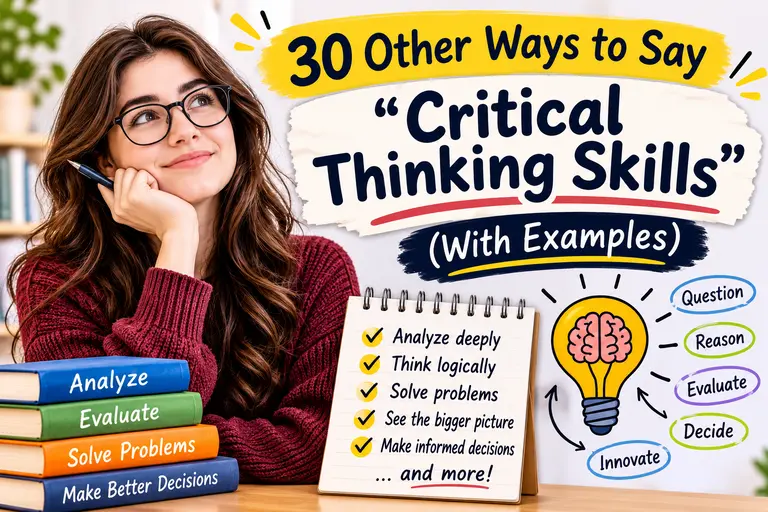

Critical thinking skills help us understand information, solve problems, and make better decisions. Whether you are writing a resume, preparing for an interview, or describing someone’s abilities, finding the right words can make your message clearer and more meaningful. Sometimes, saying critical thinking skills feels too general, especially when you want to highlight a person’s ability to think carefully and logically.
There are many other ways to describe this valuable skill, depending on the situation. Phrases like analytical thinking, problem-solving abilities, logical reasoning, and sound judgment can help you express the same idea in a more specific and natural way. Each phrase highlights a slightly different strength, making it easier to explain what someone does well.
In this article, we’ll explore 30 other ways to say “critical thinking skills”, along with simple examples to show how to use them. Whether you want to improve your professional writing, describe your strengths, or give someone meaningful recognition, these alternatives will help you communicate with confidence and clarity.
What Does “Critical Thinking Skills” Mean?
Critical thinking skills refer to the ability to examine information carefully, evaluate different perspectives, identify problems, and make logical decisions based on evidence and reasoning. These skills help people understand complicated situations instead of accepting information without questioning it.
Someone with strong critical thinking skills can analyze facts, recognize patterns, solve problems, evaluate arguments, and make informed decisions. These abilities are valuable in everyday conversations, education, workplaces, and personal relationships.
For example, an employee who carefully examines a problem before recommending a solution demonstrates critical thinking skills. Similarly, a student who compares different sources before forming an opinion shows thoughtful reasoning and independent judgment.
Is It Professional and Polite to Say “Critical Thinking Skills”?
Yes! “Critical thinking skills” is a professional, polite, and widely accepted expression. It is commonly used in resumes, job interviews, performance reviews, academic discussions, and workplace communication.
The phrase communicates that someone can approach situations logically, examine information objectively, and make sensible decisions. It is particularly useful when describing employees, students, managers, and colleagues.
However, depending on the situation, using alternatives such as analytical abilities, problem-solving skills, sound judgment, or logical reasoning can make your writing more specific and engaging.
For example:
- Professional: She demonstrates excellent analytical abilities when handling complex projects.
- Conversational: He has a great way of looking at problems from different angles.
- Academic: The student shows strong logical reasoning and independent judgment.
Choosing the right expression helps you communicate your appreciation without sounding repetitive or overly formal.
Advantages and Disadvantages of Saying “Critical Thinking Skills”
Understanding the benefits and limitations of this expression can help you decide when to use it.
Advantages
- Professional Communication: It is widely recognized in workplaces, academic environments, and professional documents.
- Clear Meaning: It communicates someone’s ability to analyze information, evaluate situations, and make informed decisions.
- Versatility: It works well in resumes, interviews, performance reviews, educational settings, and everyday professional conversations.
Disadvantages
- Can Sound Generic: The phrase is commonly used, so it may not fully highlight someone’s unique strengths.
- Lacks Specificity: It does not always explain whether someone excels at problem-solving, logical reasoning, or evaluating information.
- May Sound Formal: In casual conversations, simpler alternatives can feel warmer and more natural.
30 Alternatives to “Critical Thinking Skills” (With Examples)
Here is a complete list of useful alternatives you can use to express the same idea in different situations.
- Analytical Skills
- Problem-Solving Abilities
- Logical Reasoning
- Sound Judgment
- Independent Thinking
- Strategic Thinking
- Decision-Making Skills
- Evaluative Thinking
- Reasoning Abilities
- Intellectual Curiosity
- Analytical Thinking
- Cognitive Skills
- Thoughtful Analysis
- Rational Thinking
- Objective Thinking
- Creative Problem-Solving
- Evidence-Based Reasoning
- Reflective Thinking
- Mental Agility
- Practical Judgment
- Deductive Reasoning
- Investigative Skills
- Conceptual Thinking
- Lateral Thinking
- Informed Decision-Making
- Complex Problem-Solving
- Sound Reasoning
- Strategic Problem-Solving
- Independent Judgment
- Intellectual Problem-Solving
1. Analytical Skills
Meaning:
Analytical skills refer to the ability to examine information, break complicated situations into smaller parts, and understand how different elements connect.
Definition:
The ability to collect, interpret, and evaluate information to reach logical conclusions.
Detailed Explanation:
This expression is an excellent alternative to critical thinking skills when describing someone who can understand complex information and identify important details. It highlights a person’s ability to look beyond the surface, recognize patterns, and make sense of challenging situations.
People with strong analytical skills often approach problems carefully rather than making quick assumptions. They consider available information, compare possible explanations, and identify practical solutions.
Scenario Examples:
- She uses her analytical skills to identify problems and improve workplace processes.
- His excellent analytical skills helped the team understand the project’s challenges.
- I appreciate how you use your analytical skills before making important decisions.
Best Use:
Use this expression in resumes, professional recommendations, performance reviews, interviews, and workplace discussions.
Tone:
Professional, intelligent, confident, and respectful.
2. Problem-Solving Abilities
Meaning:
Problem-solving abilities describe someone’s capacity to recognize challenges and find effective ways to overcome them.
Definition:
The ability to identify problems, evaluate possible solutions, and take appropriate action.
Detailed Explanation:
This phrase focuses on the practical side of critical thinking. Rather than simply understanding a problem, it highlights someone’s ability to do something about it.
People with strong problem-solving abilities can remain calm when challenges arise, consider different possibilities, and choose solutions that produce positive results.
It is particularly useful when appreciating someone who consistently finds helpful answers during difficult situations.
Scenario Examples:
- Your problem-solving abilities have made a wonderful difference to our team.
- She demonstrated outstanding problem-solving abilities during the project.
- We value employees who bring strong problem-solving abilities to challenging situations.
Best Use:
Use it in job applications, workplace evaluations, interviews, and professional appreciation messages.
Tone:
Practical, encouraging, professional, and positive.
3. Logical Reasoning
Meaning:
Logical reasoning means using facts, evidence, and clear thinking to understand situations and reach sensible conclusions.
Definition:
The ability to connect ideas systematically and draw conclusions based on logical principles.
Detailed Explanation:
Logical reasoning is an important part of critical thinking because it helps people distinguish between facts, assumptions, and opinions.
Someone with strong logical reasoning abilities does not simply accept an idea because it sounds convincing. Instead, they examine the available information and determine whether the conclusion makes sense.
This phrase is especially helpful when discussing someone’s ability to think clearly and explain their decisions.
Scenario Examples:
- His logical reasoning helped us find the most effective solution.
- She uses logical reasoning to evaluate complicated situations.
- Your logical reasoning skills make your arguments clear and convincing.
Best Use:
Use this phrase in academic writing, professional discussions, interviews, and analytical assessments.
Tone:
Intellectual, objective, professional, and thoughtful.
4. Sound Judgment
Meaning:
Sound judgment refers to the ability to make sensible and well-considered decisions.
Definition:
The ability to evaluate circumstances and choose appropriate actions using experience, knowledge, and careful thinking.
Detailed Explanation:
This expression emphasizes wisdom and the ability to make good decisions. It is particularly suitable when describing someone who considers the consequences of their actions before making a choice.
A person with sound judgment understands that decisions should be based on reliable information rather than emotions or assumptions alone.
It also communicates trust and confidence in someone’s decision-making abilities.
Scenario Examples:
- She consistently demonstrates sound judgment when handling sensitive matters.
- Your sound judgment helped us avoid unnecessary complications.
- He is respected for his ability to make decisions with sound judgment.
Best Use:
Use it in leadership evaluations, recommendation letters, professional conversations, and management discussions.
Tone:
Respectful, mature, trustworthy, and professional.
5. Independent Thinking
Meaning:
Independent thinking means forming your own opinions and conclusions rather than simply following what others believe.
Definition:
The ability to evaluate information and develop personal ideas without relying entirely on outside opinions.
Detailed Explanation:
Independent thinking is closely connected to critical thinking because it encourages people to question information, explore different viewpoints, and make decisions based on their own understanding.
Someone who thinks independently is comfortable expressing original opinions while remaining open to constructive feedback.
This expression is especially meaningful when describing students, employees, and individuals who demonstrate confidence in their ideas.
Scenario Examples:
- We appreciate her independent thinking and willingness to explore new ideas.
- His independent thinking helped the team discover a better approach.
- A good education encourages independent thinking and curiosity.
Best Use:
Use it in academic recommendations, professional evaluations, educational discussions, and personal encouragement.
Tone:
Empowering, thoughtful, confident, and positive.
6. Strategic Thinking
Meaning:
Strategic thinking refers to the ability to consider long-term goals, evaluate possibilities, and develop effective plans.
Definition:
The ability to analyze situations and make decisions that support future objectives.
Detailed Explanation:
Strategic thinking goes beyond solving immediate problems. It involves understanding the bigger picture and considering how present decisions may influence future outcomes.
People with strong strategic thinking abilities can recognize opportunities, anticipate potential challenges, and develop plans that move a team or organization forward.
It is an excellent alternative when describing someone who thinks ahead and approaches challenges with a clear purpose.
Scenario Examples:
- Her strategic thinking helped the company achieve its long-term goals.
- We admire your strategic thinking and ability to plan ahead.
- His strategic thinking made a significant difference during the project.
Best Use:
Use it in leadership roles, business communication, management discussions, and professional resumes.
Tone:
Confident, forward-thinking, professional, and ambitious.
7. Decision-Making Skills
Meaning:
Decision-making skills refer to the ability to evaluate different choices and select the most appropriate option.
Definition:
The ability to assess available information, consider possible outcomes, and make informed decisions.
Detailed Explanation:
Critical thinking and decision-making often work together. Before making a good decision, people need to understand the situation, examine relevant information, and consider the possible consequences.
This phrase is useful when highlighting someone’s ability to make thoughtful choices, especially under pressure.
It also shows that someone can take responsibility and move forward with confidence.
Scenario Examples:
- Her excellent decision-making skills helped the department stay organized.
- I admire your decision-making skills during challenging situations.
- Strong decision-making skills are essential for effective leadership.
Best Use:
Use it in resumes, interviews, leadership assessments, and employee performance reviews.
Tone:
Professional, confident, responsible, and practical.
8. Evaluative Thinking
Meaning:
Evaluative thinking means carefully examining information, ideas, or situations to determine their value and effectiveness.
Definition:
The ability to assess information and make judgments based on relevant criteria and evidence.
Detailed Explanation:
This alternative emphasizes the ability to compare different options and determine which ones are most useful or reliable.
Someone who demonstrates evaluative thinking does not automatically accept the first answer they encounter. They consider strengths, weaknesses, advantages, and possible limitations before reaching a conclusion.
It is especially useful when describing someone who carefully reviews information and makes balanced assessments.
Scenario Examples:
- Her evaluative thinking helped us select the most effective strategy.
- The student demonstrated excellent evaluative thinking during the discussion.
- We appreciate your ability to approach feedback with evaluative thinking.
Best Use:
Use it in academic writing, research discussions, professional assessments, and project evaluations.
Tone:
Analytical, objective, thoughtful, and academic.
9. Reasoning Abilities
Meaning:
Reasoning abilities describe someone’s capacity to understand information, connect ideas, and reach logical conclusions.
Definition:
The mental ability to use information and evidence to develop sensible explanations or conclusions.
Detailed Explanation:
This is a broad alternative that highlights how someone processes information and makes sense of complicated situations.
Strong reasoning abilities allow people to examine different perspectives, recognize relationships between ideas, and explain why a particular conclusion is reasonable.
It works well when you want to describe someone’s overall thinking ability without focusing on one specific skill.
Scenario Examples:
- Her impressive reasoning abilities helped resolve the disagreement.
- The interview highlighted his strong reasoning abilities.
- We value employees who demonstrate clear reasoning abilities.
Best Use:
Use it in educational settings, professional assessments, interviews, and general descriptions of intellectual ability.
Tone:
Professional, intelligent, neutral, and respectful.
10. Intellectual Curiosity
Meaning:
Intellectual curiosity refers to a genuine desire to learn, explore ideas, and understand how things work.
Definition:
The natural interest in gaining knowledge, asking questions, and exploring unfamiliar subjects.
Detailed Explanation:
Although intellectual curiosity is not exactly the same as critical thinking, it supports the development of strong thinking skills.
Curious individuals enjoy asking questions, exploring different perspectives, and learning beyond what they already know.
This expression is particularly useful when appreciating someone who is eager to understand difficult subjects and continuously improve their knowledge.
Scenario Examples:
- Her intellectual curiosity inspires everyone around her to keep learning.
- I admire your intellectual curiosity and willingness to ask thoughtful questions.
- His intellectual curiosity helped him discover innovative solutions.
Best Use:
Use it in academic recommendations, educational discussions, professional introductions, and personal appreciation messages.
Tone:
Warm, encouraging, thoughtful, and inspiring.
11. Analytical Thinking
Meaning:
Analytical thinking means examining information carefully to understand its structure, relationships, and meaning.
Definition:
A systematic approach to breaking down information and understanding individual components to reach a conclusion.
Detailed Explanation:
Analytical thinking is one of the closest alternatives to critical thinking skills. It focuses on understanding complicated situations by examining smaller details and identifying connections.
Someone with strong analytical thinking can recognize patterns, investigate causes, and evaluate information before reaching a conclusion.
It is particularly useful when describing someone who approaches tasks with care and attention.
Scenario Examples:
- His analytical thinking helped the company identify the source of the problem.
- She approaches every challenge with analytical thinking and patience.
- Your analytical thinking brings valuable insights to our discussions.
Best Use:
Use it in professional resumes, academic writing, business communication, and problem-solving discussions.
Tone:
Intellectual, professional, focused, and confident.
12. Cognitive Skills
Meaning:
Cognitive skills refer to the mental abilities people use to process information, learn, remember, understand, and solve problems.
Definition:
The mental processes involved in acquiring knowledge, interpreting information, and making decisions.
Detailed Explanation:
This expression describes the broader mental abilities that support critical thinking. These include memory, attention, reasoning, information processing, and understanding.
Strong cognitive skills help individuals learn new concepts, recognize relationships, and respond thoughtfully to different situations.
It is a broader term than critical thinking, making it useful when discussing overall mental abilities rather than one particular skill.
Scenario Examples:
- The training program helps employees strengthen their cognitive skills.
- Her cognitive skills allow her to understand complex information quickly.
- Developing cognitive skills can support better learning and problem-solving.
Best Use:
Use it in educational discussions, training materials, professional development, and academic writing.
Tone:
Academic, informative, professional, and neutral.
13. Thoughtful Analysis
Meaning:
Thoughtful analysis means carefully considering information before forming an opinion or making a decision.
Definition:
The process of examining information with attention, patience, and careful consideration.
Detailed Explanation:
This expression adds a more considerate and human quality to the idea of critical thinking. It suggests that someone takes the time to understand a situation instead of rushing toward a conclusion.
Thoughtful analysis is particularly valuable when dealing with sensitive decisions, workplace disagreements, or complicated problems.
It also communicates respect for different perspectives.
Scenario Examples:
- Your thoughtful analysis helped us understand the issue more clearly.
- She provided thoughtful analysis before recommending any changes.
- I appreciate the thoughtful analysis you brought to our discussion.
Best Use:
Use it in professional feedback, reports, collaborative discussions, and appreciation messages.
Tone:
Warm, considerate, professional, and reflective.
14. Rational Thinking
Meaning:
Rational thinking refers to using reason and evidence instead of relying entirely on emotions or assumptions.
Definition:
The ability to make decisions and form conclusions through logical and sensible reasoning.
Detailed Explanation:
Rational thinking helps people approach situations objectively. It encourages them to consider facts, examine different possibilities, and avoid making unnecessary assumptions.
Someone who thinks rationally can remain focused when dealing with difficult circumstances and make decisions based on what makes sense.
This expression is useful when describing someone who maintains a balanced approach to challenging situations.
Scenario Examples:
- His rational thinking helped the team remain focused during the crisis.
- She uses rational thinking when evaluating complicated decisions.
- Your rational thinking brought clarity to an emotional discussion.
Best Use:
Use it in professional discussions, conflict resolution, academic writing, and decision-making conversations.
Tone:
Logical, calm, objective, and professional.
15. Objective Thinking
Meaning:
Objective thinking means considering information fairly without allowing personal feelings or biases to influence conclusions.
Definition:
The ability to evaluate situations based on facts and evidence rather than personal opinions.
Detailed Explanation:
Objective thinking is important because it helps people consider different viewpoints without immediately favoring one side.
Someone who thinks objectively takes time to examine available evidence and distinguish between personal beliefs and factual information.
This expression is particularly appropriate when discussing fair decision-making and balanced evaluations.
Scenario Examples:
- Her objective thinking helped resolve the disagreement fairly.
- We appreciate your objective thinking when reviewing team performance.
- Objective thinking allows us to consider different perspectives respectfully.
Best Use:
Use it in workplace evaluations, research, professional discussions, and conflict resolution.
Tone:
Fair, balanced, respectful, and professional.
16. Creative Problem-Solving
Meaning:
Creative problem-solving refers to finding original and effective ways to overcome challenges.
Definition:
The ability to develop innovative solutions by approaching problems from different perspectives.
Detailed Explanation:
This expression combines logical thinking with creativity. It highlights someone’s ability to look beyond traditional solutions and explore new possibilities.
People who demonstrate creative problem-solving are often comfortable experimenting with ideas, considering unusual approaches, and discovering better ways to complete tasks.
It is particularly useful when appreciating innovation and flexibility.
Scenario Examples:
- Her creative problem-solving helped us overcome a difficult project challenge.
- Your creative problem-solving brings fresh ideas to the workplace.
- The team demonstrated impressive creative problem-solving during the assignment.
Best Use:
Use it in business communication, creative industries, teamwork discussions, and professional recommendations.
Tone:
Positive, innovative, encouraging, and professional.
17. Evidence-Based Reasoning
Meaning:
Evidence-based reasoning means forming conclusions by examining reliable facts, information, and supporting evidence.
Definition:
The process of using credible evidence and logical analysis to support decisions and conclusions.
Detailed Explanation:
This phrase emphasizes the importance of making decisions based on trustworthy information rather than assumptions or personal preferences.
Someone who uses evidence-based reasoning looks for supporting facts, checks the reliability of information, and considers whether the available evidence supports a particular conclusion.
It is especially valuable in research, business, education, and professional decision-making.
Scenario Examples:
- Her evidence-based reasoning helped us make a well-informed decision.
- The report demonstrates strong evidence-based reasoning.
- We encourage evidence-based reasoning when evaluating new strategies.
Best Use:
Use it in research papers, academic discussions, business reports, and professional evaluations.
Tone:
Scientific, objective, trustworthy, and analytical.
18. Reflective Thinking
Meaning:
Reflective thinking means looking back at experiences, decisions, and actions to understand what happened and what can be improved.
Definition:
The process of carefully examining past experiences to develop greater understanding and improve future decisions.
Detailed Explanation:
Reflective thinking is an important skill because it encourages people to learn from their experiences.
Instead of ignoring mistakes or repeating the same approach, reflective individuals consider what worked, what did not, and how they can improve.
This expression is particularly useful when describing someone who is thoughtful, self-aware, and committed to personal development.
Scenario Examples:
- Her reflective thinking helped her grow professionally.
- I appreciate your reflective thinking after every challenging project.
- Reflective thinking allows students to learn from their experiences.
Best Use:
Use it in education, professional development, mentoring, and personal growth discussions.
Tone:
Thoughtful, encouraging, mature, and supportive.
19. Mental Agility
Meaning:
Mental agility refers to the ability to think quickly, adapt to new information, and respond effectively to changing situations.
Definition:
The capacity to process information, adjust perspectives, and develop solutions efficiently.
Detailed Explanation:
Mental agility highlights flexibility and quick thinking. It describes someone who can handle unexpected challenges without becoming stuck in one way of thinking.
People with mental agility can consider different approaches, adapt to changing circumstances, and understand new information quickly.
This phrase is particularly useful in fast-moving workplaces and situations that require flexibility.
Scenario Examples:
- Her mental agility helped the team adapt to unexpected changes.
- We admire your mental agility and ability to handle new challenges.
- His mental agility makes him an effective problem-solver.
Best Use:
Use it in leadership discussions, job interviews, professional evaluations, and fast-paced work environments.
Tone:
Confident, energetic, positive, and professional.
20. Practical Judgment
Meaning:
Practical judgment means using common sense, experience, and careful consideration to make sensible decisions.
Definition:
The ability to choose realistic and effective actions based on the circumstances.
Detailed Explanation:
Practical judgment focuses on finding solutions that work in real-life situations.
Someone with practical judgment understands that the best solution is not always the most complicated one. They consider available resources, potential challenges, and realistic outcomes before deciding what to do.
It is an excellent alternative when describing someone who combines thoughtful reasoning with everyday experience.
Scenario Examples:
- Her practical judgment helped us complete the project efficiently.
- I appreciate your practical judgment when handling difficult situations.
- His practical judgment makes him a reliable team leader.
Best Use:
Use it in management discussions, workplace evaluations, leadership recommendations, and everyday professional conversations.
Tone:
Sensible, respectful, reliable, and professional.
21. Deductive Reasoning
Meaning:
Deductive reasoning refers to using general principles or established facts to reach a specific conclusion.
Definition:
A logical process in which a conclusion follows from general statements or premises.
Detailed Explanation:
Deductive reasoning is a specific type of logical thinking. It involves starting with established information and applying it to a particular situation.
For example, if all employees must complete a training program and someone is an employee, deductive reasoning suggests that the person must complete that training program.
This expression is useful when describing someone who can follow logical steps and draw conclusions from established information.
Scenario Examples:
- His deductive reasoning helped identify the error in the report.
- Students develop deductive reasoning through logical exercises.
- She used deductive reasoning to reach a clear conclusion.
Best Use:
Use it in academic writing, mathematics, research, logic discussions, and analytical assessments.
Tone:
Technical, academic, logical, and professional.
22. Investigative Skills
Meaning:
Investigative skills refer to the ability to gather information, ask relevant questions, and examine situations to discover answers.
Definition:
The ability to investigate issues systematically and identify important facts or explanations.
Detailed Explanation:
Investigative skills are valuable when a problem requires more than a quick answer. They involve researching information, identifying missing details, examining evidence, and understanding the reasons behind an issue.
Someone with strong investigative skills is naturally curious and willing to explore a situation until they develop a clearer understanding.
This expression is especially useful when discussing research, troubleshooting, and workplace investigations.
Scenario Examples:
- Her investigative skills helped uncover the source of the problem.
- We appreciate your investigative skills and attention to detail.
- His investigative skills made the research process more effective.
Best Use:
Use it in research, auditing, journalism, problem-solving, and professional assessments.
Tone:
Curious, analytical, professional, and detail-oriented.
23. Conceptual Thinking
Meaning:
Conceptual thinking refers to the ability to understand broad ideas, relationships, and abstract concepts.
Definition:
The ability to recognize patterns and connections between ideas to understand larger concepts.
Detailed Explanation:
Conceptual thinking helps people understand how individual details fit into a bigger picture.
Rather than focusing only on immediate tasks, someone with this ability can recognize underlying principles and understand how different ideas relate to one another.
It is particularly useful when discussing planning, innovation, research, and complex subjects.
Scenario Examples:
- Her conceptual thinking helped us develop a clearer project strategy.
- His conceptual thinking allows him to understand complex ideas.
- We value your ability to connect individual details with broader goals.
Best Use:
Use it in strategic planning, academic discussions, business development, and creative projects.
Tone:
Intellectual, thoughtful, professional, and forward-looking.
24. Lateral Thinking
Meaning:
Lateral thinking means approaching problems from unusual angles and exploring solutions beyond traditional methods.
Definition:
A creative approach to problem-solving that involves considering unconventional ideas and alternative perspectives.
Detailed Explanation:
Lateral thinking encourages people to move away from predictable solutions and explore different ways of understanding a challenge.
Someone who demonstrates lateral thinking may suggest an unexpected approach that others have not considered.
This expression is especially useful when describing creativity, innovation, and flexible problem-solving.
Scenario Examples:
- Her lateral thinking helped us find a solution nobody had considered.
- I admire your lateral thinking and willingness to challenge traditional approaches.
- The team used lateral thinking to improve the design.
Best Use:
Use it in creative industries, brainstorming sessions, business discussions, and innovation projects.
Tone:
Creative, imaginative, innovative, and positive.
25. Informed Decision-Making
Meaning:
Informed decision-making refers to making choices after gathering and understanding relevant information.
Definition:
The process of selecting an appropriate course of action based on reliable information and careful evaluation.
Detailed Explanation:
This expression highlights the importance of understanding a situation before making a decision.
People who practice informed decision-making consider relevant facts, compare available options, and evaluate potential outcomes.
It is particularly helpful when describing responsible decision-makers who avoid rushing into important choices.
Scenario Examples:
- Her informed decision-making helped the company choose the right strategy.
- We encourage informed decision-making at every level of the organization.
- Your informed decision-making made the project more successful.
Best Use:
Use it in business communication, leadership discussions, policy writing, and professional evaluations.
Tone:
Responsible, professional, confident, and trustworthy.
26. Complex Problem-Solving
Meaning:
Complex problem-solving refers to the ability to understand and address difficult situations involving multiple challenges or connected factors.
Definition:
The ability to analyze complicated problems and develop effective solutions through systematic thinking.
Detailed Explanation:
Some problems cannot be solved with a simple answer. They require people to examine several factors, understand their relationships, and consider how different solutions may affect one another.
Complex problem-solving highlights someone’s ability to manage challenging situations with patience and careful reasoning.
It is particularly useful in technical, managerial, and professional environments.
Scenario Examples:
- Her complex problem-solving skills helped the organization overcome major challenges.
- We appreciate your ability to handle complex problem-solving tasks.
- His complex problem-solving abilities made him an important member of the team.
Best Use:
Use it in technical resumes, engineering, management, research, and leadership discussions.
Tone:
Professional, capable, analytical, and confident.
27. Sound Reasoning
Meaning:
Sound reasoning refers to using clear logic and reliable information to develop sensible conclusions.
Definition:
The ability to form conclusions through consistent, reasonable, and well-supported thinking.
Detailed Explanation:
Sound reasoning emphasizes the quality of someone’s thought process. It suggests that their conclusions are not based on random assumptions but on logical connections and relevant information.
Someone who demonstrates sound reasoning can explain their ideas clearly and support their decisions with sensible arguments.
It is a particularly useful phrase when discussing someone’s ability to think carefully and communicate convincingly.
Scenario Examples:
- Her sound reasoning helped us understand the situation more clearly.
- His sound reasoning made the presentation more convincing.
- I appreciate your sound reasoning and thoughtful approach.
Best Use:
Use it in professional writing, academic discussions, presentations, and decision-making conversations.
Tone:
Logical, respectful, thoughtful, and professional.
28. Strategic Problem-Solving
Meaning:
Strategic problem-solving refers to identifying challenges and developing solutions that support long-term objectives.
Definition:
A planned approach to resolving problems while considering broader goals and future outcomes.
Detailed Explanation:
This expression combines problem-solving with strategic thinking. It highlights someone’s ability to solve immediate issues without losing sight of the bigger picture.
People who demonstrate strategic problem-solving consider the possible consequences of different solutions and choose approaches that create lasting benefits.
It is especially useful when describing managers, business leaders, and employees responsible for important projects.
Scenario Examples:
- Her strategic problem-solving helped the organization improve its operations.
- We admire your strategic problem-solving during difficult projects.
- His strategic problem-solving approach helped the team achieve its goals.
Best Use:
Use it in business communication, management resumes, leadership reviews, and project planning.
Tone:
Forward-thinking, professional, confident, and solution-oriented.
29. Independent Judgment
Meaning:
Independent judgment means making personal assessments and decisions using your own reasoning rather than blindly following others.
Definition:
The ability to evaluate information and form personal conclusions based on evidence and understanding.
Detailed Explanation:
Independent judgment is closely connected to independent thinking. It highlights someone’s confidence in evaluating situations and making responsible choices.
A person with independent judgment listens to different opinions but does not automatically accept them. Instead, they carefully consider the available information and decide what makes the most sense.
This expression is useful when appreciating someone who demonstrates maturity, confidence, and personal responsibility.
Scenario Examples:
- Her independent judgment helped the team make a fair decision.
- We appreciate your independent judgment and thoughtful contributions.
- His independent judgment makes him a dependable professional.
Best Use:
Use it in professional recommendations, leadership evaluations, academic discussions, and workplace communication.
Tone:
Respectful, mature, confident, and professional.
30. Intellectual Problem-Solving
Meaning:
Intellectual problem-solving refers to using knowledge, reasoning, and mental effort to understand and resolve challenging problems.
Definition:
The ability to apply intellectual abilities and logical thinking to develop solutions to difficult situations.
Detailed Explanation:
This expression emphasizes the mental effort involved in understanding complicated challenges and finding meaningful solutions.
It describes individuals who enjoy exploring difficult questions, examining different possibilities, and using their knowledge to reach reasonable conclusions.
It is a useful alternative when you want to highlight someone’s intellectual abilities alongside their practical approach to problem-solving.
Scenario Examples:
- Her intellectual problem-solving helped the research team overcome a difficult challenge.
- We appreciate your intellectual problem-solving and thoughtful contributions.
- His intellectual problem-solving abilities make him an excellent researcher.
Best Use:
Use it in academic writing, research discussions, professional recommendations, and intellectual assessments.
Tone:
Academic, thoughtful, intelligent, and professional.
Conclusion
Finding the right alternative to “critical thinking skills” can make your communication more specific, natural, and meaningful. Although the original phrase is professional and widely understood, using expressions such as analytical skills, logical reasoning, sound judgment, independent thinking, and problem-solving abilities can help you describe someone’s strengths more accurately.
The best alternative depends on what you want to emphasize. If you’re praising someone who makes sensible decisions, sound judgment may be appropriate. If you’re describing someone who finds creative solutions, creative problem-solving might communicate your message better.
Remember that thoughtful communication is not just about choosing impressive words. It is about expressing your ideas clearly, recognizing people’s strengths, and making your message feel genuine.
Frequently Asked Questions
1. What are critical thinking skills?
Critical thinking skills are the ability to analyze information, ask questions, solve problems, and make thoughtful decisions. They help people understand situations and choose the best possible solutions.
2. What is another way to say critical thinking skills?
Some common alternatives include analytical thinking, logical reasoning, problem-solving abilities, sound judgment, and evaluative thinking.
3. How do you describe someone with strong critical thinking skills?
You can describe someone as analytical, thoughtful, logical, observant, or a good problem-solver. These words show that the person carefully considers information before making decisions.
4. How can I describe critical thinking skills on a resume?
You can use phrases such as strong analytical abilities, effective problem-solving skills, strategic thinking, and ability to make informed decisions. Include a real example to show how you have used these skills at work.
5. Why are critical thinking skills important in the workplace?
Critical thinking skills help employees solve challenges, evaluate information, make better decisions, and find practical solutions. They also improve teamwork, communication, and productivity.