
30 Other Ways to Say ‘Etc.’ can help you find clearer, more natural, and more engaging ways to finish a list.
Etc. is short for et cetera, a Latin phrase that means “and other similar things” or “and so on.” You’ll often see it in writing, emails, presentations, academic papers, business communication, and everyday conversations.
It can save space when you don’t want to mention every example. However, using etc. too frequently may make your message sound repetitive, vague, or less polished.
In this guide, you’ll discover 30 effective alternatives to etc., along with their meanings, definitions, examples, tones, and best uses. Whether you’re writing a business email, preparing a presentation, working on an academic paper, or chatting with friends, these options can help you avoid repetition and express your ideas with greater clarity, precision, and personality.
The goal isn’t to stop using etc. altogether. Instead, it’s to help you choose the expression that best fits your message, audience, and situation.
Quick Answer
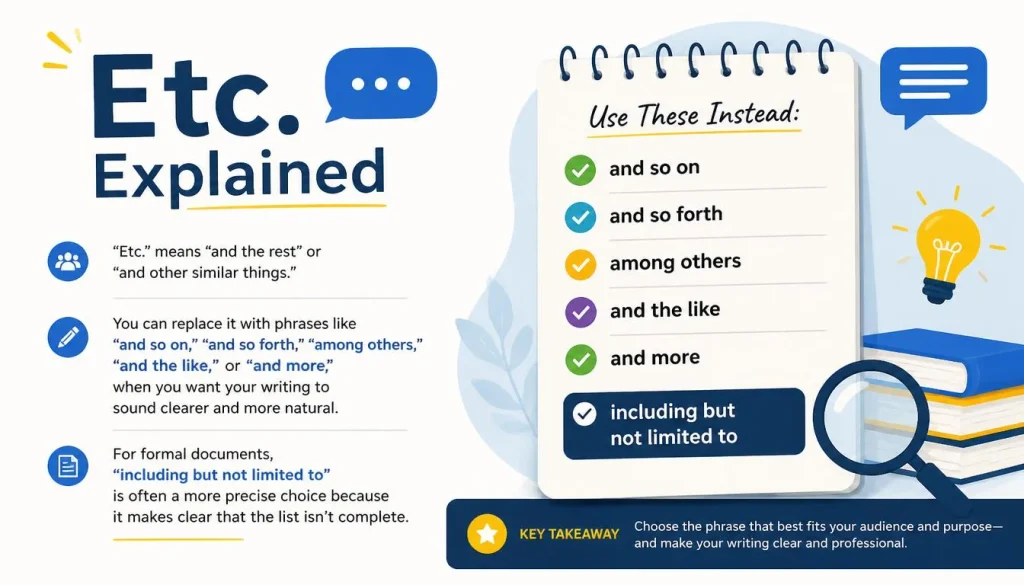
“Etc.” means “and the rest” or “and other similar things.” You can replace it with phrases like “and so on,” “and so forth,” “among others,” “and the like,” or “and more” when you want your writing to sound clearer and more natural. For formal documents, “including but not limited to” is often a more precise choice because it makes clear that the list isn’t complete.
What Does “Etc.” Mean?
“Etc.” is an abbreviation of the Latin phrase et cetera, which means “and the rest” or “and other similar things.” People use it at the end of a list when they don’t want to name every item. For example, you might say, “Bring notebooks, pens, folders, etc.” This tells the reader that other related items may also be included.
The word is convenient, but it doesn’t always provide enough information. In professional or important writing, replacing “etc.” with a clearer phrase can help readers understand exactly what you mean.
Is It Professional or Polite to Say “Etc.”?
Yes, “etc.” can be professional and polite when you use it correctly. It commonly appears in emails, reports, academic writing, instructions, and everyday communication. However, using it too often can make your writing seem vague, rushed, or incomplete.
If your reader needs to know what belongs in the list, a more descriptive alternative is often better. Phrases such as “and so on,” “and other similar items,” or “and other related examples” can sound more natural. In formal writing, it’s usually best to avoid using “etc.” when you could simply explain the remaining category.
Advantages and Disadvantages
Advantages
- It saves space: You don’t have to list every similar item.
- It keeps writing concise: A long list can become easier to read.
- It is widely understood: Most readers recognize what “etc.” means.
Disadvantages
- It can sound vague: Readers may not know what else you mean.
- It may weaken clarity: Important information can be left unstated.
- It can feel repetitive: Frequent use may make your writing sound mechanical.
Synonyms for “Etc.”
- And so on
- And so forth
- And the rest
- And others
- And other things
- And other items
- And similar things
- And similar items
- And other examples
- And related things
- And related items
- And more
- And more besides
- Among others
- Among other things
- And the like
- And the same kind
- And other such things
- And other similar examples
- And other related examples
- And other possibilities
- And other options
- And other alternatives
- And other cases
- And other instances
- And other forms
- And other varieties
- And other categories
- And other related matters
- Including but not limited to
1. And So On
Meaning: “And so on” means the list continues with similar things.
Definition: It is a common phrase used after several examples to indicate that other related examples exist.
Detailed Explanation:
“And so on” is one of the most natural replacements for “etc.” It works especially well in casual conversations and everyday writing. It tells the reader that you could continue listing examples but don’t need to.
Scenario Example:
“You’ll need to prepare your notes, assignments, presentations, and so on.”
Best Use: Use it for casual, conversational, and general writing.
Tone: Natural, friendly, and conversational.
2. And So Forth
Meaning: “And so forth” means and other similar things.
Definition: It indicates that a list continues in the same general pattern.
Detailed Explanation:
This phrase has almost the same meaning as “and so on.” However, “and so forth” can sound slightly more formal or polished. It works well when you’re explaining a process, category, or series of examples.
Scenario Example:
“The course covers grammar, vocabulary, pronunciation, and so forth.”
Best Use: Use it in professional, educational, and general writing.
Tone: Polished, neutral, and professional.
3. And the Rest
Meaning: “And the rest” refers to the remaining people or things in a group.
Definition: It indicates that the examples mentioned are only part of a larger group.
Detailed Explanation:
This alternative works when the reader already understands the broader category. Unlike “etc.”, it can emphasize that specific items have been left out because they are already understood.
Scenario Example:
“I packed the clothes, toiletries, shoes, and the rest.”
Best Use: Use it when the remaining items are already obvious.
Tone: Simple, casual, and direct.
4. And Others
Meaning: “And others” means other people or things of the same general type.
Definition: It refers to additional members or examples that have not been specifically named.
Detailed Explanation:
“And others” works particularly well when discussing people, organizations, authors, or examples. It can make a sentence shorter without using the Latin abbreviation.
Scenario Example:
“Many writers, teachers, researchers, and others have discussed this topic.”
Best Use: Use it when referring to additional people or groups.
Tone: Neutral and professional.
5. And Other Things
Meaning: “And other things” means additional things that are similar to those already mentioned.
Definition: It is a broad phrase that refers to unspecified items within the same context.
Detailed Explanation:
This is a straightforward replacement when you want your writing to sound less abbreviated. It works well in casual communication, although more precise alternatives may be better for formal documents.
Scenario Example:
“We talked about work, family, travel, and other things.”
Best Use: Use it for casual conversations and messages.
Tone: Friendly, relaxed, and informal.
6. And Other Items
Meaning: “And other items” refers to additional objects or entries in a list.
Definition: It identifies unspecified items belonging to the same category.
Detailed Explanation:
This phrase is useful when you’re discussing physical products, documents, supplies, or entries. It sounds clearer than “etc.” when the category matters.
Scenario Example:
“Please bring your laptop, charger, notebook, and other items you may need.”
Best Use: Use it for lists of physical or practical items.
Tone: Clear, neutral, and practical.
7. And Similar Things
Meaning: “And similar things” means other things resembling the examples mentioned.
Definition: It refers to additional things that share relevant characteristics with the listed examples.
Detailed Explanation:
This phrase gives the reader a useful clue about what “etc.” represents. It works well when similarity matters more than the exact items.
Scenario Example:
“She enjoys reading novels, watching documentaries, and similar things.”
Best Use: Use it when discussing related activities or interests.
Tone: Casual and approachable.
8. And Similar Items
Meaning: “And similar items” refers to other objects belonging to the same category.
Definition: It identifies additional items that resemble those already listed.
Detailed Explanation:
This option is especially helpful for shopping lists, inventory descriptions, instructions, and product information. It gives readers a clearer idea of what the omitted items should resemble.
Scenario Example:
“The box contains cables, adapters, batteries, and similar items.”
Best Use: Use it for products, equipment, supplies, or objects.
Tone: Clear, practical, and professional.
9. And Other Examples
Meaning: “And other examples” means additional examples that support the same idea.
Definition: It indicates that the examples mentioned are not the only relevant ones.
Detailed Explanation:
This phrase works beautifully in educational and explanatory writing. It reassures the reader that the list is illustrative rather than exhaustive.
Scenario Example:
“Consider examples such as teamwork, patience, communication, and other examples.”
Best Use: Use it in educational and explanatory contexts.
Tone: Clear, academic, and neutral.
10. And Related Things
Meaning: “And related things” refers to other things connected to the subject.
Definition: It indicates that additional related matters exist beyond those specifically mentioned.
Detailed Explanation:
This phrase is useful when the relationship between the examples matters more than their exact names. It can also make your writing sound more intentional.
Scenario Example:
“The workshop covers budgeting, saving, investing, and related things.”
Best Use: Use it for broad topics and connected subjects.
Tone: Neutral, informative, and conversational.
11. And Related Items
Meaning: “And related items” means other items connected to the ones listed.
Definition: It refers to additional objects or entries that belong to the same subject area.
Detailed Explanation:
This alternative is more specific than “etc.” because it tells the reader that the missing items are related to the listed ones.
Scenario Example:
“The store sells notebooks, folders, planners, and related items.”
Best Use: Use it for business, shopping, inventory, and product descriptions.
Tone: Professional and straightforward.
12. And More
Meaning: “And more” means there are additional examples or possibilities.
Definition: It is a short phrase indicating that something extends beyond what has already been mentioned.
Detailed Explanation:
“And more” is simple and flexible. It often sounds more inviting than “etc.”, especially in promotional or conversational writing.
Scenario Example:
“You’ll find recipes, cooking tips, meal plans, and more.”
Best Use: Use it in web content, marketing, casual writing, and advertisements.
Tone: Friendly, energetic, and inviting.
13. And More Besides
Meaning: “And more besides” means there are additional things beyond those already mentioned.
Definition: It emphasizes that the list contains only some of the available examples.
Detailed Explanation:
This phrase gives your writing a slightly expressive quality. It can work when you want to suggest abundance without listing everything.
Scenario Example:
“The museum has paintings, sculptures, photographs, and more besides.”
Best Use: Use it for descriptive and expressive writing.
Tone: Warm, polished, and slightly literary.
14. Among Others
Meaning: “Among others” means the listed examples are only some members of a larger group.
Definition: It indicates that other people or things also belong to the same category.
Detailed Explanation:
This is a strong alternative when you want to sound concise and professional. It is particularly common when naming people, organizations, theories, or examples.
Scenario Example:
“The event attracted writers, editors, designers, among others.”
Best Use: Use it in professional, academic, and formal writing.
Tone: Professional, concise, and polished.
15. Among Other Things
Meaning: “Among other things” means there are several other matters besides those mentioned.
Definition: It refers to additional subjects or activities that are not specifically listed.
Detailed Explanation:
This phrase is useful when describing several aspects of an experience. It allows you to keep the sentence concise without suggesting that the omitted details are unimportant.
Scenario Example:
“During the meeting, we discussed deadlines, staffing, among other things.”
Best Use: Use it for meetings, discussions, experiences, and broad subjects.
Tone: Natural, mature, and professional.
See More: 30 Other Ways to Say ‘What in the World’ (With Examples)
16. And the Like
Meaning: “And the like” means things similar to those already mentioned.
Definition: It refers to other people or things of a similar type.
Detailed Explanation:
“And the like” is a concise alternative that can sound more polished than “etc.” It works best when the category is already clear from the examples.
Scenario Example:
“The store sells journals, calendars, notebooks, and the like.”
Best Use: Use it in professional and descriptive writing.
Tone: Polished, formal, and concise.
17. And the Same Kind
Meaning: “And the same kind” means additional things belonging to the same general type.
Definition: It identifies other examples that share the characteristics of the items mentioned.
Detailed Explanation:
This phrase is easy to understand, although it is less common than “and the like” or “and similar items.” It works best when the category is obvious.
Scenario Example:
“We offer handmade cards, gift tags, decorations, and the same kind of products.”
Best Use: Use it when the type or category is already obvious.
Tone: Simple and conversational.
18. And Other Such Things
Meaning: “And other such things” means additional things of a similar nature.
Definition: It refers to other items or matters resembling those already mentioned.
Detailed Explanation:
This phrase can replace “etc.” when you want to emphasize similarity. However, it can sound somewhat old-fashioned in everyday American English.
Scenario Example:
“He spent the afternoon organizing papers, files, folders, and other such things.”
Best Use: Use it in descriptive or slightly formal writing.
Tone: Formal, traditional, and somewhat literary.
19. And Other Similar Examples
Meaning: “And other similar examples” means additional examples that resemble those already provided.
Definition: It identifies further examples within the same general category.
Detailed Explanation:
This phrase is useful when teaching or explaining something. It tells your reader exactly what the omitted examples have in common.
Scenario Example:
“Common communication skills include listening, empathy, patience, and other similar examples.”
Best Use: Use it for educational articles and explanations.
Tone: Clear, instructional, and professional.
20. And Other Related Examples
Meaning: “And other related examples” refers to more examples connected to the topic.
Definition: It identifies additional examples that share a meaningful connection with the examples listed.
Detailed Explanation:
This option works especially well in articles, reports, lessons, and research-based explanations. It provides more context than the vague abbreviation “etc.”
Scenario Example:
“The article discusses kindness, generosity, patience, and other related examples.”
Best Use: Use it in educational and informational writing.
Tone: Professional, clear, and thoughtful.
21. And Other Possibilities
Meaning: “And other possibilities” means additional options or outcomes could exist.
Definition: It refers to possibilities that have not been specifically named.
Detailed Explanation:
This is a better choice than “etc.” when you’re discussing potential outcomes rather than physical things. It leaves room for possibilities while keeping the sentence concise.
Scenario Example:
“We considered changing the schedule, moving the event, and other possibilities.”
Best Use: Use it for plans, decisions, outcomes, and future scenarios.
Tone: Open, thoughtful, and flexible.
22. And Other Options
Meaning: “And other options” means additional choices are available.
Definition: It indicates that the choices mentioned do not represent every available option.
Detailed Explanation:
This phrase is especially useful when helping someone make a decision. It sounds more specific and reader-friendly than simply saying “etc.”
Scenario Example:
“You can pay by card, bank transfer, cash, and other options.”
Best Use: Use it for choices, services, plans, and decisions.
Tone: Helpful, clear, and practical.
23. And Other Alternatives
Meaning: “And other alternatives” means additional choices or solutions.
Definition: It refers to different possibilities that could replace or supplement the examples given.
Detailed Explanation:
This phrase works well when discussing solutions to a problem. It can make your writing sound more deliberate because it tells the reader that other solutions exist.
Scenario Example:
“We explored negotiation, mediation, compromise, and other alternatives.”
Best Use: Use it for problem-solving and decision-making.
Tone: Professional and solution-focused.
24. And Other Cases
Meaning: “And other cases” means additional situations with similar characteristics.
Definition: It refers to other instances that fit the category being discussed.
Detailed Explanation:
This alternative works particularly well in legal, academic, medical, technical, and analytical writing. It can sound more precise than “etc.”
Scenario Example:
“This rule applies to late submissions, missed deadlines, and other cases.”
Best Use: Use it when discussing situations or circumstances.
Tone: Formal, analytical, and precise.
25. And Other Instances
Meaning: “And other instances” means additional occurrences or examples.
Definition: It refers to other occasions where the same situation happens.
Detailed Explanation:
This phrase is useful when you’re describing events that have occurred more than once. It has a formal quality that suits reports and analytical writing.
Scenario Example:
“The problem appeared during testing, installation, updates, and other instances.”
Best Use: Use it for reports, research, and technical writing.
Tone: Formal, precise, and analytical.
26. And Other Forms
Meaning: “And other forms” means additional versions or types.
Definition: It refers to other ways something can appear, exist, or be expressed.
Detailed Explanation:
This phrase is useful when your list involves formats, expressions, versions, or structures. It gives readers a better understanding of what the omitted examples represent.
Scenario Example:
“The course explores essays, reports, presentations, and other forms of communication.”
Best Use: Use it for formats, writing, communication, and structures.
Tone: Academic, neutral, and informative.
27. And Other Varieties
Meaning: “And other varieties” means additional types or versions.
Definition: It refers to other members within a broader group or category.
Detailed Explanation:
This phrase works particularly well for foods, products, plants, styles, and categories with multiple types. It can sound more descriptive than “etc.”
Scenario Example:
“The market sells apples, oranges, mangoes, and other varieties.”
Best Use: Use it when discussing different types or versions.
Tone: Descriptive, neutral, and polished.
28. And Other Categories
Meaning: “And other categories” means additional groups or classifications.
Definition: It refers to categories that have not been specifically named.
Detailed Explanation:
This phrase works best when organizing information into groups. It makes the structure of your writing clearer than a vague “etc.”
Scenario Example:
“The database includes books, movies, music, and other categories.”
Best Use: Use it for data, organization, research, and classification.
Tone: Technical, organized, and professional.
29. And Other Related Matters
Meaning: “And other related matters” means additional issues connected to the subject.
Definition: It refers to other relevant subjects or concerns that fall within the same general area.
Detailed Explanation:
This is a useful choice for professional communication. It works particularly well when discussing meetings, business affairs, policies, or administrative subjects.
Scenario Example:
“The committee discussed the budget, staffing, scheduling, and other related matters.”
Best Use: Use it for business, meetings, reports, and formal communication.
Tone: Professional, formal, and composed.
30. Including but Not Limited To
Meaning: “Including but not limited to” means the listed examples are only part of a larger group.
Definition: It explicitly states that additional items may exist beyond those named.
Detailed Explanation:
This phrase is much more precise than “etc.” It is frequently used when someone wants to make clear that a list is not exhaustive. You may see it in policies, contracts, legal documents, business terms, and formal notices.
Scenario Example:
“The position requires communication skills, including but not limited to writing, speaking, and presentation skills.”
Best Use: Use it for formal, legal, contractual, and professional writing.
Tone: Formal, precise, and authoritative.
FAQs
1. What does “etc.” mean?
Etc. is short for the Latin phrase et cetera, which means “and other similar things” or “and so on.” It is used when you don’t want to list every item or example.
2. What are some other ways to say “etc.”?
Common alternatives to etc. include and so on, and so forth, among others, and the like, and more, and other similar things. The best choice depends on your sentence and audience.
3. Is “etc.” professional?
Yes, etc. can be professional when used correctly. However, it may sound vague when you use it too often. In formal writing, a more specific phrase can sometimes communicate your meaning better.
4. Is “and so on” the same as “etc.”?
In many situations, and so on has the same basic meaning as etc. Both show that a list continues with similar examples. “And so on” often feels slightly more natural in everyday communication.
5. Can I use “etc.” in an email?
Yes. You can use etc. in emails, especially when the meaning is obvious from the list. For important business messages, however, consider giving specific details instead of leaving the reader to guess what else is included.
6. What is a more formal alternative to “etc.”?
Depending on the context, phrases such as among others, and other related items, or including but not limited to can work well. Choose the phrase that clearly explains what your list represents.
7. Should “etc.” be used in academic writing?
Etc. can appear in academic writing, but it should be used carefully. Academic writing usually benefits from precise information. If the missing examples are important to your argument, list them instead of relying on etc.
8. Is “etc.” casual or formal?
Etc. can work in both formal and casual writing. Its tone depends more on the surrounding sentence and context. Repeated use can make even professional writing feel rushed or imprecise.
9. What can I use instead of “etc.” in casual conversation?
In casual conversation, you can use and so on, and stuff like that, and things like that, or and more. These expressions often sound relaxed and natural when talking with friends.
10. When should I avoid using “etc.”?
Avoid etc. when the reader needs to know exactly what you mean. It can also be better to avoid it when a list is already unclear or when the missing items could change the meaning of your message.
Conclusion
Finding the right alternative to etc. can make your writing clearer and more interesting. While etc. is convenient and widely understood, repeating it too often can make your words feel vague or unfinished. A small change in wording can make a noticeable difference.
You can use and so on, and so forth, among others, and the like, or other suitable expressions depending on the situation. For formal writing, choose a phrase that adds precision. For casual conversations, choose something that sounds natural and friendly.
The key is to consider your audience, message, and purpose before choosing an alternative. You don’t need to avoid etc. completely. Instead, use it when it fits, and switch to a clearer expression when another option communicates your idea better.