

For 30 Other Ways to Say ‘Going to the Bathroom’, explore funny, playful, and natural phrases for everyday conversations without sounding too direct.
Let’s be honest, everyone needs to talk about the bathroom at some point. Saying “I need to go to the bathroom” can sometimes sound awkward, blunt, or boring, especially in casual conversations. That’s where funny, playful, and creative alternatives can help.
These lighthearted euphemisms and humorous expressions make everyday conversations more comfortable and relaxed. Whether you’re talking with friends or coworkers, these phrases give you more flexibility in how you communicate.
You’ll also find useful meanings, usage tips, and real-life examples to help you use each expression confidently while adding a personal and humorous touch.
Quick Answer
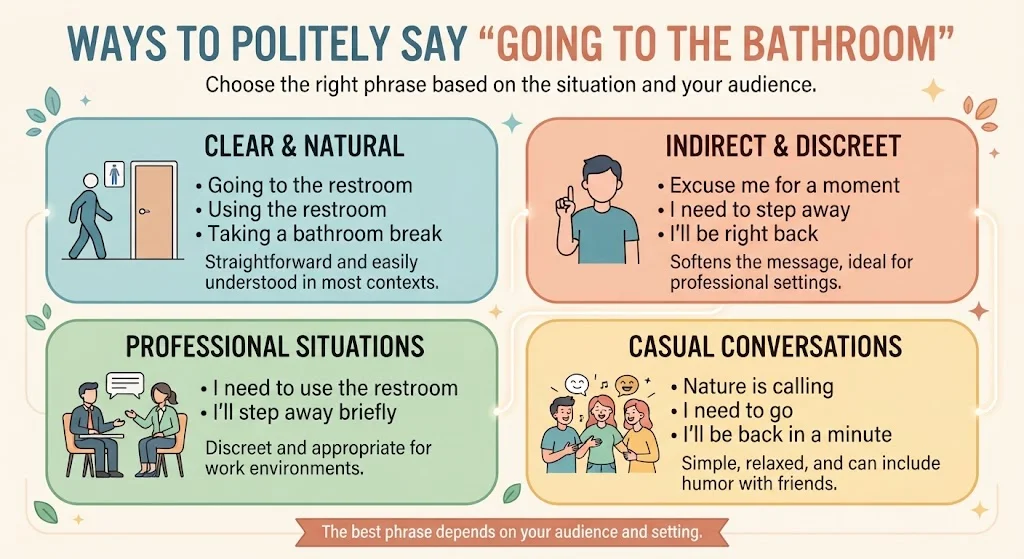
If you want a polite way to say “going to the bathroom,” you have plenty of choices depending on the situation. “Going to the restroom,” “using the restroom,” and “taking a bathroom break” are clear and natural, while “excuse me for a moment,” “I need to step away,” and “I’ll be right back” are more indirect. For casual conversations, phrases like “nature is calling” can add a little humor.
The best expression depends on your audience and setting. In a professional situation, choose something discreet such as “I need to use the restroom” or “I’ll step away briefly.” With friends or family, simpler phrases like “I need to go” or “I’ll be back in a minute” usually sound more natural.
What Does “Going to the Bathroom” Mean?
“Going to the bathroom” means leaving the current situation to use a toilet or restroom, usually for urination or a bowel movement. It is a common and generally polite expression in American English. The phrase is intentionally indirect, so you usually don’t need to explain exactly what you need to do. For example, someone might say, “Excuse me, I’m going to the bathroom,” when stepping away from a meeting, dinner, classroom, or conversation.
Is It Professional or Polite to Say “Going to the Bathroom”?
Yes, “going to the bathroom” is normally polite and acceptable, especially in everyday American English. In a workplace or formal setting, “I need to use the restroom” may sound slightly more professional. You can also simply say “Excuse me for a moment” when you don’t want to mention the bathroom at all. The best choice depends on your relationship with the listener and the level of formality.
Advantages and Disadvantages
Advantages
- Clear and easy to understand
- Natural and familiar
- Polite and discreet
Disadvantages
- Some alternatives can sound too formal
- Some expressions may be vague or confusing
- Humorous or old-fashioned phrases may not suit professional settings
Synonyms for “Going to the Bathroom”
- Going to the Restroom
- Using the Restroom
- Using the Bathroom
- Going to the Toilet
- Using the Toilet
- Going to the Washroom
- Using the Washroom
- Taking a Bathroom Break
- Taking a Restroom Break
- Excuse Me for a Moment
- I Need to Step Away
- I Need a Quick Break
- I’ll Be Right Back
- I Need to Use the Facilities
- I Need to Freshen Up
- I Need a Moment in the Restroom
- I’m Going to Powder My Nose
- Nature Is Calling
- Nature Calls
- I Need to Relieve Myself
- I Need to Go
- I’m Stepping Out for a Minute
- I’m Going to Take a Quick Break
- I’ll Step Away Briefly
- I Need to Visit the Restroom
- I’m Off to the Washroom
- I’m Going to Use the Facilities
- I Need a Quick Bathroom Visit
- I’m Going to Take Care of Something
- I’ll Be Back in a Minute
1. Going to the Restroom
Meaning: “Going to the restroom” means leaving temporarily to use a restroom or toilet.
Definition: It is a polite and common expression for saying you need to use the bathroom.
Detailed Explanation: This phrase is especially natural in American English and can sound slightly more polished than “going to the bathroom.” It works well when you want to be clear without giving personal details.
Scenario Example: “Excuse me, I’m going to the restroom. I’ll be back shortly.”
Best Use: Workplaces, restaurants, meetings, public places, and everyday conversations.
Tone: Polite, neutral, and professional.
2. Using the Restroom
Meaning: “Using the restroom” means using the toilet or bathroom facilities.
Definition: It is a discreet way to communicate that you need to attend to a personal bathroom need.
Detailed Explanation: This expression is common when someone wants to sound respectful and straightforward without being too informal.
Scenario Example: “I’ll be back after using the restroom.”
Best Use: Professional and everyday situations.
Tone: Polite, neutral, and discreet.
3. Using the Bathroom
Meaning: “Using the bathroom” means going into a bathroom to use the toilet.
Definition: It is one of the most natural alternatives to “going to the bathroom.”
Detailed Explanation: The phrase is easy to understand and doesn’t sound overly formal. It’s particularly common in casual American English.
Scenario Example: “Can you wait a minute? I’m just using the bathroom.”
Best Use: Home, family conversations, and casual situations.
Tone: Natural, casual, and direct.
4. Going to the Toilet
Meaning: “Going to the toilet” means going somewhere to use the toilet.
Definition: It is a direct expression commonly heard in British English and other varieties of English.
Detailed Explanation: Although understandable in American English, “going to the toilet” can sound less natural to some American speakers, who often prefer “bathroom” or “restroom.”
Scenario Example: “I’ll be back soon. I’m going to the toilet.”
Best Use: British English and straightforward conversations.
Tone: Direct, ordinary, and neutral.
5. Using the Toilet
Meaning: “Using the toilet” means using a toilet for a personal bathroom need.
Definition: It is a clear and direct alternative to “going to the bathroom.”
Detailed Explanation: This wording is more specific than “using the restroom.” It can be perfectly appropriate, although some people prefer more indirect language in formal situations.
Scenario Example: “The child needs help using the toilet.”
Best Use: Healthcare, childcare, family situations, and straightforward communication.
Tone: Direct, practical, and neutral.
6. Going to the Washroom
Meaning: “Going to the washroom” means going to a bathroom or toilet.
Definition: It is a polite expression frequently associated with Canadian English.
Detailed Explanation: The phrase is easy to understand and has a friendly, everyday quality. It is useful when speaking with people who commonly use “washroom.”
Scenario Example: “Excuse me, I’m going to the washroom.”
Best Use: Canada and casual or polite conversations.
Tone: Polite, natural, and neutral.
7. Using the Washroom
Meaning: “Using the washroom” means using the bathroom facilities.
Definition: It is a discreet phrase for communicating a bathroom need.
Detailed Explanation: This wording is particularly natural in places where “washroom” is the preferred term. It avoids unnecessary personal details.
Scenario Example: “She stepped away to use the washroom.”
Best Use: Polite everyday communication, especially in Canada.
Tone: Discreet, polite, and neutral.
8. Taking a Bathroom Break
Meaning: “Taking a bathroom break” means temporarily stopping an activity to use the bathroom.
Definition: It describes the short break itself rather than simply the act of going to the bathroom.
Detailed Explanation: This phrase works especially well when someone is in a long meeting, class, work shift, road trip, or event.
Scenario Example: “Let’s take a bathroom break before the movie starts.”
Best Use: Work, school, travel, events, and group activities.
Tone: Casual, practical, and friendly.
9. Taking a Restroom Break
Meaning: “Taking a restroom break” means taking a short break to use the restroom.
Definition: It is a slightly more polished variation of “taking a bathroom break.”
Detailed Explanation: The phrase can sound appropriate in professional environments while still feeling natural. It clearly communicates the purpose of the break without being overly personal.
Scenario Example: “We can take a restroom break before continuing the presentation.”
Best Use: Meetings, workplaces, conferences, and travel.
Tone: Polite, professional, and practical.
10. Excuse Me for a Moment
Meaning: “Excuse me for a moment” means you need to leave temporarily.
Definition: It is an indirect and highly polite way to excuse yourself without explaining why.
Detailed Explanation: This is useful when you prefer to keep your personal needs private. The listener generally understands that you need a brief interruption.
Scenario Example: “Excuse me for a moment. I’ll be right back.”
Best Use: Formal meetings, dinners, professional settings, and polite conversations.
Tone: Respectful, discreet, and formal.
11. I Need to Step Away
Meaning: “I need to step away” means you need to leave temporarily.
Definition: It is a vague but polite expression that doesn’t specify the reason.
Detailed Explanation: You can use it when you need privacy or don’t want to mention the bathroom directly. It works particularly well in professional communication.
Scenario Example: “I need to step away for a few minutes, but I’ll be back shortly.”
Best Use: Workplaces, meetings, phone calls, and professional settings.
Tone: Professional, discreet, and neutral.
12. I Need a Quick Break
Meaning: “I need a quick break” means you need a short pause from what you’re doing.
Definition: It is a casual expression that can include taking a bathroom break.
Detailed Explanation: Because it doesn’t specifically mention the bathroom, the phrase is useful when you want to keep the reason private.
Scenario Example: “I’ve been working for hours. I need a quick break.”
Best Use: Work, study, travel, and casual settings.
Tone: Casual, friendly, and relaxed.
13. I’ll Be Right Back
Meaning: “I’ll be right back” tells someone that you are leaving temporarily and expect to return soon.
Definition: It is a simple expression that doesn’t explain where you’re going.
Detailed Explanation: This is ideal when the reason for leaving is obvious or doesn’t need to be shared. It can also sound reassuring because it emphasizes that you’ll return quickly.
Scenario Example: “I’ll be right back. Please keep my seat.”
Best Use: Casual conversations, restaurants, offices, and social situations.
Tone: Friendly, reassuring, and casual.
14. I Need to Use the Facilities
Meaning: “Use the facilities” is an indirect way of saying you need to use the bathroom facilities.
Definition: It is a somewhat formal expression for a personal bathroom need.
Detailed Explanation: This phrase may sound more formal than necessary in everyday conversation, but it can be useful when you want to avoid saying “bathroom” or “toilet.”
Scenario Example: “Excuse me, I need to use the facilities.”
Best Use: Formal or polite situations.
Tone: Formal, discreet, and slightly traditional.
15. I Need to Freshen Up
Meaning: “I need to freshen up” means you want to clean up or make yourself feel more comfortable.
Definition: It can sometimes imply visiting the bathroom, although it does not specifically mean using the toilet.
Detailed Explanation: Someone may use this expression to wash their hands, fix their hair, adjust clothing, or generally freshen their appearance.
Scenario Example: “Give me a minute. I need to freshen up before dinner.”
Best Use: Social events, dates, dinners, travel, and casual situations.
Tone: Polite, gentle, and indirect.
See More: 30 Other Ways to Say ‘Awesome’ (With Examples)
16. I Need a Moment in the Restroom
Meaning: “I need a moment in the restroom” means you need a short amount of private time in the restroom.
Definition: It is a gentle and discreet expression.
Detailed Explanation: This wording emphasizes privacy and doesn’t provide unnecessary information about what you need to do.
Scenario Example: “Excuse me, I need a moment in the restroom.”
Best Use: Restaurants, social events, workplaces, and formal gatherings.
Tone: Polite, discreet, and calm.
17. I’m Going to Powder My Nose
Meaning: “Powder my nose” is a traditional euphemism for going to the bathroom.
Definition: It indirectly refers to stepping away to freshen up or use the restroom.
Detailed Explanation: This expression has an old-fashioned and somewhat playful quality. It isn’t usually the best choice for professional communication because it may sound dated.
Scenario Example: “Excuse me, I’m going to powder my nose.”
Best Use: Humorous, theatrical, playful, or old-fashioned conversations.
Tone: Playful, indirect, and old-fashioned.
18. Nature Is Calling
Meaning: “Nature is calling” means you feel the need to use the bathroom.
Definition: It is a humorous euphemism for needing to go to the toilet.
Detailed Explanation: The expression uses a playful metaphor rather than directly mentioning the bathroom. It is generally best among people who are comfortable with informal humor.
Scenario Example: “Sorry, nature is calling. I’ll be back in a minute.”
Best Use: Friends, family, casual conversations, and humor.
Tone: Humorous, casual, and playful.
19. Nature Calls
Meaning: “Nature calls” has the same general meaning as “nature is calling.”
Definition: It is a short, humorous expression indicating that someone needs to use the bathroom.
Detailed Explanation: The phrase is widely understood as a euphemism. However, its playful tone makes it less suitable for serious professional situations.
Scenario Example: “I have to go—nature calls!”
Best Use: Casual conversations and humorous situations.
Tone: Playful, informal, and lighthearted.
20. I Need to Relieve Myself
Meaning: “I need to relieve myself” means you need to urinate or have a bowel movement.
Definition: It is a direct but relatively formal euphemism for using the toilet.
Detailed Explanation: The expression can sound somewhat serious or old-fashioned in ordinary conversation. It is understandable but usually less natural than “I need to use the restroom.”
Scenario Example: “Excuse me, I need to relieve myself.”
Best Use: Formal, medical, or carefully worded situations.
Tone: Formal, direct, and somewhat traditional.
21. I Need to Go
Meaning: “I need to go” can mean you need to use the bathroom.
Definition: It is a very short and indirect expression.
Detailed Explanation: Context is important because “I need to go” can also mean leaving for another reason. Among friends and family, however, it is often immediately understood.
Scenario Example: “Can we stop somewhere? I need to go.”
Best Use: Family, close friends, travel, and casual conversations.
Tone: Casual, brief, and indirect.
22. I’m Stepping Out for a Minute
Meaning: “I’m stepping out for a minute” means you are leaving temporarily.
Definition: It is an indirect way to announce a short absence.
Detailed Explanation: This phrase doesn’t identify the bathroom as the destination. That makes it useful when privacy and professionalism matter.
Scenario Example: “I’m stepping out for a minute. I’ll join the meeting again shortly.”
Best Use: Workplaces, meetings, offices, and social situations.
Tone: Professional, polite, and discreet.
23. I’m Going to Take a Quick Break
Meaning: “I’m going to take a quick break” means you are briefly stopping what you’re doing.
Definition: It can be used when the break is specifically for the bathroom or another short personal need.
Detailed Explanation: The phrase is flexible and doesn’t reveal private information. It’s especially natural during long periods of work or study.
Scenario Example: “I’m going to take a quick break and then finish this report.”
Best Use: Work, studying, meetings, and long activities.
Tone: Casual, professional, and practical.
24. I’ll Step Away Briefly
Meaning: “I’ll step away briefly” means you will leave for a short time.
Definition: It is a polite and professional way to announce a temporary absence.
Detailed Explanation: This expression is particularly helpful when you’re speaking to colleagues or participating in a meeting. It avoids mentioning the bathroom entirely.
Scenario Example: “I’ll step away briefly and return in a few minutes.”
Best Use: Professional settings, meetings, presentations, and phone calls.
Tone: Professional, polished, and discreet.
25. I Need to Visit the Restroom
Meaning: “I need to visit the restroom” means you need to go to the restroom.
Definition: It is a polite and slightly formal alternative to “going to the bathroom.”
Detailed Explanation: The word “visit” makes the statement sound softer and less direct. It is clear without being overly personal.
Scenario Example: “Excuse me, I need to visit the restroom.”
Best Use: Restaurants, workplaces, hotels, meetings, and formal events.
Tone: Polite, professional, and discreet.
26. I’m Off to the Washroom
Meaning: “I’m off to the washroom” means you are leaving to use the bathroom.
Definition: It is a natural, conversational expression in regions where “washroom” is common.
Detailed Explanation: The phrase sounds relaxed and friendly. It may feel less natural to people who normally use “restroom” or “bathroom.”
Scenario Example: “I’m off to the washroom. I’ll be back soon.”
Best Use: Casual conversations and Canadian English.
Tone: Friendly, casual, and natural.
27. I’m Going to Use the Facilities
Meaning: “I’m going to use the facilities” means you are going to use the available bathroom facilities.
Definition: It is an indirect expression for going to the bathroom.
Detailed Explanation: This phrase can sound more formal than everyday alternatives. It is useful when you want to be discreet, although “restroom” is usually more natural in American English.
Scenario Example: “Excuse me, I’m going to use the facilities.”
Best Use: Formal gatherings and polite conversations.
Tone: Formal, discreet, and somewhat traditional.
28. I Need a Quick Bathroom Visit
Meaning: “I need a quick bathroom visit” means you need to make a short trip to the bathroom.
Definition: It emphasizes that the bathroom stop should be brief.
Detailed Explanation: The wording is understandable, but it is less common than “I need to use the bathroom” or “I need a quick bathroom break.”
Scenario Example: “I’ll join you after a quick bathroom visit.”
Best Use: Casual conversations and informal situations.
Tone: Casual, clear, and practical.
29. I’m Going to Take Care of Something
Meaning: “I’m going to take care of something” means you need to handle a personal matter.
Definition: It is a highly indirect expression that does not identify the bathroom.
Detailed Explanation: This wording gives you maximum privacy, but it can be vague. The listener may not know exactly what you mean unless the context makes it obvious.
Scenario Example: “I’m going to take care of something. I’ll be back shortly.”
Best Use: Professional settings, private matters, and situations where details aren’t necessary.
Tone: Discreet, vague, and professional.
30. I’ll Be Back in a Minute
Meaning: “I’ll be back in a minute” means you are leaving briefly and expect to return soon.
Definition: It is a friendly way to announce a short absence without explaining where you’re going.
Detailed Explanation: This phrase is especially useful when you don’t want to discuss your reason for leaving. The exact return time doesn’t always have to be literally one minute.
Scenario Example: “Please wait here. I’ll be back in a minute.”
Best Use: Casual conversations, family situations, workplaces, and social events.
Tone: Friendly, reassuring, and casual.
Here are six concise FAQs followed by a natural conclusion for your article.
FAQs
1. What are some funny ways to say going to the bathroom?
You can say “I need to powder my nose,” “I need to make a pit stop,” or “I’ll be right back.” These expressions keep the conversation light and less direct.
2. What is a polite way to say I need to use the bathroom?
“Excuse me, I need to use the restroom” is polite and appropriate in most situations. It works well at work, restaurants, and other public places.
3. Are bathroom euphemisms appropriate at work?
Yes, many are, but choose carefully. Professional phrases such as “I need to step away for a moment” sound more suitable than very humorous expressions.
4. Why do people use euphemisms for going to the bathroom?
People often use euphemisms because they sound softer, more comfortable, or less blunt. They can also make casual conversations feel more natural.
5. Can I use funny bathroom expressions with friends?
Absolutely. Friends are usually the best audience for playful and humorous expressions. Just consider the setting and the personalities involved.
6. What is the most common alternative to “going to the bathroom”?
“Going to the restroom” is one of the most common polite alternatives. You can also say “using the bathroom” or “stepping away for a moment.”
Conclusion
There are plenty of funny, playful, and polite ways to say you’re going to the bathroom, and each expression can give your conversation a different tone. Some phrases sound natural and casual, while others are designed to make people laugh or keep the mood light. The right expression depends on who you’re talking to, where you are, and how formal the situation is. You might use a simple phrase with coworkers, a polite expression in a professional setting, or a humorous saying when chatting with friends. Knowing several alternatives also helps you avoid repeating the same phrase every time you need to excuse yourself.
In everyday conversations, people often avoid saying “I’m going to the bathroom” directly and choose softer, more creative expressions instead. These alternatives can make your message sound more relaxed without being rude or awkward. However, not every expression fits every situation. Professional conversations usually call for polite and straightforward wording, while casual gatherings give you more freedom to use funny and playful expressions. The key is to choose a phrase that matches the setting and the people around you, so your meaning stays clear while your conversation sounds natural.