
30 Other Ways to Say ‘Shut Your Mouth’ gives you natural, funny, and respectful options for asking someone to stop talking without sounding rude.
When you need someone to stop talking for a moment, saying shut your mouth directly can feel rude, aggressive, harsh, or mean. In real-life conversations, the right phrase can change the mood from tension to laughter, especially with friends or a sibling.
Funny, playful expressions, humor, and playful wording can make an awkward moment easier. Instead of saying be quiet, you can choose funny alternatives that sound creative and natural. Joking, teasing, or reacting to shocking gossip can help you express the same idea without making the situation uncomfortable.
This guide shares 30+ natural ways to handle these moments across different conversations and social interactions. The meanings and usage tips can help you choose your words appropriately. You may need to ask someone to stay quiet during a meeting, a heated discussion, or a casual conversation.
A clear and respectful message helps you communicate effectively without offending the listener. These other ways also include real-life examples so you can understand when each expression feels natural.
Quick Answer
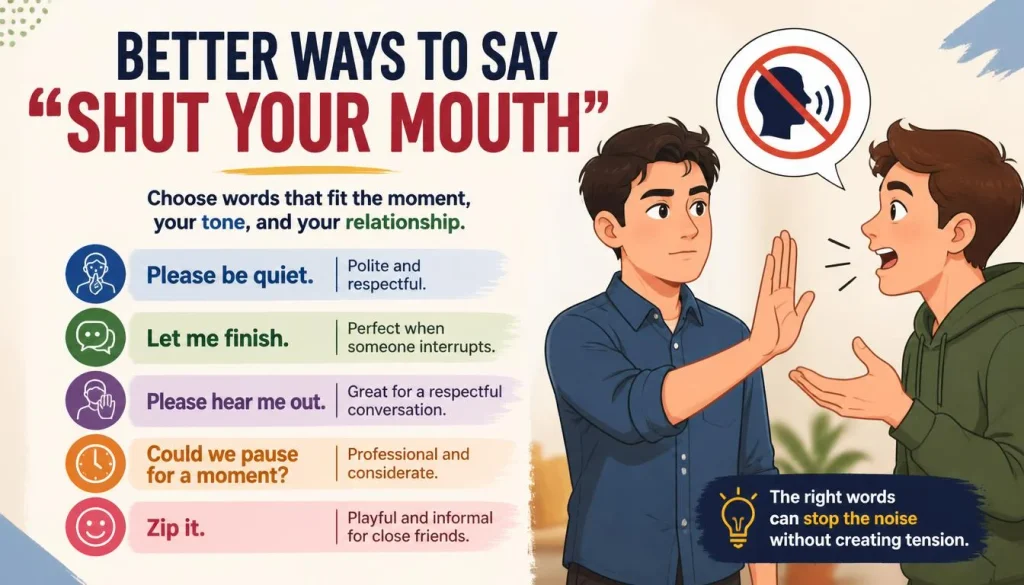
“Shut your mouth” means stop talking or be quiet, but it can sound rude, aggressive, or disrespectful. If you want to express the same idea without creating unnecessary tension, choose an alternative that matches the situation. For example, “Please be quiet” works for a polite request, while “Let me finish” is better when someone keeps interrupting you. In a professional setting, phrases like “Please hear me out” or “Could we pause for a moment?” sound more respectful. For close friends, informal choices like “Zip it” can add a playful touch. The best alternative depends on your tone, relationship, and reason for asking someone to stop talking.
What Does “Shut Your Mouth” Mean?
“Shut your mouth” means to stop talking or become quiet. People usually say it when they want someone to stop speaking immediately. Depending on the tone, it can express annoyance, anger, frustration, disbelief, or a strong demand for silence. For example, someone might say, “Shut your mouth and listen to me,” during an argument. Although the phrase can sometimes be used jokingly between close friends, it often sounds rude, aggressive, or disrespectful.
The expression focuses on the command rather than the relationship. That’s why softer alternatives can work better when you want to protect someone’s feelings. Instead of attacking the person, you can simply ask them to pause, listen, lower their voice, or give you a moment of silence.
Is It Professional or Polite to Say “Shut Your Mouth”?
Generally, “shut your mouth” is neither professional nor polite. It can easily sound confrontational, especially in the workplace, classroom, customer service setting, or another formal environment. Even when you feel frustrated, the phrase may escalate the situation rather than solve it.
If you need someone to stop talking in a professional situation, choose a calmer phrase such as “Could we pause for a moment?”, “Please let me finish,” or “I’d appreciate a moment to speak.” These alternatives communicate the same basic need without unnecessarily embarrassing or insulting the other person.
Advantages and Disadvantages
Advantages
- It is direct and clear.
The phrase leaves little doubt about what you want the other person to do. They immediately understand that you want silence. - It can communicate strong emotion.
During a heated argument, the expression can show anger, frustration, or disbelief very clearly. - It can work jokingly between close friends.
With the right relationship and tone, friends may use it playfully when reacting to something surprising or unbelievable.
Disadvantages
- It can sound disrespectful.
The phrase directly tells someone to stop speaking and may feel like a personal attack. - It can make an argument worse.
Instead of calming a tense conversation, “shut your mouth” can provoke more anger. - It is unsuitable for most professional situations.
Using it with a boss, customer, teacher, colleague, or stranger can damage your communication and credibility.
Synonyms for “Shut Your Mouth”
- Please Be Quiet
- Could You Keep It Down?
- Please Stop Talking
- Let Me Finish
- Give Me a Moment to Speak
- Please Hear Me Out
- Can We Have a Moment of Silence?
- I Need Some Quiet
- Let’s Pause for a Second
- Could We Talk About This Later?
- Please Hold That Thought
- I’d Appreciate Some Silence
- Let’s Give Everyone a Chance to Speak
- Please Lower Your Voice
- Could You Give Me a Minute?
- Let’s Take a Break From Talking
- I Need You to Listen
- Please Let Me Get a Word In
- Can You Stop for a Moment?
- Let’s Keep This Conversation Calm
- I’d Rather You Didn’t Say Anything Right Now
- Let’s Not Say Anything More
- Save It for Later
- Enough Said
- That’s Enough
- Zip It
- Keep It to Yourself
- Hush for a Moment
- Put a Lid on It
- Give It a Rest
1. Please Be Quiet
Meaning:
“Please be quiet” means you are politely asking someone to stop making noise or talking.
Definition:
A direct but courteous request for silence.
Detailed Explanation:
This is one of the simplest alternatives to “shut your mouth.” Adding “please” makes the request considerably softer. You can use it with friends, family members, classmates, or colleagues when you genuinely need some quiet.
Scenario Example:
“Please be quiet for a minute. I’m trying to hear the instructions.”
Best Use:
Use this when you need simple, respectful silence.
Tone:
Polite, direct, and calm.
2. Could You Keep It Down?
Meaning:
“Could you keep it down?” asks someone to reduce their volume.
Definition:
A polite request for someone to speak more quietly.
Detailed Explanation:
This phrase works particularly well when someone is being noisy rather than simply talking too much. It sounds much less aggressive than telling someone to shut up.
Scenario Example:
“Could you keep it down? Some people are studying in the next room.”
Best Use:
Use it when someone is speaking loudly or making excessive noise.
Tone:
Polite, casual, and mildly firm.
3. Please Stop Talking
Meaning:
“Please stop talking” means you want someone to stop speaking.
Definition:
A straightforward request for someone to end their conversation.
Detailed Explanation:
This alternative remains direct without using insulting language. It works when you need immediate silence but still want to maintain some respect.
Scenario Example:
“Please stop talking while the teacher is explaining the assignment.”
Best Use:
Use it when you need someone to stop speaking immediately.
Tone:
Direct, firm, and respectful.
4. Let Me Finish
Meaning:
“Let me finish” means you want someone to stop interrupting while you complete what you are saying.
Definition:
A request for another person to allow you to finish speaking.
Detailed Explanation:
This is especially useful during arguments, meetings, or discussions. Instead of telling the other person to be silent completely, you explain what you need.
Scenario Example:
“Let me finish, and then I’ll listen to your side.”
Best Use:
Use it when someone is interrupting you.
Tone:
Assertive, controlled, and reasonable.
5. Give Me a Moment to Speak
Meaning:
This asks someone to give you enough time to express your thoughts.
Definition:
A respectful request for an opportunity to speak without interruption.
Detailed Explanation:
This phrase sounds more mature than “shut your mouth.” It shifts attention away from controlling the other person and toward creating space for your own voice.
Scenario Example:
“Give me a moment to speak, and then we can discuss your concerns.”
Best Use:
Use it during meetings, disagreements, or serious conversations.
Tone:
Professional, calm, and assertive.
6. Please Hear Me Out
Meaning:
“Please hear me out” means you want someone to listen before responding.
Definition:
A request for someone to listen to your complete explanation.
Detailed Explanation:
This is excellent when someone keeps interrupting or reacting before understanding your point. It encourages patience instead of demanding silence.
Scenario Example:
“Please hear me out before you decide that I’m wrong.”
Best Use:
Use it during important conversations or disagreements.
Tone:
Respectful, sincere, and persuasive.
7. Can We Have a Moment of Silence?
Meaning:
This asks everyone to stop talking temporarily.
Definition:
A gentle request for temporary silence.
Detailed Explanation:
The phrase can sound polite and slightly formal. It works especially well when a group needs to settle down before something important begins.
Scenario Example:
“Can we have a moment of silence? I need everyone’s attention.”
Best Use:
Use it with groups, classrooms, meetings, or gatherings.
Tone:
Calm, polite, and slightly formal.
8. I Need Some Quiet
Meaning:
“I need some quiet” communicates that you personally need a peaceful environment.
Definition:
A statement expressing a need for less noise or conversation.
Detailed Explanation:
This option feels less controlling because you focus on your own need. It works particularly well when you are studying, working, resting, or concentrating.
Scenario Example:
“I need some quiet so I can finish this report.”
Best Use:
Use it when you need peace and concentration.
Tone:
Gentle, honest, and personal.
9. Let’s Pause for a Second
Meaning:
This asks everyone to temporarily stop the conversation.
Definition:
A suggestion to pause a discussion before continuing.
Detailed Explanation:
This phrase is useful when emotions are getting too high. It doesn’t attack anyone. Instead, it creates breathing room so everyone can collect their thoughts.
Scenario Example:
“Let’s pause for a second before this turns into another argument.”
Best Use:
Use it during tense or emotional conversations.
Tone:
Calm, diplomatic, and thoughtful.
10. Could We Talk About This Later?
Meaning:
This asks someone to postpone the conversation.
Definition:
A polite request to discuss something at another time.
Detailed Explanation:
Sometimes you don’t actually need someone to be quiet forever. You simply aren’t ready to talk. This phrase gives you a graceful way to step away from the conversation.
Scenario Example:
“Could we talk about this later? I’m too frustrated to discuss it properly right now.”
Best Use:
Use it when you need space or time before continuing.
Tone:
Polite, mature, and diplomatic.
11. Please Hold That Thought
Meaning:
“Please hold that thought” means you want someone to wait before continuing.
Definition:
A polite request to pause an idea or comment temporarily.
Detailed Explanation:
This phrase is useful when someone begins talking while you are handling something else. It doesn’t reject their opinion. It simply asks them to wait.
Scenario Example:
“Please hold that thought while I finish explaining this part.”
Best Use:
Use it during meetings, presentations, or discussions.
Tone:
Professional, courteous, and composed.
12. I’d Appreciate Some Silence
Meaning:
This means you would be grateful if someone stopped talking temporarily.
Definition:
A respectful expression of your need for quiet.
Detailed Explanation:
This sounds more formal than “please be quiet.” It can work when you want to establish a boundary without sounding hostile.
Scenario Example:
“I’d appreciate some silence while I finish this phone call.”
Best Use:
Use it when you want quiet without confrontation.
Tone:
Polite, firm, and formal.
13. Let’s Give Everyone a Chance to Speak
Meaning:
This asks people to stop dominating the conversation.
Definition:
A request for balanced participation in a discussion.
Detailed Explanation:
Instead of silencing one person, this phrase creates a fair environment for everyone. It works beautifully in group conversations.
Scenario Example:
“Let’s give everyone a chance to speak before we make a decision.”
Best Use:
Use it in meetings, classrooms, group discussions, or family conversations.
Tone:
Fair, diplomatic, and professional.
14. Please Lower Your Voice
Meaning:
This asks someone to speak more quietly.
Definition:
A direct request to reduce speaking volume.
Detailed Explanation:
This is more specific than telling someone to stop talking. It works when the person’s message isn’t necessarily the problem. Their volume is.
Scenario Example:
“Please lower your voice. People are trying to work nearby.”
Best Use:
Use it when someone is speaking too loudly.
Tone:
Polite, firm, and practical.
15. Could You Give Me a Minute?
Meaning:
This asks someone to stop talking temporarily so you can have a moment.
Definition:
A gentle request for brief personal or conversational space.
Detailed Explanation:
This phrase works when you feel overwhelmed or need time to think. It avoids blaming the other person.
Scenario Example:
“Could you give me a minute? I need to think about what you just said.”
Best Use:
Use it when you need time, space, or concentration.
Tone:
Gentle, personal, and calm.
See More: 30 Other Ways to Say ‘What in the World’ (With Examples)
16. Let’s Take a Break From Talking
Meaning:
This suggests temporarily ending the conversation.
Definition:
A request to pause verbal communication for a while.
Detailed Explanation:
This works especially well during heated discussions. Sometimes silence can cool down emotions better than another round of arguments.
Scenario Example:
“Let’s take a break from talking and come back to this later.”
Best Use:
Use it during arguments or emotionally difficult conversations.
Tone:
Calm, mature, and diplomatic.
17. I Need You to Listen
Meaning:
This means you want the other person to stop responding and pay attention.
Definition:
A firm request for focused listening.
Detailed Explanation:
This phrase doesn’t necessarily demand complete silence. Instead, it tells the person that listening is more important than responding right now.
Scenario Example:
“I need you to listen for a minute because this is important to me.”
Best Use:
Use it during serious personal conversations.
Tone:
Sincere, firm, and emotional.
18. Please Let Me Get a Word In
Meaning:
This means you want an opportunity to speak.
Definition:
A request for someone to stop dominating the conversation.
Detailed Explanation:
This phrase works well when someone talks continuously or keeps interrupting you. It can also carry a little humor in casual situations.
Scenario Example:
“Please let me get a word in before you make the final decision.”
Best Use:
Use it when someone is talking over you.
Tone:
Assertive, conversational, and slightly playful.
19. Can You Stop for a Moment?
Meaning:
This asks someone to temporarily stop what they are saying or doing.
Definition:
A straightforward request for a brief pause.
Detailed Explanation:
This phrase remains fairly neutral. You can use it when the conversation moves too quickly or you need the other person to pause.
Scenario Example:
“Can you stop for a moment? I want to make sure I understand you.”
Best Use:
Use it when you need a short pause in conversation.
Tone:
Neutral, direct, and calm.
20. Let’s Keep This Conversation Calm
Meaning:
This asks everyone to avoid shouting, insults, or aggressive language.
Definition:
A request to maintain respectful communication.
Detailed Explanation:
This is a strong alternative when someone keeps escalating an argument. It redirects the conversation toward calm behavior instead of demanding silence.
Scenario Example:
“Let’s keep this conversation calm so we can actually solve the problem.”
Best Use:
Use it during arguments or tense discussions.
Tone:
Mature, diplomatic, and firm.
21. I’d Rather You Didn’t Say Anything Right Now
Meaning:
This means you don’t want the other person to speak at that moment.
Definition:
A firm statement requesting temporary silence.
Detailed Explanation:
This is stronger than many polite alternatives. However, it remains less insulting than “shut your mouth.” Use it carefully because the wording can still feel cold.
Scenario Example:
“I’d rather you didn’t say anything right now. I need some time to calm down.”
Best Use:
Use it when emotions are high and you need space.
Tone:
Firm, serious, and somewhat cold.
22. Let’s Not Say Anything More
Meaning:
This means you want to stop the conversation from continuing.
Definition:
A request to end further discussion.
Detailed Explanation:
This phrase can help close an argument without throwing insults. It works particularly well when continuing the conversation would only create more tension.
Scenario Example:
“Let’s not say anything more until we’ve both had time to think.”
Best Use:
Use it when you want to end a difficult conversation peacefully.
Tone:
Serious, calm, and final.
23. Save It for Later
Meaning:
“Save it for later” means the person should stop discussing the topic for now.
Definition:
A casual request to postpone a comment or conversation.
Detailed Explanation:
This expression works well among friends or colleagues who already understand your communication style. It can sound dismissive in formal situations.
Scenario Example:
“Save it for later. I have to leave for an appointment.”
Best Use:
Use it when you want to delay a conversation.
Tone:
Casual, direct, and slightly dismissive.
24. Enough Said
Meaning:
“Enough said” means nothing more needs to be discussed.
Definition:
An expression used to close a conversation or statement.
Detailed Explanation:
This can mean “stop talking” depending on context. However, it doesn’t always sound rude. Sometimes people use it simply to signal that the point is already clear.
Scenario Example:
“Enough said. We’ve made our decision.”
Best Use:
Use it when the discussion has already made its point.
Tone:
Firm, concise, and final.
25. That’s Enough
Meaning:
“That’s enough” tells someone to stop what they are saying or doing.
Definition:
A firm command indicating that something must end now.
Detailed Explanation:
This is useful when someone’s behavior has crossed a boundary. It can be much less offensive than “shut your mouth,” while still carrying authority.
Scenario Example:
“That’s enough. We’re not going to insult each other.”
Best Use:
Use it when someone has gone too far.
Tone:
Firm, serious, and authoritative.
26. Zip It
Meaning:
“Zip it” means stop talking.
Definition:
A short informal command telling someone to be quiet.
Detailed Explanation:
This phrase is often playful or humorous. It can sound less aggressive than “shut your mouth,” although it is still a command.
Scenario Example:
“Zip it! The movie is about to start.”
Best Use:
Use it with friends, family, or in playful situations.
Tone:
Playful, informal, and cheeky.
27. Keep It to Yourself
Meaning:
This means you should not say your thought or opinion aloud.
Definition:
A request for someone to withhold a comment or opinion.
Detailed Explanation:
This phrase doesn’t necessarily mean “stop talking.” Instead, it specifically asks someone not to share something they are about to say. It can sound sharp depending on your delivery.
Scenario Example:
“Keep it to yourself if you’re only going to criticize her.”
Best Use:
Use it when someone is about to make an unhelpful or unwanted comment.
Tone:
Firm, blunt, and sometimes confrontational.
28. Hush for a Moment
Meaning:
“Hush for a moment” asks someone to become quiet temporarily.
Definition:
A gentle or somewhat old-fashioned request for silence.
Detailed Explanation:
This phrase can sound softer than many direct commands. It works particularly well with children or in playful conversations.
Scenario Example:
“Hush for a moment and listen to this beautiful song.”
Best Use:
Use it in gentle, playful, or informal situations.
Tone:
Soft, warm, and slightly playful.
29. Put a Lid on It
Meaning:
“Put a lid on it” means stop talking or stop complaining.
Definition:
An informal expression telling someone to be quiet.
Detailed Explanation:
This is an idiomatic alternative that can add humor to a conversation. However, it can still sound rude if you use it with someone who doesn’t appreciate playful expressions.
Scenario Example:
“Put a lid on it for a second and let me explain.”
Best Use:
Use it with friends or people comfortable with informal humor.
Tone:
Humorous, blunt, and informal.
30. Give It a Rest
Meaning:
“Give it a rest” means stop talking about something repeatedly or stop complaining.
Definition:
An informal request to stop a particular behavior or topic.
Detailed Explanation:
This expression doesn’t always mean complete silence. Instead, it often means that someone has talked about the same issue too much. It can be useful when you want to shut down repetitive complaining without saying “shut your mouth.”
Scenario Example:
“Give it a rest. We’ve already discussed this three times.”
Best Use:
Use it when someone is repeating a complaint or argument.
Tone:
Blunt, casual, and slightly annoyed.
FAQs
1. What does “shut your mouth” mean?
“Shut your mouth” means stop talking or be quiet. It usually sounds direct and can feel rude, aggressive, or disrespectful depending on the situation and tone.
2. Is “shut your mouth” rude?
Yes. “Shut your mouth” is generally considered rude because it directly commands someone to stop speaking. It can easily create tension during an argument or serious conversation.
3. What is a polite way to say “shut your mouth”?
You can say “Please be quiet,” “Please let me finish,” or “Could we pause for a moment?” These alternatives communicate the same basic idea without sounding unnecessarily harsh.
4. What is a professional way to say “shut your mouth”?
In a professional setting, try “Please let me finish,” “I’d appreciate a moment to speak,” or “Could we pause for a moment?” These phrases sound more respectful during meetings and workplace discussions.
5. Can I say “shut your mouth” to a friend?
You can use it with a close friend if your relationship includes playful teasing. However, your tone and context matter. A serious or angry delivery can still sound insulting.
6. What is a funny way to say “shut your mouth”?
For a playful situation, you might say “Zip it,” “Hush for a moment,” or “Put a lid on it.” These expressions can sound humorous when used with people who understand your sense of humor.
7. What can I say instead of “shut your mouth” during an argument?
Try “Let me finish,” “Please hear me out,” or “Let’s keep this conversation calm.” These choices help you communicate your point without making the disagreement more heated.
8. Is “be quiet” better than “shut your mouth”?
“Be quiet” is usually less aggressive than “shut your mouth.” However, it can still sound demanding if you use a sharp tone. A softer phrase may work better in sensitive situations.
9. What is a gentle way to ask someone to stop talking?
You could say “Could you give me a minute?”, “Please hold that thought,” or “Let’s pause for a second.” These expressions give the other person a clear request without sounding insulting.
10. What is the best alternative to “shut your mouth”?
There isn’t one perfect alternative for every situation. “Please let me finish” works well when someone interrupts you. “Please be quiet” is straightforward. For professional conversations, “Could we pause for a moment?” usually sounds more appropriate.
Conclusion
“Shut your mouth” is a clear way to tell someone to stop talking. However, it can sound rude, aggressive, or disrespectful, especially when emotions are already high. The words you choose can either calm a situation or add fuel to the fire.
Fortunately, you have many better options. You can use “Please let me finish” when someone interrupts you or “Please be quiet” when you need a direct request. In professional situations, softer expressions such as “Could we pause for a moment?” can protect the conversation from unnecessary tension. With close friends, playful choices like “Zip it” may add some humor.