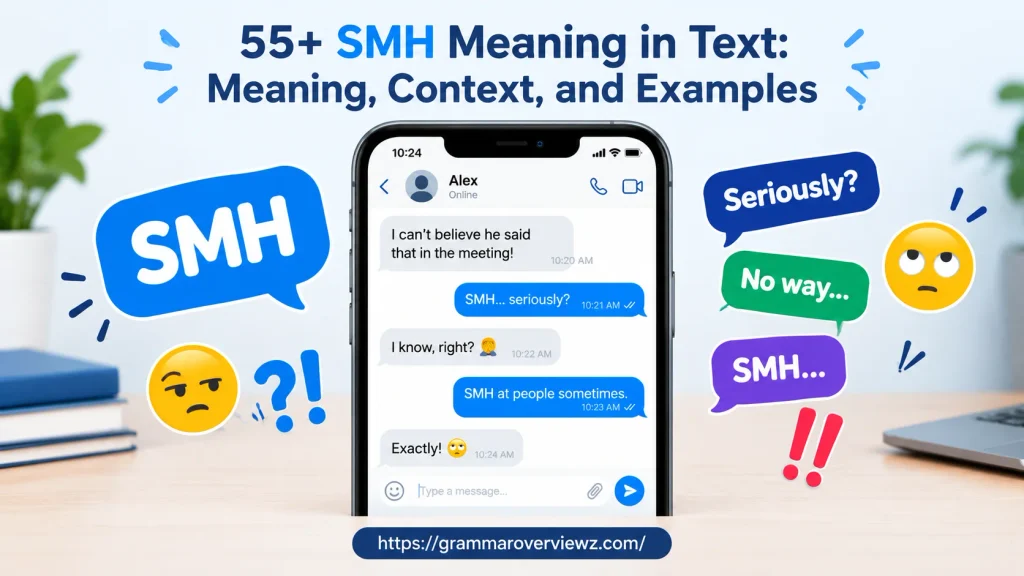

55+ SMH Meaning in Text: Meaning, Context, and Examples explains how SMH works in texting, chats, and social media when tone feels unclear online.
If your BFF is texting about a new crush, such as the kid from science class, you may feel scared to talk about it. When your friend suddenly replies with “smh,” you may wonder about the meaning and whether that person is judging you right now.
From my experience with everyday communication, text slang can feel stronger on a screen because you can’t hear the person’s voice. In online chats and text messages, SMH is a useful text abbreviation for a quick emotional reaction. Someone may use it while sharing information about mildly frustrating information or reacting to a moderately difficult situation.
Across online communication, digital communication, and social media, its usage can signal a negative reaction, judgment, or playful annoyance. You might also see WTF nearby when someone feels especially shocked or confused.
For example, if your BFF is planning to ditch a long-running Snapstreak on Snapchat, the surrounding message, conversation, and friendship can reveal whether SMH sounds serious or playful. Those streaks are familiar in Snapchat culture, while internet slang helps make quick digital messages and chats feel more natural.
Quick Answer: What Does SMH Mean in Text?
SMH means “shaking my head.” In texting and online communication, it usually expresses disbelief, frustration, disappointment, annoyance, embarrassment, or disapproval.
In simple words, someone using SMH may be saying:
- “I can’t believe this.”
- “Come on!”
- “That’s ridiculous.”
- “What were you thinking?”
- “I’m disappointed.”
- “You’re really doing this?”
- “I can’t believe you did that.”
The exact SMH meaning in text depends on the surrounding conversation, relationship between the people, punctuation, and emojis.
What Does SMH Stand For?
SMH stands for “shaking my head.”
The abbreviation takes the first letter of each word:
- S = Shaking
- M = My
- H = Head
The phrase comes from the familiar physical gesture of shaking your head when something seems foolish, frustrating, disappointing, or unbelievable.
In digital communication, nobody needs to literally shake their head. Instead, SMH describes the reaction they want to communicate.
For example:
“You left your phone at home again. SMH.”
The sender isn’t necessarily describing a physical action. They’re expressing something closer to:
“I can’t believe you did that again.”
What Does SMH Mean in Text Messages?
In everyday texting, SMH is a quick emotional reaction. It lets someone communicate a feeling without typing a full sentence.
Imagine your friend tells you:
“I studied for three hours and realized I was reading the wrong chapter.”
You could respond:
“SMH 😂”
That tiny abbreviation carries several ideas at once: That’s unfortunate. How did you manage that? I can’t believe it.
The meaning can become stronger when SMH appears with other words.
| Text | Likely meaning |
| SMH | I can’t believe this |
| SMH 😂 | That’s ridiculous but funny |
| SMH 🙄 | I’m annoyed |
| SMH… | I’m disappointed |
| SMH bro | Come on, man |
| SMH, seriously? | I’m genuinely frustrated |
| SMH at this | This situation is ridiculous |
That flexibility explains why SMH remains useful in casual digital conversations.
What Does SMH Mean in Different Contexts?
The abbreviation doesn’t have one emotional setting. Its meaning changes with context.
SMH Meaning in Text Messages
In private messages, SMH often communicates mild frustration or disbelief.
“You ordered the same thing after saying you hated it? SMH.”
Depending on the relationship, this could be criticism or friendly teasing.
SMH Meaning on Social Media
On social platforms, people frequently use SMH as a reaction to posts, comments, opinions, mistakes, or surprising situations.
For example:
“People are still arguing about this? SMH.”
Here, the writer is expressing disbelief and disapproval.
SMH Meaning on TikTok
On TikTok, SMH can appear in comments or captions reacting to something awkward, ridiculous, funny, surprising, or frustrating.
A viewer might comment:
“He really thought that would work. SMH 😂”
The laughing emoji makes the reaction feel less severe.
SMH Meaning on Instagram
Instagram users may use SMH in comments, DMs, Stories, or captions.
For example:
“You posted that after I told you not to? SMH.”
Here, the abbreviation communicates disappointment.
SMH Meaning on Snapchat
Snapchat conversations are usually informal. As a result, SMH often has a playful or teasing tone.
“You lost your sunglasses again? SMH 😂”
The sender probably isn’t delivering a serious reprimand.
SMH Meaning on Reddit
Reddit discussions can use SMH to express disbelief, criticism, frustration, or disagreement.
For example:
“They ignored every warning and still blamed everyone else. SMH.”
In this setting, SMH can sound more critical because it may accompany an argument or opinion.
SMH Meaning on Discord and Gaming Chats
Gamers often use SMH after a mistake, missed opportunity, failed strategy, or ridiculous play.
“You had the win and walked into the trap. SMH.”
The message may be frustrated. It can also be friendly banter between teammates.
What Does SMH Mean From a Guy?
There isn’t a separate male definition of SMH. A guy using SMH generally means “shaking my head.”
However, his intended emotion depends on the conversation.
He could mean:
- “I can’t believe you did that.”
- “You’re being ridiculous.”
- “That’s disappointing.”
- “Come on, seriously?”
- “That was a terrible decision.”
- “I’m joking with you.”
For example:
“You forgot your keys again? SMH.”
That sounds mildly annoyed.
Meanwhile:
“You ate the whole pizza? SMH 😂”
That sounds much more playful.
The relationship, wording, punctuation, and emoji tell you more than the sender’s gender.
What Does SMH Mean From a Girl?
The same basic rule applies when a girl sends SMH. It generally means “shaking my head.”
The tone might be:
- Playful
- Frustrated
- Sarcastic
- Disappointed
- Amused
- Critical
- Embarrassed
For example:
“You actually believed that? SMH 😂”
The emoji suggests teasing.
But:
“I already explained this. SMH.”
sounds more serious.
So, if you’re wondering what SMH means from a girl, don’t search for a hidden gender-specific definition. Look at what happened immediately before the message.
Our Related Topics: 50+ Apt Meaning in Text: What Does APT Mean in Messages?
Is SMH Rude?
SMH isn’t automatically rude. However, it can sound dismissive or critical in certain situations.
Compare these messages:
“SMH 😂”
and
“SMH. Seriously?”
The first may be friendly banter. The second carries noticeably more irritation.
A standalone “SMH” can also feel blunt because it doesn’t explain the sender’s feelings. If the other person is already upset, they might interpret it as criticism rather than humor.
When SMH Sounds Playful
“You wore two different shoes? SMH 😂”
When SMH Sounds Annoyed
“You ignored the instructions again. SMH.”
When SMH Sounds Sarcastic
“Fantastic decision. SMH.”
When SMH Sounds Harsh
“You knew exactly what would happen. SMH.”
The surrounding language creates the emotional temperature.
Is SMH Positive or Negative?
SMH is generally negative or critical, but it isn’t always hostile.
Most uses communicate some form of:
- Disbelief
- Disapproval
- Frustration
- Annoyance
- Disappointment
- Embarrassment
Still, friends often use it jokingly.
For example:
“You watched the entire movie and still don’t know the ending? SMH 😂”
That’s technically a negative reaction. Yet the social meaning is lighthearted.
This is an important distinction: negative wording doesn’t always equal negative intent.
How to Understand the Tone of SMH
The easiest way to interpret SMH is to examine what surrounds it.
| Message | Likely tone | What it may mean |
| SMH | Mildly negative | I can’t believe this |
| SMH 😂 | Playful | You’re ridiculous |
| SMH 🙄 | Annoyed | I’m tired of this |
| SMH 🤦 | Disbelief | How did this happen? |
| SMH… | Disappointed | I’m disappointed |
| SMH bro | Casual criticism | Come on, man |
| SMH, seriously? | Frustrated | Why would you do that? |
| SMH at this | Disapproval | This is ridiculous |
Why Punctuation Matters
Even punctuation can change the feel.
“SMH 😂” sounds casual.
“SMH.” feels more final.
“SMH…” may suggest disappointment or exasperation.
“SMH, seriously?” clearly communicates frustration.
That’s why reading the abbreviation alone can sometimes lead to the wrong conclusion.
55+ SMH Meaning Examples in Text
Here are practical examples showing how SMH meaning in text changes across different situations.
SMH for Disbelief
“You spent $200 on that? SMH.”
The sender can’t believe the decision.
SMH for Disappointment
“You forgot the meeting again. SMH.”
The message communicates disappointment.
SMH for Frustration
“The Wi-Fi stopped working again. SMH.”
Here, SMH expresses irritation with the situation.
SMH for Annoyance
“He changed the plan five minutes before we left. SMH.”
The writer is annoyed by someone’s behavior.
SMH for Embarrassment
“I sent that message to the wrong person. SMH.”
The writer is criticizing their own mistake.
SMH for Criticism
“You knew the deadline was today. SMH.”
The abbreviation reinforces disapproval.
SMH for Playful Teasing
“You really ate the entire pizza? SMH 😂”
This is teasing rather than serious criticism.
SMH for Sarcasm
“Great idea. Ignore all the instructions. SMH.”
The writer uses SMH to emphasize sarcastic criticism.
SMH for Shock
“They actually canceled the event? SMH.”
The sender expresses disbelief about an unexpected development.
SMH for Disapproval
“That wasn’t a smart decision. SMH.”
The sender clearly disagrees with the decision.
SMH for Secondhand Embarrassment
“Did he really say that in front of everyone? SMH.”
The sender feels embarrassed by someone else’s behavior.
SMH Between Friends
“Bro, you missed the easiest shot. SMH.”
This can be friendly gaming banter.
SMH in a Family Conversation
“Mom warned you about this. SMH.”
The sender emphasizes that the mistake was avoidable.
SMH at Work
“They moved the deadline again. SMH.”
This expresses workplace frustration. It still may not belong in formal work communication.
SMH About Gaming
“You walked straight into the trap. SMH.”
The player made an obvious mistake.
SMH About Social Media
“People really believe this? SMH.”
The sender expresses disbelief about online reactions.
SMH About a Bad Decision
“Why would you sell it that cheaply? SMH.”
The sender questions someone’s judgment.
SMH About Forgetfulness
“You forgot your wallet again? SMH.”
Repeated mistakes make the reaction stronger.
SMH About Being Late
“You said you’d be here at eight. SMH.”
The sender is frustrated about lateness.
SMH About Repeated Mistakes
“We talked about this yesterday. SMH.”
The abbreviation emphasizes exasperation.
SMH About a Ridiculous Situation
“They charged us twice for one order. SMH.”
The writer finds the situation unreasonable.
SMH About an Awkward Moment
“He waved back at someone who wasn’t waving at him. SMH.”
This can express secondhand embarrassment.
SMH About a Funny Mistake
“I wore two different shoes today. SMH 😂”
The writer laughs at their own mistake.
SMH for Mild Anger
“You seriously deleted the file? SMH.”
This sounds more serious than a playful use.
SMH for Strong Frustration
“This is the third time you’ve done that. SMH.”
Repeated behavior makes the criticism stronger.
SMH About Someone’s Choice
“You picked that restaurant again? SMH.”
The sender questions the choice.
SMH About Bad Luck
“I missed the bus by ten seconds. SMH.”
The sender is frustrated with their luck.
SMH About a Bad Joke
“That was your best joke? SMH.”
The sender isn’t impressed.
SMH About a Silly Question
“You seriously don’t know that? SMH.”
The sender finds the question surprising or obvious.
SMH About an Obvious Mistake
“The answer was right there. SMH.”
The sender can’t believe the mistake.
SMH During an Argument
“We’re still arguing about this? SMH.”
This communicates exasperation.
SMH About Procrastination
“You waited until midnight to start? SMH.”
The sender criticizes the timing.
SMH About Overconfidence
“You didn’t study and expected an A? SMH.”
The writer sees the expectation as unrealistic.
SMH About Laziness
“You couldn’t walk five steps? SMH.”
The sender finds the behavior excessive.
SMH About Confusion
“How did you even get lost there? SMH.”
The writer expresses disbelief.
SMH About an Unexpected Outcome
“I never saw that coming. SMH.”
This expresses surprise and disbelief.
SMH About a Failed Plan
“Well, that plan didn’t last long. SMH.”
The reaction can carry humor and disappointment.
SMH About an Excuse
“That’s your excuse? SMH.”
The sender doesn’t find the explanation convincing.
SMH About Dramatic Behavior
“It’s raining. You’re acting like it’s the apocalypse. SMH.”
This is generally playful criticism.
SMH About Ignoring Advice
“I told you not to touch it. SMH.”
The sender points out that the mistake could have been avoided.
SMH About Shopping
“You bought another pair? SMH.”
This may be teasing between friends or partners.
SMH About Losing Something
“You lost your phone while holding it? SMH.”
The contradiction makes the situation funny.
SMH About Forgetting an Important Date
“You forgot our anniversary? SMH.”
Here, the abbreviation can signal genuine disappointment.
SMH About Traffic
“There was no traffic until I got here. SMH.”
The sender is frustrated by bad timing.
SMH About Technology
“The computer crashed before I saved it. SMH.”
The abbreviation expresses frustration.
SMH About School
“I studied chapter five instead of chapter six. SMH.”
The writer is annoyed with their own mistake.
SMH About Work
“I sent the draft before checking it. SMH.”
This is self-directed frustration.
SMH About a Friend
“You really said that to him? SMH.”
The sender disapproves of the friend’s behavior.
SMH About a Partner
“You knew I was waiting. SMH.”
This can communicate disappointment.
SMH About a Viral Post
“This has millions of views? SMH.”
The sender finds the popularity surprising or undeserved.
SMH About Online Arguments
“People are fighting over this? SMH.”
The writer thinks the argument is unnecessary.
SMH as Self-Reaction
“I forgot why I walked into the room. SMH.”
The writer is joking about their own forgetfulness.
SMH for Self-Criticism
“I had the answer and changed it. SMH.”
The writer regrets their decision.
SMH Meaning “Come On”
“You knew better than that. SMH.”
Here, SMH carries the conversational meaning of “Come on!”
SMH Meaning “I Can’t Believe You”
“You actually did that? SMH.”
The sender expresses disbelief toward another person.
SMH Meaning “That’s Ridiculous”
“They expect us to finish all of this today? SMH.”
The writer considers the situation unreasonable.
SMH Meaning “What Were You Thinking?”
“You drove there without checking the fuel? SMH.”
The abbreviation indirectly questions someone’s judgment.
Read More: 48+ AWL Meaning in Text: Slang, Examples, and Definitions
SMH vs. Similar Texting Abbreviations
Understanding related slang helps you recognize subtle differences.
| Abbreviation | Meaning | Common purpose |
| SMH | Shaking my head | Disbelief or frustration |
| LOL | Laughing out loud | Amusement |
| OMG | Oh my God | Surprise or shock |
| WTF | What the f*** | Strong shock or frustration |
| IDK | I don’t know | Uncertainty |
| TBH | To be honest | Honest opinion |
| FR | For real | Agreement or emphasis |
| NGL | Not gonna lie | Honest admission |
| ISTG | I swear to God | Strong emphasis |
The distinction matters because these abbreviations don’t perform the same conversational job.
LOL tells you something is funny. OMG emphasizes surprise. SMH generally reacts to something that seems foolish, frustrating, disappointing, or unbelievable.
SMH vs. Facepalm
Facepalm and SMH overlap because both can communicate disbelief or embarrassment.
However, they aren’t identical.
Facepalm often suggests:
“I can’t believe this happened.”
SMH more directly suggests:
“I’m shaking my head at this.”
A person might use either one after an obvious mistake. The choice depends on their preferred online language.
SMH vs. SMDH
SMDH usually means “shaking my damn head.”
The added word makes the reaction more emphatic.
Compare:
“SMH, you forgot again.”
with:
“SMDH, you forgot again.”
The second generally sounds more frustrated or dramatic.
It also contains stronger language. Therefore, SMH is safer for casual conversations with a wider range of people.
What Does SMDH Mean in Text?
SMDH means “shaking my damn head.”
It works much like SMH but adds emphasis.
Someone might write:
“SMDH, how did you miss that?”
The intended meaning is roughly:
“I seriously can’t believe you missed that.”
Because of the stronger wording, SMDH can sound more irritated than SMH.
What Does SMH Mean With Emojis?
Emojis can dramatically change how SMH feels.
| Combination | Common interpretation |
| SMH 😂 | Playful disbelief |
| SMH 😭 | Funny or overwhelming disbelief |
| SMH 🙄 | Annoyance |
| SMH 🤦 | Strong disbelief or embarrassment |
| SMH 😅 | Awkward embarrassment |
| SMH 💀 | Ridiculously funny reaction |
For example:
“You really sent that email to the whole company? SMH 😭”
The emoji can soften the criticism by making the situation humorous.
How to Reply When Someone Texts “SMH”
Your response should match the reason behind their message.
Playful Replies
If they’re teasing you, keep the response light:
- “I know, I know 😂”
- “Don’t judge me.”
- “I had a moment.”
- “It seemed like a good idea at the time.”
Apologetic Replies
If you’ve genuinely made a mistake:
- “Yeah, that was my bad.”
- “You’re right. I messed up.”
- “I should’ve listened.”
- “Fair enough. I’ll fix it.”
Funny Replies
If the conversation is clearly joking:
- “Save the head shaking for later.”
- “I stand by my terrible decision.”
- “We’re all allowed one bad decision.”
Clarifying Replies
If you’re unsure why they used SMH:
- “Wait, what did I do? 😂”
- “Why the SMH?”
- “Okay, explain yourself.”
Serious Replies
If SMH appears during a genuine disagreement, don’t focus only on the abbreviation.
Instead, address the underlying problem.
For example:
“I get why you’re frustrated. I should’ve told you earlier.”
That response works better than arguing about whether their use of SMH was rude.
How to Use SMH Correctly in a Text
Using SMH naturally isn’t difficult. The key is matching it to the situation.
Use SMH When:
- You’re reacting to something ridiculous.
- Someone makes an obvious mistake.
- You feel disappointed.
- Something leaves you speechless.
- You’re playfully teasing a friend.
- You’re reacting to an unexpected situation.
Add Context When:
- The relationship isn’t very close.
- The conversation is serious.
- The abbreviation could be interpreted several ways.
- Your message contains criticism.
For example, instead of:
“SMH.”
you might write:
“You really forgot the appointment? SMH 😂”
The second version gives the recipient much more emotional information.
When Should You Avoid Using SMH?
Although SMH is common in casual communication, it isn’t suitable everywhere.
Avoid it when writing:
- Formal emails
- Job applications
- Academic assignments
- Official complaints
- Customer-service messages
- Sensitive personal messages
- Professional documents
Why? The abbreviation can make your message sound dismissive, sarcastic, or overly casual.
If you need to communicate professionally, write the actual thought.
Instead of:
“SMH.”
Try:
“That’s disappointing.”
Or:
“I’m surprised that happened.”
Clear language removes ambiguity.
Is SMH Appropriate for Work?
Usually, SMH isn’t ideal for formal workplace communication.
A close team may use casual slang in an informal group chat. Even then, consider the audience. A manager, client, executive, or new colleague may interpret the abbreviation differently.
Professional alternatives include:
- “I’m surprised by that.”
- “That’s disappointing.”
- “That’s frustrating.”
- “I didn’t expect that.”
- “I’m not sure what to make of that.”
- “Could we review what happened?”
The last option is particularly useful when you need to solve a problem instead of merely reacting to it.
Is SMH Still Common?
SMH remains recognizable in digital communication, particularly in informal texting and social media.
Its staying power comes from its simplicity. Three letters can communicate an entire reaction without requiring a full explanation.
Digital slang also works like conversational shorthand. Instead of typing:
“I can’t believe you made that mistake again.”
someone can simply write:
“SMH.”
That efficiency makes abbreviations useful even as newer slang appears.
Still, recognition doesn’t mean every audience uses slang the same way. A phrase that feels natural in a friend group can sound strange in a formal conversation.
The History and Origin of SMH
SMH developed within the internet and digital communication culture as an abbreviation for “shaking my head.”
Its logic is straightforward. The physical gesture of shaking your head has long communicated disbelief, disagreement, disappointment, or frustration. Online communication transformed that gesture into a compact written expression.
As texting, forums, instant messaging, and social media became central to everyday communication, abbreviations became a practical way to express reactions quickly.
SMH belongs to the same broad family of internet shorthand as LOL, OMG, IDK, TBH, and WTF. These expressions don’t simply save typing time. They also provide a way to communicate tone and emotional reaction in a text-based environment.
That matters because text removes facial expressions, gestures, and vocal tone. An abbreviation such as SMH can partially replace those missing signals.
A Simple Case Study: How Context Changes SMH
Consider three messages containing exactly the same abbreviation.
Situation One: Friendly Joke
“You ate the last slice again? SMH 😂”
Meaning: You’re being ridiculous, but I’m joking.
Situation Two: Genuine Frustration
“I asked you three times. SMH.”
Meaning: I’m frustrated because you ignored me.
Situation Three: Online Reaction
“People actually believe this? SMH.”
Meaning: I can’t believe people are accepting this.
The abbreviation hasn’t changed. The context has.
That’s the most important rule to remember when interpreting SMH meaning in text.
Final Takeaway: SMH Meaning in Text
The simplest answer is clear: SMH means “shaking my head.”
In texting and online conversations, it usually signals disbelief, frustration, disappointment, annoyance, embarrassment, or disapproval. Yet it doesn’t always indicate anger. Among friends, SMH can be playful, sarcastic, or humorous.
When you’re trying to understand what someone means by SMH, don’t look at the abbreviation alone. Check the message before it, the relationship between the people, punctuation, and emojis.
And when you’re using SMH yourself, remember that three letters can carry more attitude than you expect. In casual chats, that’s often exactly the point. In serious or professional conversations, a few clear words usually work better.
FAQs
What does SMH mean in text?
SMH means “shaking my head.” People use it in text messages, chats, and social media to show disbelief, frustration, disappointment, confusion, or disapproval. The exact feeling depends on the conversation and tone.
Is SMH rude in a text?
SMH isn’t automatically rude, but it can sound dismissive or judgmental. If someone uses it after you make a mistake, they may be showing mild frustration. Between close friends, it can also be playful.
What does SMH mean from a friend?
When a friend sends SMH, they may be reacting to something they find surprising, silly, frustrating, or hard to believe. Look at the context and the rest of the conversation before assuming they are upset with you.
What does SMH mean on Snapchat?
On Snapchat, SMH still means “shaking my head.” Someone might use it while chatting about a funny mistake, an annoying situation, or something they simply can’t believe. It can also appear in conversations about Snapstreaks and everyday social situations.
What is the difference between SMH and SMDH?
SMH means “shaking my head,” while SMDH usually means “shaking my damn head.” SMDH adds stronger emphasis, so it can express greater frustration, disbelief, or annoyance.
How should I reply when someone texts SMH?
Your reply depends on the emotional tone. If they are joking, you can respond playfully. If they seem frustrated, you can explain yourself or ask what bothered them. For example, you might say, “What did I do? 😂” or “Okay, fair enough!”
Conclusion
Understanding 55+ SMH Meaning in Text: Meaning, Context, and Examples becomes much easier when you look beyond the three letters. SMH usually means “shaking my head,” but its real tone comes from the situation, relationship, and surrounding words. It can express disbelief, frustration, confusion, disappointment, judgment, or playful teasing without requiring a long explanation.
Whether you see SMH in a private text, Snapchat conversation, social media post, or group chat, don’t assume it always means something negative. A close friend may use it as a joke, while someone else may use it to show genuine annoyance. Pay attention to the context, and you’ll have a much better idea of what the sender actually means.