
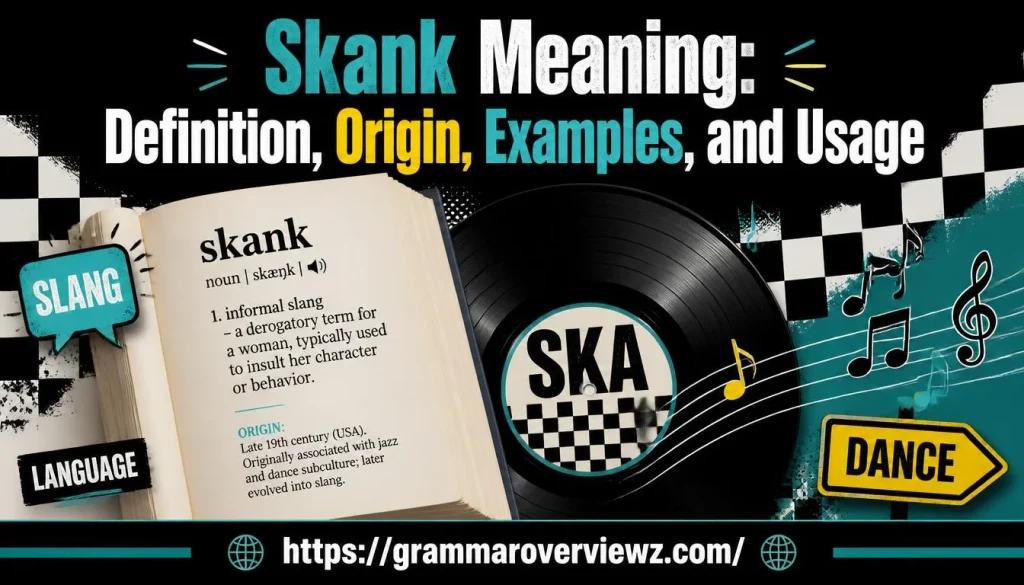

The skank meaning depends on context, ranging from an offensive slang term to a dance style in ska and reggae music.
In everyday English slang, skank is a noun used as an insult for someone considered vulgar, unpleasant, or sexually promiscuous. When directed at a woman, it can be a degrading and offensive expression that reflects the speaker’s judgment. Understanding its definition, meaning, and usage helps you recognize its negative tone.
The word skank has different meanings depending on its setting. In everyday conversation, texts, and social media comments, it can sound rude or disrespectful, so avoid it in formal writing and polite communication.
However, in ska music and reggae music, skanking refers to a dance style performed to the music’s rhythm. Always consider the context to understand whether the word describes an insult or a dance.
Quick Answer: What Does Skank Mean?
Skank is an informal, often offensive slang term used to insult someone, sometimes by suggesting that the person is sexually promiscuous or morally undesirable. Its exact implication depends on the speaker and situation.
In ska and reggae music, skank can also describe a dance performed to the music’s rhythm. The verb skanking refers to doing that dance.
Examples:
- “He called her a skank during the argument.” — An insulting use.
- “Everyone started skanking when the band played.” — A music-related use.
The key difference is context: the first example describes a personal insult, while the second refers to dancing.
Related Post: LMS Meaning in Text: Simple Definition and Full Guide
What Does Skank Mean?
The word skank has several related uses, but its insulting slang meaning is the one many people encounter in everyday conversations. It generally expresses contempt or disapproval toward another person.
Skank as an Insult
When someone calls another person a skank, they usually intend to offend or belittle that person. Depending on the situation, the insult may suggest that someone behaves in a crude, dishonest, unpleasant, or sexually promiscuous way.
The term doesn’t describe an objective quality. Instead, it reflects the speaker’s judgment, attitude, or attempt to provoke a reaction.
For example, imagine two people arguing after a disagreement. One person might use the word to attack the other person’s character rather than discuss what actually happened. In that situation, the term serves as a personal insult instead of a meaningful explanation.
Skank as a Sexually Judgmental Term
In many contexts, skank carries a sexual implication. People may use it to shame someone for their perceived sexual behavior, clothing, relationships, or reputation.
This use can be particularly degrading because it reduces a person’s identity to a judgment about their sexuality. It may also reflect a double standard when people criticize women more harshly than men for similar behavior.
Importantly, the insult doesn’t establish anything factual about the person being targeted. It simply communicates the speaker’s negative opinion.
Does Skank Always Mean the Same Thing?
No. Although the insulting meaning is common, the word can take on different meanings depending on where you encounter it.
| Context | Meaning of skank | Typical tone |
| Personal argument | An insulting label for someone | Hostile |
| Gossip or social media | A derogatory judgment about a person | Disrespectful |
| Casual conversation | A teasing insult among people who know each other | Depends on the relationship |
| Ska or reggae music | A dance associated with the music | Neutral |
| Music discussion | The act or style of skanking | Neutral |
The setting, surrounding words, and speaker’s intention help determine which meaning applies.
Skank Meaning in Text and Social Media
On social media, skank meaning in text usually refers to the insulting slang definition. People may use the term in text messages, comment sections, online arguments, or gossip about relationships.
Unlike an acronym such as LOL or BRB, skank isn’t normally an abbreviation with a standard full form. It is a slang word with meanings that depend on context.
How People Use Skank in Text Messages
A person might use the word to express anger, criticize someone, or repeat an insult they heard elsewhere. Sometimes, people also use it jokingly with close friends. However, the intended humor doesn’t guarantee that the recipient will find it funny.
Consider these original examples:
- “Why did he call her a skank?” — The sender is asking about an insulting remark.
- “That comment was rude. Don’t call people that.” — The speaker rejects the derogatory label.
- “The crowd was skanking near the stage.” — The word refers to dancing rather than an insult.
These examples show why you should read the whole message instead of interpreting one word in isolation.
Skank Meaning on TikTok and Other Platforms
On platforms such as TikTok, Instagram, and Reddit, the term may appear in comments, reaction posts, memes, or discussions about relationships.
Online communication can make the intended tone harder to identify. A short comment might be serious, sarcastic, playful, or deliberately provocative. Without facial expressions or a clear relationship between the people involved, readers can easily misunderstand the speaker’s intention.
The word’s appearance in a meme doesn’t automatically make it harmless. If a post targets a specific person, the term can still humiliate or encourage others to join in the insult.
Practical tip: When you see skank online, check whether the discussion concerns a person, a joke, or a music-related activity before deciding what it means.
Is Skank a Bad Word?
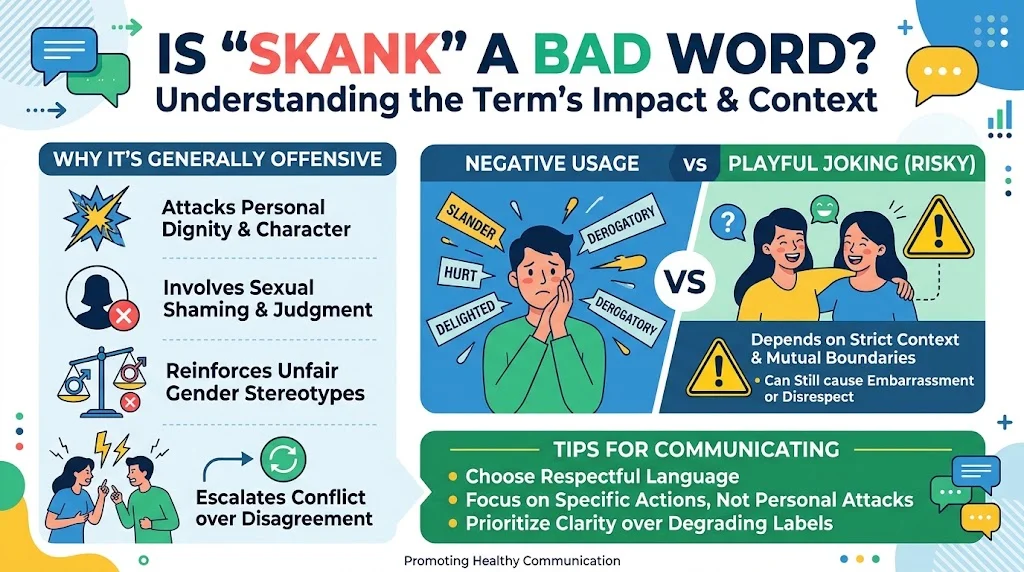
Yes, skank is generally considered an offensive or derogatory word when used to describe a person. Its insulting meaning can involve sexual shaming, contempt, or an attack on someone’s character.
The level of offense depends on the context, but the word carries enough negative baggage that using it carelessly can cause unnecessary conflict.
Why Is Skank Considered Offensive?
There are several reasons the term can hurt someone:
- It attacks personal dignity. The word labels a person rather than addressing a specific action.
- It can involve sexual shaming. The insult may judge someone based on assumptions about their intimate life.
- It can reinforce unfair stereotypes. In some situations, it reflects unequal expectations about how women and men should behave.
- It can escalate arguments. Name-calling often shifts attention away from the actual disagreement.
For example, saying, “I disagree with how he treated me,” explains a problem. Calling someone a skank attacks their identity without clarifying what happened.
Can Skank Be Used as a Joke?
Sometimes friends use offensive words playfully when they share a sense of humor and understand each other’s boundaries. However, familiarity doesn’t automatically make every insult acceptable.
A joke can cross the line when one person feels embarrassed, disrespected, or pressured to laugh along. The same word can feel harmless to one person and deeply insulting to another.
If you’re unsure how someone will react, choose a different expression. A funny conversation rarely needs a degrading label to work.
Where Did the Word Skank Come From?
The origin of skank is not completely settled. Historical dictionaries and etymological references document the word’s insulting sense, but its precise linguistic beginnings are less certain than its modern usage.
The term became established in American slang during the twentieth century. Later, skank also developed a recognized place in music and dance vocabulary, particularly around ska and reggae culture.
Historical Development of Skank
The word’s history is best understood by separating its documented uses rather than assuming that every meaning came from the same source.
- Twentieth-century slang: The insulting noun became established in American English during the 1960s.
- Music and dance vocabulary: The word became associated with a dance style linked to ska and reggae music.
- Modern informal communication: The insulting sense continues to appear in conversations, entertainment, and online discussions.
These stages describe documented usage, not a proven, single path of development. The available historical record doesn’t justify assigning the word one definitive origin without qualification.
Is the Origin of Skank Jamaican?
The word’s association with Jamaican music can lead people to assume that every meaning originated in Jamaica. However, a connection to reggae or ska culture doesn’t, by itself, prove the origin of the insulting slang term.
Ska developed in Jamaica in the late 1950s, while reggae emerged later in the 1960s. Both styles influenced music communities internationally. The dance-related use of skank belongs to this broader musical context.
To understand the word’s history accurately, it’s important to distinguish the history of a music genre from the etymology of an individual word.
For further research, consult established references such as Etymonline and Oxford Learner’s Dictionaries. These resources help readers compare definitions, historical notes, and usage labels.
What Does Skank Mean in Music and Dance?
In music culture, skank can refer to a dance associated with ska, reggae, and related styles. This meaning differs significantly from the derogatory slang term.
The dance-related use is generally neutral. It describes movement or participation in a musical tradition rather than a judgment about someone’s character.
What Is Skanking?
Skanking is a style of dancing commonly associated with ska and reggae music. Depending on the genre and performer, dancers may move their arms and legs rhythmically in time with the beat.
At a ska show, you might see people moving energetically as the band plays. Someone could describe the scene by saying, “The audience was skanking throughout the song.”
Here, the word doesn’t insult anyone. It describes what the audience is doing.
How to Recognize the Music-Related Meaning
Look for clues connected to music, dancing, and live performances.
- Music references: Words such as band, rhythm, concert, or song often indicate the dance-related meaning.
- Action words: Skanking often describes people moving to music.
- Performance settings: References to ska shows or reggae events make the musical meaning more likely.
For example, “They learned to skank at the ska festival” clearly refers to dancing. By contrast, “He used skank as an insult” refers to the derogatory slang meaning.
This distinction is essential when interpreting lyrics, event descriptions, and conversations about music culture.
Examples of Skank in a Sentence
Seeing skank used in a sentence makes its different meanings easier to understand. The examples below show how the word can function as an insult or describe a dance.
Skank Meaning: Everyday Examples
| Example sentence | Meaning | Tone |
| “He called her a skank during their argument.” | A derogatory personal insult | Hostile |
| “I can’t believe he used that word about someone.” | A reaction to offensive language | Disapproving |
| “They accused him of acting like a skank.” | An insulting judgment about someone’s behavior | Critical |
| “The crowd started skanking when the band played.” | Dancing to the music | Neutral |
| “The article explains the history of the word skank.” | Discussing the term itself | Informative |
| “She asked what skank meant in the comment.” | Asking about the slang definition | Neutral |
Understanding the Meaning Behind Each Example
Example 1: A personal insult
“He called her a skank during their argument.”
The speaker uses the term to demean another person. The sentence doesn’t provide evidence about the person being insulted. It only tells readers that someone used an offensive label.
Example 2: Rejecting offensive language
“I can’t believe he used that word about someone.”
Here, the speaker expresses disapproval without repeating the insult as a personal attack. This approach helps keep the focus on the disrespectful behavior.
Example 3: Judging someone’s behavior
“They accused him of acting like a skank.”
This sentence shows how people may use the word to criticize someone’s conduct. However, the accusation remains subjective and may reflect the speaker’s assumptions.
Example 4: A music-related use
“The crowd started skanking when the band played.”
The musical setting changes the interpretation completely. In this example, skanking describes dancing to the rhythm.
Synonyms and Related Words for Skank
The best synonyms for skank depend on the meaning you want to express. Some alternatives describe unpleasant behavior, while others carry their own insulting or sexual implications.
Choosing a synonym carefully can help you communicate your point without using a degrading label.
Common Alternatives to Skank
| Word or phrase | Meaning | Important distinction |
| Jerk | Someone who behaves rudely or selfishly | Usually focuses on behavior rather than sexuality |
| Creep | Someone whose behavior makes others uncomfortable | Often suggests unsettling or inappropriate conduct |
| Sleazebag | A contemptible person, often associated with dishonest or immoral behavior | Strongly insulting |
| Rude person | Someone who behaves disrespectfully | More neutral and specific |
| Disrespectful person | Someone who treats others without proper respect | Focuses on conduct |
| Unkind person | Someone who treats others harshly or without compassion | Less aggressive |
| Offensive person | Someone whose words or actions cause offense | Depends on the situation |
These words aren’t exact replacements in every sentence. For example, creep often suggests unsettling behavior, while jerk usually refers to rudeness or selfishness.
Is Skank the Same as Skanky?
No. Skank is commonly used as a noun, while skanky is an adjective.
- Skank: An insulting label for a person.
- Skanky: A derogatory description of someone or something considered dirty, unpleasant, or sexually disreputable.
For example, someone might use skank to insult a person directly. They might use skanky to describe someone’s appearance, behavior, or an unpleasant situation.
Both terms can offend people when used derogatorily. Their exact meanings also depend on context.
How to Respond When Someone Calls You a Skank
Being called a skank can feel humiliating, especially when someone uses the word to shame you publicly. You don’t have to accept the insult or respond with another one.
A calm, direct response can establish a boundary without turning the disagreement into a bigger confrontation.
Useful Responses to the Insult
Here are several ways to respond, depending on the situation.
- Set a clear boundary: “Don’t call me that. It’s disrespectful.”
- Ask for an explanation: “What exactly are you trying to say?”
- Stay focused on the issue: “If you have a problem with something I did, explain it without insults.”
- Disengage: “I’m not continuing this conversation while you’re speaking to me like that.”
- Respond to a public comment: “You can disagree with me without using degrading language.”
Each response addresses the behavior without returning the personal attack.
What If Someone Uses the Word as a Joke?
If a friend uses the word playfully, consider your relationship and the surrounding conversation. You can tell them that you dislike the term even if they intended it as a joke.
For example, saying, “I know you’re joking, but I don’t like being called that,” communicates your boundary without accusing the other person of having bad intentions.
If someone repeatedly ignores that boundary, the issue becomes more serious than a single word. Their response to your discomfort can reveal whether they respect your feelings.
What If the Insult Happens Online?
Online arguments can attract attention quickly, particularly when other users join the conversation. You don’t need to answer every offensive comment.
Consider these practical steps:
- Avoid responding while you’re angry.
- Save evidence if the comments become persistent harassment.
- Block or report accounts when appropriate.
- Avoid sharing private information in retaliation.
- Seek help from a trusted person if the situation becomes threatening.
The goal isn’t to win every argument. It’s to protect your dignity and prevent an unpleasant exchange from escalating.
Related Post: Wagwan Meaning: Understanding This Popular Slang in 2026
Is Skank Appropriate to Use?
In most conversations, using skank as an insult is inappropriate because the word can demean someone and carry a sexual judgment. It can damage relationships, provoke conflict, or make a discussion less productive.
However, mentioning the word in an educational, linguistic, or musical context is different from directing it at someone.
When Should You Avoid Using Skank?
It’s generally best to avoid the insulting meaning in these situations:
- Professional communication: Workplace conversations and emails benefit from respectful, specific language.
- Academic writing: Use precise descriptions unless you’re analyzing the term itself.
- New friendships: You may not know whether another person considers the word offensive.
- Public social media posts: A derogatory comment can spread beyond its original audience.
- Arguments about relationships: Sexual insults can distract from the actual issue and intensify personal conflict.
Instead of attacking someone’s character, describe the behavior that concerns you.
For example, “That comment was disrespectful” explains the problem more clearly than using a degrading label.
When Is the Word Acceptable?
The word may be appropriate when discussing its definition, history, or use in music and dance culture. Writers may also quote it when analyzing dialogue or explaining why a particular statement is offensive.
Even then, context matters. An educational article can explain an insult without endorsing it.
A useful rule: Discuss the word when it’s relevant, but avoid using it to humiliate someone.
Case Study: How Context Changes the Skank Meaning
Consider two short scenarios involving the same word. Although the spelling stays identical, the meaning changes because the situations differ.
Scenario One: A Social Media Argument
Two people disagree in a comment section. One calls the other a skank after a disagreement about a relationship.
In this situation, the term functions as a derogatory insult. It may suggest sexual judgment or express general contempt. Other users could interpret the comment as harassment, especially if the argument continues.
The word doesn’t prove anything about the person being targeted. It reveals the hostility of the exchange.
Scenario Two: A Ska Concert
A music fan tells a friend, “Everyone was skanking near the stage last night.”
Here, the word refers to dancing at a live performance. It doesn’t describe anyone’s sexual behavior or character.
The difference is straightforward: the first example involves an insult, while the second describes a musical activity.
These scenarios demonstrate why context is essential when interpreting slang. A dictionary definition gives you a starting point, but the surrounding sentence often reveals the intended meaning.
Frequently Asked Questions
1. What does skank mean?
Skank is an offensive slang term used to insult someone considered vulgar, unpleasant, or sexually promiscuous.
2. Is skank a rude word?
Yes, skank is generally considered rude and offensive, especially when used to judge or insult another person.
3. What does skank mean when referring to a woman?
When directed at a woman, skank can be a degrading insult that suggests negative judgments about her behavior or sexuality.
4. What does skank mean in music?
In ska and reggae music, skanking refers to a dance style performed to the rhythm of the music.
5. Where did the word skank originate?
The word has a history in informal English and music culture. Its meaning depends on how and where people use it.
6. Should you use skank in formal writing?
No. Avoid skank in formal writing and professional communication because it can sound insulting and disrespectful.
Conclusion
The skank meaning changes with context. In everyday slang, it is usually an offensive insult, while in ska and reggae music, skanking describes a dance style. Understanding the context helps you interpret the word correctly and avoid using language that may offend others.