

30 Other Ways to Say “Touch Base” helps you find clearer phrases for professional communication and workplace conversations. The meaning of touch base is to contact someone, check in, or share updates.
Touch base is a commonly used idiom in business correspondence and workplace communication. In professional settings, it often means checking in, reconnecting, or arranging a follow-up. However, its vague meaning can cause confusion. Understanding this idiom improves clarity in business writing and conversations.
Useful synonyms for touch base include catch up, reach out, drop a line, and keep in touch. These alternative phrases support meaningful communication, strengthen relationships, and improve word choice.
Whether you’re using friendly communication or digital communication, the right phrase can make a positive impact. A list of alternatives helps you choose wording that fits your business context.
Quick Answer
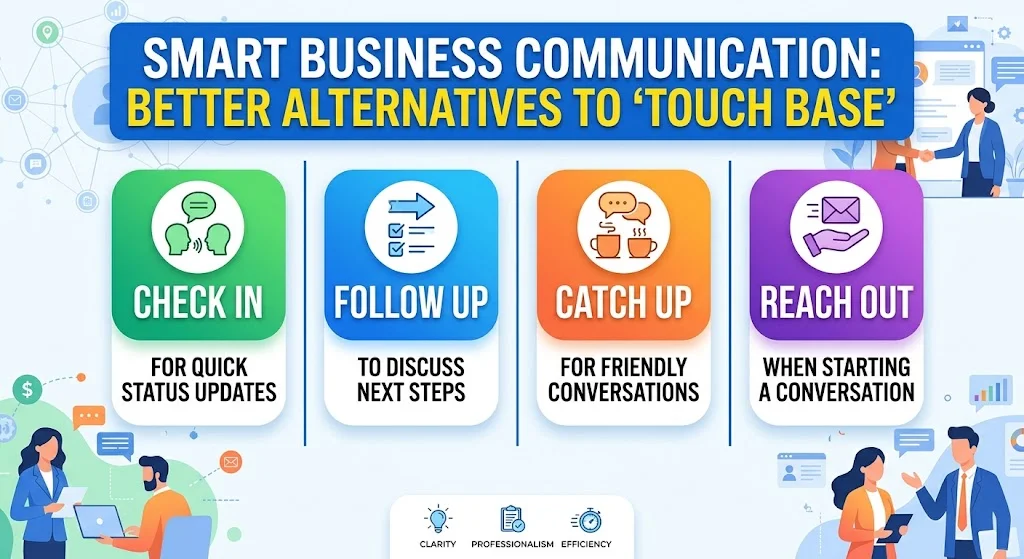
The best alternatives to “touch base” include check in, follow up, catch up, reach out, and connect. Use these phrases to make your business communication clearer, more natural, and less repetitive. Choose “follow up” for work updates, “catch up” for friendly conversations, or “reach out” when starting a conversation.
What Does “Touch Base” Mean?
“Touch base” means to contact someone briefly to exchange updates, check progress, or reconnect. People commonly use this expression in emails, workplace conversations, text messages, and personal relationships. For example, you might touch base with a coworker about a project or contact a friend to see how they’re doing. The phrase usually suggests a short, informal conversation rather than a lengthy discussion.
Is It Professional and Polite to Say “Touch Base”?
Yes, “touch base” is generally professional and polite in modern workplace communication. It’s a common expression for arranging meetings, following up on tasks, and sharing updates. However, it can sometimes sound vague or overused. Choosing a more specific alternative, such as “check in,” “follow up,” or “connect briefly,” can make your message clearer and more considerate.
Advantages and Disadvantages of Saying “Touch Base”
Advantages
- Friendly and approachable: It creates a relaxed tone in professional and personal conversations.
- Brief and convenient: It suggests a quick conversation without requiring a lengthy meeting.
- Versatile: You can use it when discussing projects, relationships, or general updates.
Disadvantages
- Vague meaning: The recipient might not understand what you want to discuss.
- Overused expression: Frequent use can make workplace messages sound repetitive.
- Less personal: It may feel impersonal when you’re trying to express genuine care or concern.
Synonyms for “Touch Base”
- Check In
- Follow Up
- Catch Up
- Connect
- Reach Out
- Get in Touch
- See How You’re Doing
- Check on Your Progress
- Touch Base Again
- Have a Quick Chat
- Catch Up Briefly
- See Where Things Stand
- Share an Update
- Circle Back
- Reconnect
- Have a Quick Check-In
- Keep in Contact
- Talk Soon
- See How Things Are Going
- Discuss the Next Steps
- Get an Update
- Follow Through
- Have a Brief Conversation
- Check on Things
- Compare Notes
- Exchange Updates
- See How You’re Getting Along
- Schedule a Quick Meeting
- Keep You Posted
- See If You Need Anything
1. Check In
Meaning
“Check in” means contacting someone to ask how they’re doing or to learn about a situation.
Definition
A brief conversation intended to understand someone’s well-being, progress, or current needs.
Detailed Explanation
This alternative sounds friendly, natural, and considerate. It works particularly well when you want to show interest without putting pressure on the other person. You can use it with coworkers, friends, family members, or clients.
Scenario Example
“I wanted to check in and see how you’re feeling about the new project.”
Best Use
Use it for workplace updates, personal conversations, and thoughtful follow-ups.
Tone
Friendly, caring, and professional.
2. Follow Up
Meaning
“Follow up” means contacting someone again about a previous conversation, request, or task.
Definition
A subsequent communication intended to obtain information or move something forward.
Detailed Explanation
This phrase is especially useful when you need an answer, want to confirm progress, or are waiting for a response. It communicates purpose more clearly than “touch base” in many professional situations.
Scenario Example
“I’m reaching out to follow up on the proposal we discussed last week.”
Best Use
Use it for business emails, pending requests, interviews, and project updates.
Tone
Professional, direct, and respectful.
3. Catch Up
Meaning
“Catch up” means talking with someone to exchange news or learn what has happened recently.
Definition
An informal conversation that helps people share updates and reconnect.
Detailed Explanation
This expression feels warmer and more personal than “touch base.” It works well when you haven’t spoken to someone in a while and want to hear about their life or work.
Scenario Example
“It’s been a while! Would you like to catch up over coffee this week?”
Best Use
Use it with friends, former colleagues, and familiar professional contacts.
Tone
Casual, warm, and inviting.
4. Connect
Meaning
“Connect” means communicating with someone to share information, ideas, or experiences.
Definition
To establish or renew communication with another person.
Detailed Explanation
This versatile word works in professional and personal settings. It sounds polished without being overly formal. You can also use it when arranging an introductory conversation or exploring a potential collaboration.
Scenario Example
“Could we connect sometime tomorrow to discuss your ideas?”
Best Use
Use it for networking, collaboration, meetings, and professional introductions.
Tone
Professional, approachable, and collaborative.
5. Reach Out
Meaning
“Reach out” means initiating contact with someone.
Definition
To communicate with another person to offer support, request information, or start a conversation.
Detailed Explanation
This phrase can express genuine care as well as professional courtesy. It works particularly well when you want someone to know you’re available to help or interested in hearing from them.
Scenario Example
“I wanted to reach out and see whether you need any help with the assignment.”
Best Use
Use it when offering assistance, contacting clients, or reconnecting with someone.
Tone
Supportive, considerate, and friendly.
6. Get in Touch
Meaning
“Get in touch” means contacting someone or establishing communication.
Definition
To communicate with another person through a message, call, email, or meeting.
Detailed Explanation
This expression is simple and flexible. It can describe either an immediate conversation or a future opportunity to communicate. It also sounds natural when inviting someone to contact you.
Scenario Example
“Let’s get in touch next week to discuss the final details.”
Best Use
Use it for general communication, professional follow-ups, and future contact.
Tone
Polite, friendly, and neutral.
7. See How You’re Doing
Meaning
“See how you’re doing” means checking on someone’s well-being or progress.
Definition
To contact someone to understand how they feel or how a situation is developing.
Detailed Explanation
This phrase adds a personal touch to your message. Instead of focusing only on tasks, it shows that you care about the person behind the work. It’s especially suitable when someone has been dealing with a challenge.
Scenario Example
“I wanted to see how you’re doing after your first week in the new role.”
Best Use
Use it with friends, colleagues, and people who might appreciate encouragement.
Tone
Caring, thoughtful, and supportive.
8. Check on Your Progress
Meaning
“Check on your progress” means asking how much work has been completed or how a task is developing.
Definition
To review the status of an activity, responsibility, or goal.
Detailed Explanation
This alternative gives “touch base” a clearer purpose. It works well when you need an update but want to keep your request polite and straightforward. In sensitive situations, consider adding a supportive phrase to avoid sounding demanding.
Scenario Example
“I’d like to check on your progress and see whether you need additional resources.”
Best Use
Use it for project management, academic work, and team coordination.
Tone
Professional, constructive, and focused.
9. Touch Base Again
Meaning
“Touch base again” means contacting someone another time to continue a conversation or review updates.
Definition
To renew communication after an earlier discussion or contact.
Detailed Explanation
Although this phrase retains the original expression, adding “again” makes the timing clearer. It’s useful when you’ve already spoken with someone and agreed to revisit the subject later.
Scenario Example
“Let’s touch base again on Friday after you’ve reviewed the documents.”
Best Use
Use it for ongoing projects, recurring discussions, and planned follow-ups.
Tone
Professional, familiar, and neutral.
10. Have a Quick Chat
Meaning
“Have a quick chat” means having a short, informal conversation.
Definition
To speak briefly with someone about a particular subject or general updates.
Detailed Explanation
This phrase sounds approachable and less corporate than “touch base.” It helps communicate that you don’t expect a lengthy meeting. You can use it to discuss an idea, ask a question, or clear up a misunderstanding.
Scenario Example
“Do you have time to have a quick chat about the presentation?”
Best Use
Use it for brief meetings, informal workplace conversations, and everyday discussions.
Tone
Casual, friendly, and inviting.
11. Catch Up Briefly
Meaning
“Catch up briefly” means exchanging recent information during a short conversation.
Definition
To share updates and reconnect within a limited amount of time.
Detailed Explanation
This phrase combines the warmth of “catch up” with a clear expectation of brevity. It’s useful when both people have busy schedules but still need to discuss recent developments.
Scenario Example
“Could we catch up briefly before the client meeting?”
Best Use
Use it for busy colleagues, short meetings, and quick personal conversations.
Tone
Friendly, practical, and considerate.
12. See Where Things Stand
Meaning
“See where things stand” means finding out the current status of a situation.
Definition
To assess the present position, progress, or circumstances of an issue.
Detailed Explanation
This alternative is helpful when you don’t know whether a task has moved forward or circumstances have changed. It invites an update without assuming that someone has made progress.
Scenario Example
“Let’s meet tomorrow to see where things stand with the project.”
Best Use
Use it for negotiations, project updates, and decisions that depend on current information.
Tone
Professional, measured, and practical.
13. Share an Update
Meaning
“Share an update” means providing new information about a situation or activity.
Definition
To communicate recent developments, changes, or progress.
Detailed Explanation
This phrase works well when the main goal is exchanging information. It tells the recipient what you want without relying on vague workplace language. You can also invite the other person to share their perspective.
Scenario Example
“Could we share an update on our respective tasks this afternoon?”
Best Use
Use it for team emails, project meetings, and collaborative work.
Tone
Clear, professional, and cooperative.
14. Circle Back
Meaning
“Circle back” means returning to a subject or conversation at a later time.
Definition
To revisit an earlier discussion, question, or decision.
Detailed Explanation
This expression appears frequently in workplace communication. It’s useful when you need more time, additional information, or another person’s input before continuing. However, it can sound like corporate jargon if you use it too often.
Scenario Example
“I’ll circle back once I’ve received feedback from the design team.”
Best Use
Use it for pending decisions, unresolved questions, and professional follow-ups.
Tone
Businesslike, neutral, and organized.
15. Reconnect
Meaning
“Reconnect” means restoring communication with someone after a period apart.
Definition
To renew a personal or professional relationship through communication.
Detailed Explanation
This word emphasizes the relationship rather than a specific task. It’s particularly useful when contacting an old colleague, former classmate, or friend after a long silence.
Scenario Example
“I’d love to reconnect and hear what you’ve been working on lately.”
Best Use
Use it for networking, old friendships, and professional relationships.
Tone
Warm, welcoming, and personal.
See More: 30 Other Ways to Say “Circle Back” with Examples
16. Have a Quick Check-In
Meaning
“Have a quick check-in” means arranging a short conversation to discuss progress or well-being.
Definition
A brief meeting intended to review updates, concerns, or immediate needs.
Detailed Explanation
This phrase combines a clear purpose with a relaxed tone. Managers can use it to support employees, while colleagues can use it to coordinate tasks. Adding a specific time makes the request even clearer.
Scenario Example
“Can we have a quick check-in tomorrow to make sure everything is on track?”
Best Use
Use it for team meetings, employee support, and project coordination.
Tone
Supportive, professional, and organized.
17. Keep in Contact
Meaning
“Keep in contact” means maintaining communication over time.
Definition
To continue communicating with someone rather than allowing contact to end.
Detailed Explanation
This expression is useful when you want to preserve a relationship after a meeting, project, or major life change. Unlike “touch base,” it suggests ongoing communication rather than a single conversation.
Scenario Example
“It’s been wonderful working with you. Let’s keep in contact after the project ends.”
Best Use
Use it when leaving a job, finishing a collaboration, or maintaining friendships.
Tone
Friendly, sincere, and positive.
18. Talk Soon
Meaning
“Talk soon” means expressing an intention to speak with someone again in the near future.
Definition
A casual closing that suggests future communication.
Detailed Explanation
This short expression is useful when you want to end a message warmly without arranging a specific meeting. It works best when you already have an ongoing connection with the recipient.
Scenario Example
“Thanks for the update. Talk soon, and let me know if anything changes.”
Best Use
Use it at the end of emails, texts, and informal conversations.
Tone
Casual, warm, and friendly.
19. See How Things Are Going
Meaning
“See how things are going” means checking the current condition or progress of a situation.
Definition
To ask about developments, experiences, or the general state of an activity.
Detailed Explanation
This phrase is broader than checking on a particular task. It allows someone to mention successes, challenges, or changes without feeling restricted to a formal status report.
Scenario Example
“I wanted to see how things are going with your transition to the new department.”
Best Use
Use it for workplace transitions, ongoing projects, and personal check-ins.
Tone
Considerate, conversational, and supportive.
20. Discuss the Next Steps
Meaning
“Discuss the next steps” means talking about what should happen after the current stage.
Definition
To identify and agree on future actions or responsibilities.
Detailed Explanation
This alternative is more action-oriented than “touch base.” It helps move a conversation toward practical decisions and clear responsibilities. It’s especially useful when a project has reached a milestone.
Scenario Example
“Let’s discuss the next steps after everyone has reviewed the proposal.”
Best Use
Use it for planning meetings, project handoffs, and decision-making.
Tone
Focused, professional, and collaborative.
21. Get an Update
Meaning
“Get an update” means obtaining recent information about a task, situation, or development.
Definition
To receive details about the current status of something.
Detailed Explanation
This expression is direct and easy to understand. It works well when you need specific information, but you can soften it with polite wording to avoid sounding demanding.
Scenario Example
“Could I get an update on the application when you have a moment?”
Best Use
Use it for reports, applications, deadlines, and project progress.
Tone
Direct, practical, and professional.
22. Follow Through
Meaning
“Follow through” means completing an action or carrying out a commitment.
Definition
To continue an intended course of action until the required task is completed.
Detailed Explanation
This phrase isn’t an exact synonym for “touch base.” Instead, it emphasizes action and accountability. Use it when you want to make sure an earlier discussion leads to meaningful results.
Scenario Example
“Let’s follow through on the ideas we agreed to implement last week.”
Best Use
Use it for commitments, action plans, and project responsibilities.
Tone
Purposeful, responsible, and professional.
23. Have a Brief Conversation
Meaning
“Have a brief conversation” means speaking with someone for a short period.
Definition
To exchange information or ideas through a concise discussion.
Detailed Explanation
This expression is suitable when you want a professional alternative that avoids casual slang. It signals that the conversation will be short while leaving the topic open for clarification.
Scenario Example
“Would you be available to have a brief conversation about your feedback?”
Best Use
Use it for professional requests, sensitive discussions, and formal communication.
Tone
Polite, clear, and composed.
24. Check on Things
Meaning
“Check on things” means reviewing a situation to learn whether everything is going well.
Definition
To contact someone or examine a situation for updates or possible problems.
Detailed Explanation
This phrase sounds relaxed and natural. It works when you want to see whether someone needs help or whether an ongoing activity requires attention. However, specify the subject when clarity matters.
Scenario Example
“I’ll check on things tomorrow and make sure the team has what it needs.”
Best Use
Use it for informal workplace updates, household matters, and general follow-ups.
Tone
Casual, helpful, and approachable.
25. Compare Notes
Meaning
“Compare notes” means sharing information and comparing observations with another person.
Definition
To exchange findings, opinions, or experiences to develop a clearer understanding.
Detailed Explanation
This phrase suggests that both people have something valuable to contribute. It’s particularly effective after separate meetings, research, or individual work on the same problem.
Scenario Example
“Let’s compare notes after speaking with the client.”
Best Use
Use it for teamwork, research, planning, and collaborative problem-solving.
Tone
Cooperative, thoughtful, and professional.
26. Exchange Updates
Meaning
“Exchange updates” means sharing recent information with one another.
Definition
A mutual communication process in which people provide relevant developments.
Detailed Explanation
Unlike “get an update,” this phrase emphasizes two-way communication. It works well when both people need to explain their progress or share information that affects a shared goal.
Scenario Example
“Let’s exchange updates before the weekly planning meeting.”
Best Use
Use it for team coordination, partnerships, and collaborative projects.
Tone
Balanced, professional, and collaborative.
27. See How You’re Getting Along
Meaning
“See how you’re getting along” means asking how someone is managing a task, experience, or situation.
Definition
To check someone’s progress or well-being in a considerate way.
Detailed Explanation
This phrase feels more personal than a formal status request. It gives the recipient room to discuss both progress and difficulties. It can be especially reassuring when someone is learning something new.
Scenario Example
“I wanted to see how you’re getting along with your first few weeks of training.”
Best Use
Use it when supporting new employees, students, or friends facing a challenge.
Tone
Encouraging, caring, and conversational.
28. Schedule a Quick Meeting
Meaning
“Schedule a quick meeting” means arranging a short, planned discussion.
Definition
To select a time for a brief meeting with one or more people.
Detailed Explanation
This alternative makes the purpose practical and specific. It works well when an informal message isn’t enough and you need dedicated time to discuss a topic or make a decision.
Scenario Example
“Could we schedule a quick meeting to finalize the project timeline?”
Best Use
Use it for work planning, decision-making, and coordinated discussions.
Tone
Professional, organized, and direct.
29. Keep You Posted
Meaning
“Keep you posted” means continuing to inform someone about new developments.
Definition
To provide ongoing updates as information becomes available.
Detailed Explanation
This phrase is especially helpful when you don’t have a complete answer yet. Instead of arranging another conversation immediately, you promise to share relevant information later. It works best when you follow through on that promise.
Scenario Example
“I’m still waiting for confirmation, but I’ll keep you posted as soon as I hear anything.”
Best Use
Use it for pending decisions, travel plans, applications, and project updates.
Tone
Friendly, reassuring, and practical.
30. See If You Need Anything
Meaning
“See if you need anything” means contacting someone to ask whether they require help or support.
Definition
To check someone’s needs and offer assistance when appropriate.
Detailed Explanation
This alternative shifts the focus from exchanging information to showing care. It works particularly well when a colleague has a heavy workload or a friend is facing a difficult situation. It communicates that you’re available without demanding a response.
Scenario Example
“I wanted to see if you need anything before the presentation tomorrow.”
Best Use
Use it when offering help, supporting colleagues, or checking on friends and family.
Tone
Thoughtful, supportive, and considerate.
FAQs
1. What does “touch base” mean?
Touch base means contacting someone to check in, share updates, or discuss something briefly.
2. Is “touch base” a professional phrase?
Yes, touch base is common in professional communication, emails, meetings, and workplace conversations.
3. What are the best alternatives to “touch base”?
Popular alternatives include check in, reach out, catch up, follow up, and get in touch.
4. Is “touch base” formal or informal?
It works in both formal and informal settings, although some alternatives sound more direct and professional.
5. How can I say “touch base” in an email?
You can write, “I’d like to check in about the project” or “I’m reaching out to discuss our progress.”
6. What is a more formal way to say “touch base”?
Use follow up, schedule a brief meeting, or connect regarding this matter in formal business writing.
7. Can I use “touch base” with my manager?
Yes. It’s a common workplace expression for discussing updates, asking questions, or sharing progress with your manager.
8. What is a friendly alternative to “touch base”?
Catch up, drop a line, and keep in touch are friendly alternatives for casual conversations.
9. Is “follow up” the same as “touch base”?
They have similar meanings, but follow up usually refers to continuing a previous discussion or checking on progress.
10. Why should I use alternatives to “touch base”?
Using alternative phrases improves clarity, avoids repetitive language, and makes your business communication more natural.
Conclusion
Knowing 30 other ways to say “touch base” helps you communicate more clearly in professional and personal settings. Whether you choose check in, reach out, catch up, or follow up, select a phrase that matches your purpose and audience. The right words make workplace conversations more natural, effective, and meaningful.


Pingback: 30 Other Ways to Say “Thank You for Your Time” with Examples