

Explore 30 Other Ways to Say “Circle Back” to find clearer, more natural phrases for professional emails, meetings, and workplace communication.
The phrase “circle back” is a common expression in modern workplace language. It means returning to a previous topic, continuing an earlier conversation, or following up on a pending discussion later.
Although widely understood, this overused phrase can make business communication sound repetitive or vague. Using professional alternatives improves clarity, reduces unnecessary wording, and supports better decision-making when teams need more time or information.
The best alternatives to circle back depend on your message and audience. In formal emails and meetings, you might say, “I’m following up on our last discussion regarding the proposal.” In casual conversations, “Just checking in on our chat from last week” sounds friendly and natural.
Choosing the right professional phrases helps you manage priorities, address unresolved matters, and postpone discussions without creating confusion. Clear word choice, a suitable professional tone, and specific follow-up times make business writing more effective and help keep communication moving.
Quick Answer
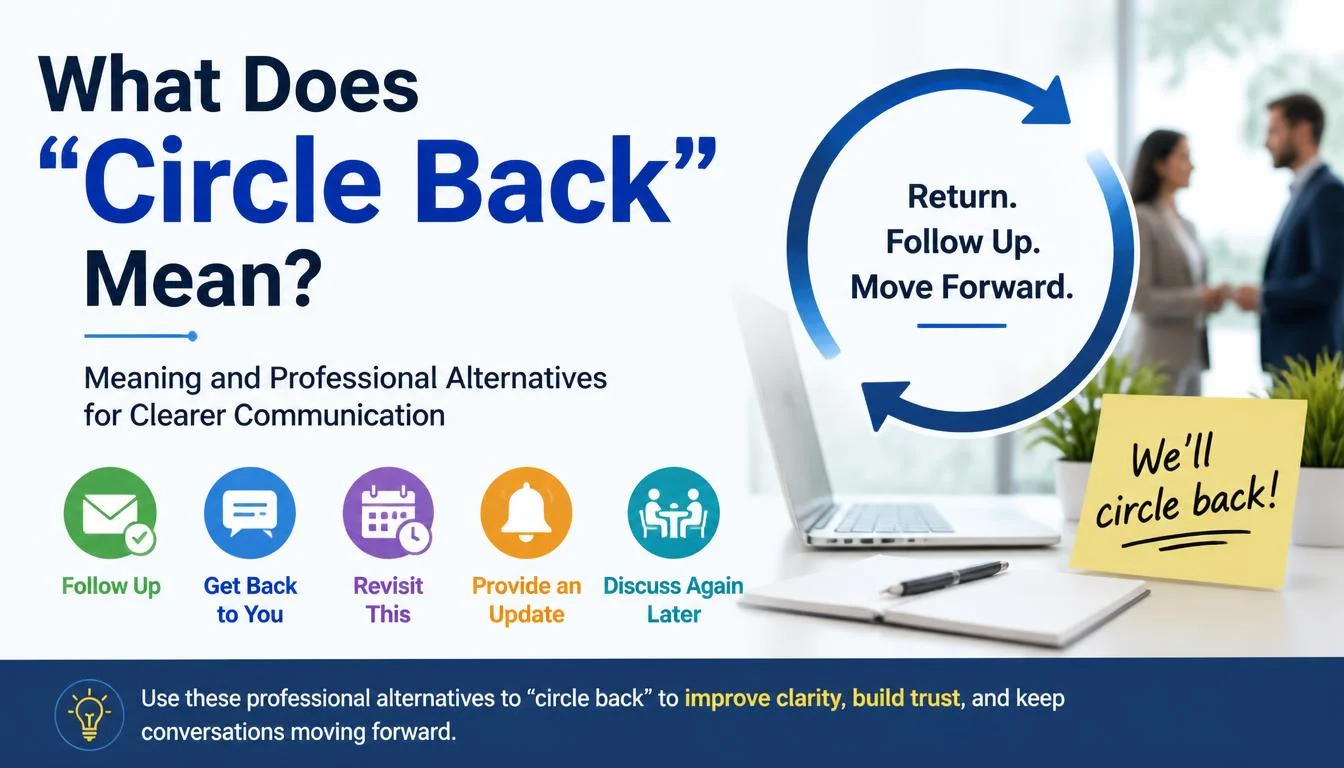
“Circle back” means returning to a conversation, following up on a task, or discussing something again later. You can use alternatives like “follow up,” “get back to you,” “revisit this,” or “provide an update” to make your communication clearer and more natural. These professional alternatives to circle back work well in emails, meetings, and everyday workplace conversations.
What Does “Circle Back” Mean?
The phrase “circle back” means to return to a topic, follow up on a conversation, or discuss something again later. People often use it in professional emails, business meetings, and workplace chats when they need more information or want to revisit a decision.
For example, you might say, “Let’s circle back next week” when you need more time to review a project. Although the phrase is useful, choosing a clearer alternative can help you communicate your intentions more directly.
Is It Professional or Polite to Say “Circle Back”?
Yes, “circle back” is generally professional and polite in workplace communication. Managers, coworkers, clients, and business partners often use it to suggest a future discussion or follow-up.
However, the phrase can sometimes sound vague or overused. Instead of saying, “I’ll circle back with you,” you could say, “I’ll send you an update tomorrow.” This version provides a clearer expectation and helps the other person understand what happens next.
Advantages and Disadvantages of Saying “Circle Back”
Advantages
- Professional communication: It fits naturally into business emails, meetings, and workplace conversations.
- Flexible usage: You can use it to revisit a topic, request an update, or continue a discussion.
- Encourages follow-up: It signals that a conversation or task may need further attention.
Disadvantages
- Vague timing: Without a specific date, the other person may not know when you’ll follow up.
- Overused expression: Repeating it too often can make workplace communication sound generic.
- Unclear responsibility: It may not explain who will take the next step or what action is needed.
Synonyms for “Circle Back”
- Follow Up
- Get Back to You
- Revisit This
- Touch Base
- Check In
- Return to This
- Discuss This Further
- Pick This Up Again
- Come Back to This
- Provide an Update
- Follow Up on This
- Reconnect
- Get in Touch Again
- Keep You Posted
- Review This Again
- Continue the Discussion
- Talk About This Later
- Reach Out Again
- Check Back
- Give You an Update
- Resume Our Conversation
- Readdress This
- Follow Through
- Schedule a Follow-Up
- Reopen the Discussion
- Get Back in Contact
- Take Another Look
- Discuss This at Our Next Meeting
- Reassess This Later
- Follow Up at a Later Date
1. Follow Up
Meaning: To contact someone again about a previous conversation, request, or task.
Definition: “Follow up” means taking another step to get information, share progress, or make sure something is completed.
Detailed Explanation: This is one of the clearest alternatives to circle back in professional communication. It explains that you intend to continue a conversation or check on progress. Adding a date or purpose makes the message even more useful.
Scenario Example: “I’ll follow up with the client on Thursday to confirm the final details.”
Best Use: Professional emails, project updates, client communication, and workplace tasks.
Tone: Professional, direct, and helpful.
2. Get Back to You
Meaning: To respond to someone later.
Definition: This phrase means providing an answer or update after obtaining the necessary information.
Detailed Explanation: Use “get back to you” when you cannot answer immediately. It communicates that you need time to review something before responding. For a more considerate message, explain when the person can expect your reply.
Scenario Example: “Let me review the proposal, and I’ll get back to you by tomorrow afternoon.”
Best Use: Emails, customer service, workplace chats, and everyday conversations.
Tone: Friendly, professional, and reassuring.
3. Revisit This
Meaning: To return to a topic for another discussion.
Definition: “Revisit this” means examining an issue, decision, or idea again at a later time.
Detailed Explanation: This expression works well when a decision needs more thought or circumstances might change. It leaves room for further discussion without forcing an immediate conclusion.
Scenario Example: “Let’s revisit this proposal after we receive feedback from the marketing team.”
Best Use: Business meetings, planning sessions, strategy discussions, and decision-making.
Tone: Thoughtful, collaborative, and professional.
4. Touch Base
Meaning: To briefly communicate with someone.
Definition: “Touch base” means checking in with another person to exchange information or discuss progress.
Detailed Explanation: This familiar workplace phrase is useful when you want a short conversation rather than a lengthy meeting. You can make it more specific by mentioning the topic and suggested time.
Scenario Example: “Let’s touch base on Friday to review the project’s progress.”
Best Use: Team communication, informal business emails, and quick meetings.
Tone: Friendly, casual, and professional.
5. Check In
Meaning: To ask about progress, needs, or well-being.
Definition: “Check in” means contacting someone to learn how things are going or whether they need assistance.
Detailed Explanation: This alternative feels warmer than some business expressions because it can communicate genuine interest. It works for project updates as well as supportive conversations with coworkers.
Scenario Example: “I’ll check in with you tomorrow to see whether you need any help with the report.”
Best Use: Team management, supportive messages, project updates, and personal conversations.
Tone: Considerate, warm, and approachable.
6. Return to This
Meaning: To discuss a subject again later.
Definition: This phrase means returning to an earlier topic after a pause or once more information becomes available.
Detailed Explanation: “Return to this” is useful when a conversation cannot be completed immediately. It communicates your intention without adding unnecessary business jargon.
Scenario Example: “We need more data before making a decision, so let’s return to this next week.”
Best Use: Meetings, reports, planning, and professional discussions.
Tone: Neutral, clear, and professional.
7. Discuss This Further
Meaning: To continue talking about a topic in greater detail.
Definition: This phrase means having another conversation to explore an issue, idea, or decision more thoroughly.
Detailed Explanation: Choose this expression when a topic requires deeper analysis or input from other people. It tells your audience that the discussion is not finished and may need additional attention.
Scenario Example: “I’d like to discuss this further once we’ve reviewed the client’s suggestions.”
Best Use: Business meetings, negotiations, proposals, and collaborative projects.
Tone: Professional, thoughtful, and collaborative.
8. Pick This Up Again
Meaning: To resume an activity or conversation after a break.
Definition: This expression means continuing something that was previously paused.
Detailed Explanation: “Pick this up again” sounds natural when a meeting ends before all topics receive attention. It also works when a project needs to restart after a delay.
Scenario Example: “We’re running out of time, so let’s pick this up again during tomorrow’s meeting.”
Best Use: Team meetings, ongoing projects, and informal workplace conversations.
Tone: Casual, cooperative, and practical.
9. Come Back to This
Meaning: To revisit a subject later.
Definition: This phrase means postponing a discussion until a more suitable time.
Detailed Explanation: Use it when you want to move forward with other tasks before returning to an unresolved question. It helps keep conversations organized while leaving the topic open for future consideration.
Scenario Example: “Let’s come back to this question after everyone has reviewed the documents.”
Best Use: Meetings, brainstorming sessions, and project planning.
Tone: Natural, flexible, and professional.
10. Provide an Update
Meaning: To share new information about progress or changes.
Definition: “Provide an update” means communicating the latest status of a task, project, or situation.
Detailed Explanation: This phrase is more specific than “circle back” when your main purpose is to share progress. It works particularly well when colleagues or clients are waiting for information.
Scenario Example: “I’ll provide an update on the project timeline by Wednesday.”
Best Use: Status reports, client emails, management updates, and team communication.
Tone: Clear, informative, and professional.
11. Follow Up on This
Meaning: To take another action regarding a particular matter.
Definition: This expression means checking, investigating, or responding to something that has already been discussed.
Detailed Explanation: Adding “on this” identifies the subject of your follow-up. It helps recipients understand which task, question, or request needs attention.
Scenario Example: “I’ll follow up on this request with the support team and let you know what they say.”
Best Use: Customer requests, workplace tasks, pending decisions, and email conversations.
Tone: Responsible, direct, and professional.
12. Reconnect
Meaning: To communicate with someone again after a period apart.
Definition: “Reconnect” means reestablishing communication or renewing a professional or personal conversation.
Detailed Explanation: This alternative works well when you haven’t spoken with someone for a while. It can also suggest rebuilding a working relationship or arranging another conversation about shared goals.
Scenario Example: “Let’s reconnect next month to discuss how our partnership is progressing.”
Best Use: Networking, client relationships, business partnerships, and professional catch-ups.
Tone: Warm, positive, and relationship-focused.
13. Get in Touch Again
Meaning: To contact someone another time.
Definition: This phrase means communicating again by email, phone, message, or another method.
Detailed Explanation: “Get in touch again” is a natural alternative when you want to maintain communication without sounding overly formal. Mentioning a time or reason makes the message more useful.
Scenario Example: “I’ll get in touch again once I’ve confirmed the meeting date.”
Best Use: Client communication, scheduling, customer service, and everyday professional messages.
Tone: Friendly, polite, and approachable.
14. Keep You Posted
Meaning: To continue informing someone about developments.
Definition: This expression means sharing new information as a situation changes.
Detailed Explanation: Use “keep you posted” when someone needs updates but doesn’t necessarily need another meeting. It communicates a willingness to maintain contact and share relevant information.
Scenario Example: “I’ll keep you posted as soon as we hear back from the supplier.”
Best Use: Project updates, workplace chats, team coordination, and informal emails.
Tone: Friendly, reassuring, and conversational.
15. Review This Again
Meaning: To examine something another time.
Definition: “Review this again” means reconsidering information, documents, decisions, or work that has already been examined.
Detailed Explanation: This alternative suits situations where accuracy matters or new information may affect an earlier conclusion. It makes the purpose of the next discussion clear.
Scenario Example: “Let’s review this again after the finance team shares its updated figures.”
Best Use: Reports, proposals, financial planning, editing, and quality checks.
Tone: Careful, professional, and analytical.
See More: 30 Other Ways to Say “Moving Forward” with Examples
16. Continue the Discussion
Meaning: To keep a conversation going.
Definition: This phrase means extending a discussion that has already started but remains unfinished.
Detailed Explanation: Choose it when a subject deserves more time or when additional people need to contribute. It sounds organized and encourages continued collaboration.
Scenario Example: “We can continue the discussion during our scheduled meeting on Monday.”
Best Use: Formal meetings, negotiations, presentations, and group projects.
Tone: Professional, collaborative, and composed.
17. Talk About This Later
Meaning: To postpone a conversation until another time.
Definition: This phrase means discussing a particular issue in the future rather than immediately.
Detailed Explanation: It is a straightforward alternative that works well in everyday conversation. In professional settings, you can make it more considerate by suggesting a specific time.
Scenario Example: “We’re short on time today, so let’s talk about this later this afternoon.”
Best Use: Informal meetings, team conversations, and everyday discussions.
Tone: Casual, clear, and practical.
18. Reach Out Again
Meaning: To contact someone another time.
Definition: “Reach out again” means initiating further communication after an earlier interaction.
Detailed Explanation: This phrase is useful when you want to maintain contact without making your message sound demanding. It can introduce a follow-up question, a reminder, or an update.
Scenario Example: “I’ll reach out again next week to see whether you’ve had time to review the proposal.”
Best Use: Business emails, networking, client relationships, and professional follow-ups.
Tone: Polite, friendly, and considerate.
19. Check Back
Meaning: To return later to see whether something has changed or progressed.
Definition: This phrase means checking the status of a task, request, or situation at another time.
Detailed Explanation: “Check back” is especially useful when you’re waiting for an answer or expecting a change. It can be more direct than “circle back” because it emphasizes checking progress.
Scenario Example: “I’ll check back with the supplier on Thursday if we haven’t received confirmation.”
Best Use: Customer service, pending requests, scheduling, and project management.
Tone: Practical, neutral, and professional.
20. Give You an Update
Meaning: To tell someone about the latest developments.
Definition: This phrase means sharing new details about a task, decision, or situation.
Detailed Explanation: It is a clear alternative when someone is waiting for information. It also creates an opportunity to set expectations by explaining when the update will arrive.
Scenario Example: “I’ll give you an update by the end of the day after speaking with the development team.”
Best Use: Emails, status reports, client communication, and team management.
Tone: Helpful, direct, and reassuring.
21. Resume Our Conversation
Meaning: To continue a conversation that was interrupted or paused.
Definition: This phrase means returning to a discussion after a break.
Detailed Explanation: Use it when you want to continue a meaningful or detailed conversation. It works particularly well when an earlier meeting ended before reaching a conclusion.
Scenario Example: “Let’s resume our conversation tomorrow when we’ve both had time to review the options.”
Best Use: Formal meetings, negotiations, interviews, and important discussions.
Tone: Formal, thoughtful, and respectful.
22. Readdress This
Meaning: To consider or deal with an issue again.
Definition: “Readdress this” means returning to a concern, problem, or subject that needs additional attention.
Detailed Explanation: This alternative is useful when an earlier decision needs reconsideration or a problem remains unresolved. However, “revisit this” often sounds more natural in everyday workplace communication.
Scenario Example: “We may need to readdress this issue if the delivery schedule changes.”
Best Use: Problem-solving, planning, workplace discussions, and policy reviews.
Tone: Serious, professional, and focused.
23. Follow Through
Meaning: To complete an action or fulfill a commitment.
Definition: “Follow through” means carrying out a planned action rather than simply discussing it.
Detailed Explanation: Unlike “circle back,” which often means discussing something again, “follow through” emphasizes execution. Use it when you want to show accountability and make sure a promise leads to action.
Scenario Example: “I’ll follow through on the agreed changes and send you the revised document.”
Best Use: Project management, commitments, client service, and task completion.
Tone: Responsible, confident, and action-oriented.
24. Schedule a Follow-Up
Meaning: To arrange another conversation or meeting.
Definition: This phrase means setting a future time to discuss progress, questions, or outstanding issues.
Detailed Explanation: It is a strong alternative when a topic requires dedicated time. Scheduling a follow-up also prevents vague promises and helps everyone understand the next step.
Scenario Example: “Let’s schedule a follow-up meeting for next Tuesday to review the results.”
Best Use: Business meetings, consultations, interviews, and project reviews.
Tone: Organized, professional, and proactive.
25. Reopen the Discussion
Meaning: To begin discussing a topic again after it was closed or paused.
Definition: This phrase means bringing a previously settled or postponed subject back for consideration.
Detailed Explanation: Use it when new evidence, changing circumstances, or fresh ideas justify another conversation. It is more specific than “circle back” because it suggests that a discussion needs to be opened again.
Scenario Example: “If the client proposes a different budget, we may need to reopen the discussion.”
Best Use: Negotiations, business decisions, project planning, and contract discussions.
Tone: Deliberate, professional, and analytical.
26. Get Back in Contact
Meaning: To establish communication again.
Definition: This phrase means contacting someone after an earlier exchange or a period without communication.
Detailed Explanation: It works well when you need to reconnect with a client, colleague, or business partner. Although it can sound slightly formal, it communicates the intention to continue the relationship.
Scenario Example: “I’ll get back in contact with the vendor once we’ve finalized our requirements.”
Best Use: Business correspondence, networking, customer relationships, and scheduling.
Tone: Polite, professional, and neutral.
27. Take Another Look
Meaning: To examine something again.
Definition: This expression means reviewing information, work, or a decision with fresh attention.
Detailed Explanation: “Take another look” sounds natural and less formal than “review this again.” It is useful when you want someone to reconsider an idea or check for possible mistakes.
Scenario Example: “Could you take another look at the proposal before we send it to the client?”
Best Use: Editing, proofreading, project reviews, and collaborative work.
Tone: Friendly, practical, and constructive.
28. Discuss This at Our Next Meeting
Meaning: To save a topic for the next scheduled meeting.
Definition: This phrase means postponing a discussion until a planned gathering.
Detailed Explanation: It gives people a clear expectation about when the conversation will continue. It is particularly helpful when a subject requires input from several team members.
Scenario Example: “Let’s discuss this at our next meeting after everyone has reviewed the updated plan.”
Best Use: Team meetings, project planning, management discussions, and group decisions.
Tone: Organized, collaborative, and professional.
29. Reassess This Later
Meaning: To evaluate a situation again in the future.
Definition: “Reassess this later” means reviewing something again to determine whether a decision or plan remains appropriate.
Detailed Explanation: This expression works well when circumstances may change or more information is expected. It suggests a fresh evaluation rather than simply continuing an earlier conversation.
Scenario Example: “Let’s reassess this later in the quarter when we have more reliable sales figures.”
Best Use: Strategic planning, budgeting, project management, and performance reviews.
Tone: Analytical, thoughtful, and professional.
30. Follow Up at a Later Date
Meaning: To contact someone again in the future.
Definition: This phrase means postponing further communication until a future time.
Detailed Explanation: It is a formal alternative when you cannot provide an exact follow-up date yet. However, whenever possible, specifying a date makes your communication more useful and accountable.
Scenario Example: “We’ll follow up at a later date once the review process has been completed.”
Best Use: Formal emails, business correspondence, administrative communication, and delayed decisions.
Tone: Formal, neutral, and professional.
FAQs About “Circle Back”
1. What does “circle back” mean?
“Circle back” means returning to a previous topic, continuing a discussion, or following up on something later.
2. Is “circle back” professional?
Yes, “circle back” is commonly used in professional emails, meetings, and workplace conversations. However, using clearer alternatives can make your message more effective.
3. What is another way to say “circle back”?
You can say “follow up,” “revisit this,” “check in,” “get back to you,” or “provide an update,” depending on the situation.
4. What is a formal alternative to “circle back”?
“I’m following up on our previous discussion” is a professional alternative for business emails and formal communication.
5. How do you say “circle back” politely?
You could say, “Could we revisit this topic next week?” This sounds respectful and gives everyone time to consider the matter.
6. What is a casual alternative to “circle back”?
“Just checking in” is a friendly option for informal conversations, workplace chats, and everyday messages.
7. Is “follow up” the same as “circle back”?
They have similar meanings, but “follow up” often emphasizes checking progress or getting information, while “circle back” can mean returning to an earlier discussion.
8. Why should you avoid overusing “circle back”?
Repeatedly using “circle back” can make your writing sound vague or repetitive. Specific phrases help readers understand your next steps.
9. How can I use “circle back” in an email?
You could write, “Let’s circle back on the proposal after reviewing the feedback.” For greater clarity, include a specific date or time.
10. What is the clearest alternative to “circle back”?
“Follow up” is often a clear choice. However, “send an update,” “discuss this again,” or “get back to you tomorrow” may communicate your intention more precisely.
Conclusion
Choosing the right alternatives to “circle back” can make your communication clearer, more natural, and more professional. Whether you’re writing business emails, participating in meetings, or sending casual messages, phrases like “follow up,” “check in,” “revisit this,” and “provide an update” help express your intentions. Choose wording that suits your audience, explain the next step, and include a specific time when possible. These small changes can improve your workplace communication and help you avoid repetitive language.


Pingback: 30 Other Ways to Say “Touch Base” with Examples