
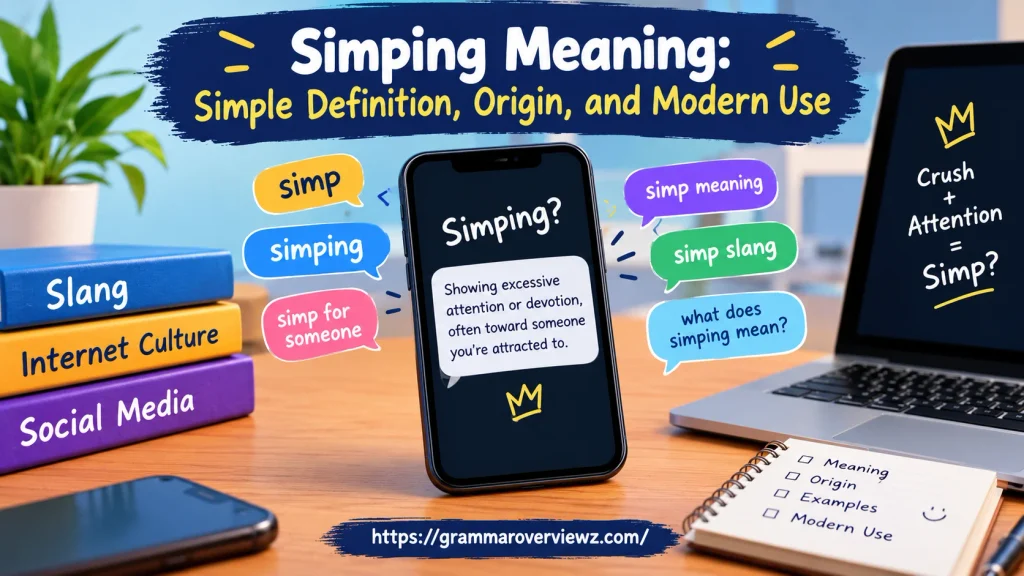

Simping Meaning: Simple Definition, Origin, and Modern Use explains how this popular slang term describes excessive attention, affection, or admiration for someone, often because of romantic interest.
Simping is common internet slang found on TikTok, Instagram, YouTube, and in text messages. The meaning of simp usually describes someone who goes out of their way to please a person they like, sometimes without receiving equal effort.
The origin of simping and the spread of simp reflect changing language trends, online communication, and internet culture. Today, this popular slang appears in conversations about dating culture, attraction, and relationships.
The meaning of simping depends on context. For example, buying gifts for a crush or showing extra attention may be described as simping. Related personality traits include generosity, admiration, and emotional attachment.
In modern usage, including 2026 slang, people sometimes use the term playfully or as an insult. Understanding its positive and negative meanings helps you avoid common mistakes and discuss relationships without unfair judgment.
Quick Answer: What Does Simping Mean?
Simping is internet slang for showing excessive attention, affection, or devotion toward someone, often in the hope of gaining their romantic interest or approval. People also use it playfully to describe having a crush or being a huge fan of someone.
For example, if someone keeps buying gifts for a person who never responds to their messages, friends might say they’re simping. On the other hand, someone saying “I simp for that actor” might simply be expressing admiration.
The word can sound playful, critical, or insulting, depending on the context.
What Is the Meaning of Simping in Slang?
In modern slang, simping describes giving someone an unusually large amount of attention, praise, money, or emotional effort. The term often appears when people believe someone is trying too hard to impress a crush or win another person’s affection.
Imagine a person who replies to every social media story their crush posts. They send compliments daily, cancel their plans whenever the other person needs help, and keep offering gifts despite receiving little interest in return. Friends might describe this behavior as simping.
However, the word doesn’t have one strict definition in every conversation. Its meaning can change based on the speaker’s tone and the situation.
Common examples of simping include:
- Excessive messaging: Sending repeated messages when someone rarely replies.
- Constant compliments: Praising someone excessively to gain their attention.
- One-sided effort: Giving time, money, or emotional support without receiving similar consideration.
- Seeking approval: Changing your opinions or interests just to impress someone.
- Overspending: Buying expensive gifts you cannot afford to gain someone’s affection.
- Ignoring rejection: Continuing to pursue someone after they’ve clearly expressed disinterest.
These behaviors aren’t a formal checklist for identifying a simp. People use the slang casually, and sometimes they apply it unfairly.
For example, helping your partner through a difficult time isn’t simping. Neither is buying someone a thoughtful birthday gift. The concern usually arises when attention becomes excessive, boundaries are ignored, or someone repeatedly sacrifices their own needs to gain approval.
What Does Simping for Someone Mean?
To simp for someone means to show strong admiration, affection, or attention toward that person. The expression often refers to a crush, romantic interest, celebrity, fictional character, or online creator.
Consider these examples:
- “I simp for him so much.” — The speaker expresses strong admiration or attraction.
- “He’s simping for his classmate.” — The speaker suggests that someone is trying hard to impress a classmate.
- “Everyone simps for that character.” — The speaker describes widespread admiration for a fictional character.
In casual online conversations, the phrase can be exaggerated for humor. Someone might say they simp for a singer simply because they love the singer’s music and appearance.
Where Did the Word Simp Come From?
The word simp existed before modern social media made it popular. Its history is connected to the older English word simpleton, which describes someone considered foolish or easily deceived.
Over time, simp developed into slang with several related meanings. Its modern association with excessive attention toward a romantic interest grew through popular culture and online communities.
The exact path from the older word to its current romantic meaning isn’t completely settled. Therefore, it’s more accurate to describe the historical connection than to claim that one specific person invented the modern term.
The Historical Connection Between Simp and Simpleton
Simpleton has long referred to someone perceived as lacking good judgment. The shortened form simp appeared in slang well before TikTok existed.
This older meaning helps explain why the modern term can carry a negative tone. When someone calls another person a simp, they may suggest that the person is acting foolishly because of attraction or a desire for approval.
However, today’s slang isn’t limited to this insulting sense. Many people use simp jokingly or affectionately without suggesting that someone is genuinely foolish.
Simping in Hip-Hop and Popular Culture
The term’s modern slang history is also associated with hip-hop and rap culture, particularly discussions of romantic relationships, masculinity, and behavior perceived as overly submissive.
In these contexts, calling someone a simp could criticize a man for prioritizing a woman or seeking her approval. The word often carried a dismissive tone, although its use varied between speakers and communities.
It’s important not to confuse this cultural development with a single confirmed origin date. Slang evolves through repeated use, and its meaning can shift as different groups adopt it.
How Did Simping Become Popular on the Internet?
The growth of social media helped simping become a mainstream internet expression. Memes, short videos, livestreams, gaming communities, and comment sections gave people new ways to use the term.
By around 2019–2020, the word had become especially visible in online youth culture. TikTok trends, including the widely circulated Simp Nation format, helped turn it into a recognizable meme.
Instead of using the term only as an insult, users began applying it to everyday crushes, celebrity admiration, fictional characters, and exaggerated romantic scenarios.
Simping in Hip-Hop Culture
Hip-hop culture helped bring the modern slang sense into wider circulation before its social media boom. The term was often used to criticize behavior viewed as excessively devoted to a romantic interest.
This use connected simping with ideas about confidence, independence, and gender expectations. Some speakers treated any display of affection as weakness, while others focused on genuinely one-sided or desperate behavior.
That distinction still matters today. A person can show love and respect without losing independence or ignoring their own needs.
The Rise of Simping on TikTok
TikTok helped spread simping through short, humorous videos and recognizable trends. Creators used the term to describe crushes, celebrity obsessions, exaggerated compliments, and playful displays of devotion.
The Simp Nation trend often presented ordinary romantic behavior as an exaggerated transformation into a hopeless admirer. Its humor came from turning familiar crush-related experiences into a shared internet joke.
The trend also helped broaden the word’s meaning. Some users applied it to almost any strong admiration, even when the behavior wasn’t excessive or one-sided.
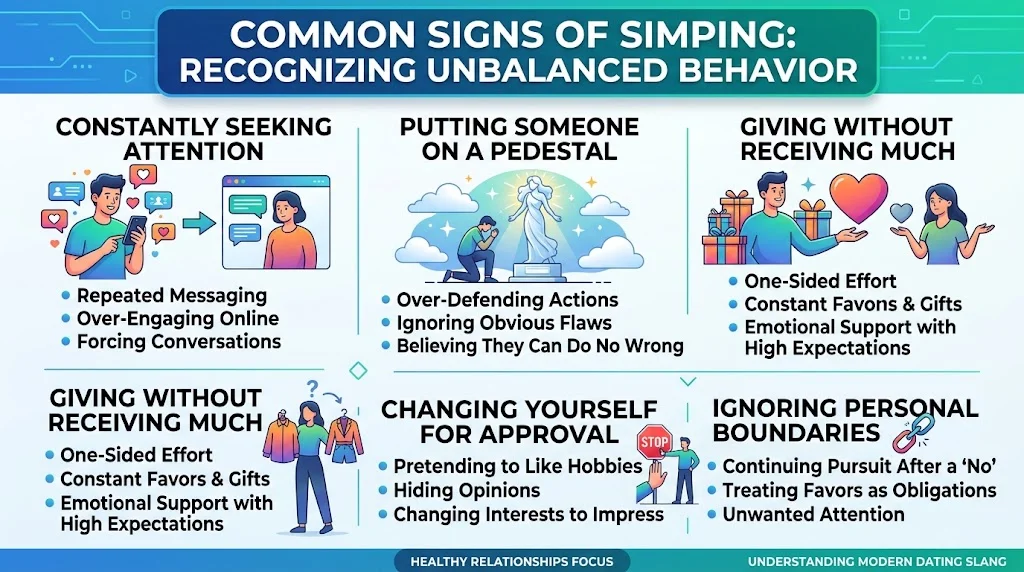
Common Signs of Simping
People generally use simping when they believe someone’s attention has become excessive or unbalanced. However, context matters more than any single action.
Here are some common behaviors associated with the slang.
Constantly Seeking Someone’s Attention
Someone might repeatedly message a crush, respond to every post, or invent reasons to start conversations. These actions aren’t automatically problematic, but they may appear excessive when the other person shows little interest.
Healthy communication allows both people to participate willingly. Repeatedly pushing for a response can make the interaction uncomfortable.
Putting Someone on a Pedestal
Another common example involves treating someone as perfect. A person might defend everything their crush says, ignore obvious flaws, or believe they can do no wrong.
Admiration is normal. However, idealizing someone can make it difficult to recognize their actual personality and behavior.
Giving Without Receiving Much in Return
Simping is often associated with one-sided effort. Someone might offer constant favors, spend money, or provide emotional support while hoping these actions will eventually create romantic interest.
Kindness doesn’t need to produce an equal reward every time. Still, a repeated pattern of giving solely to win someone’s affection can lead to disappointment.
Changing Yourself to Gain Approval
A person might pretend to enjoy certain hobbies, hide their opinions, or abandon important priorities to impress a crush. This behavior can make a relationship feel less genuine.
You don’t need to share every interest with someone you like. Genuine connection allows both people to remain themselves.
Ignoring Personal Boundaries
Continuing to pursue someone after they say no is not a healthy expression of affection. Neither is treating gifts, favors, or compliments as reasons another person must return romantic interest.
Respecting someone’s boundaries matters more than winning their attention. The slang may be humorous, but unwanted pursuit should never be dismissed as merely simping.
Simping Examples in Texting and Everyday Conversations
The easiest way to understand simp meaning in text is to see how people use it in ordinary conversations.
| Example | What it means |
| “Bro, you’re simping for her again.” | A friend teases someone for giving a crush excessive attention. |
| “He’s been simping in her comments all week.” | Someone repeatedly compliments or tries to attract attention online. |
| “I totally simp for that singer.” | The speaker playfully expresses strong admiration for a singer. |
| “Stop simping for someone who never replies.” | Someone advises a friend to stop pursuing one-sided attention. |
| “She’s simping over her favorite actor.” | Someone expresses intense admiration for a celebrity. |
| “I’m simping for this fictional character.” | Someone jokingly admits being very attracted to or invested in a character. |
The same word can communicate different feelings depending on the situation.
For instance, a friend might say, “You’re such a simp,” while laughing about a harmless crush. In another conversation, the same phrase might criticize someone for repeatedly ignoring rejection.
A Realistic Example of Simping in Everyday Life
Consider Alex, who has a crush on someone from class. Alex regularly buys them coffee, helps with assignments, and sends thoughtful messages.
At first, the interaction seems friendly. However, the other person rarely responds and has explained that they aren’t interested in dating.
Alex continues spending money and rearranging personal plans in the hope of changing their mind. Friends might describe this pattern as simping because Alex keeps investing effort despite the clear lack of romantic interest.
The important lesson isn’t that Alex should stop being kind. Instead, Alex should recognize the other person’s wishes and avoid treating favors as a way to earn affection.
This example illustrates how people commonly use the slang. It isn’t a psychological diagnosis or a rule that applies to every relationship.
Related Post: Canon Event Meaning: Full Guide in Simple Words
What Does Simping Mean on TikTok, Instagram, and in Gaming?
The meaning of simping on social media depends on the platform and the community using it. The same expression might be serious in one conversation and completely playful in another.
Simping on TikTok
On TikTok, simping often appears in videos about crushes, attractive celebrities, fictional characters, and exaggerated romantic reactions.
A creator might post a video of a favorite actor and caption it, “Everyone in the comments is simping.” Here, the word simply describes enthusiastic admiration.
The term also appears in memes about sending too many messages or becoming overly invested in someone who barely notices you.
Simping on Instagram
Instagram users may call someone a simp for repeatedly commenting on a crush’s photos, praising every post, or trying hard to attract an influencer’s attention.
For example, a friend might comment, “Bro is simping in the comments again,” after seeing someone leave several flattering messages.
However, liking a photo or leaving a respectful compliment doesn’t automatically count as simping. The label usually reflects how the speaker interprets the amount, motive, and balance of the attention.
Simping in Gaming and Livestream Chats
Gaming communities and livestream chats use simping to describe strong admiration for streamers, online personalities, and fictional characters.
A viewer might donate money to a streamer, praise every action, or repeatedly ask for personal attention. Other viewers may joke that the person is simping.
Still, supporting a creator isn’t inherently excessive. People can donate, subscribe, or express appreciation because they enjoy the content.
The distinction depends on the behavior. Spending responsibly to support a creator differs from spending money one cannot afford in the hope of receiving special affection.
Is Simping Always a Bad Thing?
No. Simping isn’t always negative, especially when people use the term humorously to describe attraction or admiration.
Someone might say, “I’m simping for my favorite actor,” without suggesting that they’ve lost their self-respect. In this case, the expression simply communicates enthusiasm.
However, the term often carries criticism when someone appears overly dependent on another person’s attention. For example, repeatedly spending money to impress someone who has rejected you may create emotional and financial problems.
The key difference is the behavior behind the label.
- Playful simping: Joking about a celebrity crush or fictional character.
- Affectionate simping: Teasing a friend for being especially thoughtful toward their partner.
- One-sided simping: Constantly giving attention to someone who doesn’t return the interest.
- Unhealthy pursuit: Ignoring rejection or crossing someone’s boundaries to gain affection.
People sometimes use simp unfairly to mock men for showing kindness, expressing emotions, or treating women respectfully. Such behavior doesn’t automatically deserve the label.
Healthy relationships require kindness, effort, and emotional openness. You don’t need to act indifferent to prove confidence, and you don’t need to sacrifice your well-being to demonstrate affection.
The Difference Between Simping, Having a Crush, and Being Nice
People often confuse simping with ordinary romantic interest. Although these behaviors can overlap, they don’t mean the same thing.
| Behavior | Meaning | Example |
| Simping | Often describes excessive or one-sided attention intended to gain approval. | Repeatedly buying gifts for someone who has expressed no interest. |
| Having a crush | Feeling romantic attraction toward someone. | Thinking about a classmate and hoping to get to know them. |
| Being nice | Treating someone with kindness without expecting romantic rewards. | Helping a friend prepare for an exam. |
| Being supportive | Offering help while respecting the other person’s independence. | Encouraging your partner before a job interview. |
| Admiring a celebrity | Appreciating someone’s talent, personality, or appearance. | Following an actor’s work and enjoying their films. |
Is Being Nice to Someone Considered Simping?
Not necessarily. Kindness and simping are different things.
Opening a door, giving a sincere compliment, helping someone with a problem, or buying a thoughtful gift can all be ordinary acts of kindness. None automatically means you’re trying too hard to gain affection.
The distinction becomes clearer when you consider motivation and boundaries. Are you helping because you genuinely want to, or because you believe the other person owes you romantic attention afterward?
It’s also important to consider whether the other person welcomes your actions. Respectful affection leaves room for both people to make their own choices.
Is Simp an Acronym?
You may encounter the claim that SIMP stands for “Suckers Idolizing Mediocre Pussy” online. This phrase circulates as a slang expansion, but it isn’t the established historical origin of the word.
The older word simp is connected to simpleton. The modern slang meaning developed through cultural use, and its exact history isn’t fully settled.
The acronym claim is an example of a backronym. A backronym assigns words to the letters of an existing term after that term already exists.
For example, people sometimes invent humorous expansions for familiar words to make a joke sound like a formal definition. That doesn’t establish the word’s actual origin.
When explaining simping, it’s more accurate to describe the recognized slang meaning and historical connection than to present a viral acronym as a proven fact.
Simp vs. Simping: What’s the Difference?
The words simp and simping are closely related, but they serve different grammatical purposes.
- Simp: Usually a noun that labels a person.
- Simping: A noun or verb form that describes the behavior or action.
- Simped: The past-tense form of the verb simp.
Here are a few examples:
| Word or phrase | Example | Meaning |
| Simp | “He’s a simp.” | Labels someone as overly devoted. |
| Simping | “He’s simping for his crush.” | Describes his behavior. |
| Simped | “I simped for that character last year.” | Describes past admiration or devotion. |
| Simp for | “I simp for that singer.” | Expresses strong admiration. |
| Simp over | “She’s simping over her favorite actor.” | Describes intense attraction or admiration. |
These expressions are informal. They fit naturally in texts, memes, social media comments, and casual conversations, but they may not suit formal writing.
Related Slang Words You Should Know
Understanding related internet slang makes it easier to interpret conversations about attraction, admiration, and relationships.
| Slang term | Meaning | How it differs from simping |
| Down bad | Extremely attracted to someone or desperate for their attention. | Emphasizes strong desire or desperation. |
| Thirsty | Eager for attention, approval, or romantic interest. | Often suggests an obvious or intense desire for attention. |
| Stan | An extremely enthusiastic fan of a celebrity or public figure. | Focuses on fandom rather than necessarily romantic attraction. |
| White knight | Someone who defends or supports another person, sometimes to gain approval. | Often emphasizes defending someone to appear favorable. |
| Doormat | Someone who lets others take advantage of them. | Describes a broader pattern of failing to stand up for oneself. |
These words sometimes overlap, but they aren’t interchangeable.
For example, someone can stan a musician because they admire the music without wanting a relationship. A person who is down bad may feel desperate for a crush’s attention, while a doormat may struggle to establish boundaries in several types of relationships.
Understanding the differences helps you interpret slang without assuming that every expression describes the same behavior.
FAQs About Simping Meaning
1. What Does Simping Mean in Slang?
Simping means showing excessive attention, affection, or admiration toward someone you like, sometimes without receiving equal effort in return.
2. What Does Simp Mean on TikTok?
On TikTok, a simp is someone who goes out of their way to impress or please a person they admire. The term often appears humorously in videos, memes, and comments.
3. What Is the Origin of Simp?
The word simp is commonly linked to simpleton, meaning a foolish person. Its modern slang meaning developed over time and gained popularity through internet culture and social media.
4. Is Simping Always Bad?
No, simping isn’t always bad. Showing kindness, affection, and support can be healthy. However, excessive efforts to please someone may become unhealthy when they involve poor boundaries or one-sided relationships.
5. What Are Some Examples of Simping?
Examples of simping include constantly buying gifts for a crush, repeatedly seeking someone’s attention, or always prioritizing a person who rarely returns the same effort.
6. What Is the Difference Between Simping and Genuine Love?
Simping often describes excessive efforts to impress someone, sometimes without mutual interest. Genuine love involves mutual respect, trust, care, and balanced effort from both people.
Conclusion
Understanding simping meaning helps you recognize how modern slang describes affection, attraction, and online relationships. The term appears frequently on TikTok, Instagram, YouTube, and in everyday conversations. Although people sometimes use simp as an insult, showing kindness or expressing romantic interest isn’t automatically simping. Healthy relationships depend on self-respect, clear boundaries, and mutual respect.


Pingback: What Does ALR Mean? Complete Guide