

Canon Event Meaning: Full Guide in Simple Words explains how this popular internet slang describes life-changing experiences that shape who we become.
The internet creates new words every year, and canon event has become a familiar social media phrase on TikTok, Instagram, and YouTube. People use this viral phrase in memes and online trends to describe important moments, funny mistakes, and meaningful experiences.
The canon event trend often focuses on lighthearted moments, embarrassing experiences, awkward situations, and funny memories. However, it can also describe significant life events, major life changes, turning points, and formative experiences that influence someone’s personality development, identity, and personal growth.
For example, failing an important test might teach you to prepare better, while an awkward first date could become a funny story later. These relatable experiences often provide valuable life lessons and support self-discovery. On social media, someone might say, “Let them make that mistake; it’s their canon event,” meaning the person needs to learn from the experience themselves.
Although the phrase is often used humorously in memes and viral videos, it can also refer to serious events that change someone’s outlook. To ensure correct usage, remember that a canon event usually has personal significance rather than being just an ordinary occurrence.
Related Post: Wagwan Meaning: Understanding This Popular Slang in 2026
Quick Answer: What Does Canon Event Mean?
Canon event means a significant experience that feels like an important or unavoidable part of someone’s life story. In internet slang, people often use it humorously for embarrassing mistakes, awkward situations, relationship problems, or lessons someone seems destined to learn.
For example, if your friend gets a terrible haircut despite everyone’s warnings, you might say, “Let him have his haircut. It’s a canon event.”
The phrase doesn’t mean that every experience is genuinely unavoidable. Instead, it playfully suggests that some moments are part of growing up and learning through experience.
What Does Canon Event Mean in Slang?
The canon event meaning in slang centers on an experience that seems important to someone’s personal journey. People often use the term when they believe another person needs to experience something firsthand rather than receive advice from everyone around them.
Imagine your friend starts dating someone who repeatedly cancels plans. You explain the warning signs, but your friend keeps defending the relationship. When the relationship finally ends, you might jokingly call it a canon event.
The expression adds humor to a familiar situation: sometimes people don’t understand a lesson until they experience it themselves.
What Does “It’s a Canon Event” Actually Mean?
When someone says, “It’s a canon event,” they usually mean one of these things:
- It’s part of the journey: The experience seems connected to someone’s growth or personal story.
- They need to learn for themselves: Advice might not change their decision.
- It’s a familiar life experience: Other people recognize the situation because they’ve experienced something similar.
- The outcome feels predictable: Someone’s choices appear likely to lead to a particular lesson.
- It’s funny in hindsight: An awkward or frustrating moment may eventually become a story people laugh about.
However, the exact meaning depends on context. Friends might use the phrase affectionately, while others use it sarcastically to comment on questionable decisions.
Simple Examples of Canon Event Meaning
Here are a few examples that show how the phrase works:
- Relationship: “She went back to her ex again. That’s a canon event.”
- School: “Everyone has that one embarrassing classroom moment. Mine was definitely a canon event.”
- Fashion: “He ignored our advice and bought those shoes. Let him cook. It’s a canon event.”
- Personal growth: “Moving away for college was a canon event that changed how I see the world.”
- Humor: “My terrible teenage haircut was a canon event.”
In each example, the speaker connects an experience with a larger personal story. Sometimes the focus is on learning, while other times the joke matters more than the lesson.
Where Did the Term Canon Event Come From?
The phrase became widely recognized through Spider-Man: Across the Spider-Verse, an animated superhero film released in 2023. The movie explores different versions of Spider-Man living in separate universes, each with its own history and challenges.
The film introduced the idea of canon events as important occurrences that help shape the stories of Spider-People across the multiverse. Online audiences later adapted the concept to describe familiar experiences in real life.
Canon Events in Spider-Man: Across the Spider-Verse
<PRIVATE_PERSON> O’Hara, also known as Miguel O’Hara or Spider-Man 2099, explains the importance of canon events in the movie. According to his understanding of the multiverse, certain major experiences connect the lives of different Spider-People.
These events may involve personal loss, major relationships, or moments that shape a Spider-Person’s identity. The film presents them as significant parts of a character’s established story.
The idea creates tension because Miles Morales questions whether these events must happen as expected. His situation raises a central question: should someone accept a painful outcome because a larger system says it must occur?
That conflict gives the phrase more depth than a simple internet joke. In the movie, canon events relate to the stability of fictional universes and the choices characters make when facing difficult circumstances.
In everyday slang, however, people generally use the expression much more casually. A bad haircut isn’t literally a multiverse event. It’s simply a funny way to describe an experience that seems memorable or familiar.
What Does “Canon” Mean in Storytelling?
To understand the phrase, it helps to know the meaning of canon.
In storytelling, canon refers to the events, facts, and details officially accepted as part of a fictional universe. These details establish what has happened in a story and what readers or viewers can treat as part of its recognized history.
For example, if an official movie establishes that a character grew up in a particular city, that detail belongs to the movie’s canon. A fan-created story might place the same character somewhere else, but that version doesn’t automatically become official.
A canon event is therefore an important occurrence within a story’s established structure.
The internet slang meaning borrows this idea and applies it to real life. People jokingly treat someone’s experiences as if they were essential chapters in a personal storyline.
How Canon Event Became an Internet Meme
After Spider-Man: Across the Spider-Verse reached audiences in 2023, the phrase spread across TikTok and other social platforms. Users began applying the movie’s concept to everyday situations that seemed predictable, embarrassing, or formative.
The format was easy to understand. Someone would show a person making a questionable choice, then add a caption explaining that it was a canon event and shouldn’t be interrupted.
For example, a video might show a teenager cutting their own hair after being warned against it. The caption could read, “His first DIY haircut is a canon event.”
The humor comes from treating an ordinary mistake as if it were an important event in a superhero’s destiny. The phrase also lets people laugh at experiences they once found embarrassing.
Rather than identifying one confirmed person as the sole creator of the trend, it’s more accurate to connect its popularity with the movie and the many social media users who adapted the phrase.
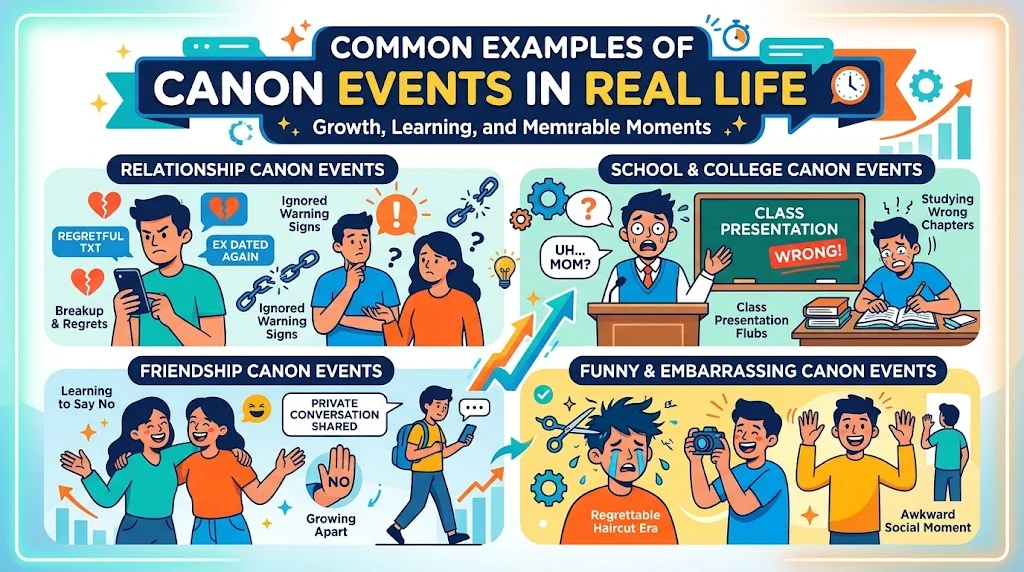
Common Examples of Canon Events in Real Life
A canon event in real life can describe almost any memorable experience that people view as part of growing up, learning, or developing their identity. The phrase appears especially often in jokes about relationships, friendships, school, and embarrassing decisions.
Not every difficult experience deserves this label. The phrase works best when the speaker uses it lightly and doesn’t dismiss someone’s genuine pain.
Relationship Canon Events
Relationships offer plenty of situations that people recognize as canon events. First love, awkward dates, breakups, and ignored warning signs often become stories people remember for years.
Examples include:
- Dating someone who turns out to be incompatible with you.
- Getting back together with an ex despite knowing the relationship has problems.
- Ignoring obvious warning signs because you’re excited about someone.
- Sending a long emotional message and regretting it the next morning.
- Experiencing a breakup that helps you understand your boundaries.
Example: “He ignored every red flag because he liked her so much. I guess this is his canon event.”
The joke suggests that the person may need to learn through experience. Still, healthy relationships don’t require people to make the same mistakes repeatedly, and harmful behavior shouldn’t be excused as destiny.
School and College Canon Events
School and college experiences also fit the phrase because many people share similar awkward memories. These moments may feel disastrous at first but become funny stories later.
Common examples include:
- Forgetting your lines during a class presentation.
- Studying the wrong chapters before an exam.
- Answering a question confidently and getting it completely wrong.
- Joining a club and realizing it isn’t what you expected.
- Choosing a course before discovering your actual interests.
Example: “I called my teacher ‘Mom’ in front of the entire class. That was my canon event.”
These experiences can teach practical lessons about preparation, confidence, and handling embarrassment. They also remind people that a single awkward moment rarely defines their entire reputation.
Friendship Canon Events
Friendships change as people grow, and some experiences can reshape how they understand trust and communication.
Examples include:
- Trusting a friend who shares a private conversation.
- Learning to say no instead of agreeing with everything.
- Realizing that a long friendship has become one-sided.
- Discovering that two friends have grown in different directions.
- Making a new friend who changes your perspective.
Example: “She finally learned that she doesn’t have to please everyone. That was a canon event.”
In these situations, the phrase can express a meaningful change rather than make fun of a mistake. It highlights the way experiences influence someone’s expectations and future choices.
Funny and Embarrassing Canon Events
The most recognizable internet examples often involve harmless embarrassment. These situations are easy to turn into memes because the audience can imagine experiencing them.
| Situation | Example caption | Why it fits |
| A regrettable haircut | “His haircut era is a canon event.” | It turns an awkward style choice into a funny memory. |
| A message sent to the wrong person | “That text mistake was a canon event.” | The embarrassment becomes part of the person’s story. |
| An awkward social moment | “She waved back at someone who wasn’t waving at her. Canon event.” | The situation feels familiar and humorous. |
| A failed fashion experiment | “Everyone needs one questionable outfit phase.” | It suggests that personal style develops through trial and error. |
| A first job interview | “My first interview disaster was a canon event.” | The experience may become a lesson about preparation. |
These examples capture the phrase’s playful tone. A small mistake becomes a memorable chapter rather than a permanent disaster.
How to Use Canon Event in a Sentence
You can use canon event as a noun phrase when discussing your own experiences or commenting on someone else’s. Online, it often appears in short reactions, captions, and jokes.
The expression is informal, so it usually fits conversations with friends, memes, and social media posts better than formal business writing.
Using “It’s a Canon Event”
This is one of the most common forms. It suggests that an experience belongs to someone’s story and should be allowed to unfold.
Examples:
- “Let him grow his hair long. It’s a canon event.”
- “Her first solo trip is a canon event.”
- “He needs to learn from this mistake. It’s a canon event.”
The phrase can sound playful or supportive depending on the situation.
Using “My Canon Event”
Use my canon event to describe an experience that you consider a defining or memorable part of your own life.
Examples:
- “My first public speaking failure was my canon event.”
- “Moving to a new city became my canon event.”
- “That terrible haircut was my canon event, and I still have the pictures.”
This form often combines humor with reflection. You’re looking back at an experience and treating it as an important chapter in your personal story.
Using “That’s a Canon Event”
This version works as a quick reaction to another person’s experience or decision.
Examples:
- “He keeps buying gadgets he doesn’t need. That’s a canon event.”
- “She decided to travel alone for the first time. That’s a canon event.”
- “Your first attempt at baking is always a little chaotic. That’s a canon event.”
The phrase works best when the listener understands the joke. If someone is genuinely upset, a supportive response may be more appropriate.
Using “You Can’t Interfere”
The idea that you shouldn’t interfere with a canon event is another common part of the meme. It suggests that warning someone won’t necessarily change their decision or teach them the lesson they need.
Example: “I told him not to cut his own bangs, but he wouldn’t listen. Apparently, it’s a canon event.”
In a real situation, though, this is a joke rather than a rule for life. You can still offer advice, set boundaries, or step in when someone’s safety is at risk.
Related Post: Skank Meaning: Definition, Origin, Examples, and Usage
What Does Canon Event Mean on TikTok?
On TikTok, canon event meaning usually refers to a memorable or predictable experience that someone seems destined to have. Videos often show embarrassing decisions, relationship drama, fashion experiments, or lessons people learned while growing up.
The phrase became popular because it works well with short videos. A creator can show a familiar situation and let the caption deliver the punchline.
Common TikTok formats include:
- Storytime videos: A creator describes a past mistake and calls it a canon event.
- Friendship jokes: Someone explains why they won’t interfere with a friend’s questionable decision.
- Before-and-after videos: A person shows an awkward phase and reflects on how they changed.
- Relationship memes: A creator jokes about ignoring red flags or returning to an ex.
- Nostalgic posts: Someone looks back at an experience that shaped their personality.
For example, a creator might post an old photo from an awkward fashion phase with the caption, “Nobody could have stopped this. It was a canon event.”
The expression combines humor with recognition. Viewers laugh because they remember having their own version of the same experience.
TikTok usage can change over time, and the phrase isn’t limited to one specific trend. Its meaning still depends on the video, caption, and conversation surrounding it.
Is a Canon Event Always Bad?
No. A canon event doesn’t have to be negative. Although internet jokes often focus on mistakes and embarrassing moments, the expression can describe positive experiences that feel important to someone’s story.
The key idea is significance, not suffering.
A person might describe their first solo trip as a canon event because it helped them become more independent. Someone else might use the phrase for a friendship that changed their outlook on life.
Consider these contrasting examples:
| Type | Example | Possible meaning |
| Negative or awkward | Failing a driving test | A frustrating experience that encourages preparation. |
| Funny | Getting an unfortunate haircut | An embarrassing memory that becomes a joke. |
| Positive | Taking a first solo trip | A meaningful step toward independence. |
| Personal growth | Learning to set boundaries | An experience that changes future relationships. |
| Major life change | Starting college in another city | A transition that shapes new habits and friendships. |
However, people should avoid treating every painful event as necessary for personal growth. Serious harm, abuse, or trauma isn’t something someone must experience to become stronger.
The slang phrase is most useful when it describes ordinary life experiences without minimizing genuine distress.
Canon Event vs. Character Development
Although people sometimes use canon event and character development in similar ways, the two expressions don’t mean exactly the same thing.
A canon event is an important occurrence within a fictional storyline. Character development describes how a character’s personality, beliefs, motivations, or behavior change throughout that story.
For example, a fictional hero might lose someone important in a canon event. The grief, decisions, and changes that follow can contribute to the hero’s character development.
The same distinction helps explain the slang meaning. A person might experience a difficult breakup and later become more confident about setting boundaries. The breakup is the event, while the person’s changing outlook represents growth.
Here’s a simple comparison:
| Term | Meaning | Example |
| Canon event | A significant occurrence in a story or an informal metaphor for a defining life experience | “My first big failure was a canon event.” |
| Character development | Changes in a fictional character’s personality or outlook | A shy character gradually becomes more confident. |
| Life lesson | Something a person learns through experience | “I learned to prepare before making important decisions.” |
| Turning point | An event that changes the direction of a situation or person’s life | Accepting a new job changes someone’s career path. |
In everyday conversation, these ideas can overlap. Still, canon event is an informal expression rather than a recognized psychological concept.
Is Canon Event Used Seriously or as a Joke?
Most online uses of canon event are playful, ironic, or humorous. People often use the phrase to describe situations that seem predictable when viewed from the outside.
For instance, a friend might ignore advice about an obviously impractical purchase. When the purchase goes badly, someone could joke, “That was a canon event.”
The joke works because the speaker treats an ordinary decision as an essential chapter in a larger story.
However, the phrase can also carry a sincere meaning. Someone might describe leaving home for college as a canon event because the experience changed their independence, priorities, or relationships.
Context determines the tone. A funny caption about a bad haircut is different from a serious conversation about a painful experience.
A useful rule: Use the phrase for lighthearted mistakes and meaningful milestones, but avoid using it to dismiss someone’s distress or suggest they deserved a harmful experience.
Canon Event vs. Similar Expressions
Several expressions describe important experiences, but each emphasizes something slightly different. Understanding these differences helps you choose the right phrase for your sentence.
| Expression | What it emphasizes | Example |
| Canon event | A memorable experience treated as part of someone’s personal storyline | “That awkward first date was a canon event.” |
| Coming-of-age experience | An experience associated with growing up or becoming more mature | “Moving away for college was a coming-of-age experience.” |
| Rite of passage | A traditional or symbolic transition into a new stage of life | “The ceremony marked an important rite of passage.” |
| Turning point | An event that significantly changes someone’s direction | “Getting that scholarship became a turning point.” |
| Life lesson | Knowledge or understanding gained through experience | “The mistake taught me an important life lesson.” |
| Character development | Changes in a fictional character’s personality, beliefs, or behavior | “The challenge gave the main character room to grow.” |
The main difference is tone and context. Canon event often sounds casual and internet-driven, while terms such as turning point and rite of passage can fit more formal discussions.
For example, you might call a friend’s disastrous first date a canon event in a group chat. In a personal essay, you might describe the same experience as a turning point in how you approach relationships.
Neither expression is automatically better. Choose the one that communicates your meaning naturally.
Frequently Asked Questions
1. What does canon event mean?
A canon event is a significant life experience that helps shape your personality, decisions, or future. It can be funny, embarrassing, or meaningful.
2. Where did the term canon event originate?
The phrase became widely popular through Spider-Man: Across the Spider-Verse (2023), where canon events are important moments in a character’s life story.
3. Why is canon event popular on TikTok?
TikTok users use the phrase in videos and memes to describe relatable experiences, awkward mistakes, and life lessons in a humorous way.
4. Can a canon event be embarrassing?
Yes. An embarrassing moment, awkward date, or school mistake can become a canon event if it teaches you something or shapes your behavior.
5. Is a canon event always a bad experience?
No. A canon event can be positive, negative, funny, or emotional. What matters is how the experience influences your life.
6. How do you use canon event in a sentence?
You can say, “Making that silly mistake was my canon event.” This means the experience became a memorable part of your personal growth.
Conclusion
The canon event meaning centers on experiences that shape who we become. Popular on TikTok, Instagram, and other social media platforms, the phrase often describes funny, awkward, or important moments that teach us valuable lessons. Whether it involves a school mistake, a relationship experience, or a major turning point, a canon event represents a memorable part of someone’s life journey. Understanding its meaning and context helps you use this popular internet slang naturally in conversations, captions, and memes.



Pingback: Simping Meaning: Simple Definition, Origin, and Modern Use